The Roughest Water in Cruising, and How to Sail It Comfortably
The ship leans, the hangers in your closet all slide to one side at once, and you lie there doing math about how many hours are left. Rough water is rarely dangerous on a modern ship, but it is uncomfortable, and a lot of that is avoidable.
My quick take
I do not treat rough water as a risk to manage. I treat it as a comfort setting you choose at the booking stage, because by sailing day almost every useful decision has already been made for you.
The only stretch on this list I have a personal stake in is the Gulf of Alaska, since I have sailed out of Whittier. Everywhere else I go by the forecast, and by the fact that the same handful of water gets named every single time.
The quick facts
- The usual suspects: The Drake Passage, the Bay of Biscay, the Tasman Sea, the Gulf of Alaska and the winter North Atlantic.
- Season beats geography: Most of these are flat for months at a time and only earn the reputation in one window.
- Best cabin: Low deck and midships, as close to the middle of the ship as your budget allows.
- What stabilizers do: They cut side to side roll while the ship is moving, and they do nothing for pitching.
- The easiest fix: Book an itinerary that stays inside sheltered water instead of crossing open ocean.
What a rough night actually feels like
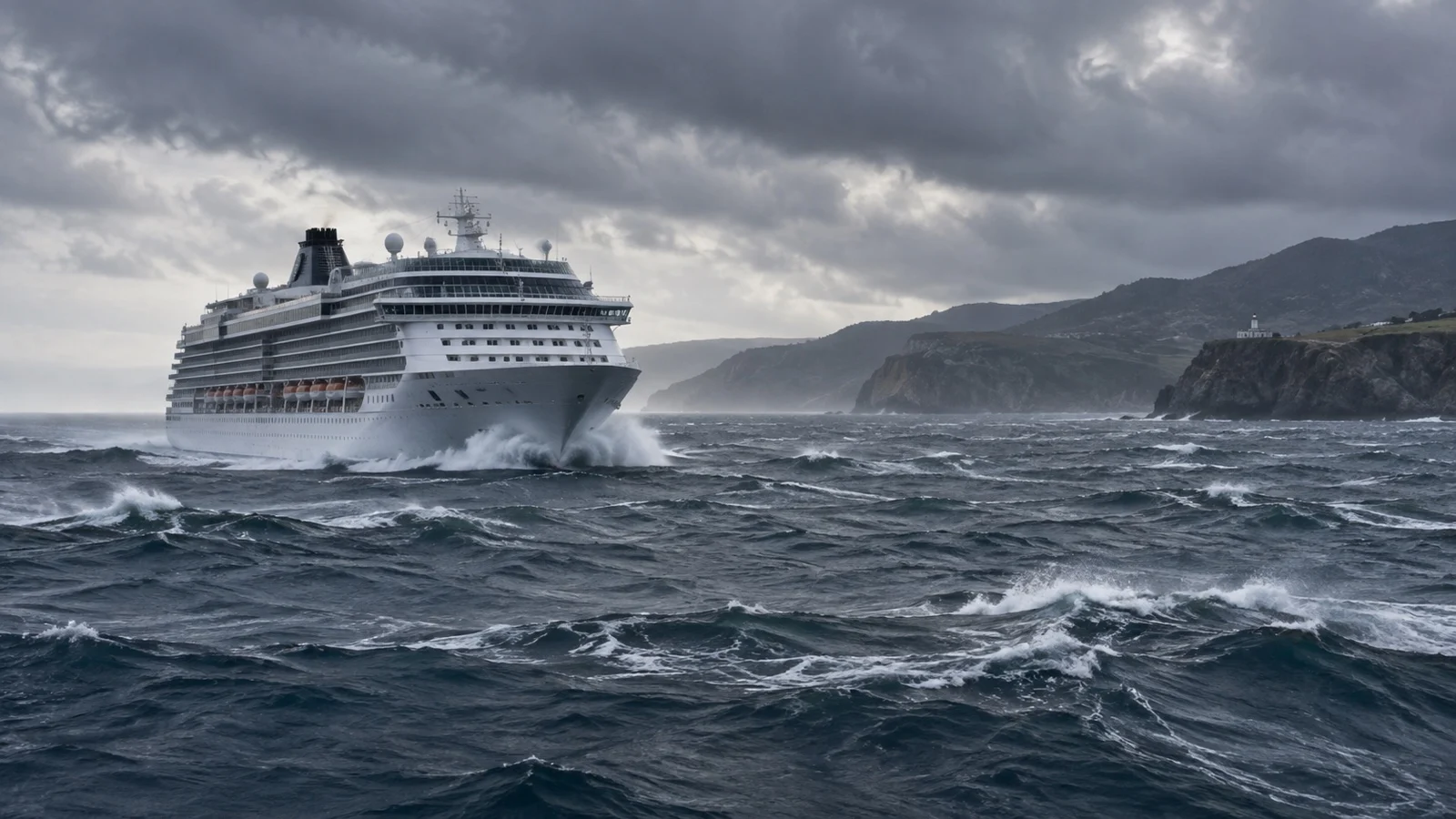
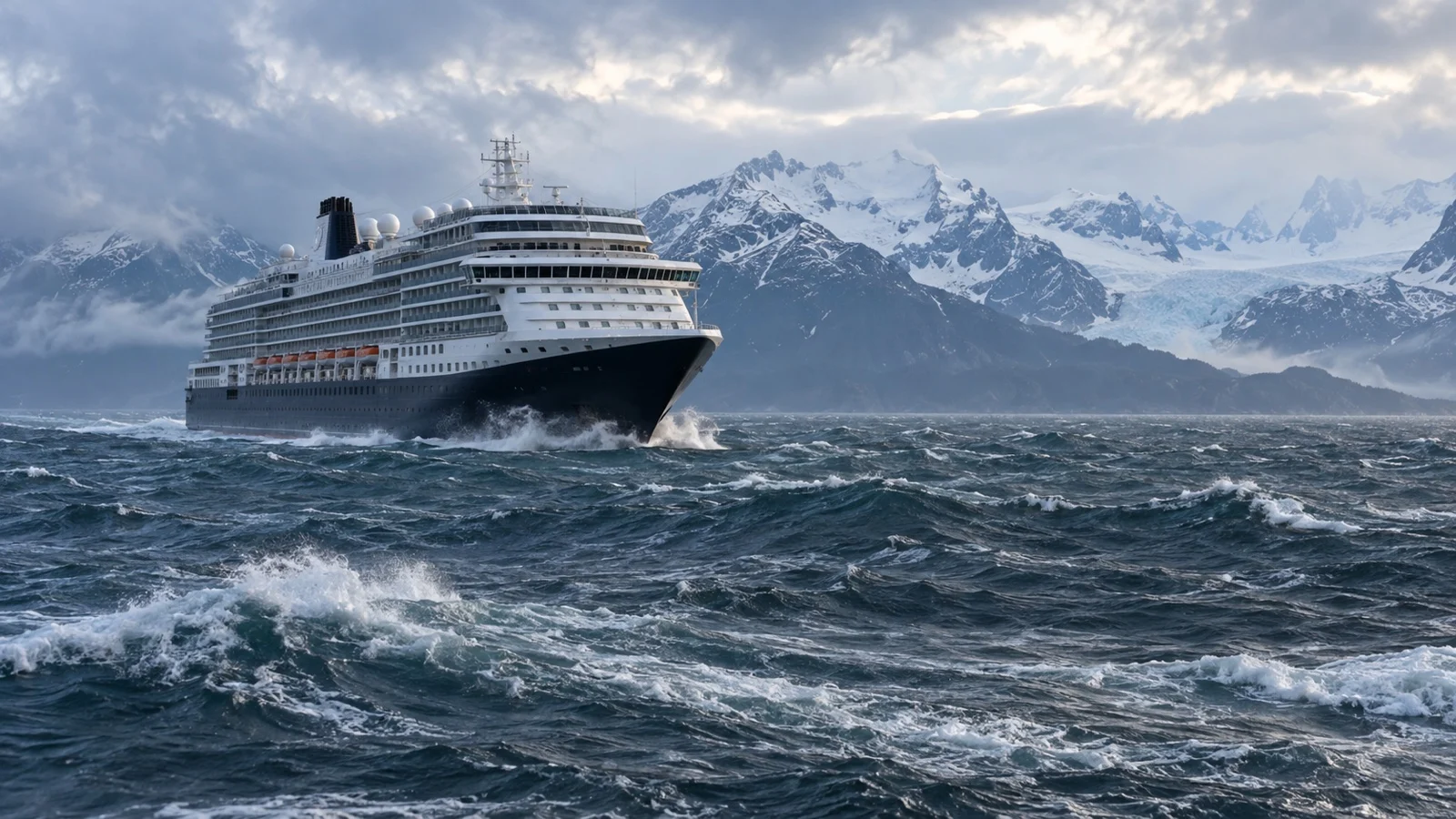
On a big modern ship, rough usually means a slow lean measured in seconds rather than a sharp jolt. Things slide off the nightstand and the hull makes a low groan that sounds far worse than it is.
The pool gets drained or roped off, the outer deck doors get locked, and paper bags appear in little holders beside the elevators. That last detail alarms people more than the motion does.
Most passengers sleep through it. A minority feel genuinely awful, and if you are in that minority you almost certainly already know it.
The Bay of Biscay catches people who never planned to cross it
Nobody books the Bay of Biscay. You book a British Isles loop, or a spring repositioning from the Mediterranean up to Southampton or Hamburg, and the bay is simply the water in between.
The trouble is the shape of the seabed. Atlantic swell that was harmless over water more than 15,000 feet (4,600 m) deep runs into a wide continental shelf, stands up and shortens.
Gales there can exceed 70 miles per hour (113 km/h), and squalls are a hazard in any month of the year. Late October through March is the window I would avoid if I had the choice, and a June or July crossing is often glassy.
The Tasman Sea has earned the nickname
Australians and New Zealanders call it crossing the Ditch, which rather undersells it. The Tasman is roughly 1,400 miles (2,250 km) across and sits squarely in the belt of westerlies known as the roaring forties.
Any Sydney to Auckland sailing, and most of the seasonal repositionings between Australia and New Zealand, spend two or three days in it. Low pressure systems track through from the west all year, which is why it is noted for its storminess rather than for one bad season.
If you want better odds, the southern summer months of December through February are the ones to aim for. That is also when these itineraries run most often, so you are not giving anything up.
The Gulf of Alaska is a booking decision, not a weather problem
This is the most useful distinction on the whole list. A round trip Alaska sailing from Vancouver spends nearly the entire week inside the Inside Passage, tucked behind Vancouver Island and the islands of the Alexander Archipelago.
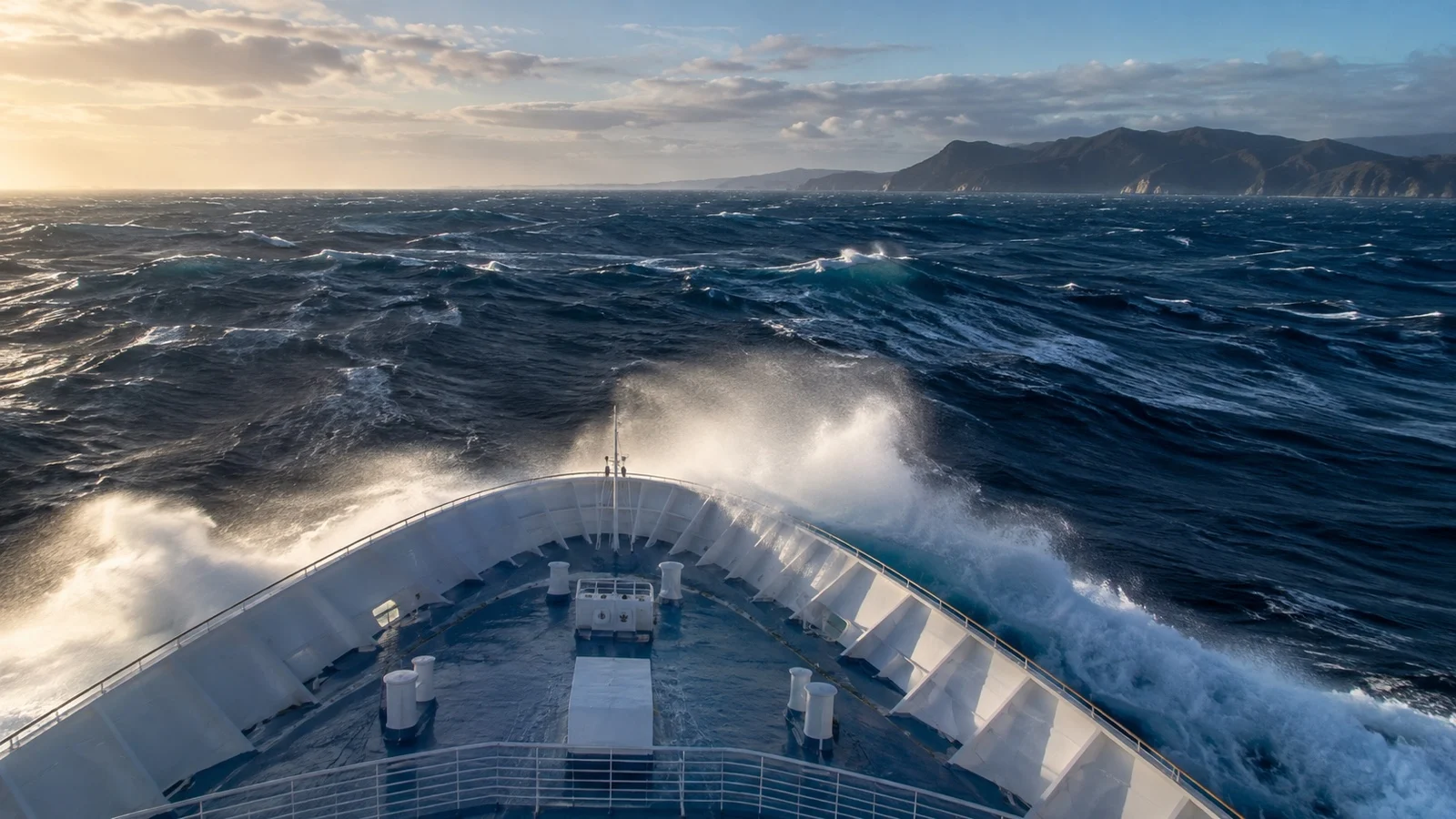
A one way sailing between Vancouver and Seward or Whittier does not. It crosses the open Gulf of Alaska for the better part of a day, usually overnight, and that single leg is where the motion lives.
Two caveats keep this honest. Even the sheltered route crosses exposed gaps at Queen Charlotte Sound and Dixon Entrance, and round trips out of Seattle often run down the outside of Vancouver Island instead.
September sailings are windier than June ones, reliably. If someone in your group is worried about motion, a midsummer round trip from Vancouver is the version of Alaska I would book.
Spring eastbound and fall westbound are not the same crossing
Transatlantic repositionings run in two directions and the difference is real. Eastbound sailings cluster in April and May, as the winter storm track over the North Atlantic is winding down.
Westbound sailings cluster in October and November, when that storm track is spinning back up and the Atlantic tropical season still has weeks left to run. You are sailing into a busier pattern rather than out of one.
There is a direction effect on top of that. The prevailing winds up there are westerly, so an eastbound ship takes the weather from behind, and a following sea is generally kinder than the same water on the bow.
If you are weighing the two, my piece on how a true crossing differs from a repositioning cruise covers the rest of the tradeoffs.
The Drake Passage, briefly, because it has its own page
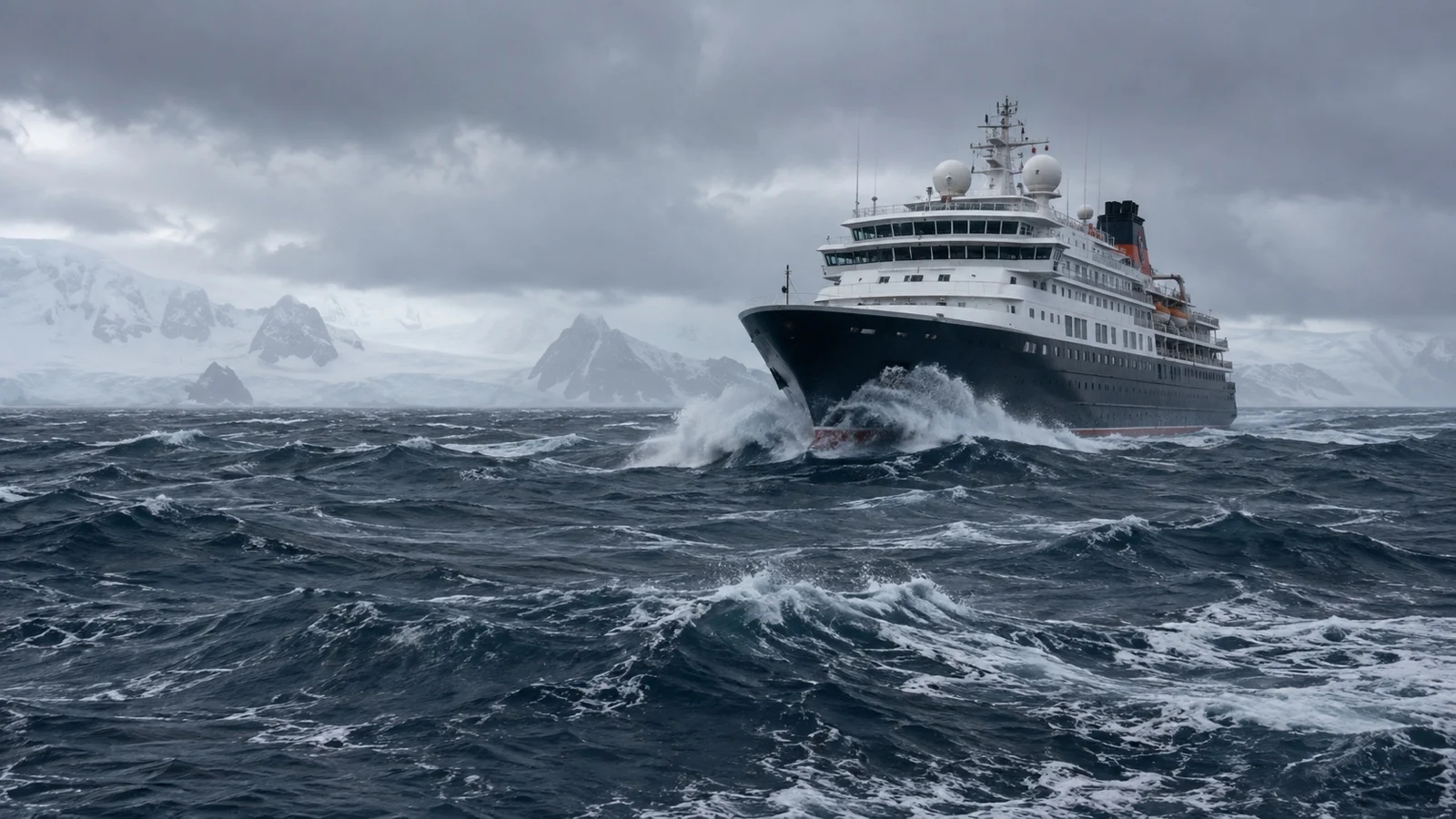
Six hundred miles (1,000 km) of open water sit between Cape Horn and the South Shetland Islands, with no land at that latitude to slow the wind or current. Crews joke about the Drake Lake and the Drake Shake, and both are genuine outcomes on the same route in the same week.
It is about two days each way, on small expedition ships that are the least forgiving vessels you can be aboard. My guide to sailing those two days of open ocean goes through what to expect and how people get through it.
The Caribbean gets bumpy with no storm anywhere near you
Winter Caribbean cruising has a reputation for glassy water, and in the lee of the islands it usually deserves it. The open Atlantic side is a different story from roughly December through February.
The trade winds strengthen in that window and can hold at 20 to 25 knots for days on end. Long period swell generated by North Atlantic storms thousands of miles away also runs south and reaches the northern and eastern islands.
None of that is a storm. It is wind and swell doing ordinary winter things, and it is the most common reason an exposed tender port quietly turns into a sea day.
My post on what actually cancels a port call covers how those calls get made, and how late.
The Mediterranean in shoulder season is windier than the brochure
Two named winds do most of the damage. The mistral is a cold, dry northerly that funnels down the Rhone valley into the Gulf of Lion, averaging around 45 miles per hour (74 km/h) and reaching about 80 miles per hour (130 km/h) where the valley narrows.
It is strongest and most frequent in winter, it can blow for several days without a break, and it is why a Provence call in March sometimes does not happen. The meltemi is the summer counterpart, a steady northerly across the Aegean from about mid May to mid September.
The meltemi tends to peak in the early afternoon and often eases overnight, which is why an Aegean tender port can look fine at 8am and be impossible by 2pm. Mediterranean seas are also short and steep rather than long and rolling, and plenty of people find that chop worse than a big ocean swell.
What a stabilizer actually does, and what it does not
Fin stabilizers are retractable wings that extend from the hull below the waterline, roughly amidships. They tilt to generate lift and downforce that fights the ship’s roll, and on a modern ship they are genuinely good at it.
They only address roll, which is the side to side lean. They do nothing about pitch, which is the bow rising and dropping in a head sea, and nothing about heave, which is the whole ship lifting and falling.
They also need forward speed, because they are wings and wings need flow across them. Slow the ship down for traffic or weather and they lose bite, and they are retracted entirely in port and in tight channels.
So a smooth ride with the sea on the beam is a stabilizer win. A night of pitching into a head sea feels much the same whether the fins are out or not.
Where to sleep if motion bothers you
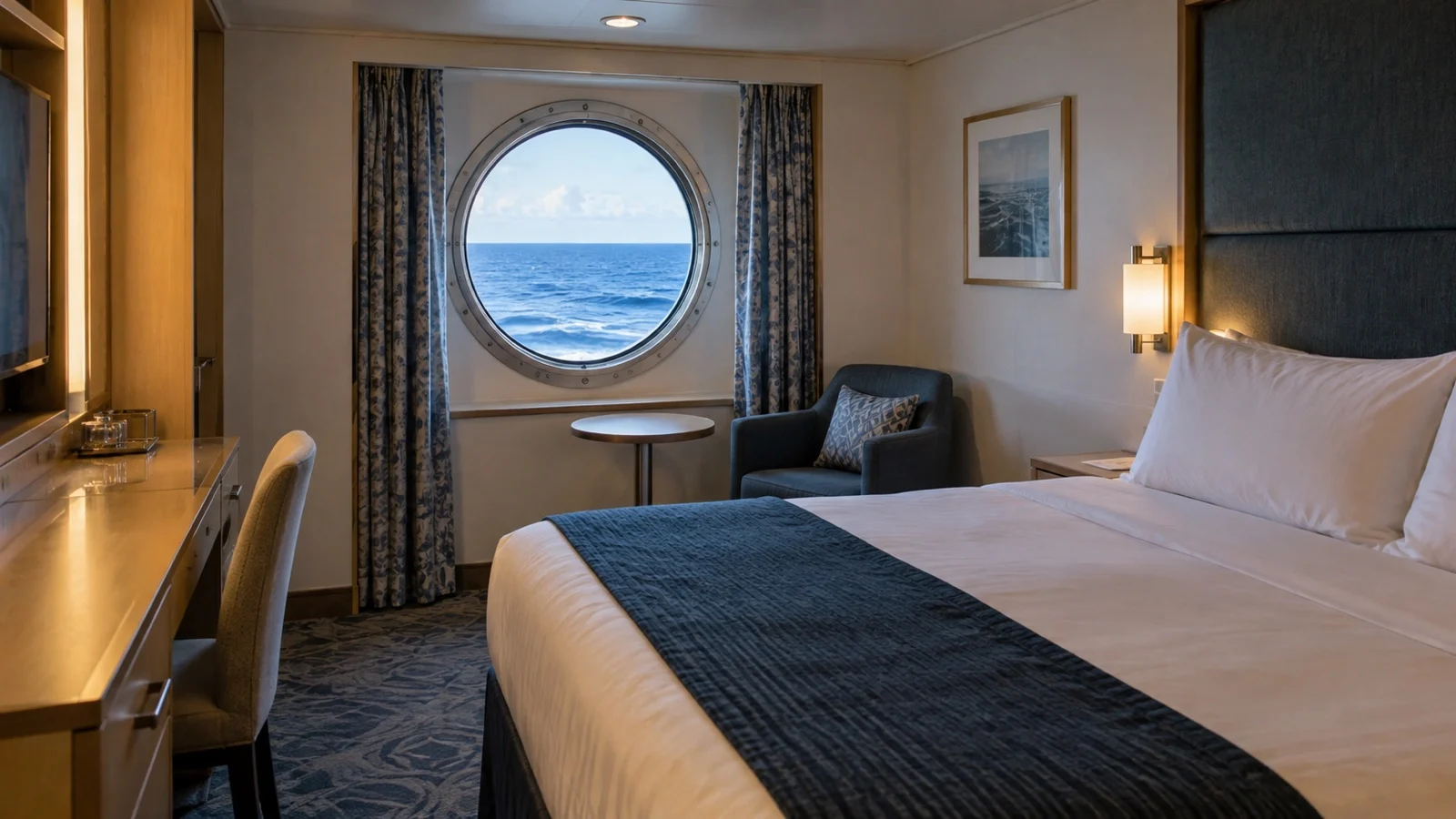
Low and midships, every time. Motion on a ship is rotational, so the closer you are to the middle in both directions, the smaller the arc you travel through.
The tradeoffs are worth saying out loud, because that address is not free.
- The best spots are often windowless: Low midships real estate tends to be interior or obstructed ocean view, and losing your window costs you the horizon.
- You pay for the exception: A low midships balcony exists on most ships and it is priced like the good cabin it is.
- Noise moves in: Low and central puts you near the galley, crew areas or the theater on plenty of deck plans.
- Aft is a compromise: Aft cabins pitch less than forward ones but pick up propeller vibration.
- Forward is the one to skip: Bow cabins get the most pitch and the anchor chain at 6am.
My guide to picking a cabin for motion, noise and distance works through the deck plans in more detail. If you are choosing between a high balcony and a low ocean view and motion worries you, take the low one.
What actually helps when you feel it starting
The two free things work. A visual horizon has real support behind it, and so does fresh air on your face, which is why the promenade deck fills up on a rough afternoon.
Wristbands are the popular answer and the evidence is not kind to them. Acupressure bands generally test no better than placebo, though placebo is not nothing, so if they work for you then keep wearing them.
Over the counter antihistamines are the usual first line and they do work, at the cost of drowsiness. The prescription patch worn behind the ear lasts far longer but takes hours to take effect, so it is a plan rather than a rescue.
I am not going to tell you what to take or how much of it. Ask a pharmacist or your own doctor before you sail, and read the general guidance on preventing motion sickness while traveling so you know what the real options are.
How to read the forecast for your own route
Wave height on its own is a poor predictor of comfort. Period matters more, because 8 feet (2.4 m) at six seconds is a nasty chop and 8 feet at fourteen seconds is a long, slow lift most people never notice.
Direction matters just as much, since the same swell is a mild roll on the beam and an all night pitch on the bow. The free offshore and high seas products that cover the northern Atlantic and Pacific take in most of the water on this list.
Look a few days out, not the night before. I wrote a full walkthrough on reading a marine forecast before your cruise if you want the step by step version.
The itinerary that skips the problem entirely
If motion is a real limiter for someone in your party, choose sheltered water first and optimize everything else second. Round trip Alaska from Vancouver, the Chilean fjords, the Baltic in summer and any river cruise keep you inside protected water almost the whole time.
Norway needs one caveat. The fjord legs themselves are flat, but the open coastal hops between them are exposed and can get lively.
Size and age help too. A large modern ship generally rides better than a small older one, and that difference does more for you than anything you can change once you are aboard.
Quick answers
What is the roughest cruise route in the world?
The Drake Passage to Antarctica, by a wide margin, because it is fully open ocean and it is sailed on small expedition ships. The Bay of Biscay in winter and the Tasman Sea are the next tier down.
Is the Bay of Biscay always rough?
No, and summer crossings are frequently calm. The reputation belongs to roughly October through March, when Atlantic gales and a shoaling seabed work together.
Do cruise ship stabilizers stop seasickness?
They cut roll while the ship is underway, which helps a lot when the sea is on the beam. They do nothing about the bow pitching in a head sea, so a rough night can still feel rough.
What is the best cabin to avoid seasickness?
Low deck, midships, and with a window if you can manage it. The horizon is worth more to you than the balcony is.
Which Alaska cruise has the least open ocean?
A round trip from Vancouver, which stays inside the Inside Passage for almost the whole week. One way sailings to or from Seward and Whittier cross the open Gulf of Alaska.
Final word
Rough water is a scheduling problem far more than a safety one. You pick the season, you pick the route, you pick the cabin, and by the time you board there is almost nothing left to decide.
If someone in your group is genuinely prone to it, plan around that person instead of hoping. A sheltered itinerary in the right month costs nothing extra and takes the question off the table.
How this guide was researched: Seasonal wind and swell patterns for each stretch of water, how fin stabilizers work, and current general guidance on preventing motion sickness were all checked in September 2026. Weather windows, itinerary routings and available remedies change, so confirm the details for your own sailing and talk to a clinician before taking anything. See our Editorial Policy.
More on this topic: browse every guide on weather, crowds and conditions.