Kiel Canal Cruise Transit: A Sea Day That Is Not at Sea
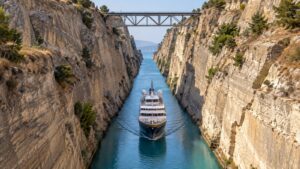
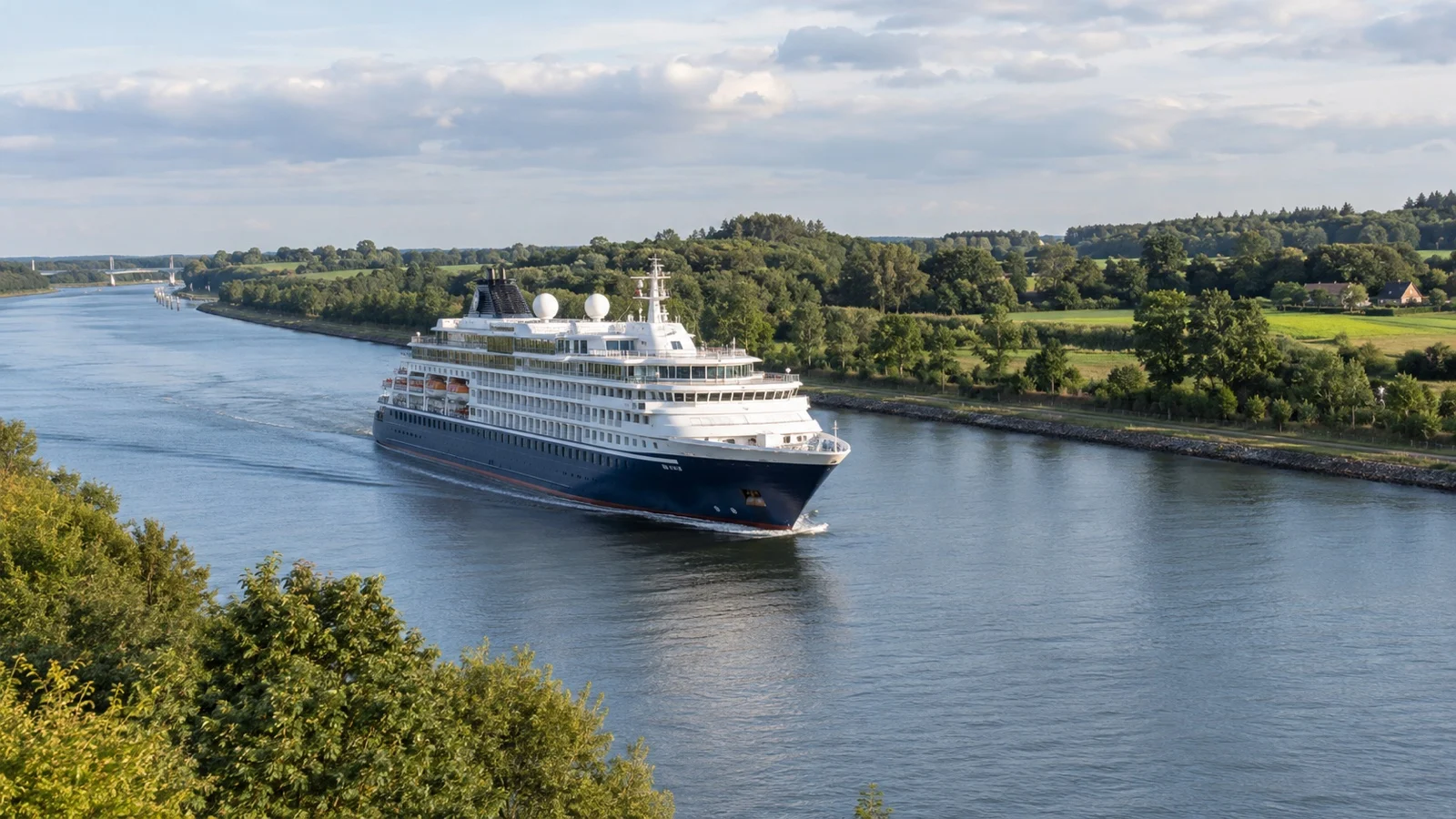
The Kiel Canal is the only sea day where somebody can cycle past your ship and beat it. Your vessel crosses Germany at roughly walking pace, between two sets of locks, close enough to the fields that you can count the cows.
That is the charm and also the catch. A Kiel Canal cruise transit is slow, low, flat and entirely dependent on your ship being small enough to fit through in the first place.
My quick take
This can be a rewarding transit day, but the timing is operational rather than theatrical. The locks and major crossings are the obvious highlights, with long stretches of farmland and passing traffic between them.
An open forward deck can be useful for a lock approach, while a forward lounge is the practical weather backup. Check the onboard commentary schedule because the direction and timing determine which landmark comes next.
Keep the transit day flexible rather than scheduling around a precise lock time. Some itineraries use a full through passage, while others may include only part of the waterway or pass at night.
The quick facts
- Where it runs: from Brunsbuettel on the lower Elbe to Kiel-Holtenau on the Kiel Fjord. The Wasserstrassen- und Schifffahrtsamt Nord-Ostsee-Kanal gives the length as a shade over 61 miles.
- How long it takes: Allow roughly eight hours for the canal passage, plus variable waiting at the locks and for traffic control. Speed and movement instructions come from the waterway authority and pilots.
- The locks: one group at each end, at Brunsbuettel and at Kiel-Holtenau, each with large and small chambers. A fifth chamber is under construction at Brunsbuettel and the small lock at Kiel-Holtenau is being replaced, so chamber availability at either end can change.
- Size limits: the maximum is roughly 771 feet long by 107 feet wide at about 23 feet of draft, with alternative combinations of roughly 633 by 66 feet or 525 by 89 feet at about 31 feet of draft, plus interpolation between them.
- Headroom: the WSA lists about 138 feet of clearance under the canal’s bridges, described as roughly 131 feet of ship plus about 6.5 feet of reserve. That is the limit that quietly disqualifies a lot of modern tonnage.
- The channel itself: about 36 feet deep and roughly 531 feet wide at the surface. The original 1895 canal was about 190 feet wide and 28 feet deep.
- How busy it is: official 2025 figures report 22,262 commercial ships carrying 69.5 million tons, plus leisure traffic. The canal remains one of the world’s busiest artificial seagoing waterways, but annual totals move with trade and operating conditions.
- How often the transit is missed: No reliable public percentage is available. Lock availability, visibility, wind, traffic control, maintenance, and vessel requirements can delay or change a planned passage.
The locks at each end, and what actually happens in them
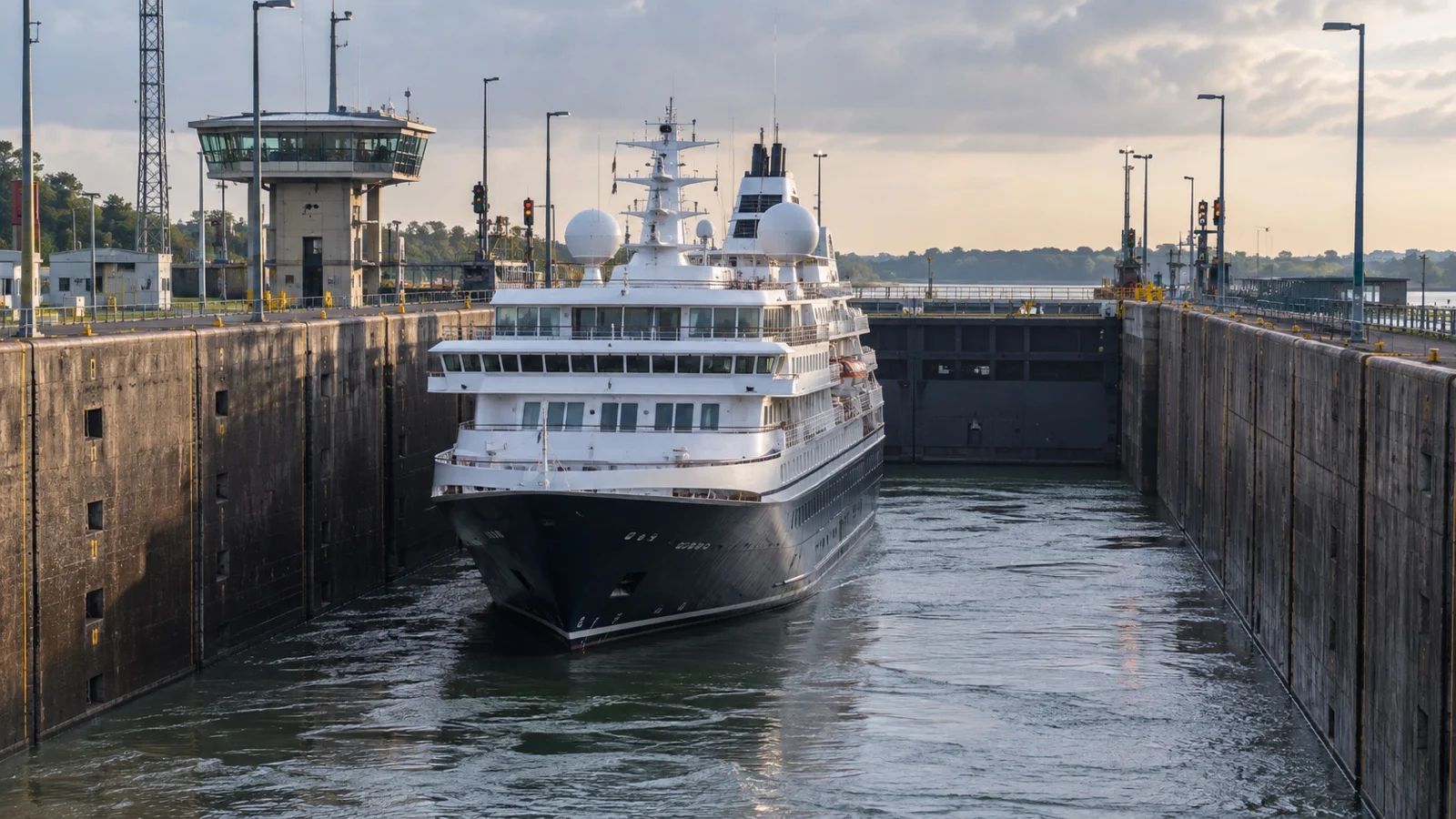
The canal does not lift ships over high ground like the Panama Canal. Its locks manage water-level differences and protect canal operations at the Elbe and Baltic ends.
At Brunsbuettel the lock separates the canal from the Elbe, which is properly tidal and properly busy. Depending on the state of the tide you may go up, go down, or barely move at all.
What you actually see is a long approach, possible waiting, and then the ship easing into a chamber under pilot and traffic-control instructions. Clearance depends on the vessel and assigned chamber, so avoid inferring the gap from the canal’s published maximum beam alone.
Lock operations run around the clock, which is why some itineraries lock in before breakfast. If the canal is the reason you booked, ask at reception the night before for the scheduled lock time and get up for it.
Suez is the other long, slow canal day worth planning for, and we cover how that transit runs in its own guide.
Why a Kiel Canal cruise ship has to be small
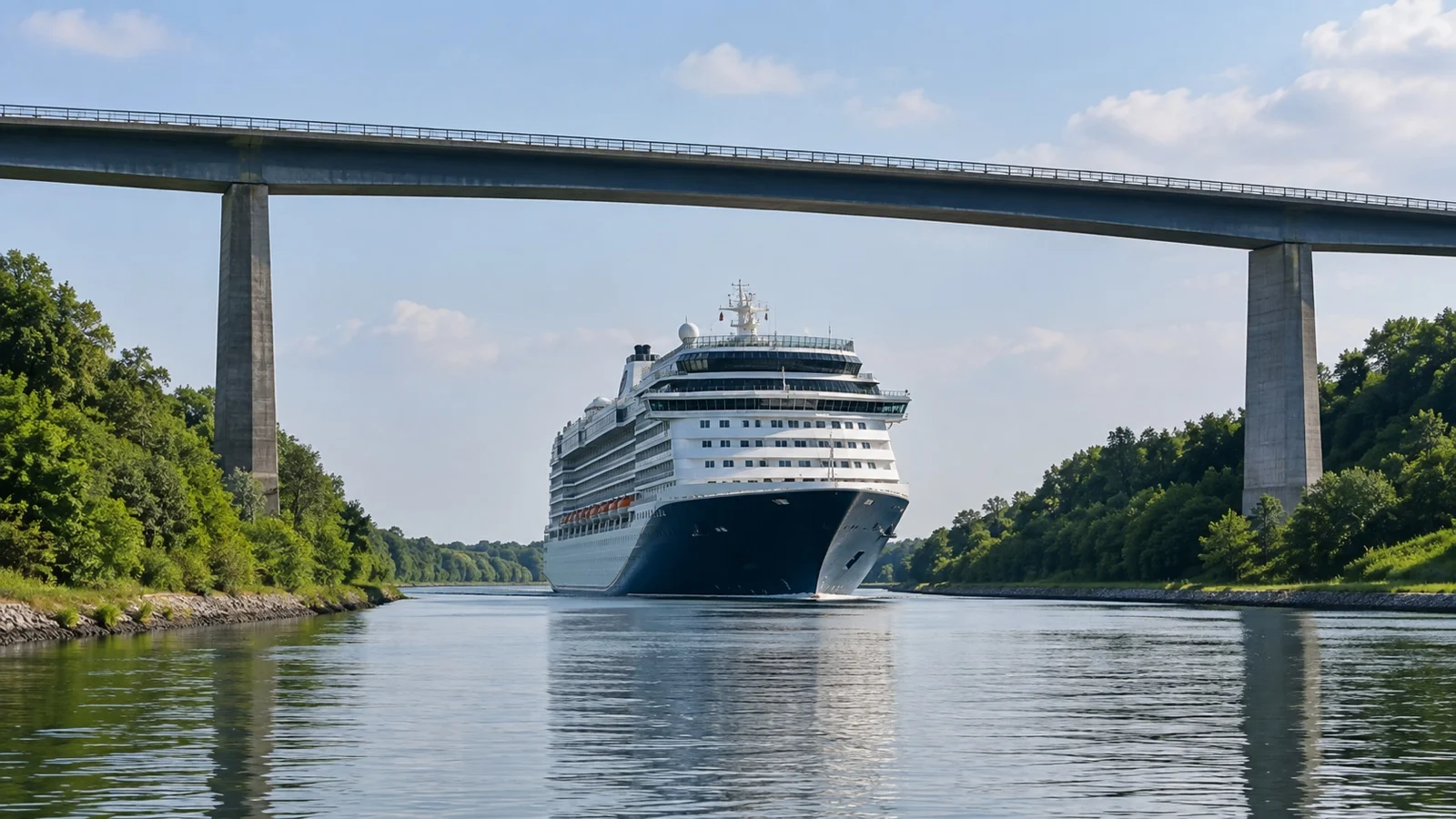
Two numbers do all the work here. The canal allows roughly 771 feet of length and 107 feet of beam, and its bridges allow about 138 feet of air draft.
Beam is one important limit, and many modern large cruise ships exceed the published maximum. Others may fail on length, draft, air draft, or a combination of operating limits.
Canal transits therefore favor ships whose dimensions and operating profile fit the waterway. A published Kiel Canal day still needs confirmation because dimensional eligibility alone does not guarantee passage.
One caveat worth repeating: these are the waterway’s published maxima, not a guarantee that any given ship is permitted on any given day. Traffic grouping, weather and one-way sections all sit on top, and that part is your captain’s problem rather than yours.
The bit in the middle: bridges, ferries, cyclists and cows
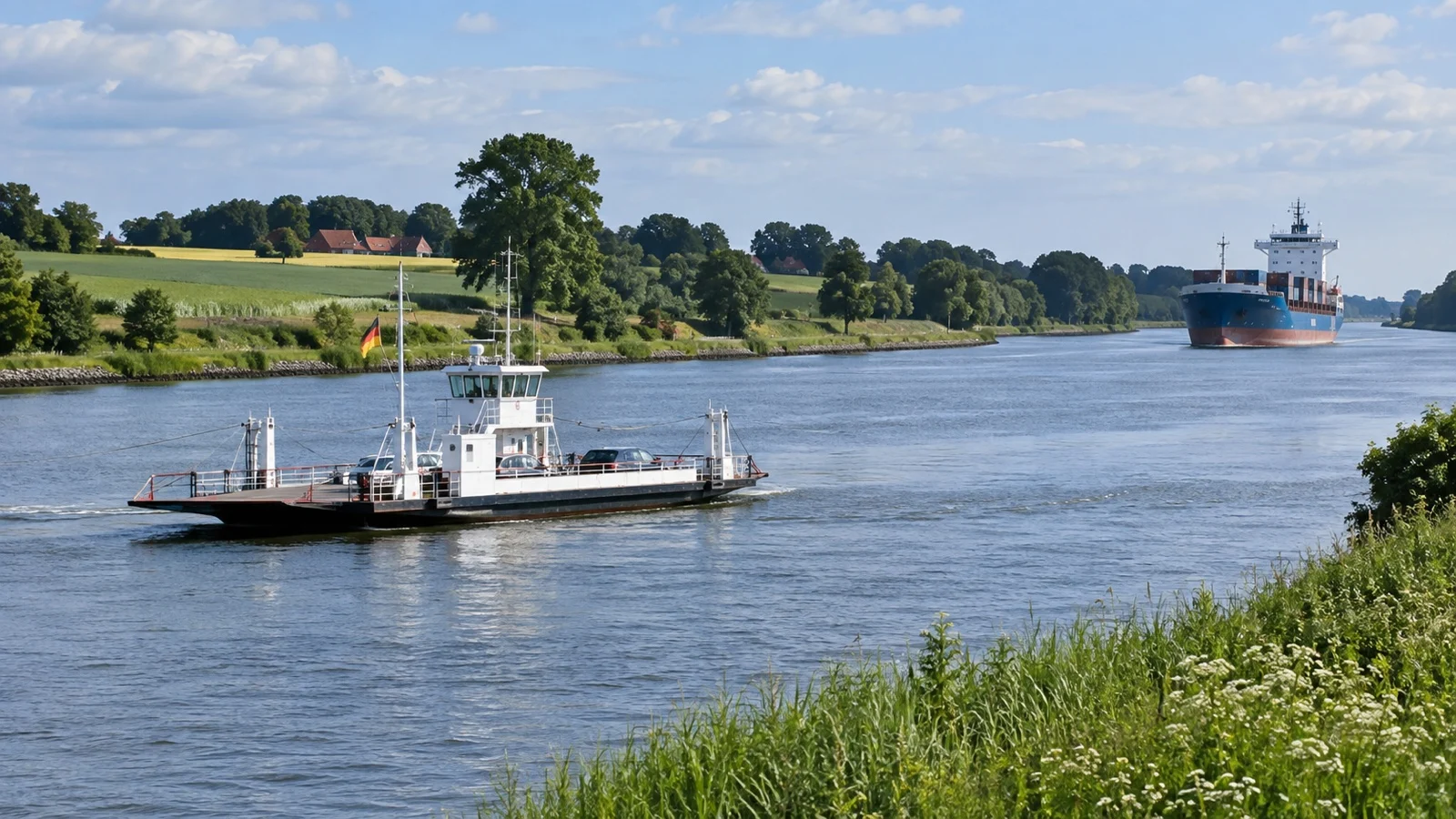
Between the locks the canal is a long straight-ish cut through farmland, woodland and small towns. The banks are close, the towpath is busy, and the whole thing feels much more like a canal boat vacation than a cruise.
The canal has far more crossings than this short highlight list, including high road and rail bridges plus the road and pedestrian tunnels at Rendsburg. The fixed bridges provide roughly 138 feet of navigational clearance, so they arrive overhead with a satisfying amount of steel and not much margin.
Rendsburg is the highlight. The railway reaches its bridge on a long looping approach through the town, and underneath the bridge hangs a transporter ferry that carries people and small vehicles across on a suspended platform.
And yes, the cows are real. Large stretches of bank are grazing land, and cyclists may appear to keep pace while the ship follows canal speed and traffic instructions.
Why the long way round Denmark is so much longer
Without the canal, getting from the North Sea to the Baltic means going over the top of Denmark. You run north up the Jutland coast, round the Skagen, then back south through the Kattegat and the Danish straits.
The saving is large enough to be measured in emissions. The German waterways administration, GDWS, credits canal traffic with avoiding around 783,000 tons of carbon dioxide a year compared with the Skagen route.
This is also why the canal day is often paired with a call at either end. Hamburg or Cuxhaven on the Elbe side, Kiel on the Baltic side, and the canal as the connective tissue between them.
The things I would actually watch for
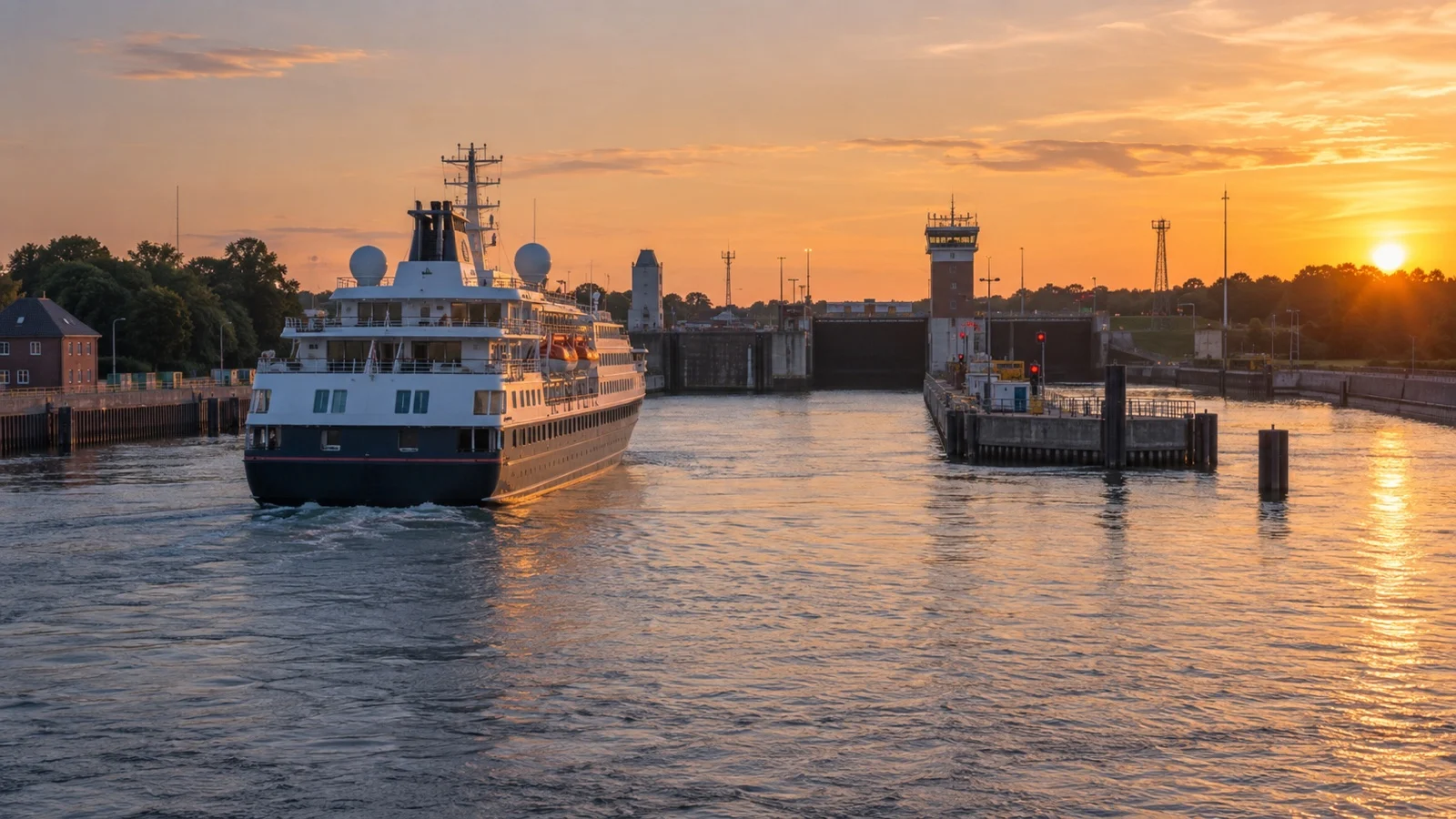
This is a day of small events rather than big ones, so it helps to know what is coming. Roughly in the order you meet them traveling west to east.
- The Elbe approach to Brunsbuettel: heavy commercial traffic, buoyed channels and a genuinely industrial skyline. Not pretty, but it is the best shipping-spotting hour of the day.
- The lock chamber itself: stand where you can see the gate close behind you. The scale only registers when the walls are alongside and the water starts moving.
- Hochdonn railway bridge: the first of the big high bridges, and a good reminder of how tight 138 feet looks from a top deck. If a train crosses while you pass underneath, that is the day made.
- The Rendsburg high bridge and transporter ferry: the single most photographed thing on the canal, and rightly so. The suspended ferry connects Rendsburg and Osterrönfeld beneath the railway bridge when the service is operating.
- Levensauer Hochbruecke near Kiel: the last big bridge before the eastern end. Once you are past it you are minutes from the Holtenau locks.
- Holtenau locks and the run into Kiel Fjord: the transition from ditch to sea happens fast. Within twenty minutes of leaving the lock you are in open Baltic water with the Kiel waterfront off to starboard.
Fun fact: The Rendsburg transporter ferry is a suspended platform beneath the railway bridge, according to the WSA Nord-Ostsee-Kanal. Check the authority’s current operating notice rather than assuming it will run during your transit.
How I would actually decide
If you are choosing between two Baltic itineraries and one includes the canal, the canal is a reason to pick it. It is a proper piece of travel rather than a filler day, and it is the sort of thing that ends up in the photos you keep.
But I would not pay a large premium for it, and I would not book a whole cruise around it. It is one good day, not a destination, and the ships that can transit tend to be the ones you were already choosing for other reasons.
If your ship is doing a full daylight passage, clear your day. If it is doing a partial or overnight transit, treat it as a bonus rather than the main event and plan accordingly.
A realistic word on accessibility
A through transit can avoid the gangways, tenders, motorcoaches, and cobbles of a port day. Accessibility still depends on the ship’s route to a suitable viewing space.
The bad news is that the best views are outdoors and forward, which is exactly where ship access is usually worst. Forward observation decks are often reached by stairs only, and the bow area on smaller ships is frequently crew territory.
Find an accessible viewing space the day before rather than on the morning of the transit. A promenade deck, covered aft area, or forward-facing lounge may work, depending on the ship.
Rails can get crowded at the locks and major crossings. Ask the crew early whether an accessible viewing position can be arranged.
When to go, and the weather
The canal operates year-round, while cruise transit dates depend on each line’s Baltic and northern European schedule. Do not assume shoulder-season sailings will be quieter or cheaper without comparing live itineraries.
Northern Germany can be cool, warm, windy, or wet during the cruise season. Check the forecast close to the transit and expect an exposed deck to feel cooler than a sheltered lounge.
Spring and early fall often need more layers than midsummer, but conditions vary. Pack a windproof and waterproof outer layer for long periods outside.
Rain and reduced visibility can occur in any season and may affect viewing or operations. Follow onboard updates rather than assuming a delay or cancellation outcome.
Plan the transit as an operating waterway
A Kiel Canal passage depends on ship dimensions, traffic control, pilots, locks, wind, and maintenance, so the published itinerary is not a guaranteed hour-by-hour schedule. Keep the whole transit day flexible and listen for the bridge and lock commentary rather than planning a fixed meal or spa appointment around one landmark.
There are many more crossings than the four highlights often named in cruise commentary, including high road and rail bridges plus the Rendsburg road and pedestrian tunnels. The fixed bridges share roughly 138 feet of navigational clearance, which is why many large modern cruise ships cannot use the canal.
Stay on your ship during a through transit unless the cruise line specifically offers an organized overland program. The banks are an active federal waterway, not a hop-on promenade, and an independent detour has no safe way to catch a vessel moving between lock systems.
Wind and rain can make the open deck uncomfortable even when navigation continues, and exterior decks may not be step-free. Use the forward lounge as a backup, ask which elevator reaches the viewing deck, and carry a waterproof layer because the useful views last for hours.
Quick answers
How long does a Kiel Canal transit take?
Allow roughly eight hours for the canal passage, plus variable waiting at the locks and under traffic control. Use the ship’s live announcements for the day’s timing.
Can large cruise ships use the Kiel Canal?
Some can, but many cannot because the ship must satisfy the waterway’s dimensional and operating limits, including length, beam, draft, and air draft.
Which side of the ship is best?
Neither, honestly, because the canal is narrow enough that both banks are close and the interesting things alternate. Get outside and walk around instead of picking a side.
Do the locks lift the ship much?
Not really. The canal is at sea level, so the locks manage the tidal Elbe at one end and small Baltic level changes at the other rather than raising you over high ground.
Why not just sail around Denmark?
Because sailing around Skagen adds substantial distance between the North Sea and Baltic. The German waterways administration has published an estimated annual carbon saving for canal traffic, but the saving for one ship depends on its route and operation.
The last word
This is the kind of cruise day where the ship’s movement through a working waterway is the attraction. Expect locks, bridges, ferries, commercial traffic, farmland, and timing that can shift.
Most transits deliver you into the Kiel Fjord, so it is worth reading up on what Kiel offers as a port call before you arrive. The Port of Kiel’s own terminal listing puts the Ostseekai berths about 985 feet from the city center, which is unusually convenient.
At the western end, the canal meets the Elbe, but a transit does not guarantee a call at Hamburg. If you are assembling a wider route, my overview of German cruise ports is the place to start.
And if you have done this and want the bigger, hotter, more theatrical version of the same experience, the obvious next step is a full Panama Canal transit rather than a partial one. Kiel is the quiet cousin, and it has better cows.
How this guide was researched: This guide was desk-researched on September 12, 2026 using current German federal waterway and Port of Kiel sources. It does not claim a personal canal transit, lock passage, shipboard viewing experience, or Kiel port visit.
Confirm the scheduled route, lock timing, vessel eligibility, bridge commentary, accessibility, weather, and any shore program with the cruise line before travel. See our Editorial Policy.
More on this topic: browse every guide on expedition and alternative cruises.