Corinth Canal Cruise Ship Guide: Spectacular, and Too Small for Almost Every Ship
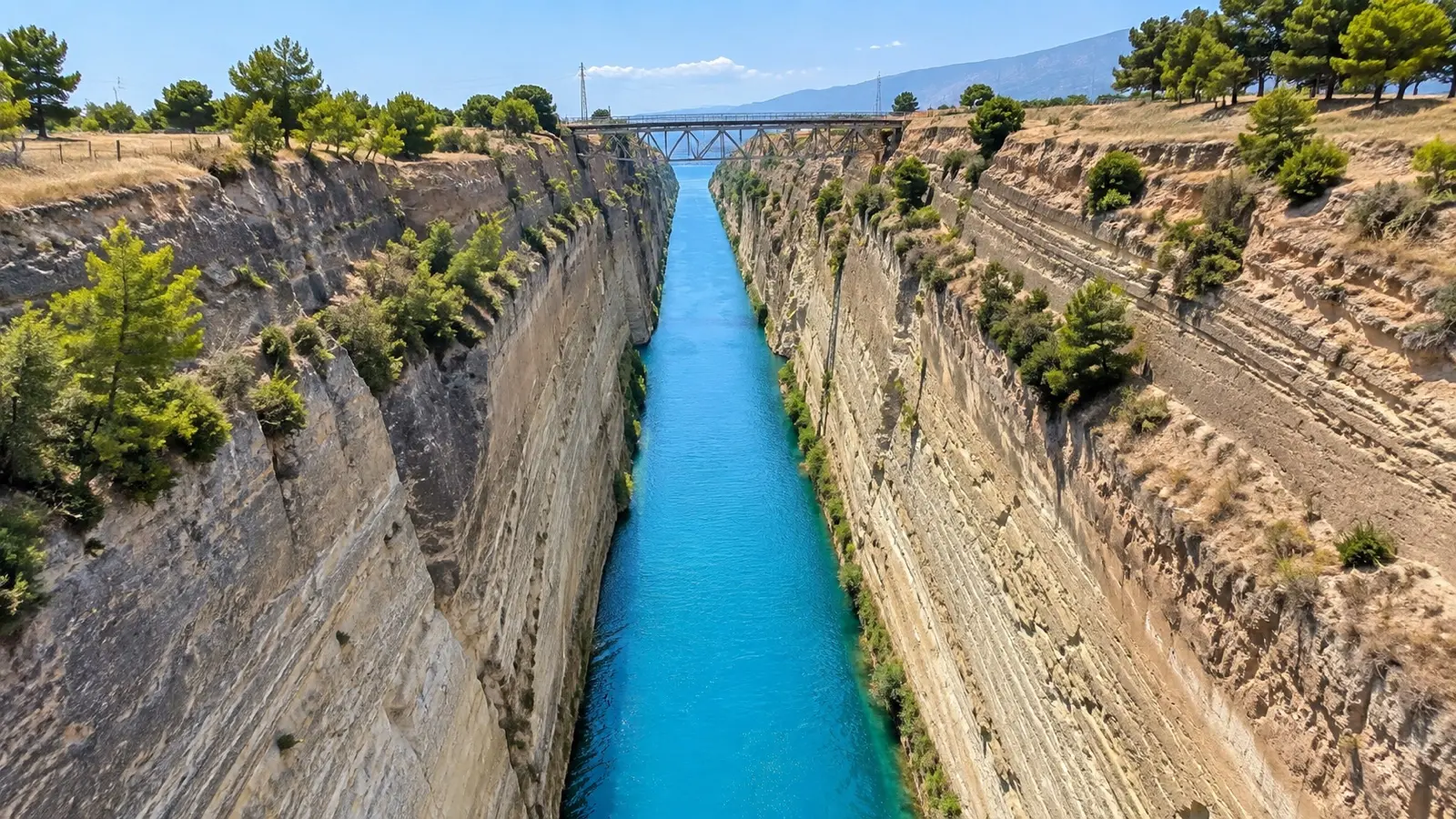
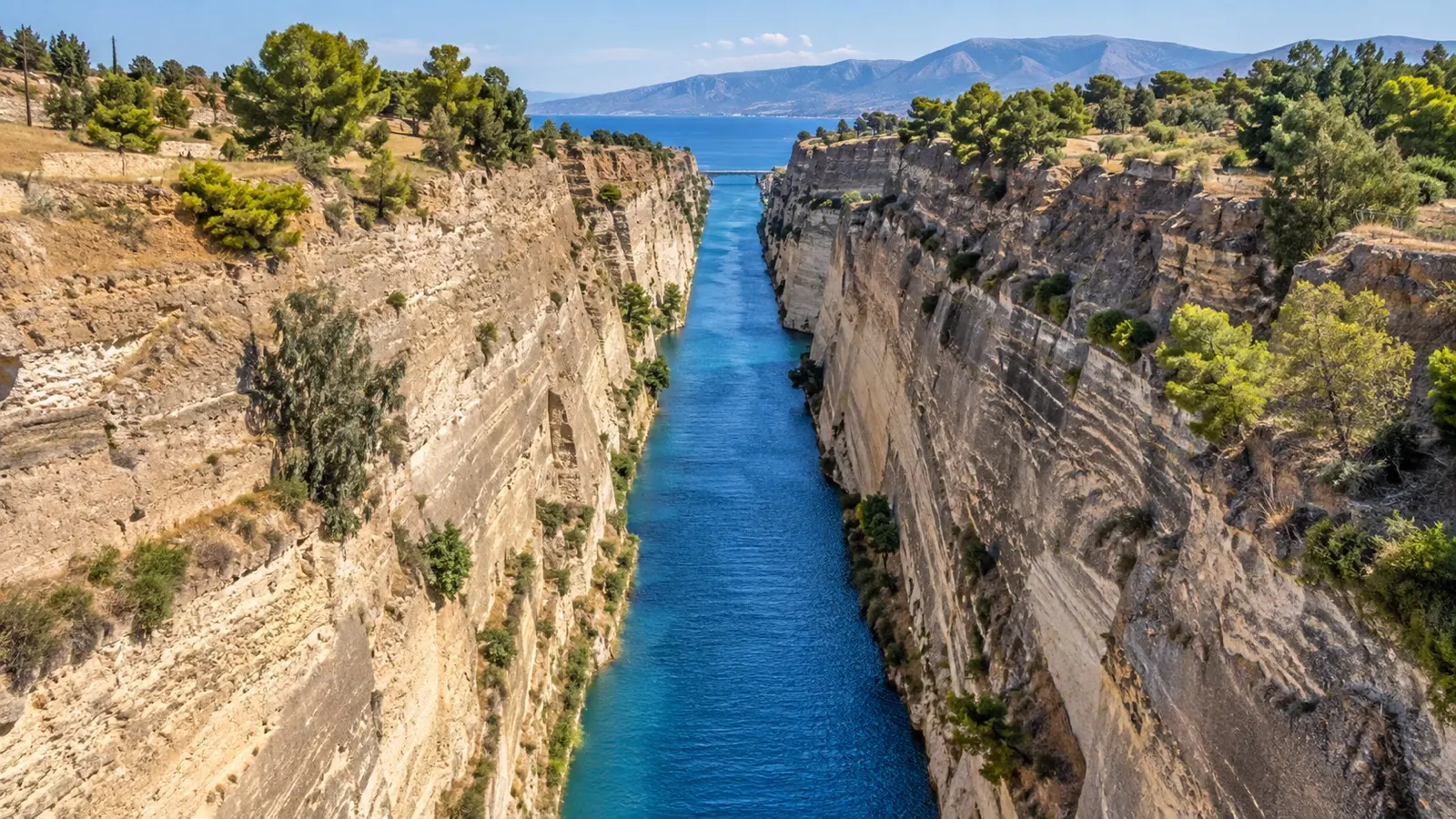
The Corinth Canal is the most photographed waterway in Greece that your ship will almost certainly never enter. It is a 3.9-mile slot cut through solid rock, under 82 feet wide at sea level.
That single number is why the phrase corinth canal cruise ship is mostly a fantasy. Unless you are on something very small indeed, the closest you will get is standing on a road bridge looking down at it.
My quick take
This is the rare attraction where the disappointment and the appeal are the same fact. The canal is spectacular precisely because it is absurdly narrow, and it is absurdly narrow precisely because nothing modern fits.
If you are calling at Piraeus and someone offers you a shore excursion that includes the canal, understand what you are buying. You are buying twenty minutes on a bridge, a photograph straight down a rock corridor, and probably a stop at Ancient Corinth to justify the motorcoach.
My honest view is that the canal alone does not fill a day, but the canal plus Ancient Corinth does. I would take that pairing over a third pass through the Acropolis crowds.
The thing I would not do is build a whole cruise around transiting it. A handful of small ships have managed it, the permissions are awkward, and the canal has spent large parts of recent years closed for landslide repairs.
The quick facts
- Where it is: across the Isthmus of Corinth, the neck of land joining the Peloponnese to mainland Greece. It links the Gulf of Corinth to the Saronic Gulf, and therefore to Piraeus.
- Who runs it: AEDIK, the Corinth Canal company, which publishes the technical characteristics, the navigation regulations and the toll calculator on its own site. The figures below come from those pages.
- The dimensions: roughly 3.9 miles long, including about 1,770 feet of harbor approaches at Isthmia and Poseidonia. The safe navigable width is about 81 feet at sea level, narrowing to about 69 feet at the bottom.
- The depth: about 26 feet of dredged channel. That is shallower than the draft of a great many ocean cruise ships before you even think about width.
- The walls: near vertical limestone and marl, rising to a maximum of around 259 feet above sea level. There is no bank and nowhere to go wrong.
- The size limit: AEDIK’s navigation regulations set a maximum beam of about 60 feet and a maximum draft of roughly 23.6 feet for vessels up to about 46 feet wide in normal conditions. Maximum air draft under the bridges is about 171 feet.
- The speed limit: 6 knots, with vessels kept roughly one nautical mile apart and slowed further at the entrances. Passenger vessels are given priority in the transit order.
- Opening hours: the canal is nominally open 24 hours a day, seven days a week, except Tuesdays from 06:00 to 18:00 for routine maintenance. Nominally is doing a lot of work there, for reasons covered below.
Why no modern cruise ship fits
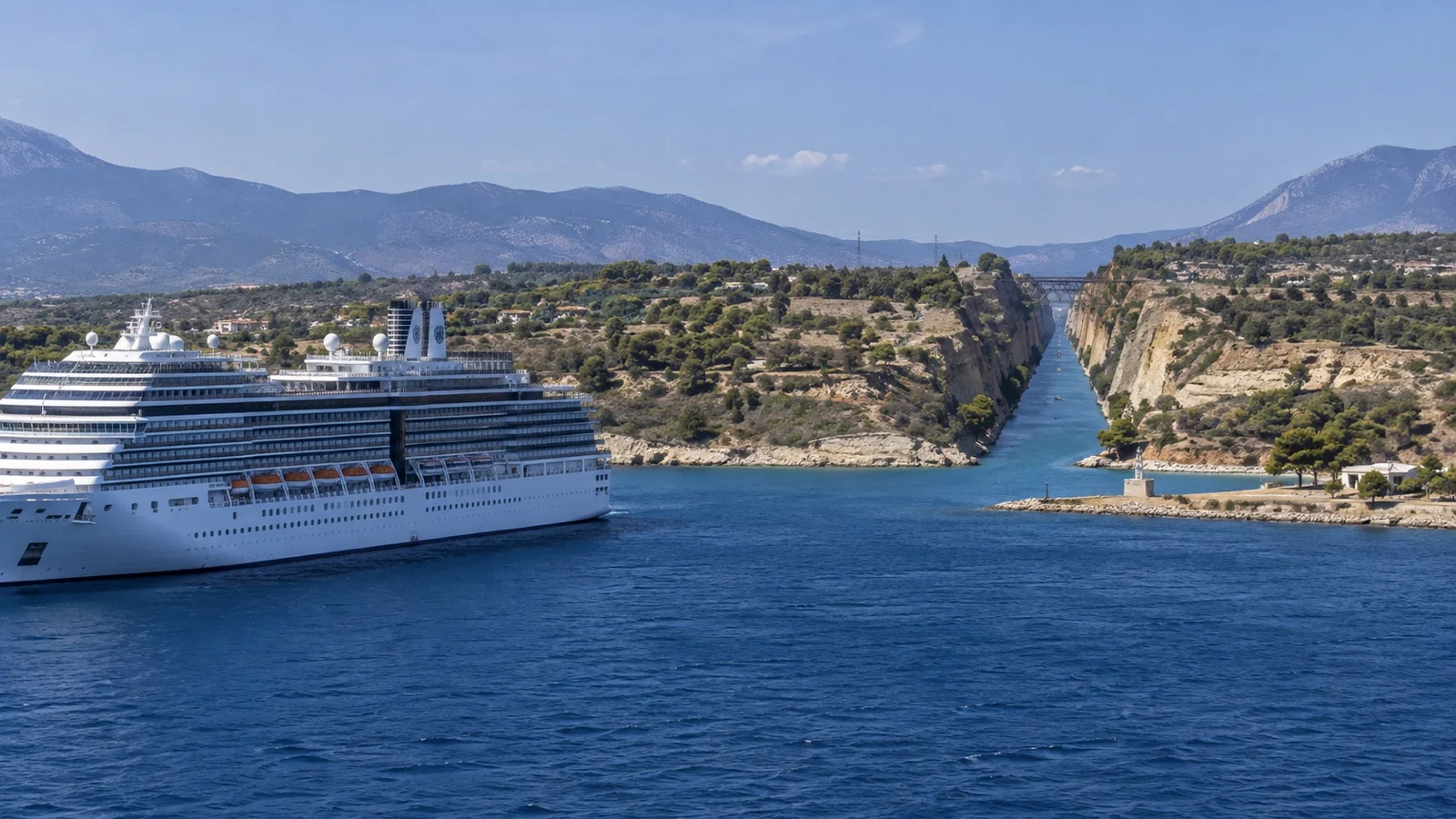
Start with beam, because beam is the wall you hit first. AEDIK caps vessels at about 60 feet across, which is roughly the width of a large motor yacht or a small coastal freighter.
Mainstream cruise ships are not built anywhere near that narrow. Even the older mid-size ships people think of as small are typically well over 82 feet in the beam.
Draft finishes the job, with about 26 feet of water and a published limit of roughly 23.6 feet written for narrow vessels in calm conditions. Plenty of ocean ships draw more than that alone.
The practical effect is that the ships small enough to fit are expedition vessels, private yachts, small coasters and tourist boats. Anything with a theater and a promenade deck is out.
The most cited exception is Fred Olsen’s Braemar, which was reported to have squeezed through in October 2019 at around 74 feet of beam and about 640 feet long. That transit was well outside the published limit and needed specific arrangements, which is exactly why it made news rather than becoming a regular thing.
What actually uses the canal now
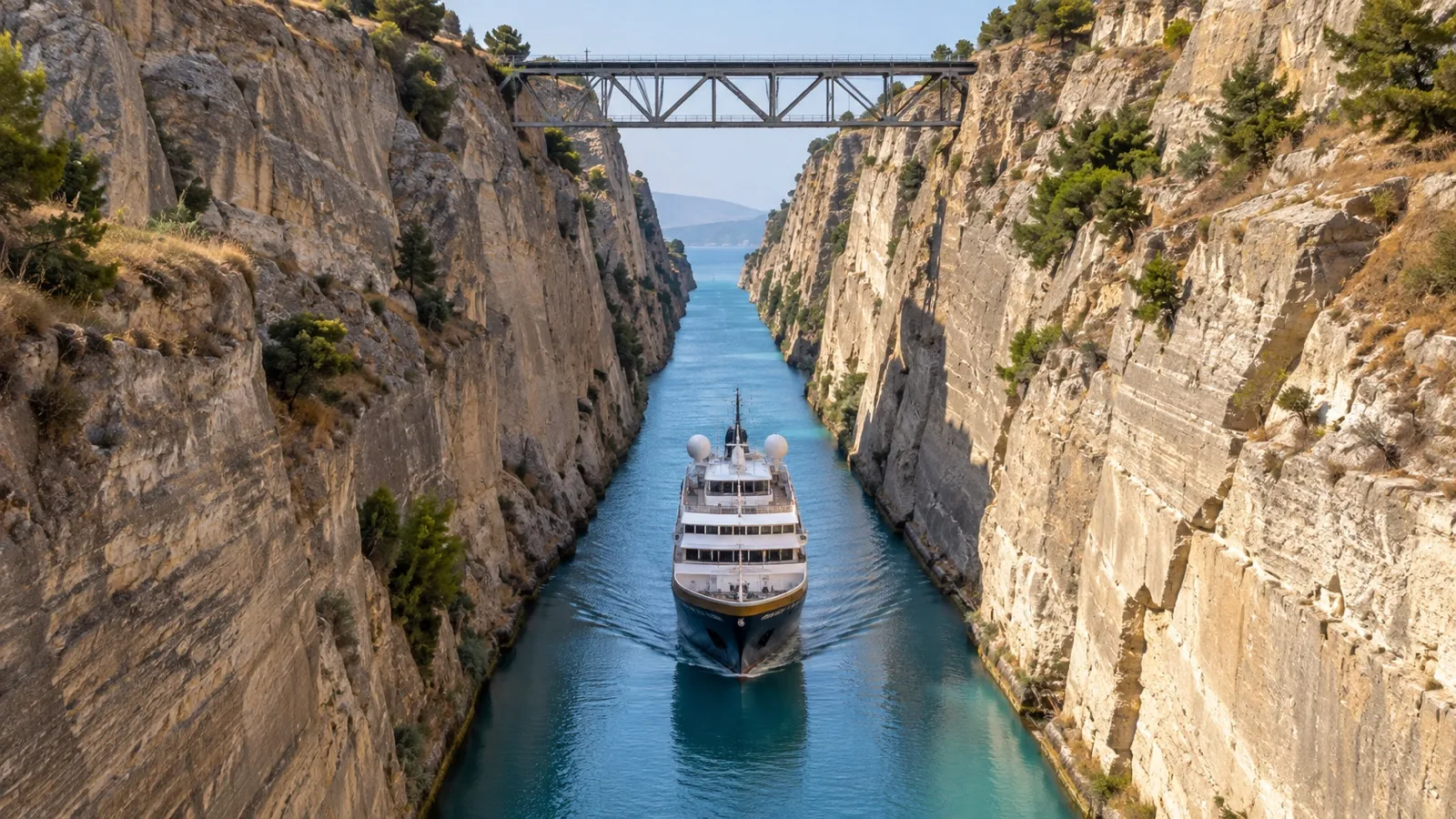
The canal has never been a commercial success in the way Suez is, and the modern traffic reflects that. It is mostly yachts, small tourist boats, coasters, tugs and the occasional expedition vessel, and short boat trips run from the Isthmia end when the canal is open.
AEDIK’s own general information page frames the case in distance rather than tonnage. Using the canal saves 195 nautical miles between Patras and Piraeus, 133 from Corfu, 131 from Brindisi and 130 from Venice.
Transiting vessels are not simply waved in. AEDIK requires notification at 72, 24, 6 and 3 hours before arrival, and towage is compulsory for vessels of 800 net tons and above, for engineless sailing craft, for dangerous cargoes and for empty tankers.
Pilotage is compulsory for any towed vessel and for anything over 100 net tons transiting at night. The canal’s own rules, published in the navigation regulations, also make the master liable for damage throughout.
Two submersible bridges, at Isthmia and Poseidonia, sink beneath the water to let traffic through and rise again for road vehicles. Watching one of them disappear is genuinely good value, and it is the bit most visitors do not know to wait for.
From Nero’s golden axe to 1893
The idea is roughly two and a half thousand years old. AEDIK’s history pages credit Periander, tyrant of Corinth, with the first serious plan around 602 BC, which his engineers talked him out of.
Nero did dig. In 67 AD he opened the works himself with a golden axe and a fanfare, then put thousands of laborers on the job, including 6,000 Jewish prisoners, before the project collapsed with his reign.
The modern canal followed the Suez boom. A concession went to the Hungarian general Istvan Turr’s International Maritime Canal Company in 1882, excavation began on 23 April that year in the presence of King George I, and the canal opened on 25 July 1893.
Eleven years of dynamite produced a waterway that was obsolete for cargo almost immediately. Ships had already outgrown it, which is a very Greek kind of tragedy and also why it survives as a spectacle.
The landslides, and why the canal keeps shutting
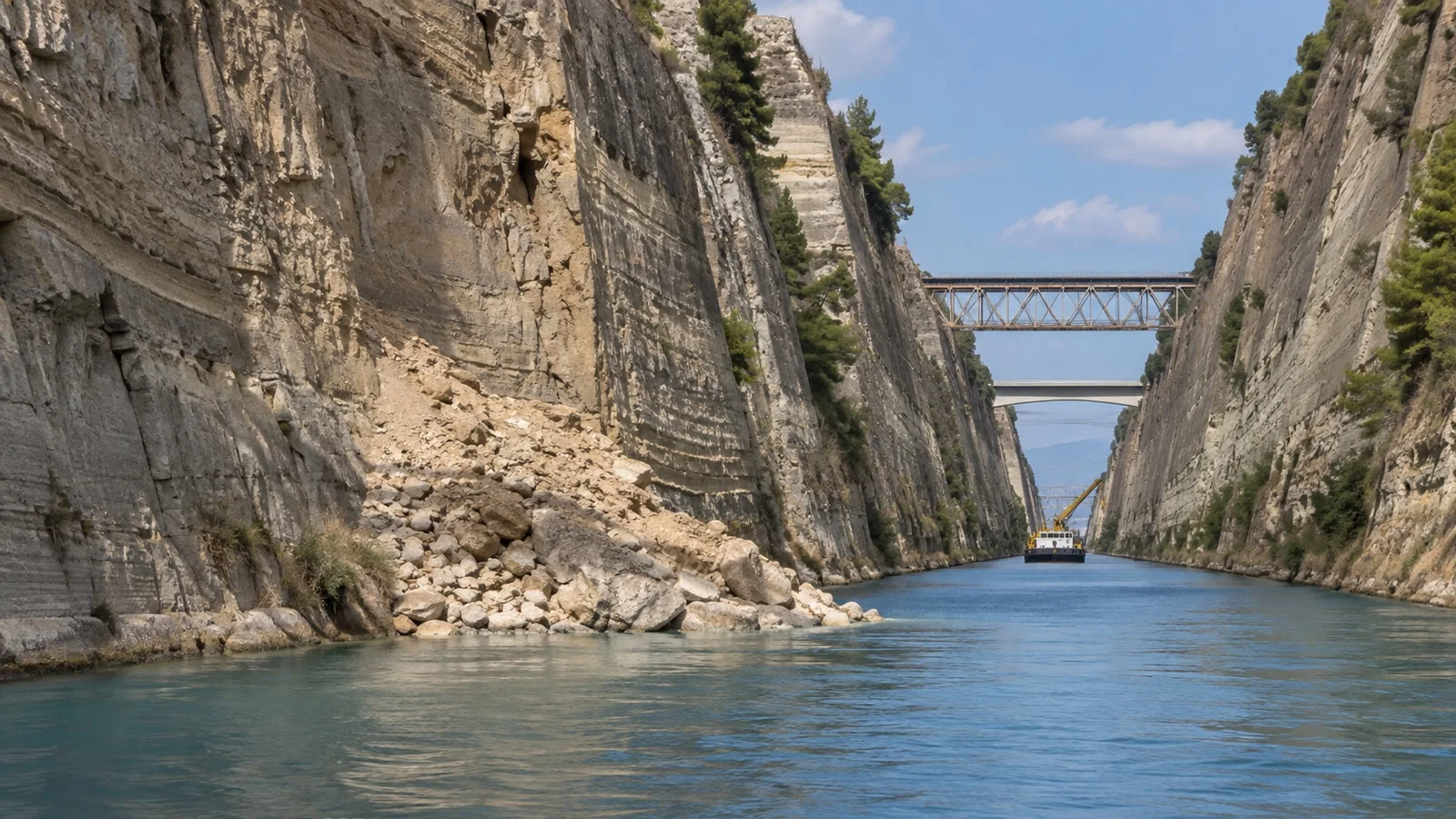
Here is the part the excursion desk will not mention. Those beautiful vertical walls are not stable rock, and the canal has a long history of slope failures dumping material into the channel.
Major landslides forced a prolonged closure from early 2021, and the restoration work has run on and off ever since. AEDIK’s announcements page reads less like a schedule and more like a list of navigation windows.
AEDIK reopened the canal on June 17, 2026 after completing the main critical slope-stabilization work. The canal is open at this review date, but confirm its status for your sailing because restoration work and navigation restrictions can change.
So if a transit matters to you, check AEDIK’s announcements yourself in the weeks before you sail. Do not rely on a tour listing written a year earlier.
The ways I would actually see it from Athens or Piraeus
Almost everyone reaches the canal from a Piraeus call. These are the options, ranked by how well they use a port day.
- The ship excursion to Corinth: the safest option, because the cruise line’s stated late-return protection applies if its motorcoach is delayed. It is also the most expensive way to look at a ditch, and you will share the bridge with three other groups.
- A private driver from the port: flexible, faster, and the only version where you can stand on the bridge for as long as you like. Agree the route and the return time in writing before you leave the quay.
- The train to Corinth: Hellenic Train runs the Athens regional line from Piraeus through central Athens to Kiato, calling at Corinth. It is cheap and reliable, but Corinth station is not the canal, so you need a taxi at the far end.
- The road bridge viewpoint: the old national road crosses the canal with sidewalks on both sides, and this is the view everyone has seen. Wind funnels along the cut, so hold onto hats and phones.
- Ancient Corinth: about twenty minutes from the canal and the reason the day is worth doing. The American School of Classical Studies at Athens has excavated here since 1896 and the site draws over 150,000 visitors a year.
- Acrocorinth: the enormous fortified crag above the ancient city, layered Greek, Byzantine, Frankish, Venetian and Ottoman. It is a hot, steep, largely unshaded walk and it is magnificent.
Fun fact: before anyone dug anything, Corinth simply moved whole ships across the land on the Diolkos, a paved trackway around 16 feet wide on which vessels were hauled on wheeled cradles, described on AEDIK’s history pages. It worked for roughly seven centuries, which is longer than the modern canal has managed so far.
How I would actually decide
The decision is really about whether this is your first Athens call or your third. On a first call, the Acropolis and the Acropolis Museum win, and the canal can wait.
On a repeat call, Corinth is the best half day within easy reach of Piraeus. You get the canal, a major archaeological site and a fortress, without the Athens crush.
If you are traveling with someone whose knees have opinions, do the canal bridge and the museum at Ancient Corinth and skip Acrocorinth entirely. The fortress is a long uphill walk on rough ground and there is no gentle version of it.
A realistic word on accessibility
The canal viewpoint itself is one of the more manageable sights in Greece. The bridge has paved footways, the approach is flat, and you can see everything without climbing anything.
The surroundings are less kind, with rough parking areas and inconsistent curbs. Expect a stretch of unmade ground between the parking lot and the bridge.
Ancient Corinth is a working archaeological site with gravel paths, uneven stone and a few short slopes, and Acrocorinth is not realistically accessible at all. The site museum is the easier half of the visit.
Small canal boats mean a step down onto a low deck and no lift, so they rule themselves out for many people. If mobility is a factor, do the bridge and the museum, and treat everything else as optional.
When to go, and the weather
The Corinthia coast follows the standard Greek pattern of hot dry summers and mild wet winters. The canal is exposed and treeless, which makes July and August punishing at midday.
High summer afternoons in this part of Greece regularly reach the low 90s Fahrenheit, with very little shade anywhere near the bridge. Carry water and go early if your call allows it.
May, early June, September and October are the sweet spot, with warm days in the 70s Fahrenheit. That is also when Ancient Corinth is walkable without suffering.
Winter calls are cooler and wetter, and the wind through the cut is the constant in every season. Bring a layer even in August.
Quick answers
Can a cruise ship go through the Corinth Canal?
Almost none can. The published beam limit is about 60 feet, which excludes every mainstream cruise ship and most small ones too.
What is the widest ship to transit the Corinth Canal?
Fred Olsen’s Braemar is the transit everyone cites, reported at roughly 74 feet of beam in October 2019. It was a one-off arrangement well beyond the normal limit, not a precedent.
How deep is the Corinth Canal?
About 26 feet in the dredged channel. AEDIK’s published draft limit is roughly 23.6 feet for narrow vessels in normal conditions.
Is the Corinth Canal open?
Sometimes, and that is not a joke. Landslide repairs have closed it for long stretches since 2021, so check AEDIK’s announcements before counting on a transit.
Can I visit the Corinth Canal from Piraeus on a port day?
Yes, easily, as a half day by motorcoach, car or train. Pair it with Ancient Corinth, because the canal on its own is a twenty minute stop.
At the opposite end of the scale, our Suez Canal transit guide covers a canal wide enough for anything afloat.
The last word
The Corinth Canal is a monument to ambition slightly missing its moment. It was dug for a generation of ships that had already stopped existing by the time the dynamite went quiet.
That makes it a better sight than a route, and there is no shame in treating it that way. Plan it as a half day out of the Athens cruise port, and it earns its place on a repeat call.
If you want a canal you can genuinely sail, look instead at the ones built for commercial traffic, such as a Kiel Canal transit or the difference between a full and partial Panama Canal crossing. Those are itineraries; Corinth is a photograph.
And if you are staying a night either side of your sailing to make the trip work, my notes on hotels near the Piraeus cruise port will save you a taxi fare. The canal will still be there in the morning, assuming nothing has fallen into it.
How this guide was researched: Unless a first-hand visit is explicitly identified above, this guide is based on independent research using official port, tourism, transit, government, and attraction sources where available. Dimensions, vessel limits, transit rules and closure history were taken from AEDIK, the Corinth Canal company, with rail information from Hellenic Train and archaeological detail from the American School of Classical Studies at Athens; logistics and time-sensitive details were reviewed September 12, 2026; see our Editorial Policy.
More on this topic: browse every guide on expedition and alternative cruises.