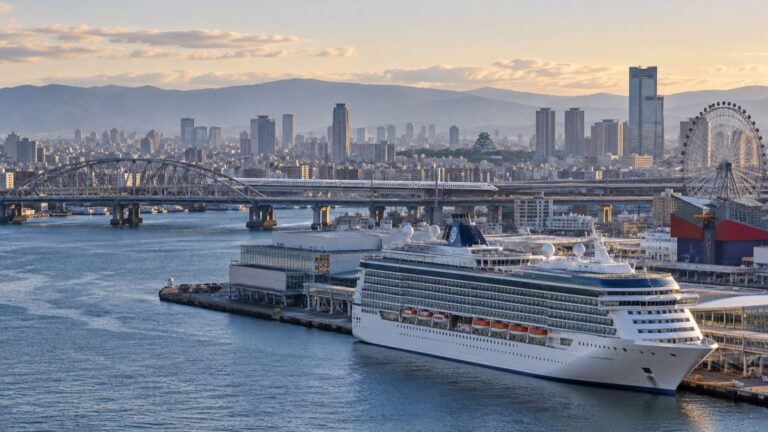
Diving on a Port Day: The No Fly Rule and Which Ports Work
You can absolutely dive on a port day. The question that decides whether you should is not how good the reef is, it is what time your plane leaves on the morning the cruise ends.
My quick take
Diving from a cruise ship is one of the best value things you can do in a port, and it is also the one activity where a scheduling mistake has a medical consequence rather than a financial one. That is why I plan the last dive of a cruise before I plan the first.
The good news is that the fix is arithmetic, not luck. Work backward from your flight home, leave yourself more margin than the published guidance asks for, and the rest of the trip plans itself.
The quick facts
- The constraint: Published guidance asks for a surface interval before flying, and it is measured against your flight, not your ship.
- The threshold: Altitude exposure above roughly 2,000 feet (610 m) counts, which covers essentially every commercial flight.
- Best port: Cozumel, where the dive sites are minutes from the piers and operators run to cruise clocks.
- What you must carry: Your certification card and a recent logbook, because operators do check.
- Not covered here: Anything about your own fitness to dive, which is a conversation for a doctor.
The surface interval principle, in plain terms
Diving loads your body with inert gas, and going to altitude too soon after surfacing lowers the surrounding pressure while that gas is still coming out of solution. The waiting period between your last dive and your flight is there to give the gas time to leave quietly instead of forming bubbles.
The numbers most operators work to come from a long standing consensus, and they are stated as guidelines rather than law. The widely used flying after diving guidance asks for a minimum of 12 hours after a single no-decompression dive and a minimum of 18 hours after multiple dives or several days of diving, with substantially longer after any dive requiring decompression stops.
Read the word minimum carefully, because it is doing a lot of work. The same guidance says plainly that following it reduces risk without guaranteeing anything, and that a longer interval is always the safer version.
Health guidance for travelers frames it the same way and adds the altitude threshold, noting that exposures above about 2,000 feet (610 m) are the ones that matter. I treat all of this as a planning floor, not a target to shave.
Your ship is not the problem, your flight home is
This is the part people get backwards constantly. The ship stays at sea level for the entire cruise, so diving on a Tuesday and sailing on a Tuesday night creates no altitude exposure at all.
The exposure is the airplane you get on after disembarkation. A dive on the last sea day before a Saturday morning flight is a much tighter squeeze than a dive on the first port day of a two week itinerary.
Which means the constraint lands on one specific day: whichever port call is closest to the end of the cruise. Everything earlier in the itinerary is free, and I would spend that freedom rather than saving diving for the end.
The ports where a two tank morning genuinely fits
A two tank morning needs three things to line up. Dive sites close to where the ship ties up, a port call long enough to absorb a delay, and an operator who runs the trip on a timetable rather than on island time.
- Cozumel: The easiest yes in the Caribbean, with reef minutes from the piers.
- Bonaire: Walk off berths in town and sites all along the sheltered leeward coast.
- Grand Cayman: Excellent water and wrecks close in, with a tender ride to factor in.
- Curacao: Reef and a famous shallow wreck within a short drive of Willemstad.
- Roatan and St. Croix: Both work well, and both cost you a drive each way.
- Sharm el-Sheikh: World class Red Sea reef, alongside berthing, and a long flight home to plan around.
Notice what is missing from that list. Plenty of gorgeous ports have diving that is technically possible and practically a bad bet, usually because the sites are an hour away or the call is too short to absorb a single thing going wrong.
Cozumel is the port this whole article exists for
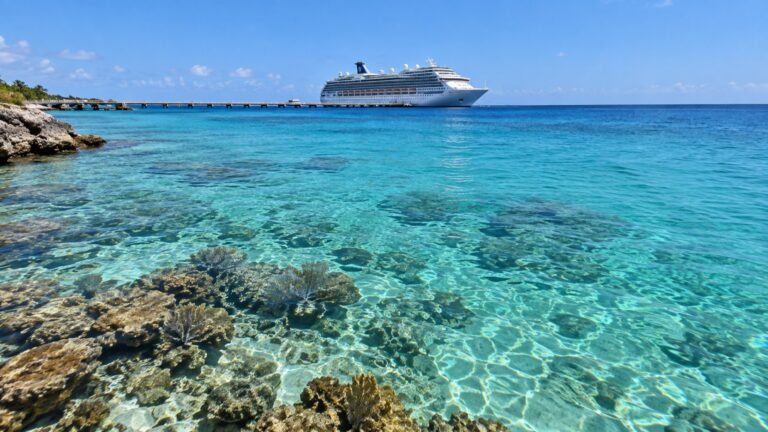
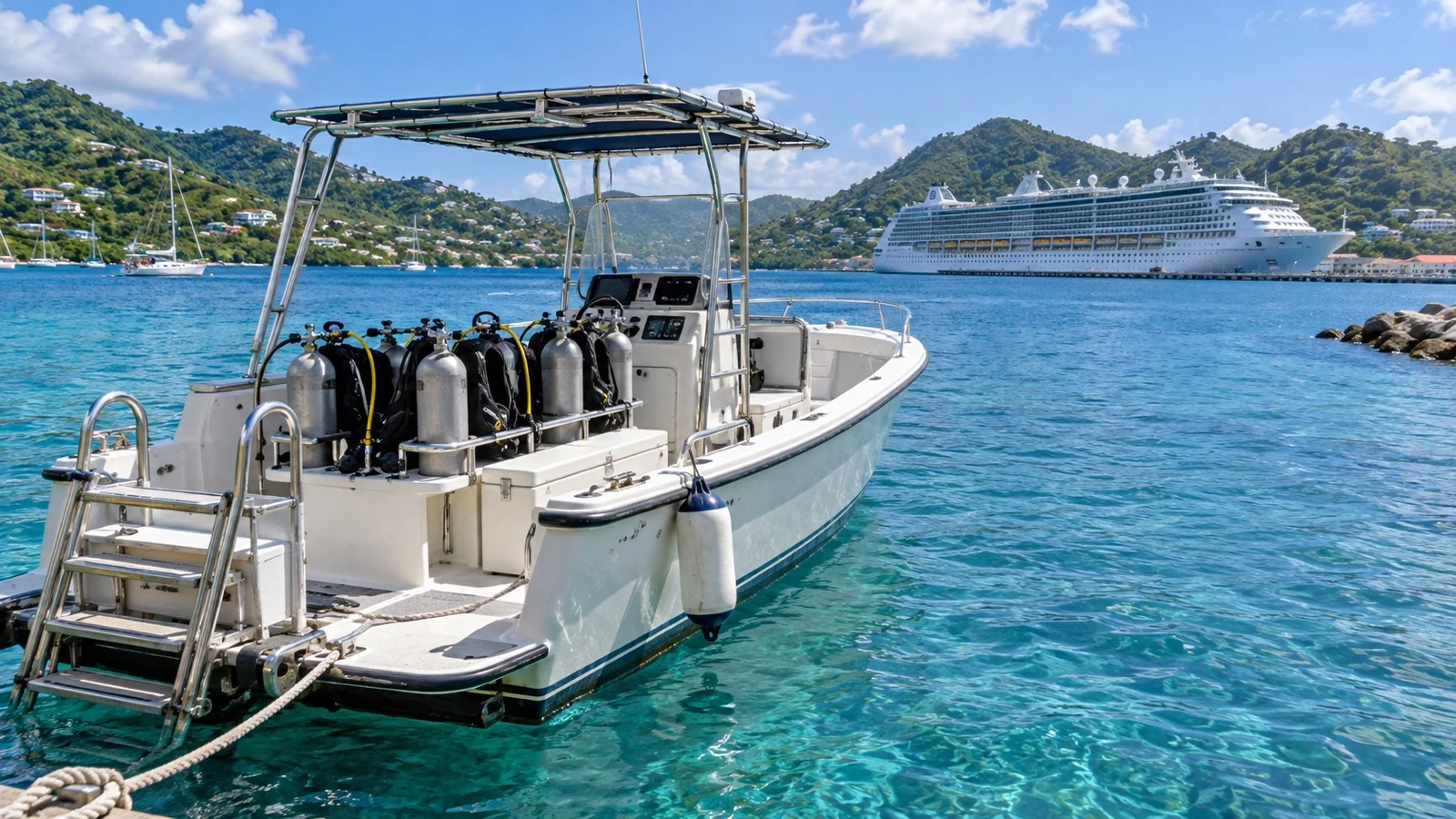
If you only dive once on a cruise, dive here. Ships berth at Puerta Maya, the international pier or Punta Langosta, the reefs run down the sheltered west side of the island, and the boat ride to the good stuff is short by any standard.
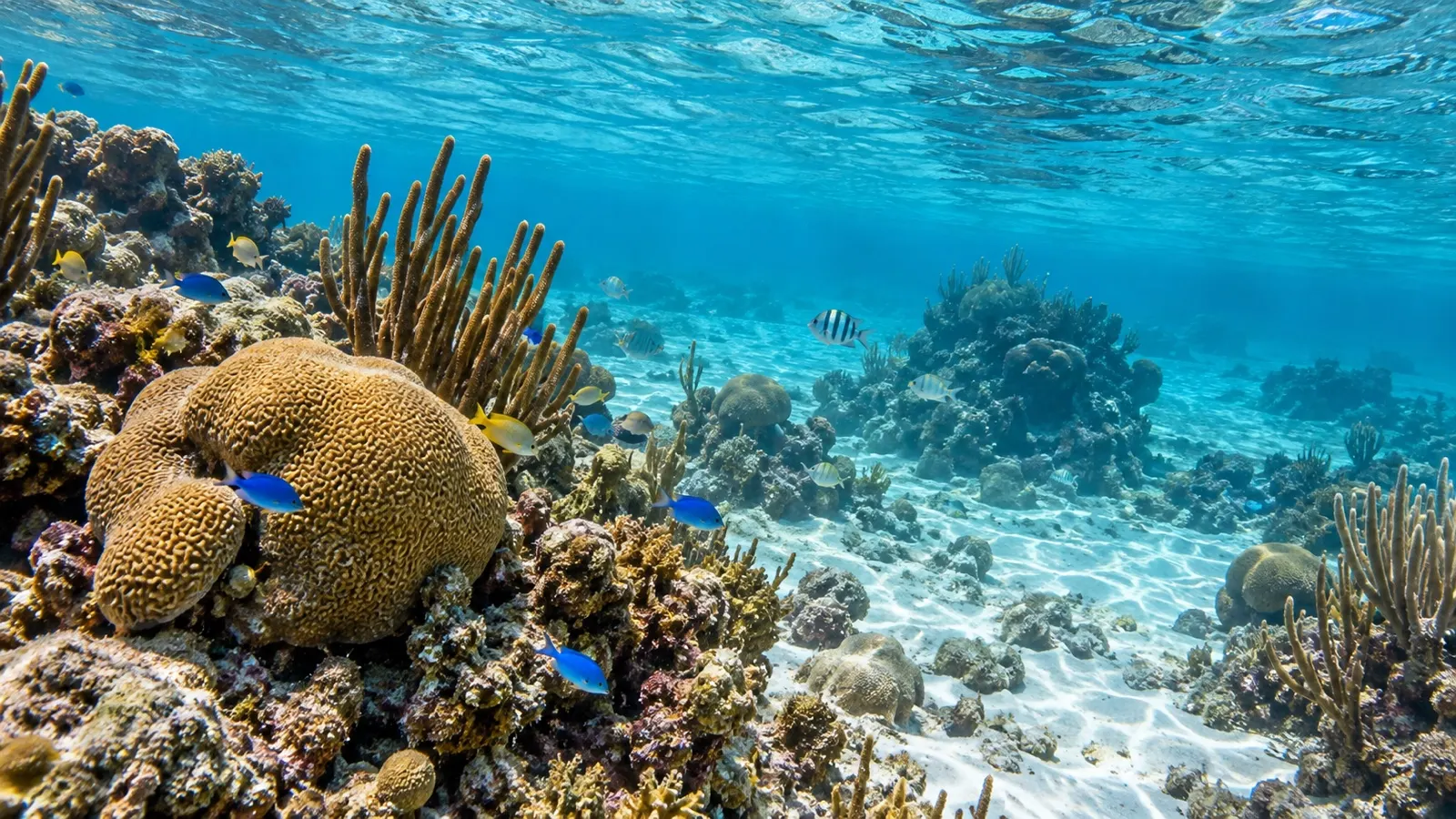
Cozumel diving is drift diving, which surprises people who learned in a quarry. You descend, the current carries you along the wall, and the boat follows your bubbles, which is easy and pleasant once you stop trying to swim against it.
The practical advantage of a Cozumel port day is the sheer density of operators, which means someone is always running a morning trip that ends with hours to spare. If a plan falls apart here you have alternatives, and that is not true in most ports.
Grand Cayman, Bonaire and Curacao
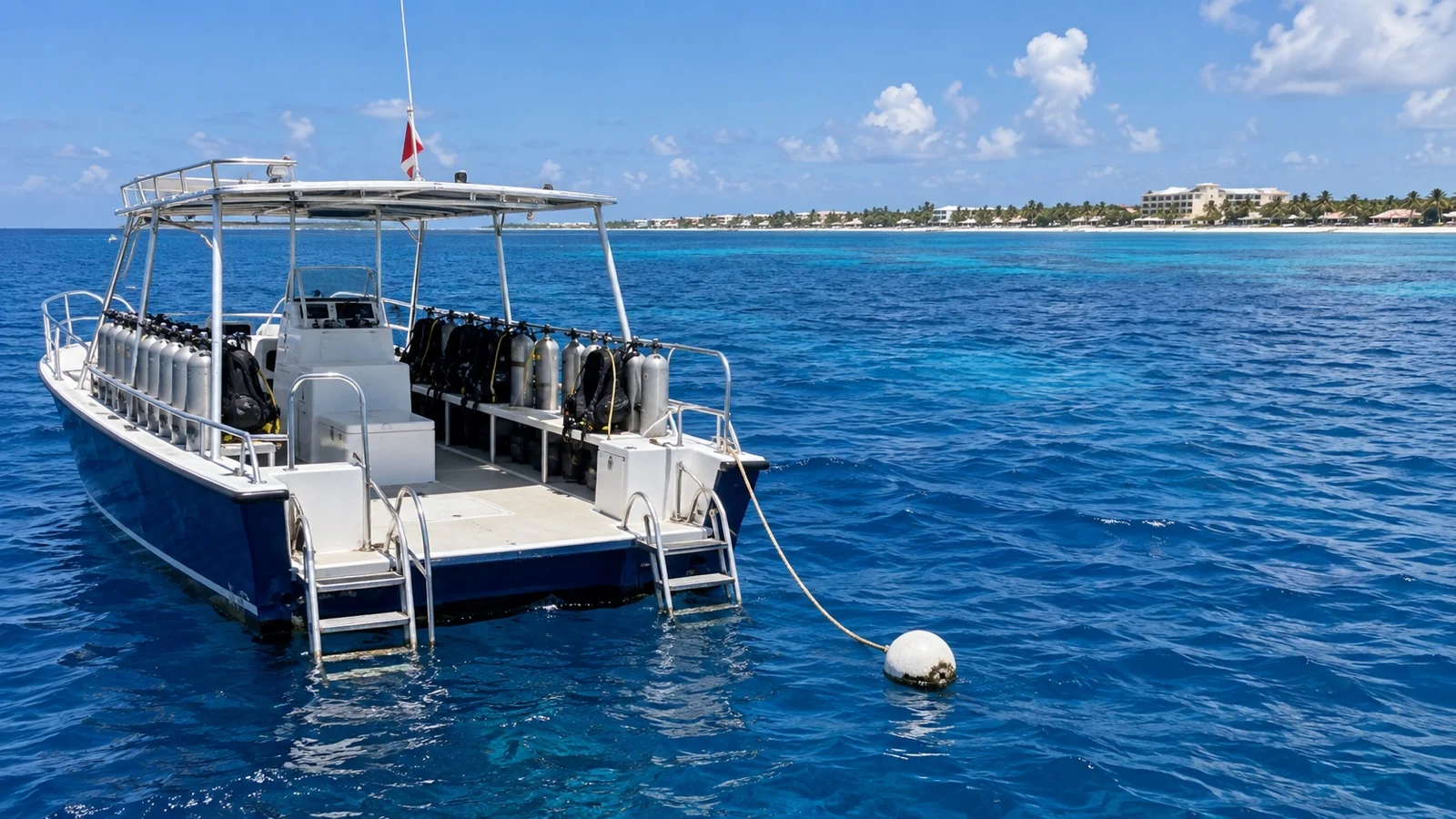
Grand Cayman has some of the clearest water in the region, shallow wrecks and reef within a few minutes of George Town, and roughly half its coastal waters inside published marine park boundaries. The complication is that it is a tender port, so your morning starts with a line and ends with another one, and I build an extra hour into a George Town dive plan that I would not need at a dock.
Bonaire is the opposite in every way that helps. Ships tie up in Kralendijk itself, the reef starts near the shore along most of the leeward coast, and shops will happily run a boat trip or set you up for shore diving instead.
Everyone entering the water in Bonaire pays an annual nature fee, currently 40 dollars per person for the calendar year, and buying it online before you sail saves you a wait in line. The rules across the water in Curacao are looser, and a Willemstad port day gives you reef and a well known shallow wreck within a short drive of the pier.
Roatan, St. Croix and the ports that cost you a drive
Roatan sits on the Mesoamerican Barrier Reef and the diving is superb, but the shops cluster at the west end of the island. From the Mahogany Bay pier that is a real drive on a two lane road, and the return leg is the part I would worry about.
St. Croix has the same shape of problem with a specific twist. The Frederiksted pier is a famous shore dive and diving under it is not permitted while a cruise ship is alongside, which is exactly when you would want to, so a Frederiksted call means operators move you to Butler Bay or the Cane Bay wall instead.
Sharm el-Sheikh and the long flight home
The Red Sea is the strongest reef diving most cruisers will ever have on an itinerary, and ships berth alongside at Sharm el Maya rather than tendering. Certification cards are checked properly and marine park rules are enforced, which is a good sign rather than a hassle.
The catch is what happens at the end of the cruise. A Sharm el-Sheikh port day often sits on an itinerary that ends with a long haul flight home, and long haul usually means an earlier departure and a connection, which eats the interval faster than a domestic hop would.
Finding an operator who understands cruise timing
Dive shops in cruise ports fall into two camps, and the difference shows up in the first email. One asks which ship you are on and what time all aboard is, the other asks what time you want to go.
Book the first one. An operator who tracks ship schedules will put you on the early boat, pick sites close to port on a tight call, and tell you honestly when a two tank trip does not fit your window.
Ask three questions before you pay. What time are we back at the dock, what happens if the ship is late arriving, and how many other cruise passengers are on the boat, because a boat of ship people leaves when the ship people need it to.
Counting backward from your flight, not from your last dive
Start with your boarding time, not your departure time, and subtract the guideline interval from the moment you surfaced on the final dive of the day. Then compare that against the ship’s arrival, because disembarkation adds its own delay and the clearance process is not under the cruise line’s control.
If the answer is close, move the dive rather than the flight. Ports repeat on most itineraries and flights do not, and I have never regretted diving earlier in a cruise.
Airplanes are not the only altitude on the itinerary
The threshold that matters is a low one, and plenty of shore excursions cross it without anybody calling it altitude. A mountain road, a cable car, a rainforest tram or a flightseeing add on can all put you well above the level where the guidance applies.
This catches people on itineraries that mix water and mountains. If you are diving in one port and taking a gondola or a small plane in the next, the same counting exercise applies between those two days.
Certification cards, logbooks and the refresher question
Bring the physical card or the app version, and bring your logbook if you have one. Reputable operators check certification and many ask when you last dived, which is not gatekeeping, it is the shop deciding which sites are appropriate for you.
If it has been a year or more since your last dive, book a refresher rather than pretending. Most shops offer a short skills session in shallow water first, and doing that on the boat with a drift dive about to start is nobody’s idea of a good time.
Uncertified travelers can usually do an introductory dive under direct supervision. It is shallow, it is guided closely, and it still counts as a dive for the purposes of everything above, which people forget.
Ship excursion or book it yourself
The ship’s dive excursion costs more and buys you one specific thing, which is that the ship waits if the excursion runs late. On a tight call in a port where the sites are a drive away, that guarantee is worth the markup.
In a port like Cozumel or Bonaire, where the sites are close and the operators are plentiful, I would book direct and keep the difference. My general framework for choosing between a ship excursion and an independent operator applies here with one extra weight on the safety side of the scale.
Whichever way you go, check that your travel insurance actually covers recreational diving. Plenty of policies exclude it or cap the depth, and the time to discover that is not from a hyperbaric chamber.
What I would not do
I would not dive on the last port day of a cruise that ends with a morning flight. I would not book an afternoon two tank trip on a call that ends at five, and I would not dive at all on a day when I felt rough, dehydrated or short of sleep.
I would also not treat any of this as medical advice, including from me. Guidance about your own body, medications and fitness to dive comes from a doctor, and dive medicine services exist precisely because those questions are individual.
Quick answers
How long after diving can you fly home from a cruise?
The common guidance asks for at least 12 hours after a single no-decompression dive and at least 18 hours after multiple dives or multiple days. Those are minimums that reduce risk rather than remove it, so build in more time than the number suggests.
Does the cruise ship itself count as altitude after a dive?
No, the ship stays at sea level, so sailing away after a dive is not the exposure. The exposure is the flight after disembarkation, or any shore excursion that takes you up a mountain.
Which cruise port is best for a two tank dive?
Cozumel, because the sites sit minutes from the piers and dozens of operators run morning trips built around ship schedules. Bonaire is a close second and Grand Cayman is excellent if you allow for the tender.
Do I need my certification card on a cruise?
Yes, and bring a logbook too. Operators check certification and often ask about recent experience before assigning you to a site.
Can I dive if I have not been in the water for years?
Book a refresher session first and tell the shop honestly how long it has been. A short skills review in shallow water is far better than remembering your buoyancy halfway down a wall.
Final word
Diving is the rare port activity where the schedule is a safety item and not just a convenience. Get the sequencing right and a cruise is a genuinely good way to dive several countries in a week, which is hard to arrange any other way.
So put the dive early in the itinerary, book with a shop that asks about your ship, and leave a bigger gap before the flight than the guidance strictly requires. The reef will still be there on the port day that suits you.
How this guide was researched: Flying after diving guidance, altitude thresholds, port berthing arrangements and marine park fees were checked in October 2026 against published dive medicine consensus, public health guidance and official destination pages. Recommended surface intervals, park fees, operator schedules and airline timings all change, so confirm the current guidance and your own port and flight times before you book a dive. See our Editorial Policy.
More on this topic: browse every guide on shore excursions and DIY port days.