Stromboli and the Strait of Messina: The Night Sail-By Nobody Announces
Somewhere after midnight a red flicker appears off the rail, and the handful of people who came out for air start pointing. That is Stromboli, and nothing in the daily program told you it was coming.
My quick take
I have never stood on a deck for this one, and it is still on my short list of nights worth losing sleep over. A volcano that does something small every few minutes, reliably, is a strange and lovely thing to sail past.
What I would not do is treat it as a guaranteed show. I work out the timing before I sail, set an alarm, and go to bed prepared to see nothing at all.
The quick facts
- Where it is: Stromboli sits in the Aeolian Islands off Sicily’s north coast, and the Strait of Messina is the gap between Sicily and mainland Calabria.
- How often it goes: Small explosions typically come every 10 to 20 minutes, and most of them are modest.
- How narrow: The strait pinches to about 2 miles (3 km) at its northern end.
- When it happens: Most ships make this run in the evening or overnight.
- Which side: Southbound through the strait, Sicily is to starboard and the mainland is to port.
What Stromboli actually is
Stromboli is a volcanic island that rises about 3,030 feet (924 m) above the sea, with a great deal more of it underwater. It is the northeastern corner of the Aeolian chain, and it has been erupting in small bursts, more or less without pause, for over a thousand years.
That persistence is why sailors have called it the lighthouse of the Mediterranean. The glow was a fixed point on a dark sea long before anyone bolted a real light onto a tower.
People live there, which surprises almost everyone the first time they hear it. A few hundred residents are spread across two small villages, both well clear of the active slope, and the ferries from the Aeolian tender port at Lipari keep them supplied.
What continuously active looks like from the rail
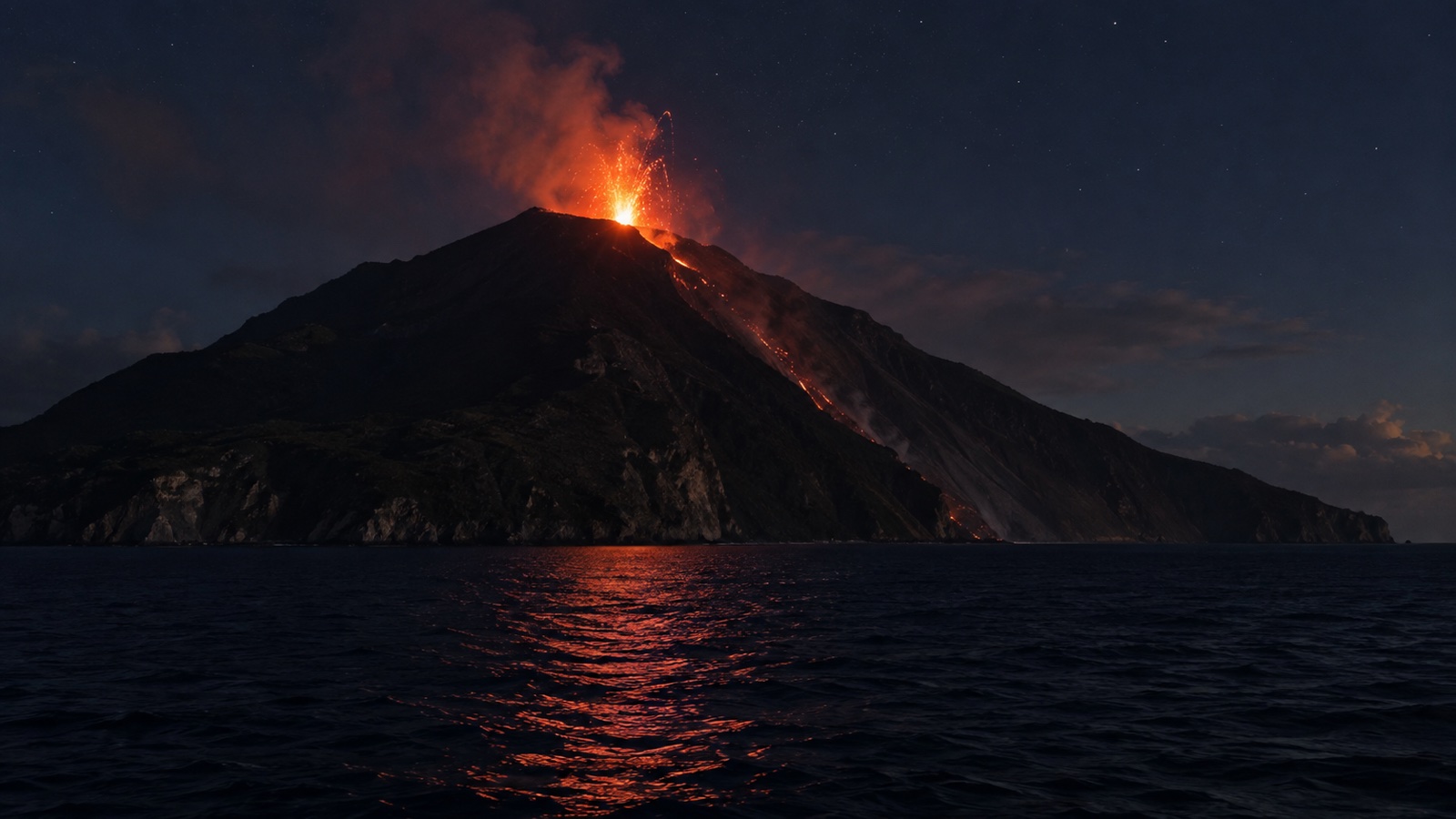
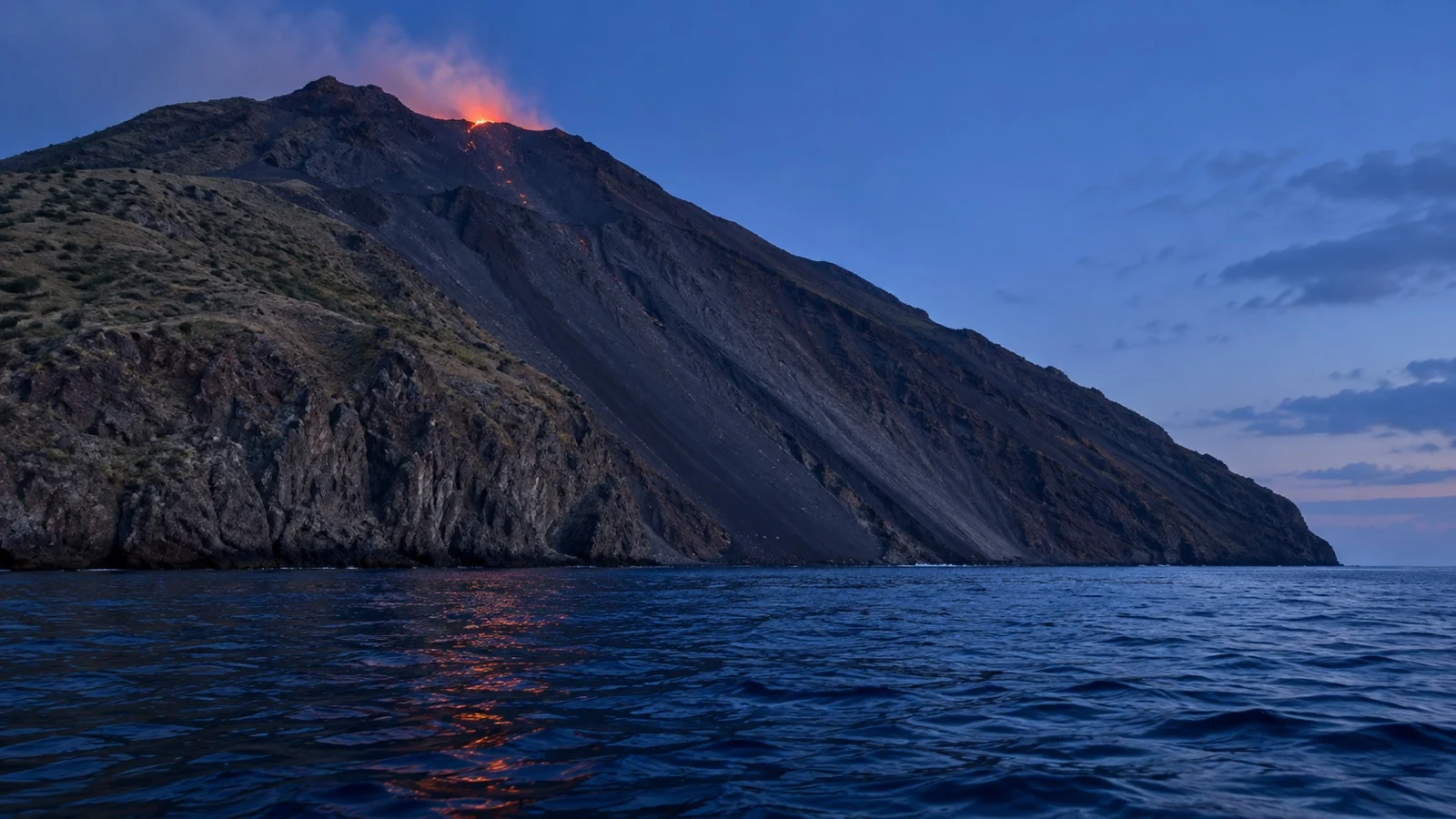
Forget the documentary footage. What a passing ship usually sees is a brief orange flash at the summit, a scatter of glowing fragments thrown a few hundred feet, and then darkness again while you wait for the next one.
The pattern of essentially continuous mild explosions has been logged for more than a millennium, and it is the mildness that makes it watchable. Every so often there is a lava overflow that runs down the slope toward the water, and that is the version people photograph.
In daylight you get much less. A gray steam and ash puff above the summit is often the whole event, which is why the hour of your passage matters more than the volcano’s mood.
The Sciara del Fuoco is the side you want
The northwest flank of the island is not a hillside, it is a scar. The Sciara del Fuoco is a huge collapse scarp that opened more than 5,000 years ago and runs from near the summit straight into the sea.
Everything the craters throw in that direction funnels down it. At night that means you can watch incandescent blocks bouncing and rolling for hundreds of feet, sometimes all the way to the waterline, which reads far better from a distance than a single summit flash.
The slope is watched around the clock by radar, cameras and seismic instruments, because slope failures here can push water. That is the unglamorous reason ships treat the island with a bit of respect rather than parking next to it.
Which itineraries actually pass it
This is not a marketed sea day, so it never appears as a bullet in the brochure. It happens because of where the sea lanes go.
- Rome to Naples to Sicily: The classic western Mediterranean loop, running south from the Naples cruise terminal toward Sicily overnight.
- Adriatic repositioning: Ships moving from the Adriatic to the western Mediterranean round the toe of Italy and come up through the strait.
- Naples to Greece: Southbound to the Ionian Sea, which puts the strait in the middle of the night more often than not.
- Sicily calls: Anything arriving at the Messina cruise berth from the north has to come through the strait to get there.
Be honest with yourself about the odds. A ship calling at Catania on Sicily’s east coast after a Naples day is a strong candidate, while a routing that swings west around Sardinia will not go anywhere near Stromboli.
Slowing down for a closer look is the captain’s call
When activity is visible and conditions allow, ships do sometimes ease back or shift the track a little to give the island a better showing. I have seen enough accounts of it to believe it is a real habit rather than a rumor.
What it is not is a scheduled event. There is no time printed in the daily program, no guarantee, and no compensation if the ship holds its course and speed because the schedule is tight or the sea is up.
Treat any announcement as a bonus. If one comes over the PA at 1am, someone on the bridge decided the view was worth waking you for, and that decision belongs entirely to them.
How to work out when your ship will pass
You can get within an hour or so with a map and some arithmetic. This is the part I actually enjoy doing over a drink the night before.
- Start with all-aboard: Take the departure time from your last port, not the posted sailaway, and add roughly half an hour to clear the harbor.
- Measure the water: Naples to the northern mouth of the strait is roughly 200 miles (325 km) by sea, and Stromboli sits about three quarters of the way along that line.
- Assume a cruising speed: Most big ships settle around 18 to 20 knots overnight, which is about 21 to 23 mph (33 to 37 km/h).
- Divide, then pad: That gives roughly 7 hours from Naples to Stromboli and about 10 to the strait, so a 6pm departure puts the island near 1am.
Then sanity check it against arrival time. If the ship is due alongside in Sicily at 7am, it is not going to be dawdling past a volcano at 4am, and your window is earlier than you think.
The strait is narrower than the photos suggest
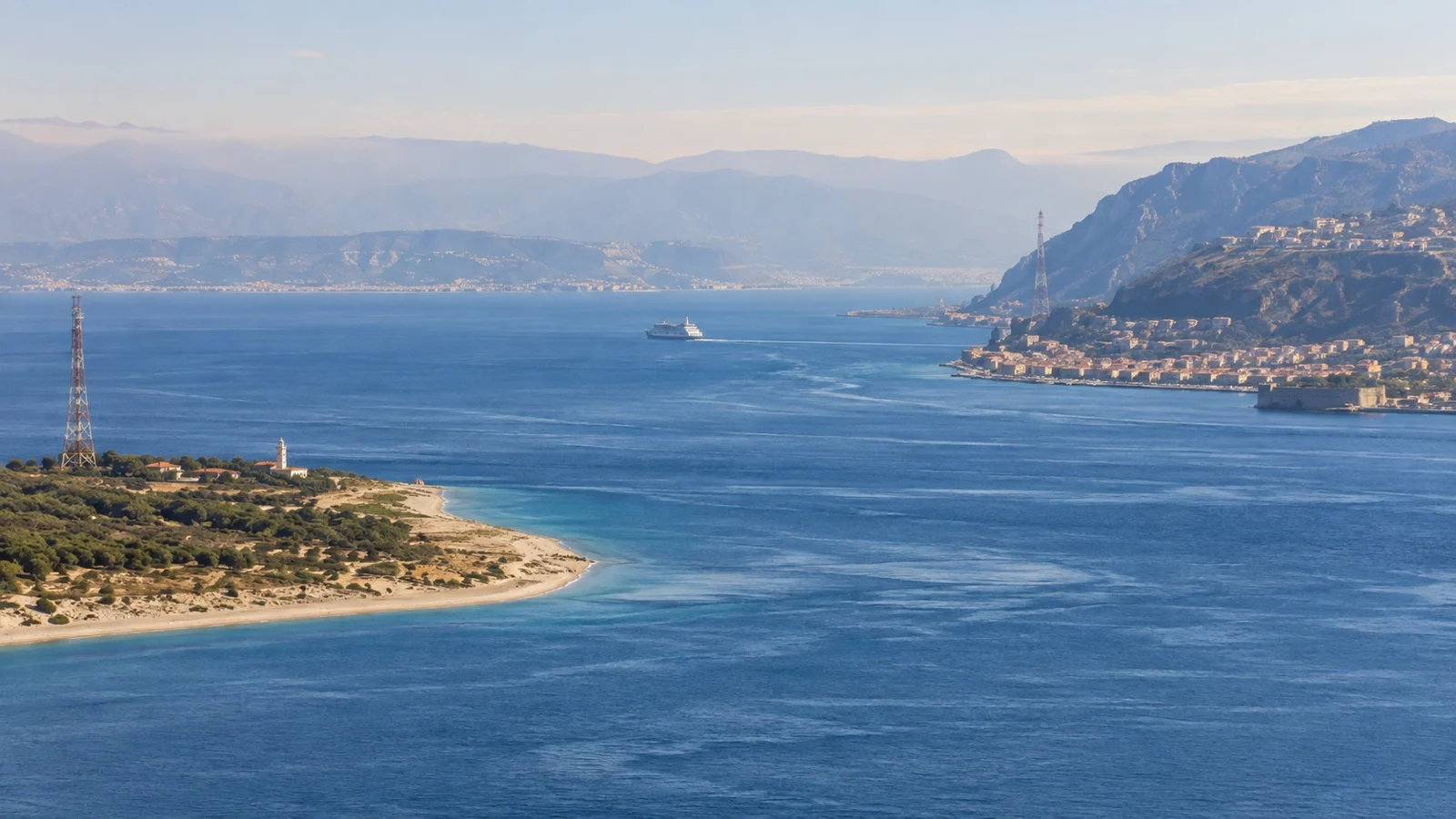
The Strait of Messina runs about 20 miles (32 km) from end to end and squeezes down to roughly 2 miles (3 km) at its northern neck. It is also shallow up there by open sea standards, around 300 feet (90 m).
From a top deck that reads as a corridor rather than a channel. You get land close on both sides, headlights moving on coast roads, and the odd sense that a very large ship is threading something it should not fit through.
There is also constant cross traffic. Vehicle and rail ferries shuttle between Sicily and the mainland all day and much of the night, and watching them cut across the bow is half the entertainment.
Scylla and Charybdis were basically a current report
Two bodies of water with different levels and temperatures meet in that neck, and the tide pushes them back and forth. The dominant flow reverses roughly every six hours, and where it runs hardest it throws up eddies, boils and standing rips on the surface.
That is the whole origin of the monsters. Scylla was the rocky Calabrian shore that wrecked you if you hugged it, and Charybdis was the swirling water near the Sicilian point that got you if you did not.
Modern ships are not remotely troubled by it, so do not expect drama. What you may see, if you look straight down over the side in daylight, is water that is visibly doing something odd for no reason you can point at.
What you can actually see from the deck
The Calabrian side gives you steep green hills with villages stacked up them, and at night a long scatter of lights that goes on for miles. Reggio Calabria sits near the southern end and is the biggest thing on that shore.
The Sicilian side gives you Messina itself, a working port city with a curved sickle of a harbor. Guarding the entrance is a gilded statue on a column about 200 feet (60 m) high, lit at night and visible well before you can make out anything else in the port.
If you are actually calling at Messina rather than passing, the city has more going on than most people give it credit for. If you are only transiting, the statue and the ferries are the two things you will remember.
Etna sits behind Sicily, and the plume arrives first
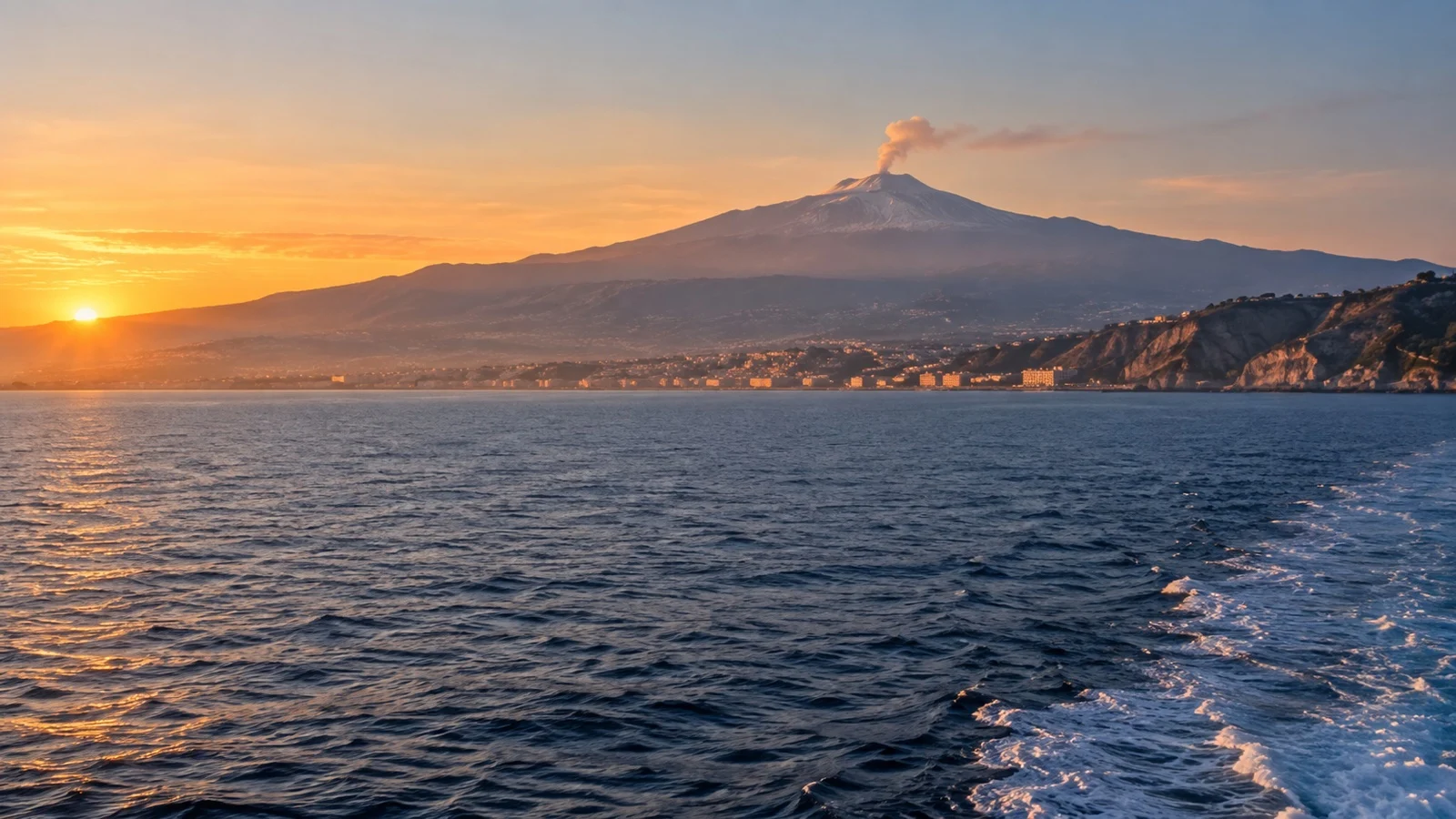
Etna is around 11,000 feet (3,350 m) and stands well south of Messina, which puts it behind the Sicilian shoulder of the strait. On a clear day the summit clears everything in front of it and you can pick it out from a long way offshore.
What you usually notice first is not the mountain but the plume. It is almost continuously erupting from its summit craters, and a thin white or gray drift downwind is often the first sign that the smudge on the horizon is the volcano and not weather.
Haze beats you more often than cloud does. Summer afternoons in the Ionian can be milky enough to hide a mountain that size completely, which is why the same view can be spectacular one week and blank the next.
Which side of the ship to stand on
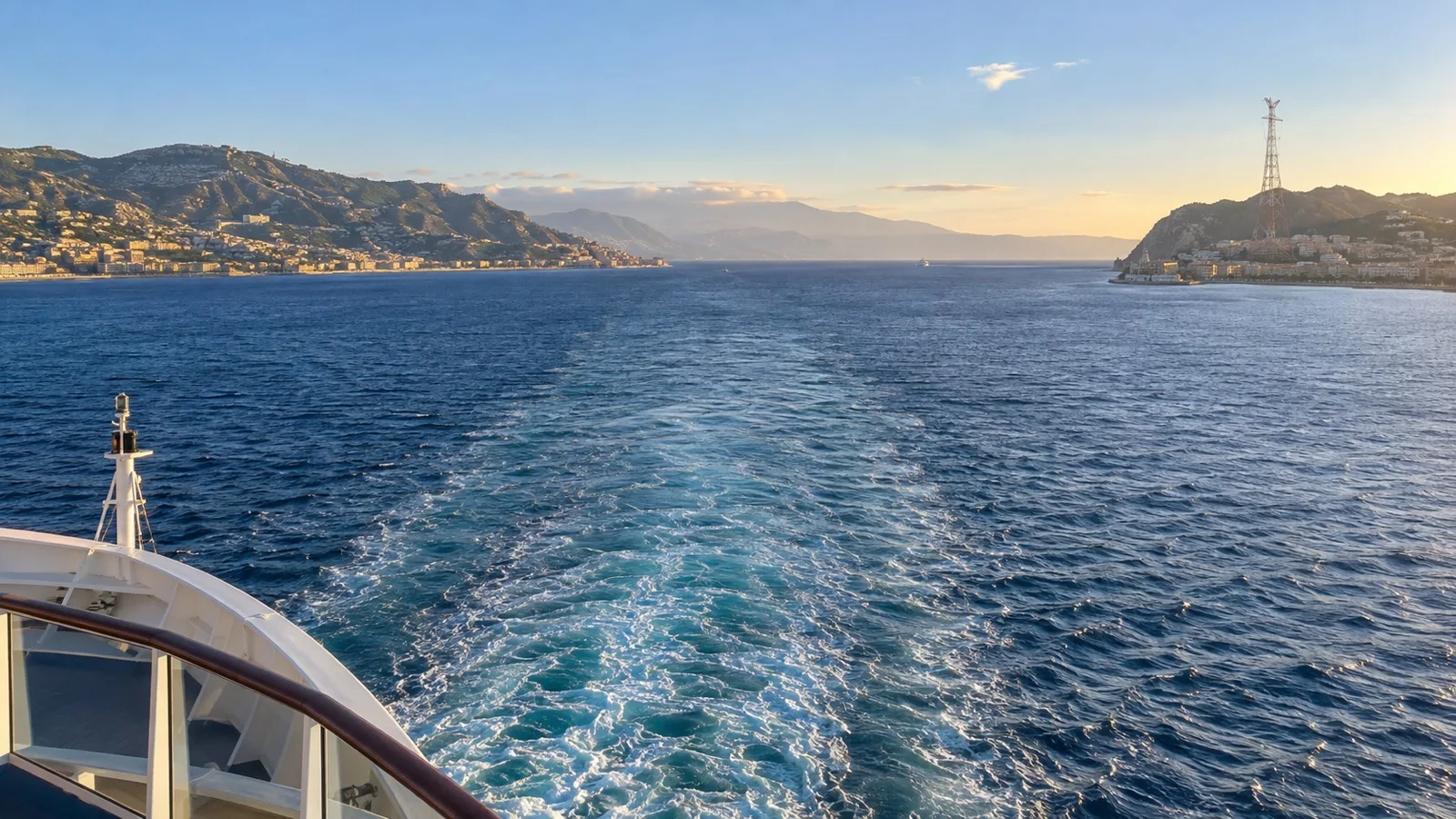
The strait is the easy one because it runs north to south with Sicily on the west side. Heading south, Sicily, Messina, the statue and eventually Etna are all to starboard, and the Calabrian mainland is to port.
Northbound out of the Ionian, flip all of that. Sicily is to port, the mainland is to starboard, and Etna is behind you over the port quarter as you come up the channel.
Stromboli is the one I would not commit to in advance. Many southbound tracks from Naples pass east of the island, which puts it to starboard, but a ship going out of its way to show off the northwest slope has to run up that side and the island ends up to port.
So do not camp out. Find an open deck with access to both rails, because the walk across takes thirty seconds and being on the wrong balcony takes the whole night.
Photographing a volcano in the dark from a moving ship
This is genuinely hard, and I would rather you knew that before you spend an hour failing at it. The ship is moving, the subject is dim, and the flash lasts a second or two.
- Keep the shutter short: Anything slower than about 1/60 turns the glow into a smear, so push the ISO up to 3200 or higher instead.
- Skip the tripod: It transmits engine vibration straight into the camera, and bracing your elbows on a rail beats it every time.
- Turn off phone night mode: It stacks long exposures and assumes you are standing still, which you are not.
- Find a dark spot: Deck lighting and lit windows will fog every frame, so get away from both and never shoot through glass.
- Shoot bursts: Fire a short run at each flash and sort it out later, because you cannot time an eruption by reflex.
Manual focus set to infinity saves you the most grief. Autofocus hunts endlessly on a black sea and will miss the one good burst of the night while it thinks about it.
What I would actually do with the night
I would work out my estimated time the afternoon before, set an alarm for twenty minutes ahead of it, and lay out a jacket. Even in July the wind over an open deck at 20 knots is colder than the day led you to believe.
Then I would give it forty-five minutes and go back to bed without sulking if nothing appears. The margin of error on a homemade estimate is real, and so is the chance the summit is simply in cloud.
If you want the more dependable version of a slow scenic transit, this is not it. A booked passage like a small ship transit of the Corinth Canal is scheduled, announced and hard to miss, and that is exactly what this passage is not.
Quick answers
Can you see Stromboli erupting from a cruise ship?
Often, yes, if you pass at night and the summit is clear. Expect brief orange flashes every ten to twenty minutes rather than a continuous fountain of lava.
Do ships announce the Stromboli sail-by?
Sometimes, and only when the bridge decides the view is worth it. It is never printed in the daily program, so plan as though no announcement is coming.
What time do cruise ships go through the Strait of Messina?
Most often in the evening or the small hours, because the passage falls between an afternoon departure and a morning arrival. Estimate it from your departure time, the sea distance and a cruising speed of about 20 knots.
Which side of the ship is best for the Strait of Messina?
Starboard if you are heading south, since that is the Sicilian side with Messina and Etna. Port if you are heading north toward Naples or Rome.
Can you see Mount Etna from the water?
On a clear day you can see it from a long way out, usually spotting the plume before the mountain. Summer haze hides it completely more often than most people expect.
Final word
This is the rare bit of cruising that nobody sells you and nobody owes you. The ship is going through anyway, the volcano is doing what it always does, and the only variable you control is whether you are awake.
Do the arithmetic, set the alarm, and accept that some nights you get a black horizon and a cold neck. The nights you do not are the ones people are still describing at breakfast three days later, and the whole thing costs you nothing but sleep.
How this guide was researched: Volcanic activity patterns at Stromboli and Etna, the dimensions and currents of the Strait of Messina, and the landmarks visible from a transit were all checked against official monitoring and reference material in September 2026. Ship routings, timings, speeds and whether a captain slows for a closer look change constantly, so confirm the details against your own itinerary before you set an alarm. See our Editorial Policy.
More on this topic: browse every guide on expedition and alternative cruises.