Booking Direct vs Travel Agent vs Warehouse Club for Cruises
For most simple cruises, book through the channel that gives you the best total value and support you will actually use. For a complicated trip, a skilled cruise specialist usually beats a bigger gift card.
Direct booking gives you the most control, a traditional travel advisor can add expertise and advocacy, and a warehouse club can offer a strong post-trip reward. None wins every time, and the base fare is not guaranteed to be identical across all three.
The verdict up front
- Book direct: Best for experienced cruisers who know the exact line, ship, cabin, and fare they want and prefer to control changes themselves.
- Use a full-service travel advisor: Best for first cruises, expensive sailings, groups, suites, back-to-backs, accessible needs, complicated flights, and itineraries with difficult recovery.
- Use a warehouse club: Best for a straightforward cruise when its written reward outweighs any service limitations and you are comfortable working through a call center.
Price all three from the same screen on the same day, using the same cabin, fare code, guest mix, taxes, fees, and refundable terms. A comparison built from different promotions is confetti, not math.

What changes with the booking channel
The ship, itinerary, cabin, dining, and onboard operation come from the cruise line no matter who sells the reservation. Your booking channel changes the price package around that cruise and who controls most reservation changes.
The meaningful differences are:
- The final fare and fare rules
- Onboard credit, gift cards, rebates, or agency amenities
- Planning advice and cabin selection
- Service hours and response time
- Who can reprice, change, or cancel the booking
- Separate agency service or cancellation fees
- Help when flights or the itinerary go sideways
Your loyalty number and eligible cruise-line benefits should follow the guest, not disappear because an advisor made the booking. Confirm that the number appears on the reservation and that the fare itself qualifies for the benefits you expect.
Is the cruise fare really the same?
Often, but not always. Cruise lines publish widely available fares, while agencies may also have group space, consortium amenities, rebated commission, or promotions that change the price or extras.
A lower quote can also carry a less flexible deposit, different cancellation terms, reduced onboard credit, or a guarantee cabin instead of the exact room you priced. Compare the booking confirmation, not the headline number.
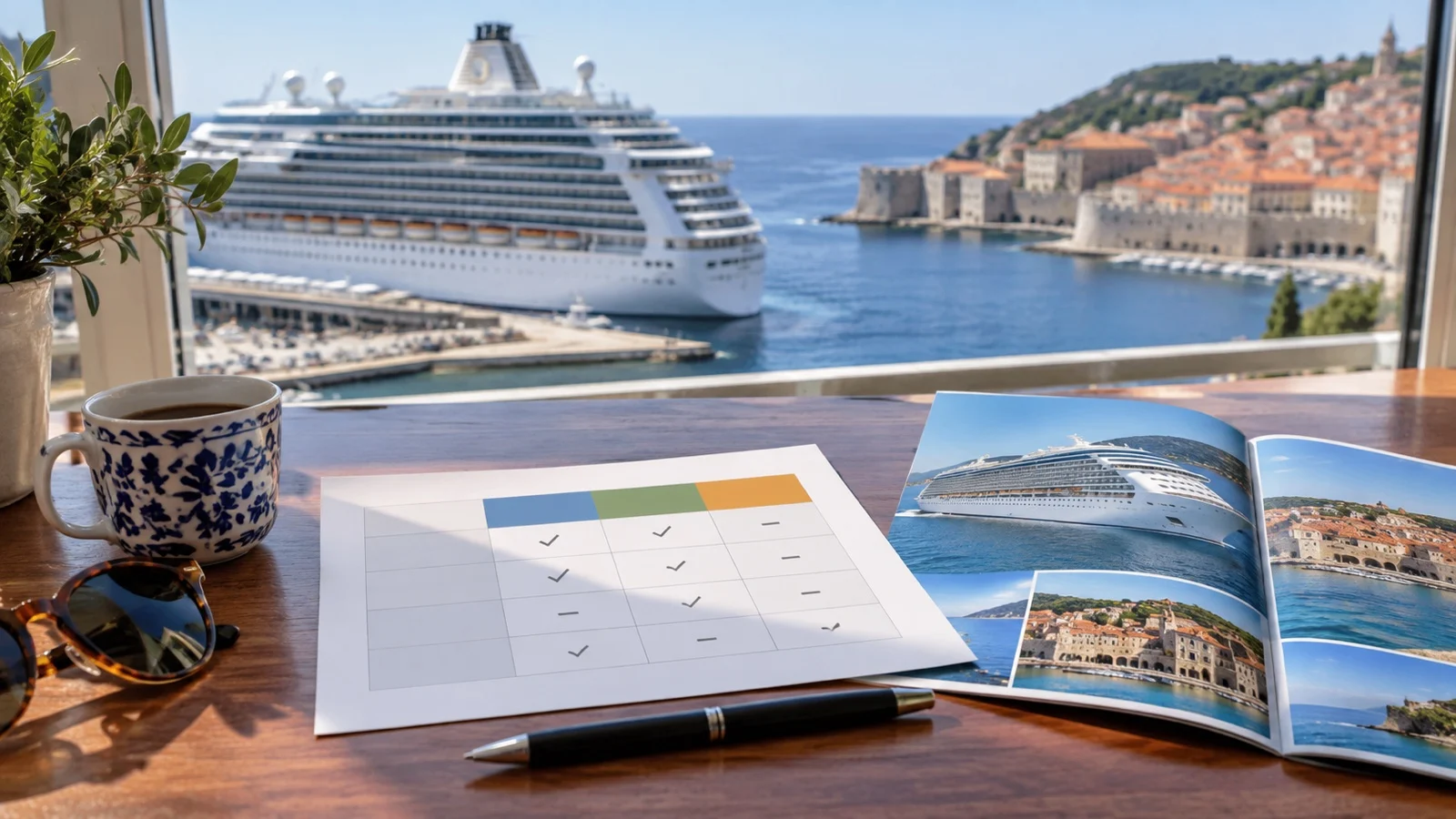
Use this same-trip checklist for every quote:
- Same ship, sailing date, cabin number or guarantee status
- Same fare name, deposit type, and refundability
- Same guest ages, residency, loyalty status, and eligibility
- Same taxes, required fees, and port expenses
- Same drinks, Wi-Fi, gratuities, dining, and other inclusions
- Every onboard credit, gift card, rebate, and agency fee
Do not assign full cash value to an extra you would not buy. A $300 drinks package is not worth $300 to someone who wanted tap water and coffee.
Booking direct with the cruise line
Direct booking gives you a clean relationship with the cruise line. You can call or use the line’s online tools without asking an outside agency to make the reservation change.
Direct-booking advantages
- You control repricing, cabin changes, payments, and cancellation requests.
- The line can see and service its own reservation without an agency handoff.
- Online account tools may make simple changes faster.
- A line-employed cruise consultant can become a named contact for loyal guests.
Direct-booking drawbacks
- You may give up an agency amenity or warehouse reward.
- The representative sells only that cruise line and is not an independent comparison shopper.
- You must watch price changes and fare deadlines yourself.
- You remain the project manager when flights, hotels, and the cruise sit on separate reservations.
Direct is a strong choice when you already know the line and the trip has few moving parts. It is less attractive when you need someone to compare competing ships or coordinate several households.
Booking with a travel advisor

A good advisor can compare lines, explain cabin tradeoffs, coordinate groups, track deadlines, and handle approved changes. CLIA’s 2026 industry report says 63% of respondents who had cruised in the previous 12 months used a travel advisor to book.
Many advisors receive commission from the supplier, but “free” is too simple. Some charge planning, change, or cancellation fees, and those fees should appear in writing before you deposit.
What a strong advisor adds
- A named person who knows the trip and the travelers
- Independent comparison across cruise lines, if the advisor sells broadly
- Experience with cabin locations, fare rules, dining, and accessibility
- Group coordination, payment reminders, and linked reservations
- Agency or consortium amenities that may stack with the cruise-line offer
- Help communicating with suppliers when a covered change is needed
An advisor is not automatically available around the clock, cannot override a cruise contract, and is not a substitute for travel insurance. The value depends on the actual person and agency support system, not the label on the business card.
Interview the advisor before handing over the reservation. Ask which lines they book most, their business hours, backup coverage, fee schedule, price-drop process, and what happens during an after-hours travel disruption.
Booking through a warehouse club
A warehouse club is still acting as a travel agency, but usually with centralized service rather than one dedicated cruise specialist. Its headline advantage is often a member reward tied to the completed trip.
Costco Travel is the best-known American example, and its current terms make the tradeoffs unusually clear. An applicable reward appears in the Included Extras section of the invoice.
When applicable, Costco says the Digital Costco Shop Card is emailed about 10 days after the cruise begins and is limited to one offer per room. It is not redeemable for cash except where law requires, cannot be used at Costco gas stations, car washes, or food court kiosks, and cannot be applied to a future cruise purchase.
That card is a post-trip shopping benefit, not onboard credit. Keep it separate from any refundable or nonrefundable onboard credit listed on the cruise reservation.
Costco also says cruise changes may trigger supplier fees, and rate reductions generally stop once penalties begin or the cruise is paid in full unless the cruise line allows an exception. A price change can also change the Shop Card amount.
Warehouse booking makes the most sense when the reward is valuable to you and the trip is simple enough for call-center servicing. It makes less sense when you need one person to learn a complicated family, accessibility, air, or group file.

Who controls an agency booking?
When a traditional advisor or warehouse club owns the reservation, important cruise changes generally go back through that seller. The cruise line may still answer questions and allow some online purchases, but it can restrict who changes the core booking.
Royal Caribbean’s reservation guidance gives a useful official example. Guests who booked through a travel advisor are directed back to that advisor for adding guests or updating a group reservation, while some bed changes remain available online or by phone.
This makes service hours a practical part of the price. A $250 perk feels smaller when a short-lived cabin or promotion appears after the agency has closed.
Ask exactly which actions you can complete online, which require the agency, and who covers the file when your advisor is unavailable. Get the emergency number before departure, not while staring at a canceled flight.
Price drops and repricing
No booking channel should be assumed to monitor fares automatically. Some individual advisors do it as a service, while direct and warehouse customers usually need to notice the change and request a review.
Royal Caribbean’s current Best Price Guarantee allows an eligible request before final payment or within 24 hours of booking. The match must be for the same cruise, date, and room type, is not available in every country or on every reservation, and agency customers submit through their travel partner.
A lower fare can require moving to new promotion terms and surrendering onboard credit, a cabin assignment, deposit flexibility, or another inclusion. Ask for the new all-in value before anyone touches the booking.
The article previously treated Carnival’s Early Saver rules as a current universal example, but Carnival’s posted terms currently say that offer applies to sailings through April 2026. For a new booking, use the exact fare rules displayed for that sailing instead of relying on an expired date range.
Your final-payment and penalty dates are the natural reminders for fare checks. My cruise fare timeline explains why a price drop before penalties can behave differently from one after them.
Can a direct booking be transferred to an advisor?
Some cruise lines allow a recent direct reservation to move to a travel agency, but the window and eligibility rules vary. A paid-in-full booking, group reservation, casino offer, or old booking may be excluded.
Ask the cruise line for its current transfer form and deadline before assuming the option exists. Then confirm the advisor will accept the reservation and which amenity, if any, will apply after transfer.
Once an eligible transfer is complete, the agency normally becomes the servicing channel. Do not transfer for a small perk unless you are comfortable routing future changes through that agency.

When travel disruption changes the answer
A missed embarkation, canceled flight, or medical problem does not magically become someone else’s financial responsibility because an advisor made the booking. Airlines, cruise lines, insurers, credit-card benefits, and agencies each control different pieces.
A capable advisor may help find flights, hotels, supplier contacts, and possible ways to rejoin the ship. That is assistance, not a guarantee that the ship will wait, the line will approve reboarding, or anybody else will pay.
Call the cruise line or port emergency contact immediately if embarkation is at risk, then contact the airline, insurer, and booking agency as relevant. Keep receipts and written notices because reimbursement follows policy language, not panic.
A round-trip sailing from a nearby Florida port has fewer moving parts than a world cruise segment or a one-way repositioning cruise. The guide to round-trip versus one-way cruise costs covers the air and hotel side of that choice.
For a complex itinerary, buy the quality of the advisor’s disruption plan instead of assuming every agency provides one. For a simple cruise, a warehouse reward or direct control may be worth more.
How to vet a travel advisor or warehouse seller
A pleasant sales call is not enough. The best questions expose how the relationship works after the deposit.
- Who owns my file? Ask whether you have a named advisor or whichever agent answers next.
- What are the service hours? Get ordinary, weekend, and emergency contact details.
- What fees do you charge? Include planning, changes, cancellation, group work, and air ticketing.
- Do you monitor prices? Ask whether it is automatic, on request, or entirely your job.
- Which promotions can stack? Have the cruise-line offer, agency amenity, and any restrictions written on the invoice.
- How do you handle accessibility? Ask who documents equipment, cabin features, dietary needs, and assistance requests.
- What happens after hours? Ask for a real disruption process, not a promise to “take care of everything.”
A first-time cruiser may get more value from careful cabin and fare advice than from a small credit. Pair that conversation with the guide to easy ports for first-time cruisers.
Mistakes that cost more than the perk
- Comparing different fare types: A nonrefundable deposit is not the same product as a flexible fare.
- Counting unusable extras at face value: Value a reward by what it replaces in your real budget.
- Assuming every advisor monitors prices: Put the service promise in writing or set your own reminders.
- Ignoring agency fees: A cancellation fee can erase the onboard credit that won the booking.
- Expecting the cruise line to bypass the agency: Know who can touch the reservation before an urgent change.
- Believing an advisor replaces insurance: Helpful phone calls do not create coverage for nonrefundable losses.
- Trusting a verbal amenity: Guest Services needs a documented credit, not the story of a lovely sales call.
Which channel should you choose?
Choose direct when
You know the exact product, want immediate control, and are willing to track fare changes and deadlines. Direct is especially tidy for a repeat sailing on a familiar line with self-booked local travel.
Choose a travel advisor when
The cruise is expensive, unusual, or connected to complex flights, hotels, transfers, or multiple cabins. It is also the strongest option when you need thoughtful accessibility or multigenerational planning.
Choose a warehouse club when
The cruise is straightforward, the written reward is substantial, and centralized phone support suits you. Read the reward and change terms first, then save the invoice.
Quick answers
Is booking direct always cheaper?
No. Public fares are often similar, but group space, agency promotions, amenities, and fare rules can produce different total values.
Does a travel advisor cost extra?
Many are paid commission by the supplier, but some charge their own planning, change, or cancellation fees. Ask for the complete fee schedule before depositing.
Can the cruise line change an agency booking?
It may answer questions or handle limited items, but core reservation changes commonly go through the agency that owns the file. The exact division varies by line and request.
Is a Costco Shop Card the same as onboard credit?
No. It is a post-trip Costco benefit with its own restrictions, while onboard credit lives on the shipboard account.
Who gets me a price drop?
The person or agency servicing the reservation must request any eligible change under the current fare rules. Do not assume the line, advisor, or warehouse club is watching automatically.
What matters more than onboard credit?
For a complex trip, responsive support and correct fare advice can protect far more value than a small amenity. For a simple trip, direct control or a warehouse reward may win.
The last word
Choose the booking channel by total value, reservation control, and the difficulty of recovering when plans fail. The cheapest-looking quote can become expensive if its fare rules or service model do not fit the trip.
Get every perk and fee in writing, save the confirmation, and calendar the payment and penalty dates. Then move on to the enjoyable decision of which port deserves your excursion budget.
How this guide was researched: This guide uses current official cruise-line, retailer, and trade-association sources, including Costco Travel’s terms, Royal Caribbean’s reservation and price-guarantee guidance, Carnival’s published Early Saver terms, and CLIA’s 2026 State of the Cruise Industry report. No first-hand booking or disruption is claimed.
Time-sensitive details were reviewed in September 2026. Fare rules, rewards, deadlines, and agency policies change, so save the terms attached to your actual quote.
See our Editorial Policy.
More on this topic: browse every guide on choosing a cruise.