Passports, Closed-Loop Cruises and the Birth Certificate Rule
A US closed-loop cruise can qualify for a passport exception, but that does not make a birth certificate acceptable on every round trip. Your citizenship, age, itinerary, destinations, and cruise line’s rules all matter.
The rules themselves are not complicated. What they are is narrow.
The short answer
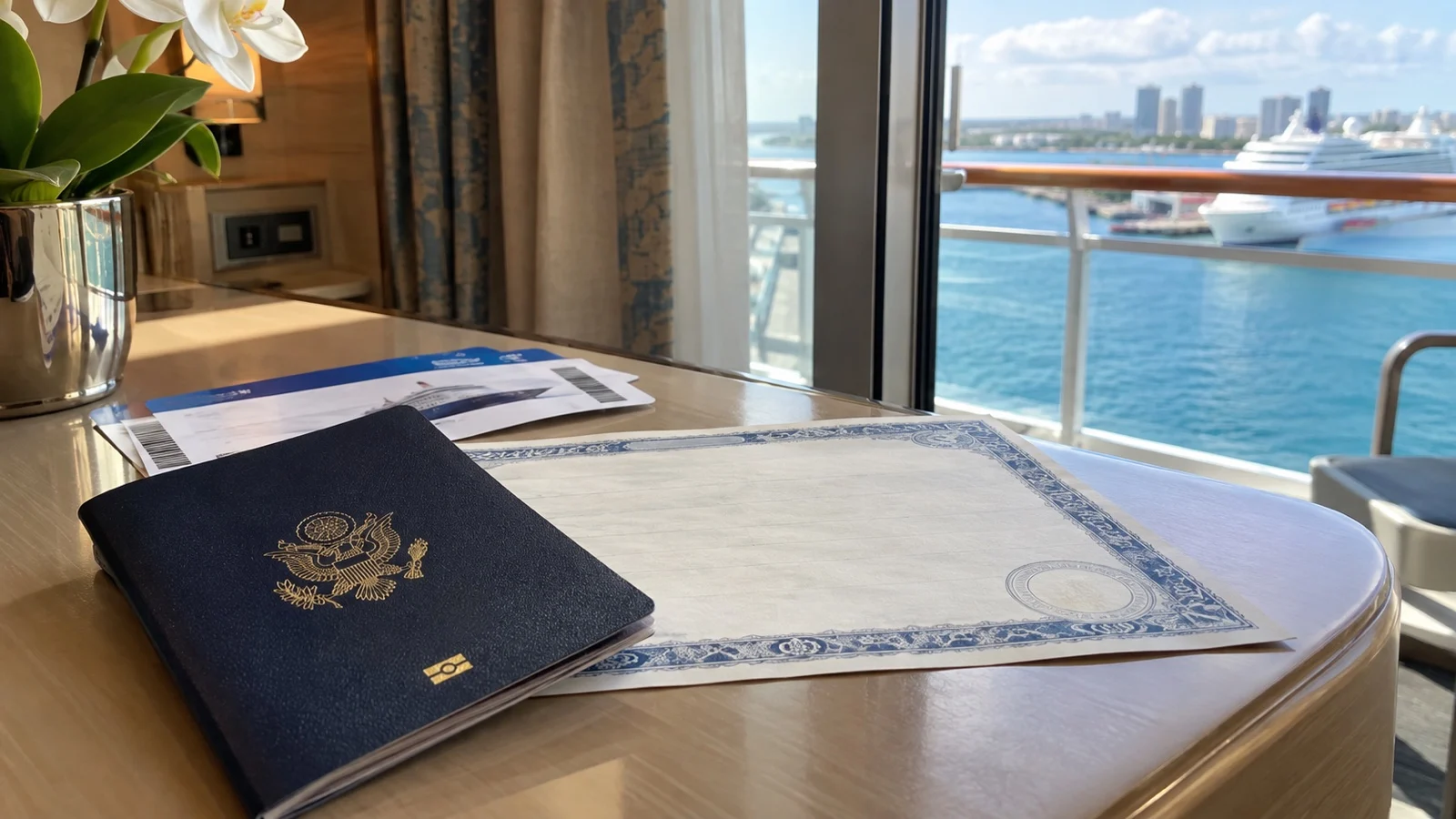
Some US citizens can use an acceptable proof of citizenship, such as a government-issued birth certificate, plus government-issued photo identification on an eligible closed-loop cruise. Confirm every port and your cruise line’s current rules before relying on that option.
I still recommend a valid passport book because it gives you the best emergency options. A birth certificate or passport card is not valid for international air travel back to the United States.
If you already own a passport book, check its condition and the exact validity required by every destination and the cruise line. Some itineraries require six months beyond travel, while other countries apply a shorter rule.
Everything below reflects the rules as published and checked in August 2026. Entry requirements move, so read your line’s own document page again about a month before you sail.
How it actually works
The US passport exception appears in 22 CFR 53.2. Cruise lines and destination countries can still require documents beyond what is sufficient to return to the United States.
The exception applies to a US citizen traveling entirely within the Western Hemisphere who leaves from a US port or place and returns on the same ship’s return voyage to that same US port or place. CBP and cruise lines publish which citizenship and identity documents they accept in place of a passport for eligible sailings.
The lines call these WHTI-compliant documents, after the Western Hemisphere Travel Initiative that Customs and Border Protection administers. Carnival’s proof of citizenship page lists the same set plus a US passport card, a state Enhanced Driver’s License and a Native American tribal card.
What counts as a closed-loop cruise
Same ship, same port, both ends. Miami out and Miami back qualifies, and Miami out with Fort Lauderdale back does not, even though the two terminals sit about 25 miles apart.
Fun fact: the regulation never once uses the phrase round trip. It requires you to return on the return voyage of the same cruise ship to the same United States port or place you departed from, which is exactly why a one-way repositioning sailing and a Miami-out, Port Canaveral-back itinerary both fall outside it.
One-way sailings are the clearest failure case. A crossing that starts in Fort Lauderdale and ends in Barcelona needs a passport book from everyone aboard, and my explainer on transatlantic crossings versus repositioning cruises covers why those fares look cheap and then are not.
The same problem shows up on world cruise segments. Joining in Sydney and leaving in Cape Town means two foreign turnaround ports, which is a passport situation from day one.
The itineraries that quietly break the rule
A sailing can meet the federal closed-loop definition and still require a passport book under a destination’s entry rule or the cruise line’s policy. The port list matters just as much as the round-trip shape.
Royal Caribbean is the clearest on this. Its travel documents page tells US citizens they need a passport book on round-trip sailings that include Panama, Colombia or Martinique, and on all one-way transatlantic, transpacific and Panama Canal itineraries.
Carnival’s list runs longer. It names Colombia, Greenland, Panama and Martinique, plus every Australia, New Zealand, Asia, Europe and transatlantic sailing, where Europe’s own entry rules for US cruisers apply on top.
This is why ports such as Cartagena or Colón deserve a fresh document check. Do not assume a round-trip Caribbean label means the cruise line will accept a birth certificate for that exact sailing.
Canal sailings deserve their own warning, because a partial transit can look like an ordinary Caribbean round trip. My guide to full and partial Panama Canal transits explains what you are actually booking.
Children, and the certificate families get wrong
Children under 16 have a separate federal document exception at land and sea borders, but the itinerary and cruise line can still impose additional requirements. Royal Caribbean, for example, explains when guests age 15 and younger may use proof of citizenship without photo identification.
The regulation says the same thing in drier language. A US citizen under the age of 16 may present an original or a copy of a birth certificate, a Consular Report of Birth Abroad, or a Certificate of Naturalization at a land or sea port of entry.
The document that fails is the souvenir. Carnival requires a certificate issued by a government agency at state, county or city level, or by a department of health and vital statistics, which rules out the framed hospital keepsake with the footprints on it.
Puerto Rico is a trap of its own. Carnival states plainly that Puerto Rico birth certificates issued before July 1, 2010 are not valid proof of citizenship, because the island invalidated and reissued all of them that year.
Families also need to check the line’s policy when a child travels with one parent, grandparents, or another adult. Some lines require passports or extra authorization in those situations so the group can remain together during an emergency.
Carry a consent letter when one parent is not aboard, and check what grandparents need to cruise with kids. Carnival strongly recommends an original signed letter from the absent parent or legal guardian, and officials in several Caribbean countries do ask for it.
Name mismatches, and why they end at the pier
A reservation name should match the government-issued identification used to board. If the citizenship document shows an earlier name, carry the documents the cruise line requires to connect the names.
If your name has changed, you carry the paper that explains the change. Carnival asks for a marriage certificate, marriage license or legal name change court document at embarkation, as an original or a clear legible copy.
A birth certificate makes this harder rather than easier. Someone sailing on a maiden-name birth certificate needs the marriage certificate too, and a second marriage means carrying the whole chain of documents.
The real argument is the port you fly home from

The State Department puts this in one sentence. Its page for cruise ship passengers says that if you cannot return on the cruise ship and need to fly back to the United States for any reason, you will need a passport book.
That can matter after a missed ship, medical disembarkation, family emergency, or another interruption that requires an international flight. The exact recovery route varies, but an airline cannot accept a birth certificate or passport card in place of a passport book for that flight.
Rejoining the ship or returning home may require several flights, a hotel, and new entry formalities. A passport book will not remove those costs, but it keeps international air travel available.
A time-zone mistake is one preventable way to miss the ship. My explainer on ship time versus local time covers the clock issue, and my guide to how early to head back to the ship helps you build a safer buffer.
A passport card does not solve any of this. The State Department is explicit that the card works for entry by land and sea only and is not valid for international air travel.
Four situations, and what I would do in each
- Round trip from a US port to the Caribbean, no passport, sailing in three weeks: check your citizenship, every destination, the exact embarkation and return ports, and the cruise line’s written rules before deciding. Use a birth certificate and photo ID only if the line confirms they are acceptable for your whole itinerary.
- Same round trip, but the port list includes Cartagena, Colón or Fort-de-France: check the destination and line rules immediately because a passport book may be mandatory. Current State Department processing estimates exclude mailing time and do not guarantee delivery by your sailing date.
- One parent traveling with children under 16: check the line and every destination before assuming birth certificates are enough. Carry the required consent or custody documents, and ask the cruise line to confirm the whole party’s document requirements in writing.
- Your passport expires four months after you get back: compare the expiration date with every destination and the cruise line’s policy. Renew if any rule requires more validity, because an unexpired passport can still be insufficient for a specific itinerary.
Where people get burned
An unexpired passport can still fail an itinerary’s remaining-validity rule. Check each destination and the line rather than applying a universal six-month assumption.
A hospital souvenir certificate is not government-issued evidence of citizenship. If the line allows a birth certificate, use the exact original or government-issued copy it describes and ask before laminating or altering the document.
Follow the ship’s instructions on whether to carry your passport ashore or leave it secured onboard. A paper copy and encrypted phone image can help you report a lost document, but neither is a substitute for the physical passport.
The last one is assuming the line will sort it out. Holland America warns that guests arriving without proper documentation may be denied boarding with no refund, and every major line says a version of the same thing.
A realistic word on accessibility
Documents are one part of cruise planning where time and access matter. A first adult passport requires an in-person application at an acceptance facility, while eligible renewals may use mail or the State Department’s online process.
Build the timeline generously and check the State Department’s current processing times before applying. Its published estimates do not include mailing time, and an urgent appointment is limited by eligibility and availability rather than guaranteed.
If anyone in your party has a condition that could put them ashore in an ambulance, the passport stops being a preference. A passenger evacuated in a foreign port is flying home, and a birth certificate will not board that plane.
Quick answers
Do I need a passport for a closed-loop cruise?
Not always, because a US citizen may qualify for an exception while the cruise line or a destination can still require a passport book for the exact itinerary.
Does a passport card work on a cruise?
It may work for eligible land and sea travel from Canada, Mexico, Bermuda, and the Caribbean, but it is not valid for international air travel and line or destination rules still apply.
What kind of birth certificate is accepted?
Lines commonly require an original or government-issued copy from a vital-records authority, while hospital souvenirs and Puerto Rico certificates issued before July 1, 2010 are not valid citizenship evidence.
Do children need a passport for a cruise?
It depends on the itinerary, destination, line, age, and accompanying adults because the federal under-16 exception does not override a destination or line requirement.
What if my last name does not match my birth certificate?
Book in the name required by the line, carry every linking document in the format it accepts, and ask for written confirmation if several changes create a chain.
The last word
The closed-loop exception is real, but it is narrow. It addresses the US passport requirement for an eligible return by sea and does not override destination or cruise-line rules.
An adult passport book is generally valid for 10 years, while one issued to a child under 16 is valid for five. It costs more and takes planning, but it gives the traveler an international-flight option during an emergency.
Apply early, and never assume a pending application makes the documents you already have acceptable. Before sailing, compare the names, dates, condition, and validity of every travel document with the line’s written requirements.
How this guide was researched: The closed-loop exception was checked in September 2026 against 22 CFR 53.2, current US Department of State cruise and passport guidance, CBP document rules, and the published document policies of Carnival, Royal Caribbean, and Holland America. Destination and line requirements can change, so verify the exact sailing before travel and see our Editorial Policy.
More on this topic: browse every guide on choosing a cruise.