Can You Drink the Tap Water? A Port by Port Guide
The tap in your cabin is fine. The question is what happens four hours later when you are hot, out of water, and standing in front of a cafe in a town you have never been to before.
My quick take
I fill a bottle in the cabin before every port day, and it has solved this problem more times than any other habit I have. It costs nothing, it weighs less than the guilt of paying four dollars for a small bottle at a pier kiosk.
The rest of it comes down to knowing which of three categories your port sits in. Safe, safe but unpleasant, or genuinely not worth the risk, and those three are not distributed the way most people assume.
The quick facts
- Fill up onboard: Ship drinking water is treated and monitored, and it is free.
- Safe is a network question: Water can leave the treatment plant clean and pick up trouble in old pipes.
- Bad taste is not the same as unsafe: Desalinated and heavily chlorinated water is usually fine to drink.
- Ice counts as tap water: If you would not drink the water, do not put it in a cube.
- Salad is the sleeper risk: Raw leaves washed in questionable water get more people than a glass of it does.
What safe actually means, because it is not one thing
Roughly three quarters of the world now uses a drinking water source that counts as safely managed, which sounds reassuring until you notice that the other quarter is about two billion people. Cruise itineraries touch both halves of that number in the same week.
Two separate things have to go right. The water has to be treated properly, and then it has to survive the pipes, pumps and rooftop storage tanks between the plant and the faucet you are looking at.
Plenty of countries do the first part well and the second part unevenly. That is why the honest answer in a lot of ports is that the water is probably fine and nobody local drinks it anyway.
Ports where I drink the tap water without thinking about it
The United States and Canada are straightforward. Every public water system in the US has to meet enforceable federal limits on contaminants, so Seattle, Vancouver, Juneau, Boston, Miami and Honolulu are all non issues.
Northern and Western Europe is the same story, backed by rules that meet or exceed international quality standards and require countries to publish what is in the supply. Iceland, Norway, Sweden, Denmark, Finland, the Netherlands, Germany, Switzerland, Austria, Belgium, Ireland and the UK all fall here.
So do France, Spain, Portugal, Italy and mainland Greece. Drinking fountains in Rome and Lisbon are not decorative, and the water in Reykjavik is better than most of what you can buy in a bottle.
- Pacific and Asia: Japan, South Korea, Singapore, Australia and New Zealand are all fine straight from the tap.
- The Baltic and Adriatic: Estonia, Croatia and Slovenia are reliable, and Croatian tap water is genuinely good.
- South America has one standout: Chilean city water is treated to a drinkable standard.
- Israel: Haifa and Ashdod are safe, though a lot of the supply is desalinated and tastes flat.
Coquimbo was the only South American port where I stopped carrying a bottle off the ship. In Callao, Salaverry, Pisco and Santa Marta I did not, and I would make the same call again.
Where locals drink it and you probably should not
This is the awkward middle category, and it is bigger than the genuinely unsafe one. The water meets a standard at the plant, residents have drunk it their whole lives, and a visitor with an unfamiliar gut has a worse time with it than they do.
Istanbul is the clearest example. The city treats its water seriously, almost nobody drinks it from the tap, and the reason is old building plumbing and rooftop tanks rather than the treatment itself.
Much of Brazil, Turkey and the eastern Mediterranean works the same way. If you walk into Galataport and straight up into the city and every restaurant puts a sealed bottle on the table without asking, that is your answer.
Mexico and Central America, plainly
Do not drink the tap water in Mexican ports, and understand that this is not a tourist rule. Mexican households buy garrafones of purified water by the jug because the municipal supply loses pressure and picks things up on the way to the building.
That covers Cozumel, Costa Maya, Progreso, Ensenada, Cabo, Mazatlan and Puerto Vallarta. Resorts and cruise terminals run their own purification, so the water in a beach club’s drink station is a different thing from the water in a public restroom sink.
Belize, Honduras and Guatemala are the same answer with less infrastructure behind it. Costa Rica is better than its neighbors in the main cities, and I would still buy bottled on a port day.
The Caribbean does not have one answer
Barbados, the Cayman Islands, Bermuda, Puerto Rico and the US Virgin Islands are generally safe, and Barbados in particular has famously good water out of its limestone aquifer. The Bahamas, Aruba, Curacao and Bonaire run largely on desalination, which is safe and tastes like it.
Haiti, the Dominican Republic, Jamaica outside the main systems, and the smaller Windward and Leeward islands are where I default to bottled.
The Greek islands are a separate country as far as water goes
Athens tap water is fine and I would drink it happily. The islands are a different situation, and the difference catches people out because they assume Greece is Greece.
Many of the smaller and drier islands run on desalination or on brackish groundwater, and the municipal supply is treated for washing rather than for drinking. On Santorini and Mykonos you will see bottled water in every taverna and almost none of it is theater.
Safe to drink, unpleasant to drink
There is a whole tier of ports where the water will not hurt you and you will not enjoy it. Desalinated supply tends to taste flat and slightly metallic, and heavily chlorinated supply tastes like a hotel pool.
Malta, the Canary Islands, the Balearics in high summer, Cyprus, Dubai and Abu Dhabi all live here. So do a lot of Caribbean islands, and so does Bermuda, where the roof of the house you are looking at is the collection system.
My rule is that bad taste is a preference problem, not a health problem. If you are in Valletta for the day and the water tastes odd, that is a reason to buy a bottle, not a reason to panic about the glass you already drank.
Southeast Asia, and the ice question everyone asks about
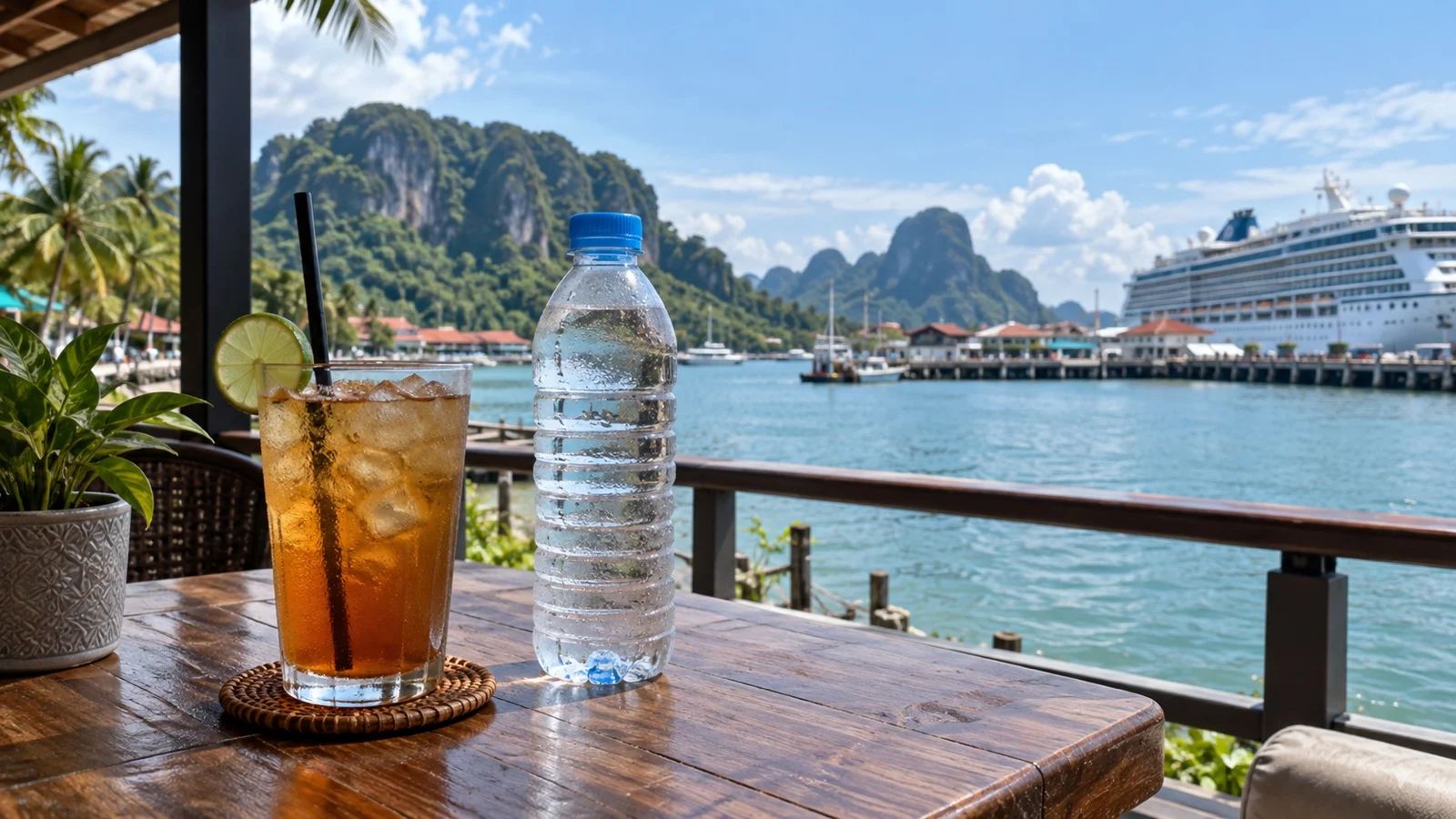
Singapore is the exception in the region and its tap water is meant to be drunk. Thailand, Vietnam, Cambodia, Indonesia, Malaysia and the Philippines are not, and neither is India.
Ice is the interesting part. In much of Thailand and Vietnam the ice in a restaurant drink is usually factory made tube ice from treated water, delivered in sealed bags, and it is a different product from ice somebody froze in a home tray.
The uniform cylinders with a hole through the middle are the commercial stuff. Irregular crushed chips of unknown origin are where I would pass, and if the drink arrives in a sealed bottle with a straw I am happy either way.
Ice, salad and the two rules that actually matter
The standard guidance is blunt about both. Skip ice anywhere the drinking water is a concern, since it was almost certainly made from that same water, and be careful with anything raw that was rinsed rather than cooked.
The salad line is stricter than most travelers expect. Fresh salads are worth avoiding in higher risk destinations even when finely cut, along with pre cut fruit, because contamination on a leaf does not rinse off.
Whole fruit you peel yourself is the reliable version. A grilled skewer from a busy stall is usually a safer bet than the garnish sitting next to it, which is not the intuition most people arrive with.
Other things that count as drinking the water
- Brushing your teeth: A quick brush with tap water is low risk, and bottled is the cautious call in high risk ports.
- Fresh squeezed juice from a cart: Often cut with tap water or served over ice from a bucket.
- Bottles with a broken seal: Check the cap cracks when you open it, since refilled bottles are a real thing.
- Hot drinks are the exception: Coffee and tea made with boiled water are fine nearly everywhere.
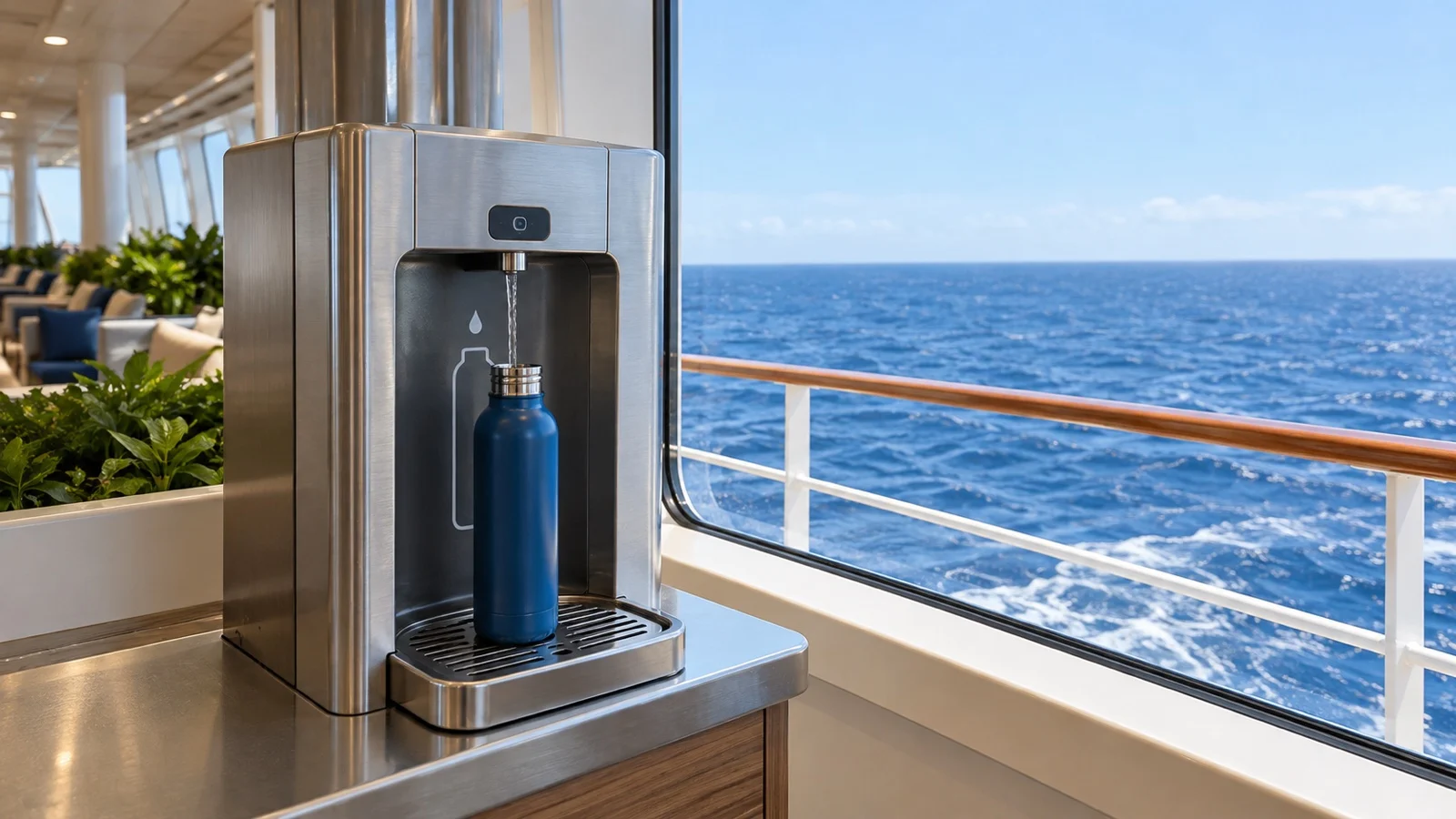
Fill a bottle before you leave the ship
This is the practical answer to the entire post. Drinking water on a large ship is produced, treated and monitored under a health inspection program that covers ships calling at US ports, and clean water is one of the things it exists to check.
So the cabin tap is safe, and so is the buffet water station. A one quart bottle (1 liter) filled before you walk off covers most of a port day in mild weather and gets you to lunch in hot weather.
Two quarts (2 liters) is the right amount in the Gulf, the Red Sea, the Caribbean in August or anywhere you are walking in the sun. My notes on port days in genuine extreme heat go further into how fast that runs out.
Filter bottles and tablets, honestly assessed
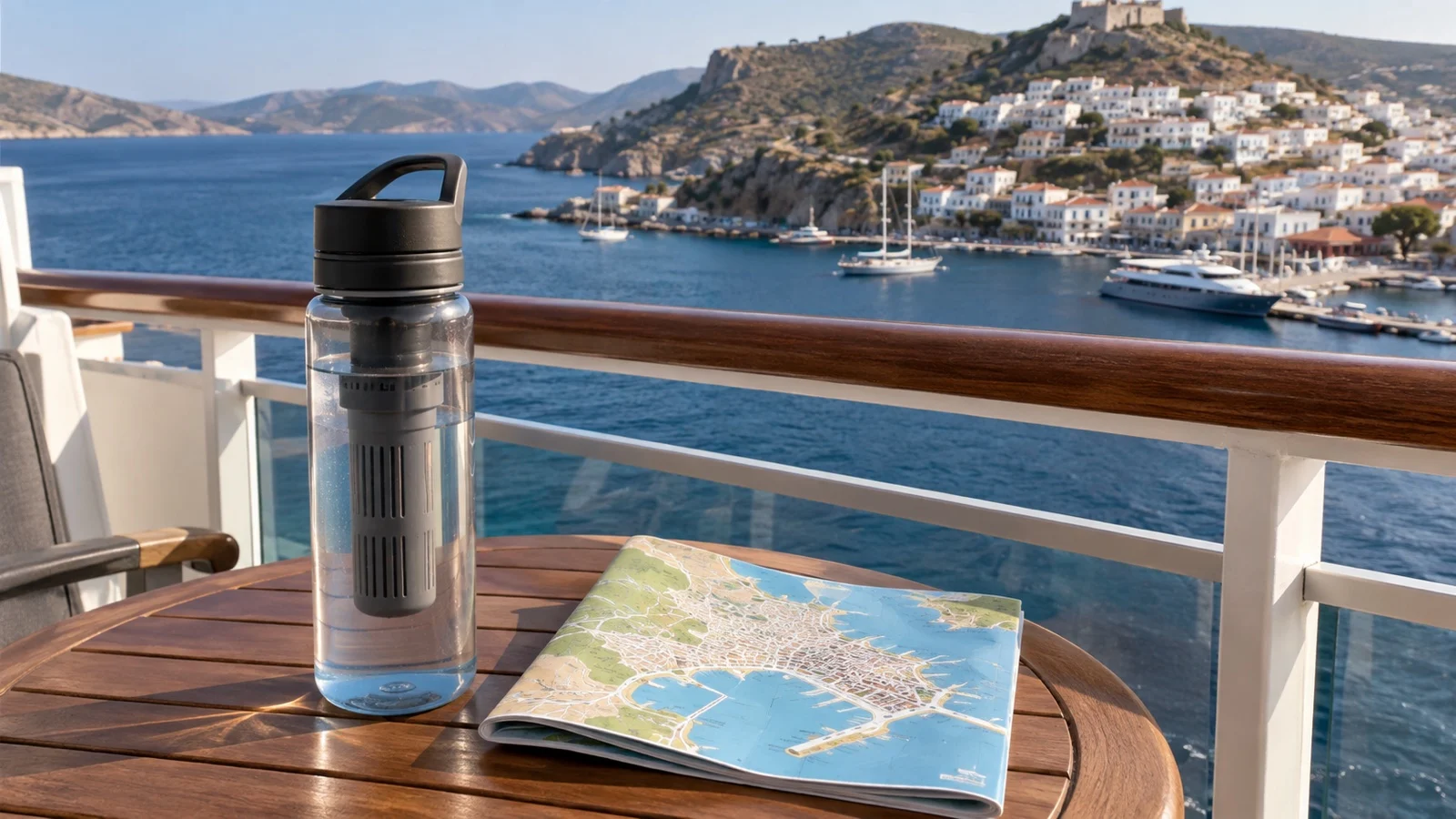
For cruising specifically, I think a filter bottle is mostly unnecessary weight. You are never more than a few hours from a ship that makes its own water, which is a very different situation from backpacking.
If you carry one anyway, know what it does. Ordinary portable filters do not remove viruses, and you want a small pore size for parasites, so a straw filter is not a magic pass in a port with a real water problem.
What I actually do on a port day
I fill two bottles in the cabin, one for the bag and one for the walk back. If I run out ashore I buy sealed bottled water from a supermarket rather than a pier stall, because it costs a third as much three blocks in.
In a port I am unsure about I skip ice, order beer or bottled soft drinks with lunch, and eat cooked food. It is not a hardship and it has kept me off the ship’s medical deck, which is an expensive place to end up.
Quick answers
Can you drink the water on a cruise ship?
Yes. Ship drinking water is treated and monitored, and the cabin tap and the buffet water station are both fine to fill from.
Is the tap water safe in Cozumel or Costa Maya?
No, treat Mexican tap water as not for drinking. Purified water is what everyone actually drinks there, including residents.
Can I drink the tap water in Greece?
On the mainland and in Athens, yes. On many islands the supply is desalinated or brackish and is not intended for drinking, so ask locally.
Is ice safe in port?
Ice is only as safe as the water it was made from, so skip it wherever you would skip the tap. Commercially produced ice in sealed bags is a different and lower risk category.
Do I need a filter water bottle for a cruise?
Not really, since you can refill free onboard every day. Filters also do not remove viruses unless they are specifically built to.
Final word
Most of the anxiety about this is aimed at the wrong target. People agonize over one glass of tap water and then eat a salad rinsed in it, and the salad is the part that ruins the sea day.
Carry water from the ship, treat ice as tap water, eat things that were cooked or peeled, and stop worrying past that. If you are genuinely unsure in a port, ask a crew member on the gangway, because they have been here more times than the guidebook has.
How this guide was researched: Official drinking water standards, public health travel guidance and regional supply information were checked in November 2026 for every region named here. Water quality varies by neighborhood, by season and by building, so confirm the current situation for your own ports and ask locally when you are unsure. See our Editorial Policy.
More on this topic: browse every guide on port logistics and timing.