Cruise Port Parking: What It Costs and How to Choose
Cruise-port parking can be beautifully simple or sneakily expensive. The smart choice comes from pricing the whole trip, confirming the correct terminal, and deciding how much shuttle time and uncertainty you are willing to trade for savings.
My quick take
Start with the port’s official parking page, then compare the total for your exact sailing with a reputable off-site lot and any hotel package you would genuinely use. Daily rates alone are not enough because taxes, reservation fees, extra charged days, shuttle policies, and vehicle size can change the winner.
For the easiest morning, terminal-adjacent parking is hard to beat. For a long cruise, the savings from an off-site lot, hotel package, or round-trip ride can be large enough to justify a little homework.
The quick facts
- Current official examples: Port Canaveral and Port Everglades each publish a $20 daily rate for standard vehicles, although taxes and counting rules differ.
- Count the port’s way: some facilities charge both embarkation and disembarkation dates, while others start a 24-hour or calendar-based parking clock.
- Reservations vary: Galveston sells prepaid reservations, while Port Canaveral and Port Everglades say they do not accept parking reservations.
- Cheapest is not always easiest: off-site parking may add two shuttle waits, luggage handling, limited hours, and a longer ride.
- Match the terminal: verify the ship’s current terminal before choosing a garage, lot, entrance, or drop-off route.
- Check the vehicle: tall vans, roof boxes, RVs, trailers, and dual-rear-wheel vehicles may face clearance limits or higher rates.
- Accessibility rules are local: accessible spaces, fee waivers, shuttle access, and required credentials differ by port and parking operator.
What cruise-port parking costs
There is no reliable nationwide “typical” rate because ports price parking differently and can change rates without notice. Use current official figures as examples, then calculate your own dates on the operator’s booking page.
Port Canaveral currently lists $20 per day plus tax for standard vehicles and RVs. It counts both the day you arrive and the day you depart, so a seven-night Saturday-to-Saturday cruise costs eight parking days before tax.
Port Everglades currently lists a $20 daily maximum for standard vehicles and $25 for oversized vehicles. Its parking clock starts when the driver pulls the entry ticket, which is a useful reminder that counting rules are not universal.
The Port of Galveston offers multiple garage, park-and-walk, shuttle, and economy choices through a prepaid reservation system. The price depends on the sailing and selected facility, so run the exact trip rather than borrowing a rate from someone else’s cruise.
Calculate the real total
- Enter the actual embarkation and disembarkation dates, not simply the number of cruise nights.
- Add taxes, booking or service fees, oversize charges, and any extra day created by the facility’s billing method.
- Include shuttle fees for every traveler and both directions if they are not included.
- Subtract only discounts you can verify and use, including any hotel-package parking allowance.
- Compare that total with a round-trip taxi, rideshare, car service, or a ride from someone you trust.
Screenshot the final price and cancellation terms before paying. A pleasing daily number can lose its sparkle once the checkout screen finishes accessorizing it.
Official port parking: easiest, not automatically best
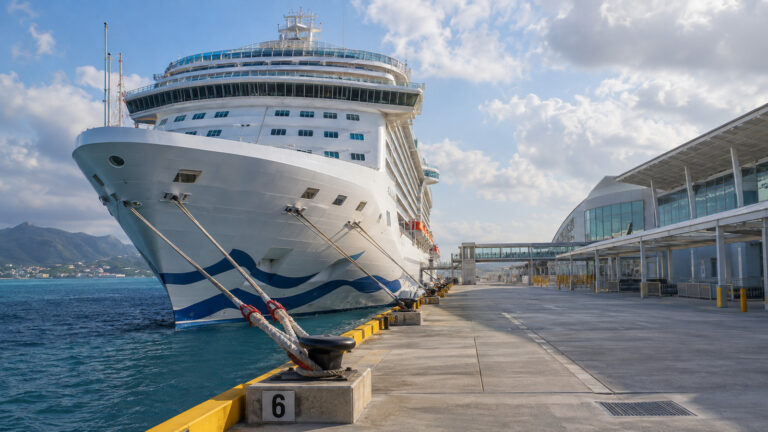
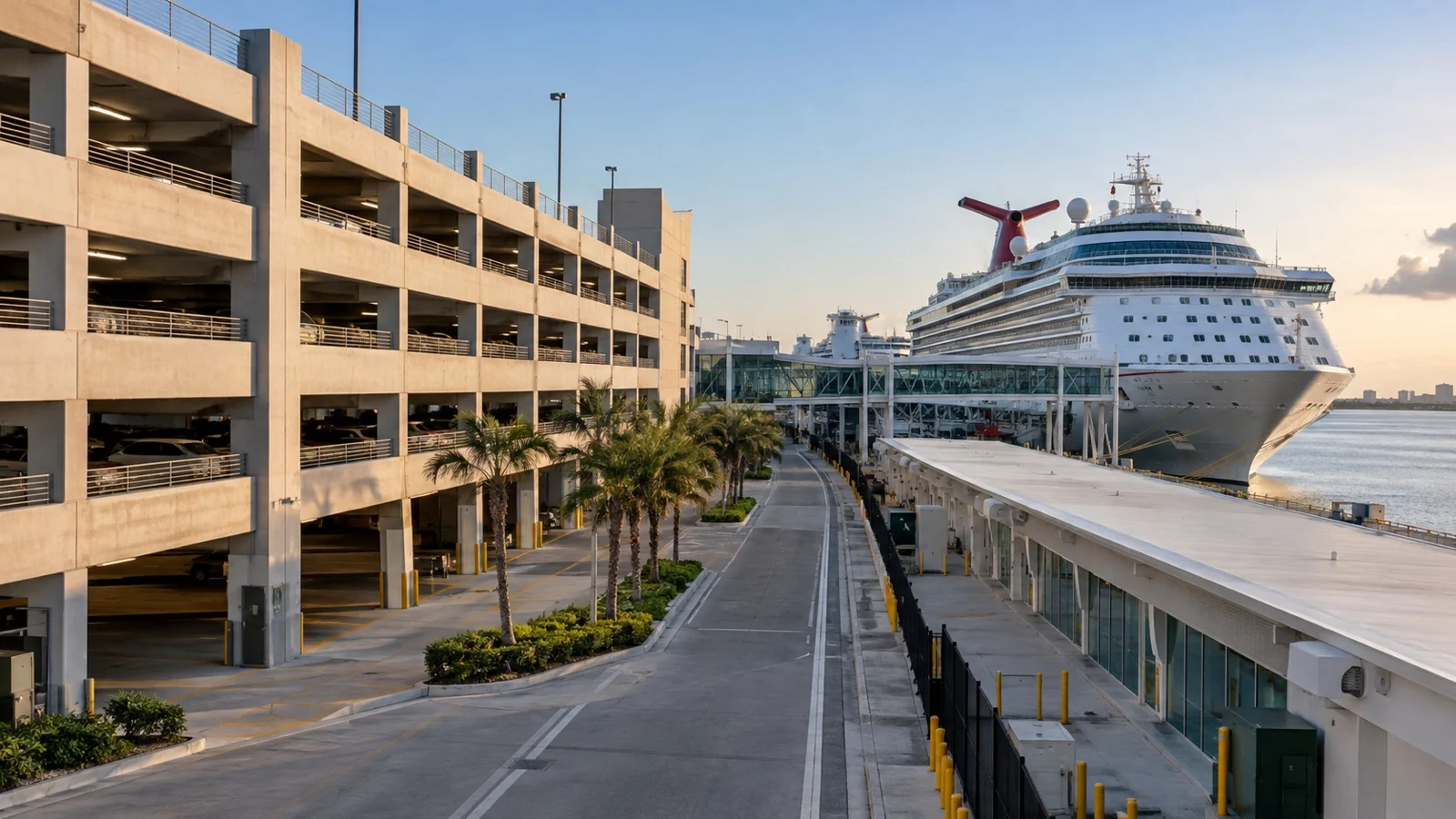
Official lots and garages are usually positioned for the port’s terminals, and some let you walk directly to check-in. Port Canaveral says its parking is adjacent to each cruise terminal with no shuttle required, while Port Everglades assigns specific garages or lots to different terminals.
The tradeoff is often price and flexibility. A port may offer no reservations, limited oversize spaces, a garage-height restriction, or no guarantee that your preferred area will be open.
Official does not mean every lot fits every ship. Confirm the current terminal with the cruise line because ship schedules and terminal assignments can change.
Off-site parking: compare the operation, not just the rate
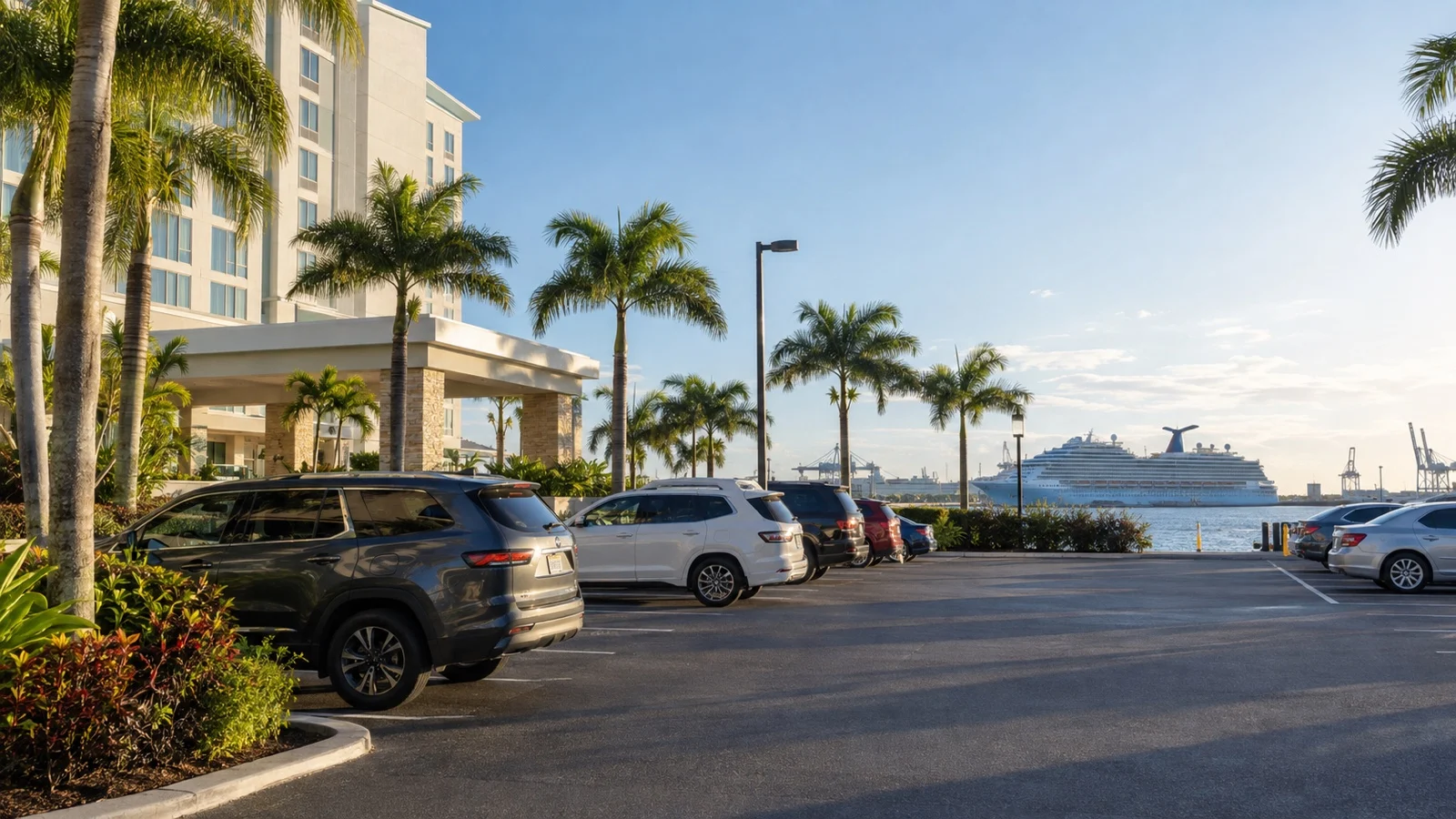
An independent lot can be a good value when the operator is established and the shuttle plan suits your schedule. Check the address carefully, because a lot marketed with the port’s name may still sit several miles away.
- Is the quoted price the complete total for your exact dates and vehicle?
- Is the shuttle included for every passenger in both directions?
- Does the shuttle run continuously, on a schedule, or only when called?
- Which terminals does it serve, and where is the return pickup point?
- What happens if the ship arrives early, late, or at a different terminal?
- Must you leave your keys, and who can move the vehicle?
- What are the cancellation, delay, and no-show policies?
- Are the lot and shuttle accessible for your specific mobility equipment?
Read recent operating details, but use the lot’s written policy for the booking decision. A five-star review from last year cannot promise that the first shuttle this Sunday still leaves at the same time.
Hotel park-and-cruise packages
A hotel package can combine an overnight stay, cruise parking, and terminal transportation. It is especially worth pricing when you already plan to arrive the day before or when port parking for a longer trip costs more than the room package.
The words “park and cruise” do not guarantee unlimited parking or a free ride for everyone. Confirm the number of included parking days, shuttle fee and capacity, reservation process, luggage rules, return pickup procedure, and charge for extra days.
Also check whether the hotel requires you to stay before the cruise, after it, or either one. Arriving a day early remains a sensible buffer, but only the hotel’s current package terms tell you whether it saves money.
Reservations: three different answers
Reservation required or strongly encouraged
Reserve as soon as your ship and dates are firm, then save the confirmation offline. Make sure the booking names the correct terminal area and vehicle type.
Reservation offered but not required
Prepaying can lock in a spot or rate, but read the refund terms before committing. If your cruise line changes the terminal, confirm whether the reservation remains valid.
No reservations accepted
Follow the port’s arrival instructions and opening time rather than paying an unrelated company that appears to “reserve” official parking. Port Canaveral and Port Everglades currently state that they do not take reservations or prepayment for their port parking.
Covered parking, surface lots, and weather
A garage can reduce sun exposure and protect the vehicle from ordinary rain or hail, but it does not make a car storm-proof or flood-proof. Surface lots are often easier for tall vehicles and may cost less.
Check the height before booking if your vehicle has a roof box, rack, lift, or raised suspension. Port Everglades lists a 7-foot clearance at its Heron and Palm garages and directs oversized vehicles to limited special parking.
In severe weather, follow the port, emergency-management, cruise-line, and parking-operator instructions. Do not assume that a covered level is the right place to leave a vehicle during a hurricane or flood threat.
Accessible parking and disability fee waivers
Accessible spaces do not automatically mean free parking, reservable spaces, or an accessible shuttle. Ask about the route from the parking space to check-in, curb cuts, elevators, wheelchair or scooter handling, and the return trip after disembarkation.
Port Canaveral’s fee waiver applies only to specific vehicle equipment or Florida credentials listed on its official page. Galveston says accessible spaces are available in all its lots on a first-come basis, which is a different rule and a good reason to check the exact port.
Bring the required placard, plate, permit, identification, and any documentation the port specifies. Call ahead if the published instructions do not cover your vehicle or mobility setup.
Oversized vehicles, EVs, and special cases
RVs, trailers, buses, dual-rear-wheel trucks, tall vans, and vehicles with roof equipment may need a designated area. Ask for the maximum length, width, height, rate, reservation rule, and whether you can disconnect a trailer.
If you drive an electric vehicle, do not assume a charging space can be occupied for the entire cruise. Verify whether long-term parking and charging are permitted, whether a charger can be reserved, and what idle fees or time limits apply.
Motorcycles and vehicles with disability adaptations can also have distinct policies. The operator’s written answer is far more useful than a generic parking guide.
Security, keys, and insurance
Fencing, lighting, cameras, staff, and patrols can reduce risk without eliminating it. Galveston says its official lots are monitored and patrolled around the clock, while Port Canaveral says its facilities are secure and patrolled 24 hours a day.
Ask an off-site operator whether you keep your keys and whether staff may move the car. Remove valuables, lock the vehicle, photograph its condition and location, and keep the parking receipt where you can find it after a week of vacation photos.
Coverage for theft, weather, flooding, vandalism, towing, or damage depends on your auto policy and the circumstances. Check with your insurer if the answer matters to your decision, and never assume the parking operator accepts liability.
Embarkation morning without the parking-lot scavenger hunt
- Reconfirm the ship’s terminal and your assigned arrival window.
- Download the official port map and route to the correct parking entrance.
- Save the reservation, QR code, receipt, and phone number offline.
- Drop bags only where the port instructs, and keep passports, medication, valuables, and boarding documents with you.
- Photograph the level, row, space, elevator, and nearest landmark before leaving the car.
Port Canaveral currently tells drivers to proceed to the terminal for passenger and baggage drop-off before parking personnel direct them to the appropriate facility. That is a port-specific process, not a rule to copy everywhere.
If everyone gets out with luggage first, make a clear meeting plan for the driver. “By the big ship” is adorable, but it is not a location.
The return trip matters too
Before boarding, learn where the off-site or hotel shuttle collects returning passengers and whether you must call. Port closures, terminal changes, customs delays, and a late ship can all affect pickup timing.
Keep the claim ticket and lot phone number accessible during disembarkation. If you use self-assist departure, choose it because your party can safely manage every bag, not solely to beat a shuttle line.
Inspect the vehicle before leaving and report a problem promptly under the operator’s procedure. Keep photos and paperwork if you may need to make an insurance claim.
When driving may not be the best deal
For a long voyage, compare parking with a round-trip ride, one-way rental car, train, or flight plus local transportation. Include fuel, tolls, lodging, parking, and the value of an extra travel day rather than comparing only one line item.
Driving can still win for a family or for travelers carrying more luggage, but it is not automatically cheaper. Our guides to cruise-port rental cars, cash and cards near ports, and post-cruise flight timing can help with the surrounding decisions.
Quick answers
How much is cruise-port parking?
Current official examples include $20 per day plus tax at Port Canaveral and a $20 daily maximum for standard vehicles at Port Everglades. Your total can differ because the port, dates, vehicle, facility, taxes, and counting method all matter.
Does a seven-night cruise mean seven parking days?
Not always. Port Canaveral counts the arrival and departure dates, making a Saturday-to-Saturday cruise eight charged days, but other operators use different rules.
Do I need a parking reservation?
It depends on the operator. Galveston offers prepaid reservations, while Port Canaveral and Port Everglades currently do not accept them for official port parking.
Is off-site parking safe?
No operator can promise a risk-free stay. Compare access control, lighting, staffing, patrols, key handling, written liability terms, and current operating details before booking.
Is a hotel parking package worth it?
It can be, especially if you already want a pre-cruise hotel or need many parking days. Compare the package’s complete price and transportation terms with every other option.
Can I leave luggage with a passenger while I park?
Many terminals have designated baggage drop-off procedures, but follow that port’s instructions. Keep travel documents, medication, electronics, and other valuables with you rather than in checked luggage.
The bottom line
Choose cruise-port parking with four things in view: total cost, terminal fit, transportation time, and the operator’s rules. Check the official source shortly before departure because rates, access, and terminal assignments can change.
Then save the paperwork and photograph where you parked. Future-you, standing in a garage with a suitcase and vacation brain, will be wildly grateful.
Current planning sources: Port Canaveral parking, Port of Galveston cruise parking, and Port Everglades parking. Checked September 2026; confirm current prices and rules for your sailing, and see the CruisePorts.co Editorial Policy.
More on this topic: browse every guide on port logistics and timing.