What Is Rafting on a River Cruise? River Cruise Double Docking Explained
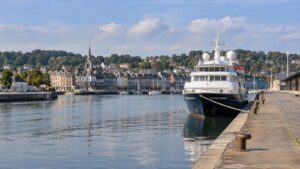
Rafting means river ships moor side by side and passengers cross neighboring vessels to reach land. It is common at busy European berths, but the depth of the raft, deck alignment, view, and accessibility route can change after the schedule is printed.
My quick take
Rafting is fine. The people who hate it are almost always the people who did not know it could happen, which is a marketing failure rather than an operational one.
What I would do is stop treating a river balcony or a French balcony as guaranteed scenery on a port day. If the view matters that much to you, the money is better spent on a longer itinerary with fewer overnight calls in the busiest cities.
Reception cannot usually change a locally assigned berth because of a blocked view or inconvenient crossing. The master and operator still retain safety responsibilities, so report a genuinely unsafe gangway or cross-ship route immediately and ask for the available alternative.
The quick facts
- What it means: two or more river ships moor side by side at the same quay, tied to each other rather than to the bank. The industry calls it rafting, stacking, or double docking, and the terms are interchangeable.
- How many deep it goes: Two ships are common at busy European river berths, and deeper rafting is possible when the authority and safe channel width permit it. The number changes with traffic, vessel dimensions, water level, and the local mooring plan.
- How you get ashore: At a rafted European river berth, passengers usually cross one or more neighboring ships before using the shore-side gangway. Some river destinations and expedition operations use launches or tenders, so this is not a universal rule for every river cruise.
- Who decides: The local port or harbor authority assigns berths, as Uniworld explains, while each master and operator remains responsible for accepting a safe mooring and gangway arrangement. Reception usually cannot move the ship simply because a passenger dislikes the view.
- When you find out: timing varies by operator and port. Avalon Waterways says exact embarkation docking locations are available 24 to 72 hours beforehand, and that berths vary with how many ships are in port.
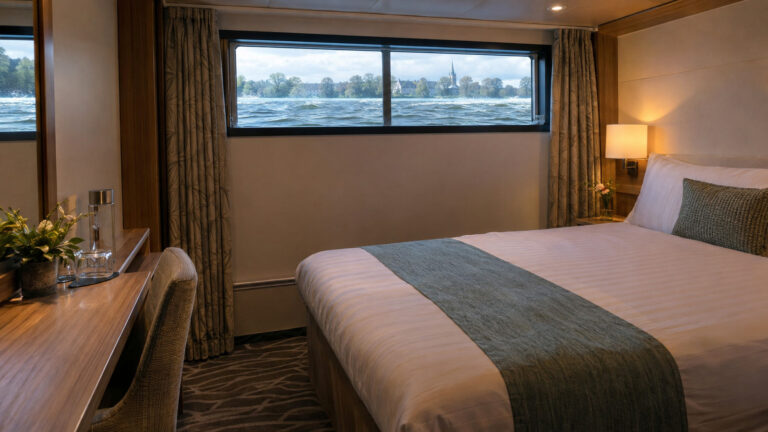
- The cabin window problem: if you are on the inside ship, your river-facing window looks straight into the cabin of the ship rafted outside you. Curtains close, and they stay closed until one of you leaves.
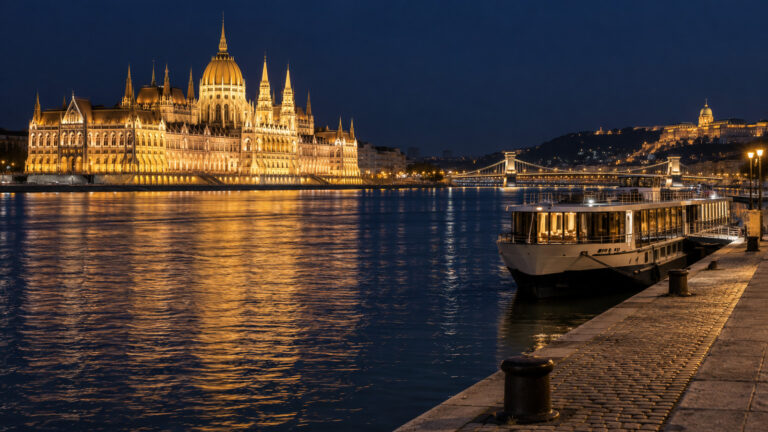
- Where it happens most: busy ports with limited quay space, especially when several river ships call at once. No dependable city-by-city rafting rate is published, so the arrangement can vary by port and date.
Why there are never enough berths
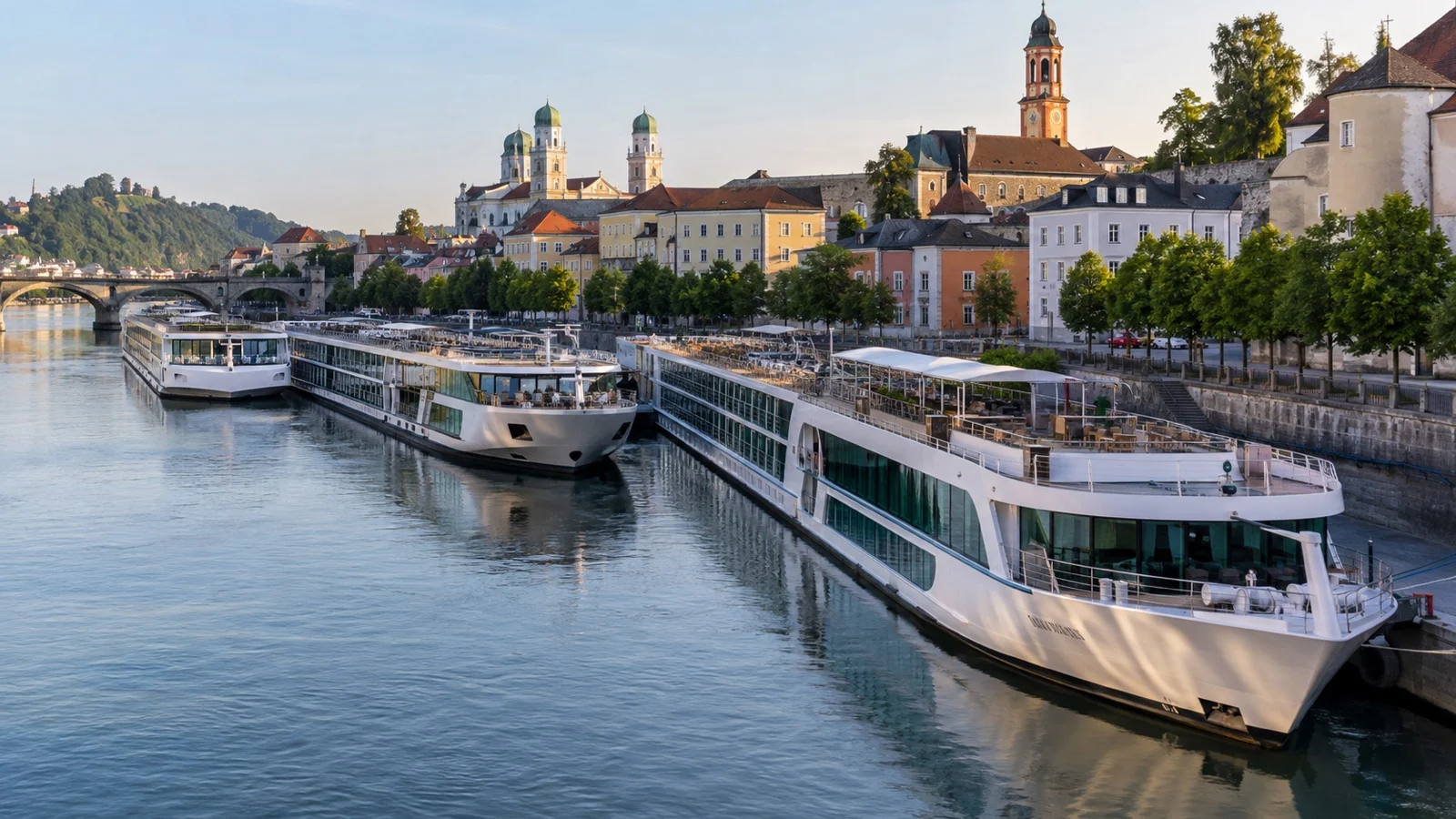
A modern European river ship is about 360 or 443 feet long. Those two hull lengths exist because of lock chambers, and they mean a single ship eats a very long stretch of quay.
You can see the constraint written into the berth lists themselves. Port of Amsterdam publishes its river cruise berths individually, six along Ruijterkade Oost and five along Ruijterkade West, each tagged with whether it takes a roughly 360-foot or 443-foot vessel.
Passau is the clearest example of a town built around this. Stadtwerke Passau lists 17 landing stations with 29 berths in total, which sounds generous until you remember Passau is the junction where Danube itineraries turn around.
What river cruise double docking actually feels like
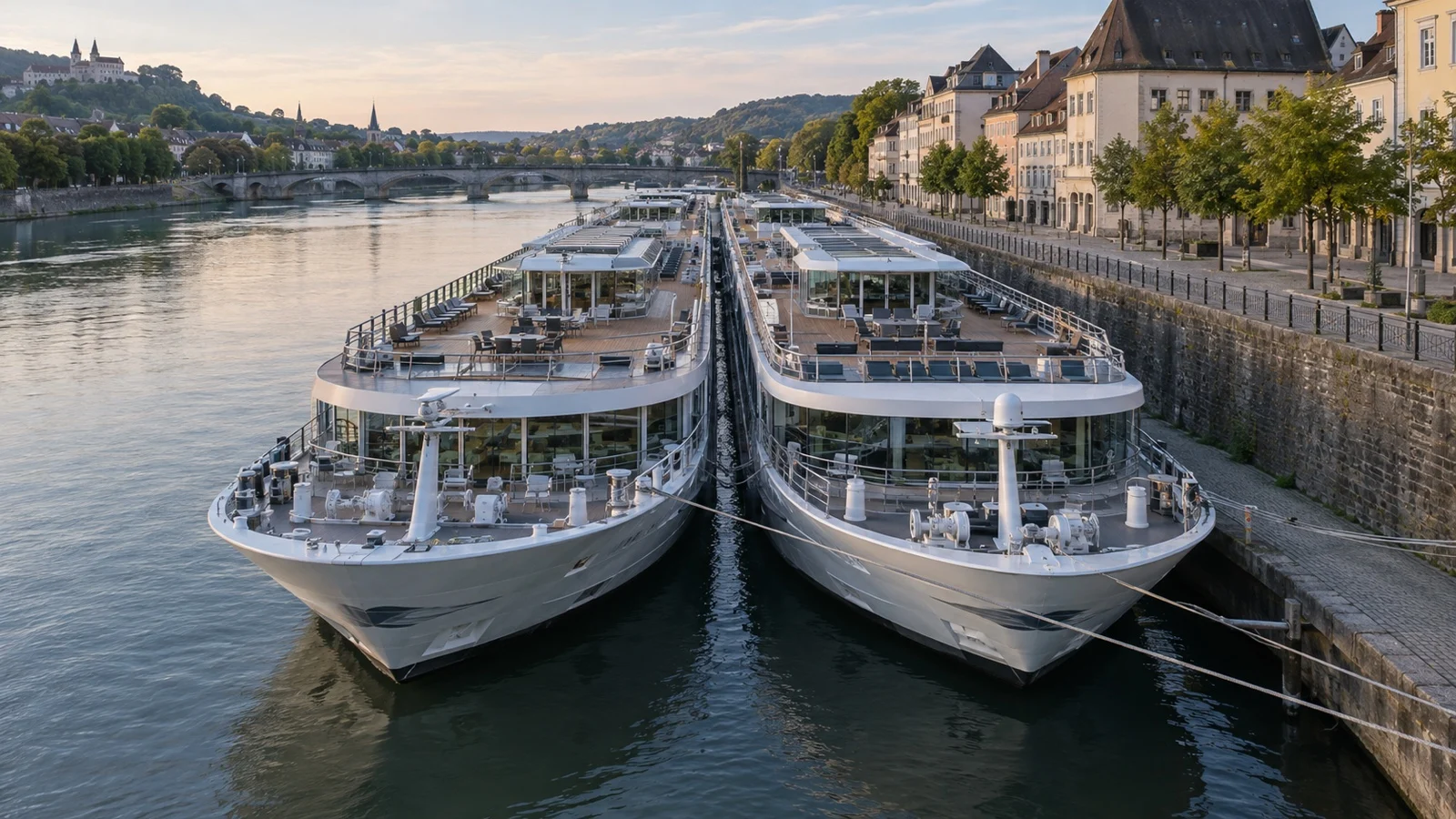
The first time it happens you will think something has gone wrong. You look out of the lounge window at breakfast and there is a wall of blue hull about 6.5 feet away.
Then you go to leave and the cruise director points you across a short connecting gangway onto the ship next door. You walk through its reception, past its front desk staff, and down its gangway onto the quay.
There are two small courtesies that matter. Keep your voice down through the other ship’s lobby, because their passengers are having breakfast, and do not use their elevators unless you genuinely need to.
Coming back is the same in reverse, with the added complication that ships sometimes move during the day. Photograph your ship’s name and the berth signage before you walk away, because four white river ships in a row look identical from a distance.
When the deck levels do not line up
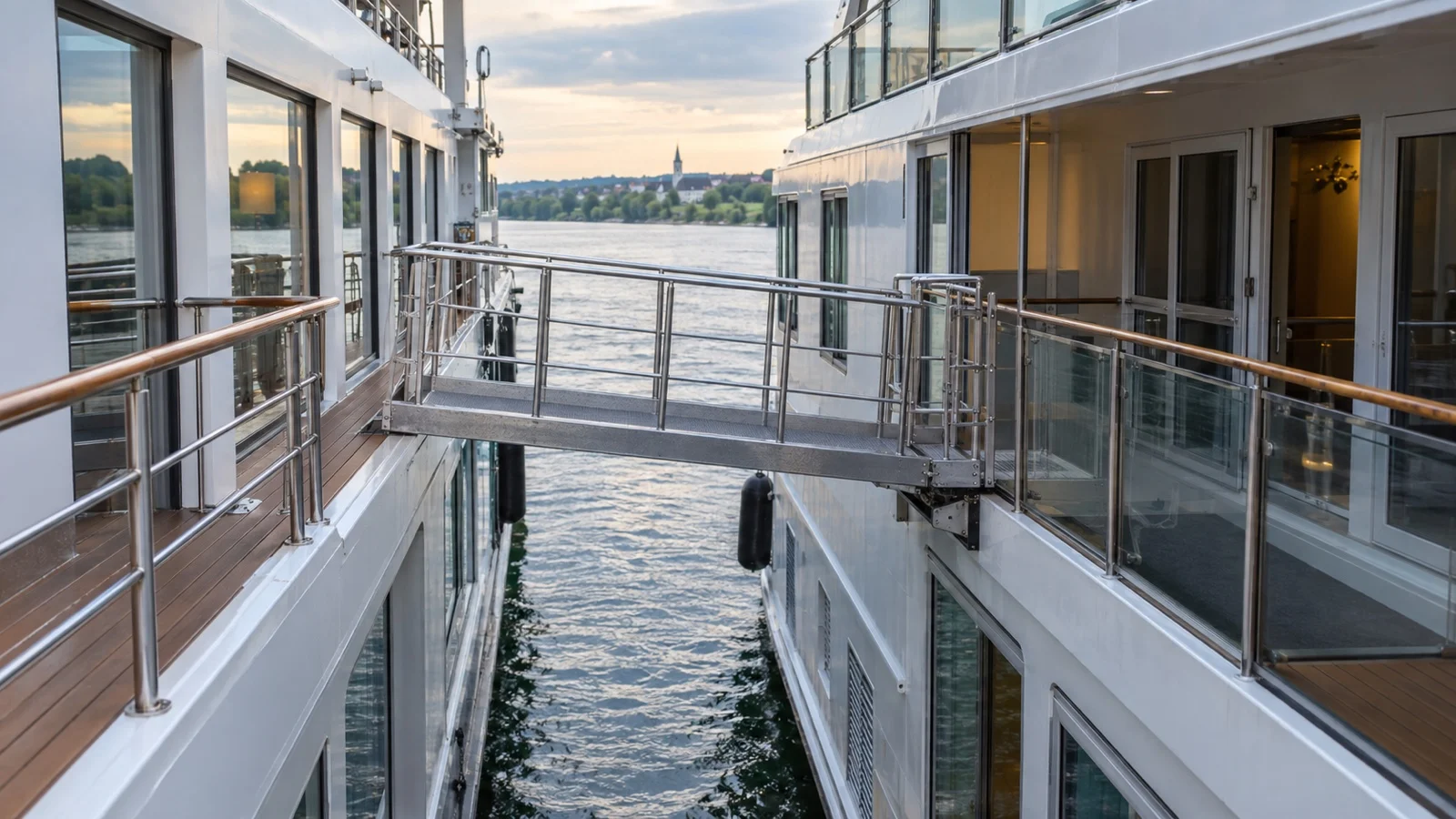
This is the part that turns a minor inconvenience into a real one. Ships from different lines and different build years sit at different heights in the water, and their main decks do not always match.
When the levels are close, the crew lays a short flat gangway between the two ships and you barely notice. When they are not close, you go up and over instead.
Up and over means climbing an internal staircase to the sun deck of your own ship, crossing the open top deck of the neighboring ship, and descending its stairs to its gangway. It is a genuine flight of stairs each way, outdoors, in whatever weather the day has produced.
The crossing can remain uncertain until the raft forms because ship height, load, and berth order all affect deck alignment. Ask reception when the berth plan becomes available, then check again before going ashore.
Who actually controls a berth, and who just says they do
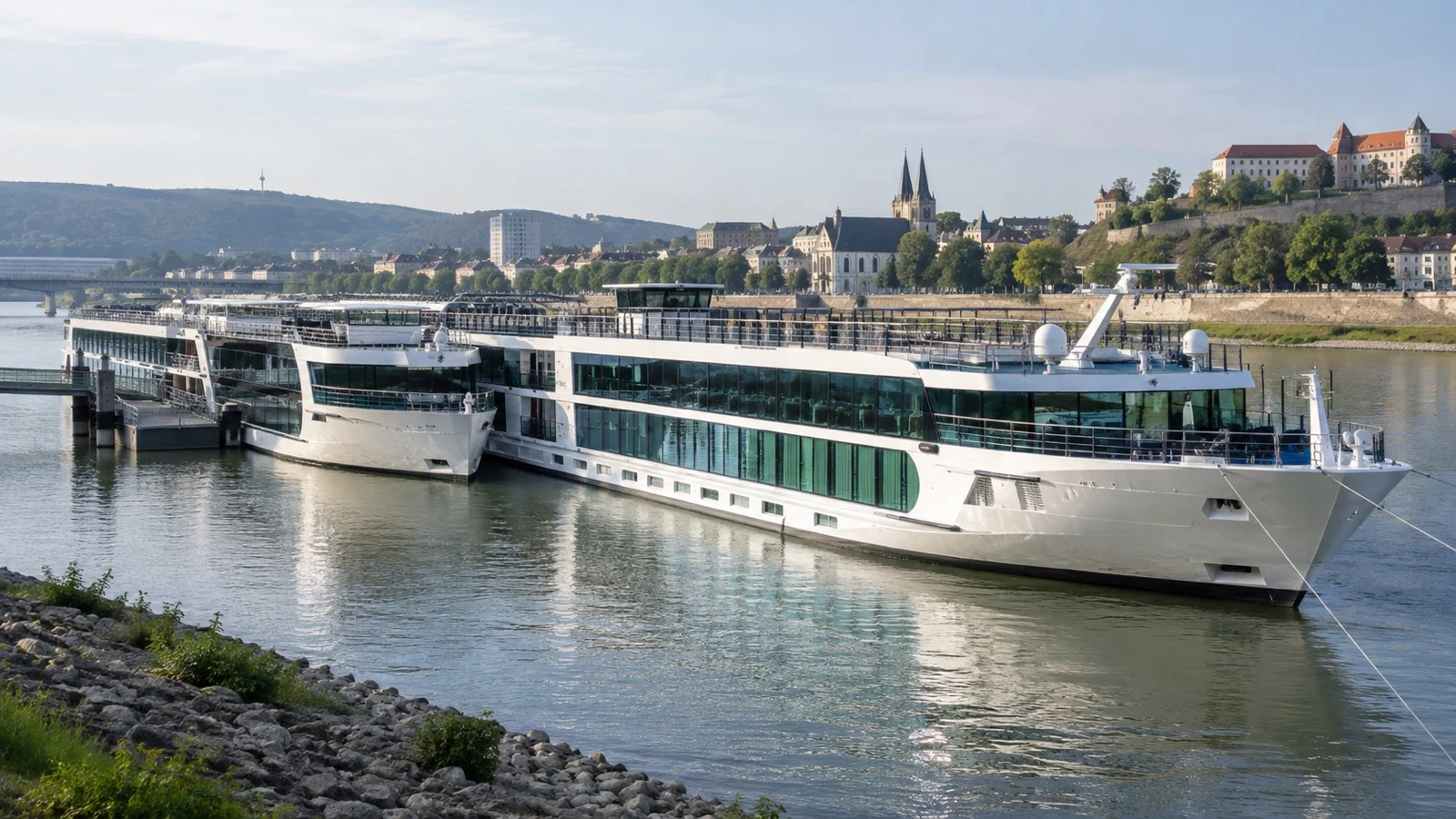
There is a persistent belief that the big lines own their docks and therefore always get the inside berth. Be skeptical, because the lines themselves do not say this in their own terms and conditions.
Avalon Waterways tells its passengers that docking positions at each port are assigned by local authorities and may vary with the number of ships in port. Uniworld tells its passengers that harbor authorities decide, not Uniworld and not the captain.
Amsterdam is explicit about the mechanism. Port of Amsterdam describes Amsterdam and Zaanstad as a single river cruise region in which Cruise Port Amsterdam manages the planning of berths, which is a port function rather than a cruise line one.
I would not book a European Rhine or Danube itinerary on a promise of a guaranteed inside berth, and I would ask any salesperson who makes that promise to put it in writing.
Rafting is common enough that the navigation rules have a formal way to forbid it. The Rhine Police Regulations published by the Central Commission for the Navigation of the Rhine include a dedicated article, 3.33, covering the board a vessel displays to indicate that no one may moor alongside it.
What to do when the crossing does not work for you
Ask before booking whether the line can accommodate mismatched deck heights, steps, narrow thresholds, and a gangway through another operator’s ship. Crew assistance does not mean they can safely lift a passenger or a heavy power device, and a neighboring ship’s elevator may be unavailable or off the permitted route.
If the normal crossing is unusable, ask whether staff can arrange a different gangway time, repositioning, or an accessible shoreside transfer. None is guaranteed, so get the line’s answer in writing while the fare is refundable and make a plan for staying onboard when no safe route exists.
The raft order and berth can change while you are ashore. Carry the ship’s direct phone number, photograph the berth map or daily program, and allow a conservative return buffer based on your operator’s instructions.
The things I would actually do about it
- Ask the night before: reception may have the berth plan by the evening briefing, but the final raft order can still change. Check again before you leave the ship.
- Allow extra time: crossing another ship and waiting at a gangway can add time. This matters most on short calls and when several groups depart together.
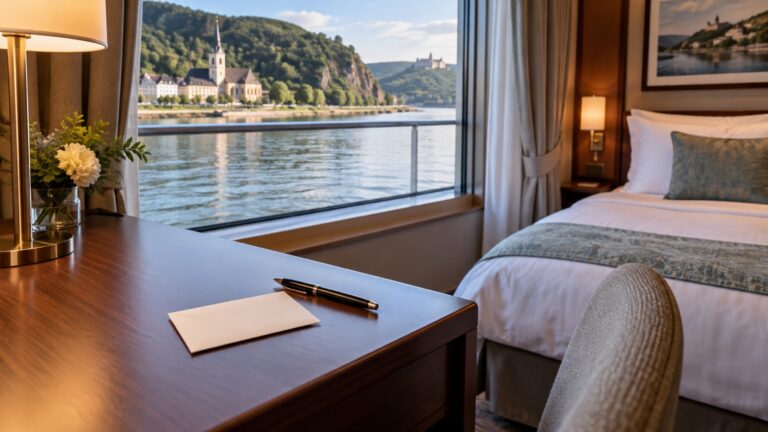
- Rethink the balcony premium: a French balcony is excellent on a scenic cruising day and worth nothing while rafted. Weigh the upgrade against how many big-city overnights your itinerary has.
- Photograph the berth: your ship’s name, the berth number, and the nearest street sign. Four identical white hulls at dusk is a real navigation problem.
- Do not rely on season alone: berth demand varies with the ships scheduled on your date, not just the month. Ask the operator about likely arrangements, but treat any answer as provisional.
Fun fact: the scale of this traffic is measured lock by lock, and the Central Commission for the Navigation of the Rhine recorded 1,131 cruise vessel passages through the Iffezheim lock on the Upper Rhine in the first six months of 2024 alone. That is roughly six river cruise ships a day through a single lock, all of them needing somewhere to tie up that night.
How I would actually decide
If you are choosing between itineraries and rafting is your deciding factor, look at the port list rather than the brochure photography. Busy ports with several ships and limited berths are more likely to use shared moorings, but there is no reliable city-by-city forecast.
A Rhine or Danube itinerary may raft at a busy call, but no particular city or overnight guarantees it. Compare the exact ports and dates, then plan for the possibility rather than choosing by river name alone.
If you want a guarantee, there is not one, and I would treat any brochure that implies otherwise with suspicion. What you can control is your expectations, your departure time, and how much you paid for a view you might not get.
A realistic word on accessibility
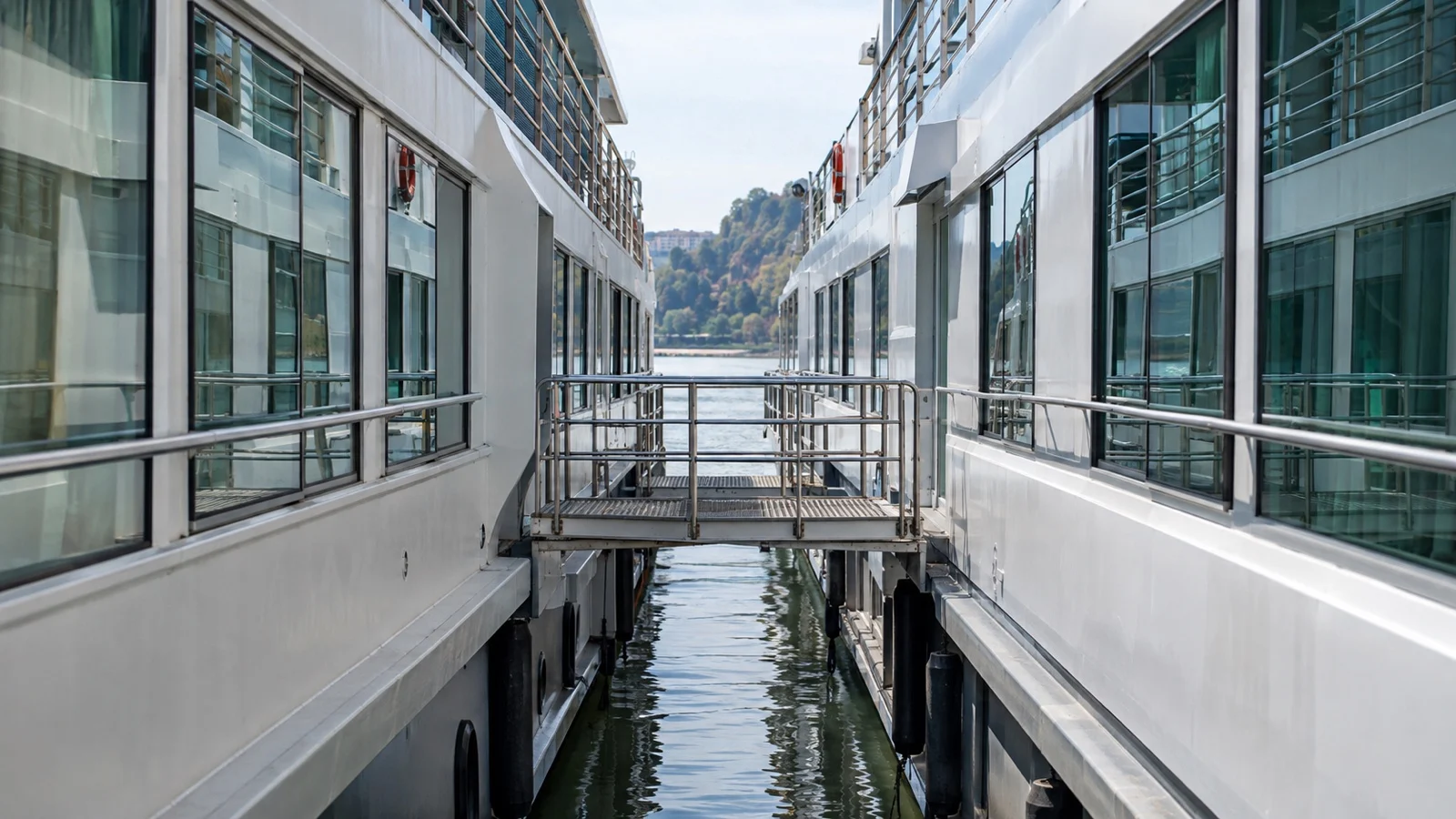
This is where I stop being relaxed about rafting. If you use a wheelchair, a walker, or simply cannot manage stairs, being the outside ship in a three-deep raft can end your day before it starts.
Elevator coverage varies by ship, and an elevator may not reach the sun deck used for a cross-ship route. Ask the line about the exact vessel and make a written backup plan before final payment.
Say it at booking, in writing, and say it again at check-in, so the hotel manager knows before the berth allocation arrives. Uniworld says a motorcoach transfer may be provided when a ship docks farther from the center, but that is not a promise of an accessible alternative to every rafted crossing.
Mobility-device and companion policies vary by operator, ship, and itinerary, so get the line’s current rules in writing before booking. For the wider picture across ports, see my guide to wheelchair-friendly cruise ports, and remember that a river quay is a moving target in a way a fixed pier is not.
When to go, and the weather
Rafting depends on the berth plan and the ships in port on your date. Summer can be busy, but no authoritative source publishes a dependable month-by-month rafting rate.
Summer highs across Central Europe run in the high 70s to mid 80s Fahrenheit. A sun deck crossing is pleasant in that; the unshaded line on the quay afterwards is not.
Cooler spring and fall sailings do not guarantee a clear berth. Pack for a wet crossing of an open deck and confirm the day’s route with the crew.
Christmas market sailings can put several ships into popular ports on the same dates. In cold or wet weather, take exposed metal stairs slowly, use the rail, and follow crew directions.
Quick answers
What is rafting on a river cruise?
It is when two or more river ships tie up side by side at the same berth, with only the innermost one actually touching the quay. Everyone on the outer ships walks across and through the inner ones to get ashore.
Two ships are common and three or more can occur on crowded dates, but there is no reliable citywide maximum for a passenger to plan around. Local rules, ship dimensions, current, water level, and channel width determine the safe raft on that day.
Will I lose my view if my ship is rafted?
If you are on the inside ship, yes, for as long as the other ship is there. Avalon Waterways warns in its own booking information that rafting temporarily obstructs some views from on board.
Can I pay to avoid double docking?
No, and be wary of anyone who suggests you can. Berths are allocated by the port authority, and the allocation often arrives only a day or two before the call.
Is it safe to walk through another ship?
It can be a normal operating arrangement when the crew has set and approved the route. Follow crew directions, use handrails, watch for thresholds and stairs, and report any crossing that does not feel safe.
The last word
Rafting is one tradeoff for the central berths that make European river cruising convenient, and for ocean cruisers it resembles a tender call only in the added access step. On these European routes the ship normally reaches a quay, while other river-cruise regions may still use launches or tenders.
The wider version of this story is congestion, which is the same force that produces four ocean ships in one Caribbean harbor. I have written about what happens when several cruise ships share a port, and the mechanics are more similar than they look.
For one port-specific example, my guide to the Vienna river cruise berths explains the city’s landing areas, and the roundup of river cruise ports that are not walkable covers calls where the berth itself creates an extra transport step. Rafting is rarely the brochure photo, but it is much easier to handle when you know how the crossing works.
How this guide was researched: Unless a first-hand visit is explicitly identified above, this guide is based on independent research using official port, tourism, transit, government, and attraction sources where available. Docking policy was checked against the published passenger information of Avalon Waterways and Uniworld, berth inventories against Port of Amsterdam and Stadtwerke Passau, and traffic and regulation against the Central Commission for the Navigation of the Rhine.
Logistics and time-sensitive details were reviewed on September 12, 2026. See our Editorial Policy.
More on this topic: browse every guide on river cruise planning.