Upstream or Downstream: Which Direction to Sail on the Danube, Rhine and Douro
Upstream or downstream sounds like a tiny checkbox once you have decided which European river to cruise. It can change transit time, but the better direction is the one with the best day-by-day itinerary and the easiest start and finish for you.
Start by comparing the actual port hours, scenic-cruising windows, and flight or rail options at each end. Direction alone cannot promise a quieter cabin, a particular castle-viewing hour, or more time ashore.
My quick take
On the Rhine and Danube, downstream ships travel with the current, while upstream ships work against it. Cruise lines build that difference into their schedules, so passengers should compare the itinerary rather than assume downstream is automatically better.
If the two versions truly match, choose by the city where you want extra hotel nights. A relaxed pre-cruise stay in Amsterdam, Basel, Budapest, or Passau can matter far more than the direction of travel.
Most weeklong Douro cruises are round trips from the Porto area, which means you sail upstream and downstream on the same vacation. Check the precise route, though, because not every Douro program follows an identical pattern.
The quick facts
- Which way the rivers flow: the Rhine flows generally north from Basel toward the North Sea, the Danube flows east and southeast toward the Black Sea, and the Douro flows west toward the Atlantic. Basel to Amsterdam, Passau to Budapest, and the Spanish border to Porto are downstream.
- How much the Danube current matters: viadonau, Austria’s waterway authority, gives typical Danube ship speeds of about 6 to 9 mph upstream and 10 to 12 mph downstream, depending on the river section.
- Where the Danube is steepest: viadonau reports an average gradient of about 2 feet per mile on the Upper Danube, compared with roughly 5 inches per mile on the Middle Danube and 2.5 inches per mile on the Lower Danube. The current matters below Belgrade too, even though the gradient is gentler.
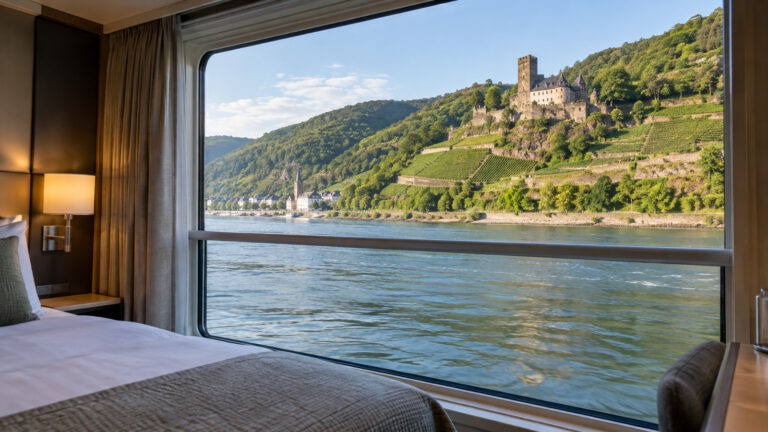
- The scenic stretches: the UNESCO-listed Upper Middle Rhine Valley runs about 40 miles between Bingen, Rüdesheim, and Koblenz, while the Wachau lies between Melk and Krems. The Iron Gates stretch of the Danube follows the Serbia-Romania border.
- The Douro is different: the Portuguese port authority APDL lists five locks between the Porto area and Barca d’Alva, including a roughly 115-foot lift at Carrapatelo. A typical round trip passes the locks in both directions.
What the current changes, and what it does not
A ship can cover more ground in an hour when the current is helping it. On the Upper and Middle Danube, viadonau’s published speed ranges show a meaningful difference between upstream and downstream travel.
That does not mean a downstream vacation is always shorter or an upstream one is always rushed. Cruise lines adjust departure times, overnight sailing, port calls, and sometimes the route itself to make the schedule work.
It also does not prove that one direction is quieter in your cabin. Noise and vibration depend on the vessel, cabin position, speed, docking, lock maneuvers, and other operations, so ask the line about the specific ship if you are sensitive to either.
This is why the day-by-day program matters more than the arrow on the map. My guide to how river cruise sailing schedules work explains why ships often move while passengers sleep.
Locks do not favor one direction
A lock raises an upstream vessel and lowers a downstream vessel, and either process can take time. Waiting depends on traffic, chamber availability, maintenance, and the lock operator’s sequence rather than a simple upstream-versus-downstream rule.
viadonau lists 18 lock facilities on the Danube, including 16 on the Upper Danube and the two Iron Gates facilities. Fourteen have two chambers, which helps traffic move in both directions.
The Rhine is busy too. The Central Commission for the Navigation of the Rhine reports average daily traffic of about 400 vessels near Cologne and 100 near Iffezheim, so delays can happen in either direction.
Lock entries may bring thruster noise, lights, and a gentle bump regardless of direction. See the guide to European river cruise locks if you want to estimate how often those maneuvers may interrupt the night.
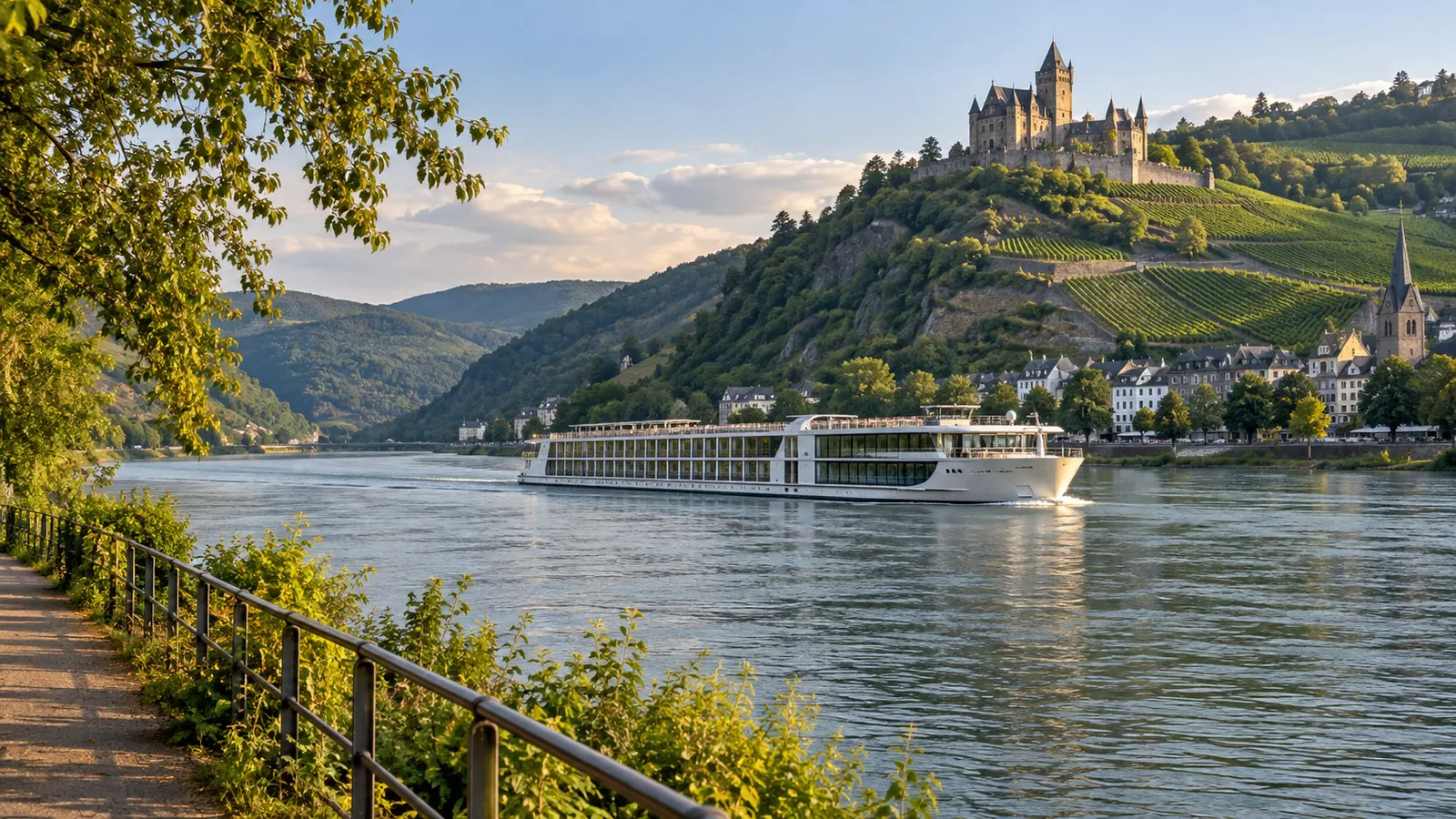
The Danube: Passau to Budapest or Budapest to Passau
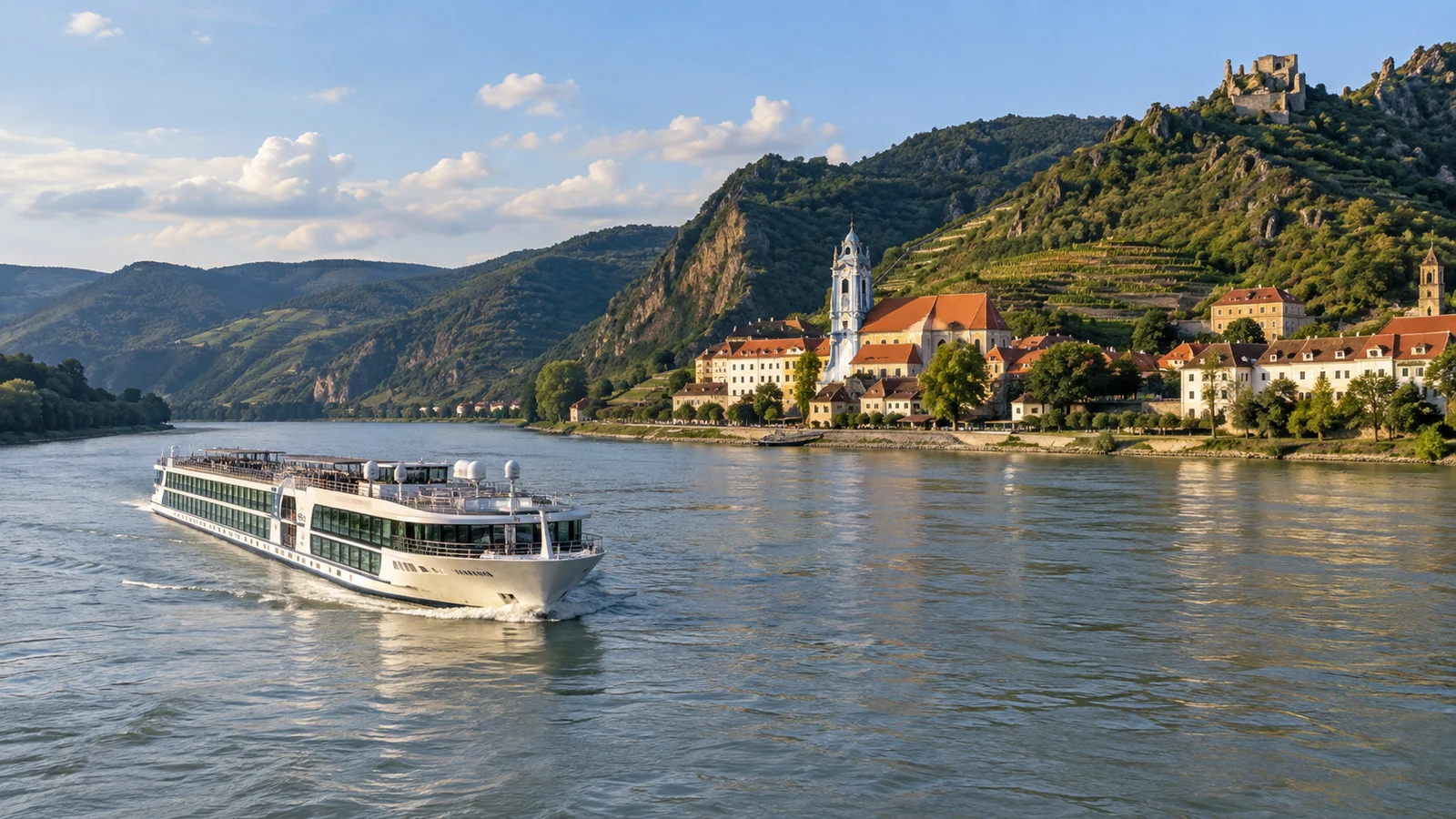
Passau to Budapest is downstream, while Budapest to Passau is upstream. Both can include the Wachau, Vienna, Bratislava, and ports near Linz, but the order, port hours, and included stops can differ.
Do not assume the downstream itinerary always crosses the Wachau in afternoon light or the upstream one always does so at breakfast. Lines can alter timing for locks, traffic, water levels, excursion schedules, and berth availability.
Ask for the current day-by-day schedule and look for a labeled Wachau scenic-cruising period. Treat the listed hour as a plan rather than a guarantee, because river operations can move it.
Choose the endpoint you most want to explore before or after the cruise. Budapest rewards extra time, and an added hotel night is safer than hoping embarkation or disembarkation day will deliver a full city visit.
The Rhine: Amsterdam to Basel or Basel to Amsterdam
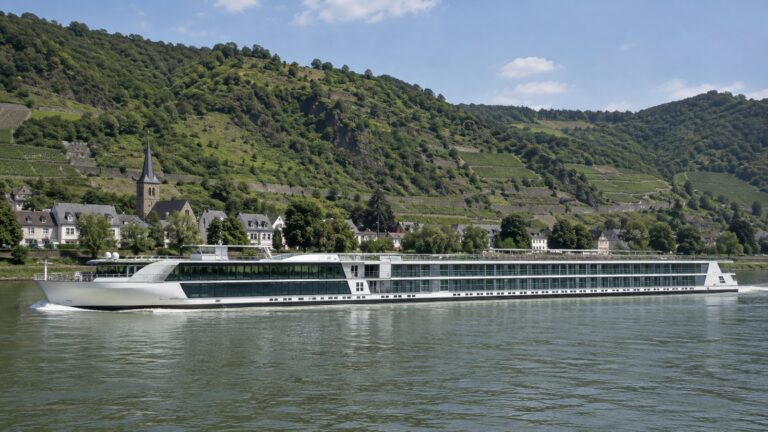
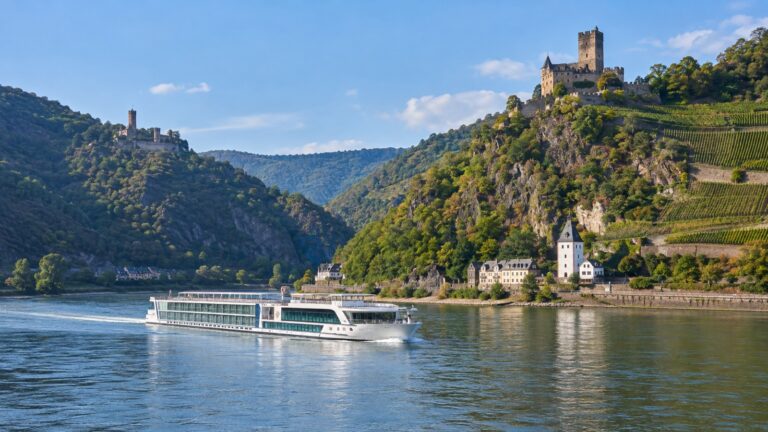
Amsterdam to Basel is upstream, and Basel to Amsterdam is downstream. The headline scenic section is the UNESCO-listed Upper Middle Rhine Valley, a roughly 40-mile corridor of castles, historic towns, vineyards, and the Loreley.
The current can make the upstream passage slower, but slower does not automatically mean more daylight sightseeing. A line may compensate elsewhere in the schedule, so compare when the itinerary expects to enter and leave the gorge.
Water level is a separate question from direction. The Kaub gauge is an important reference point in this rocky section, and the German Federal Institute of Hydrology explains its location and role in Rhine water-level monitoring.
The Rhine commission says its reference low-water level at Kaub is 30 inches, but that gauge reading is not the river’s depth. Low water can restrict draft and trigger itinerary changes in either direction, while high water can also interrupt navigation.
If river conditions worry you, read the guide to what low water can do to a river cruise. No direction can eliminate the possibility of a bus transfer, ship swap, changed berth, or adjusted sailing time.
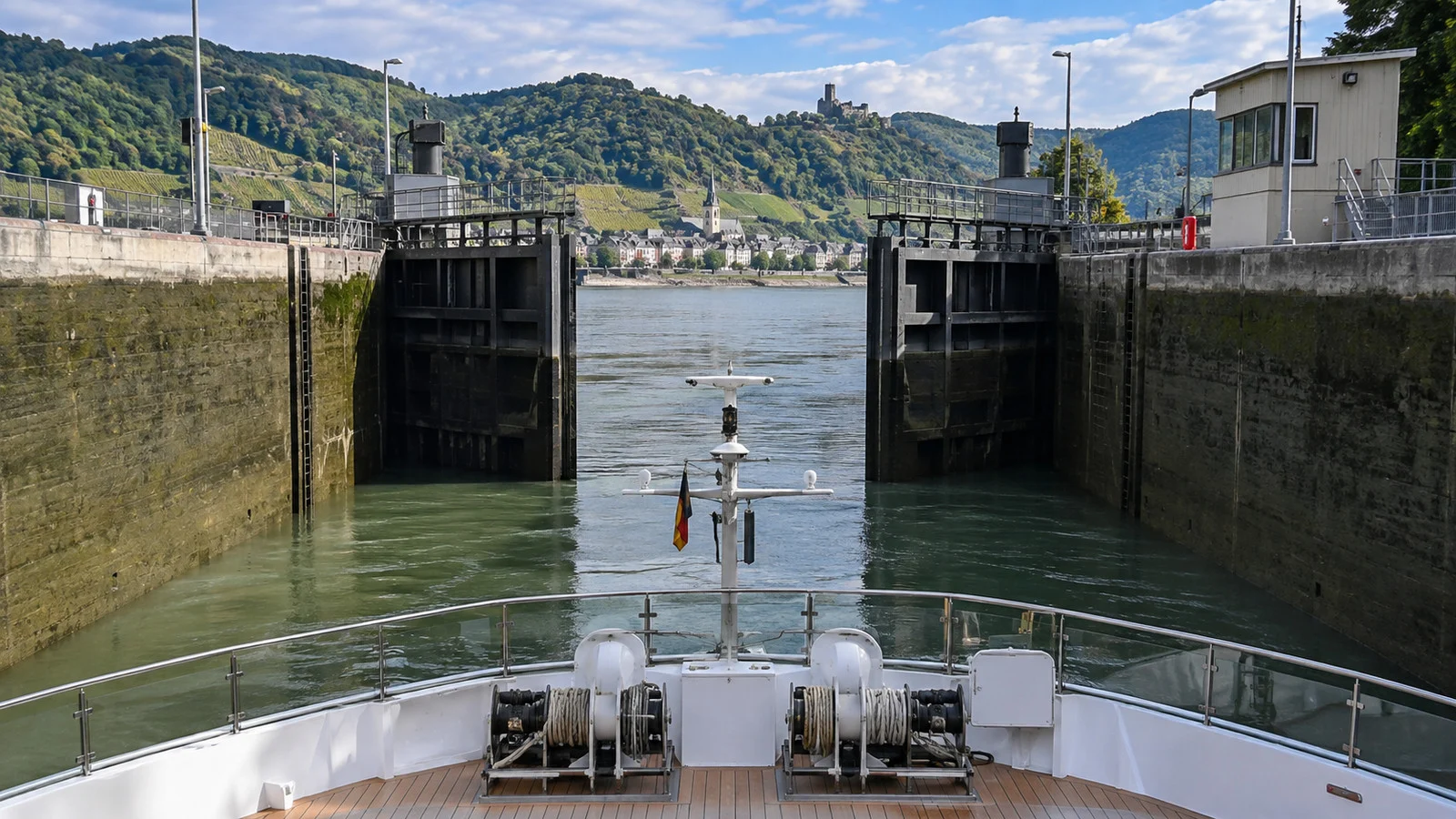
The Lower Danube and the Iron Gates
The Lower Danube has a gentler average gradient than the Upper Danube, but the current does not disappear. viadonau lists typical downstream speeds of about 11 to 12 mph and upstream speeds of about 7 to 9 mph on this section.
The Iron Gates and its two large lock facilities are the scenic and engineering centerpieces of many Lower Danube cruises. viadonau gives the lock chamber dimensions as roughly 1,017 feet long by 112 feet wide.
Do not count on the gorge or locks falling at the same time of day on every departure. Ask whether the published itinerary includes a narrated daylight passage, then remember that operating conditions can change the plan.
The guide to Iron Gates scenic cruising covers the views and practical details. Direction matters less here than confirming the passage, the docking plan, and the transfer between the ship and Bucharest.
The Douro: usually both directions
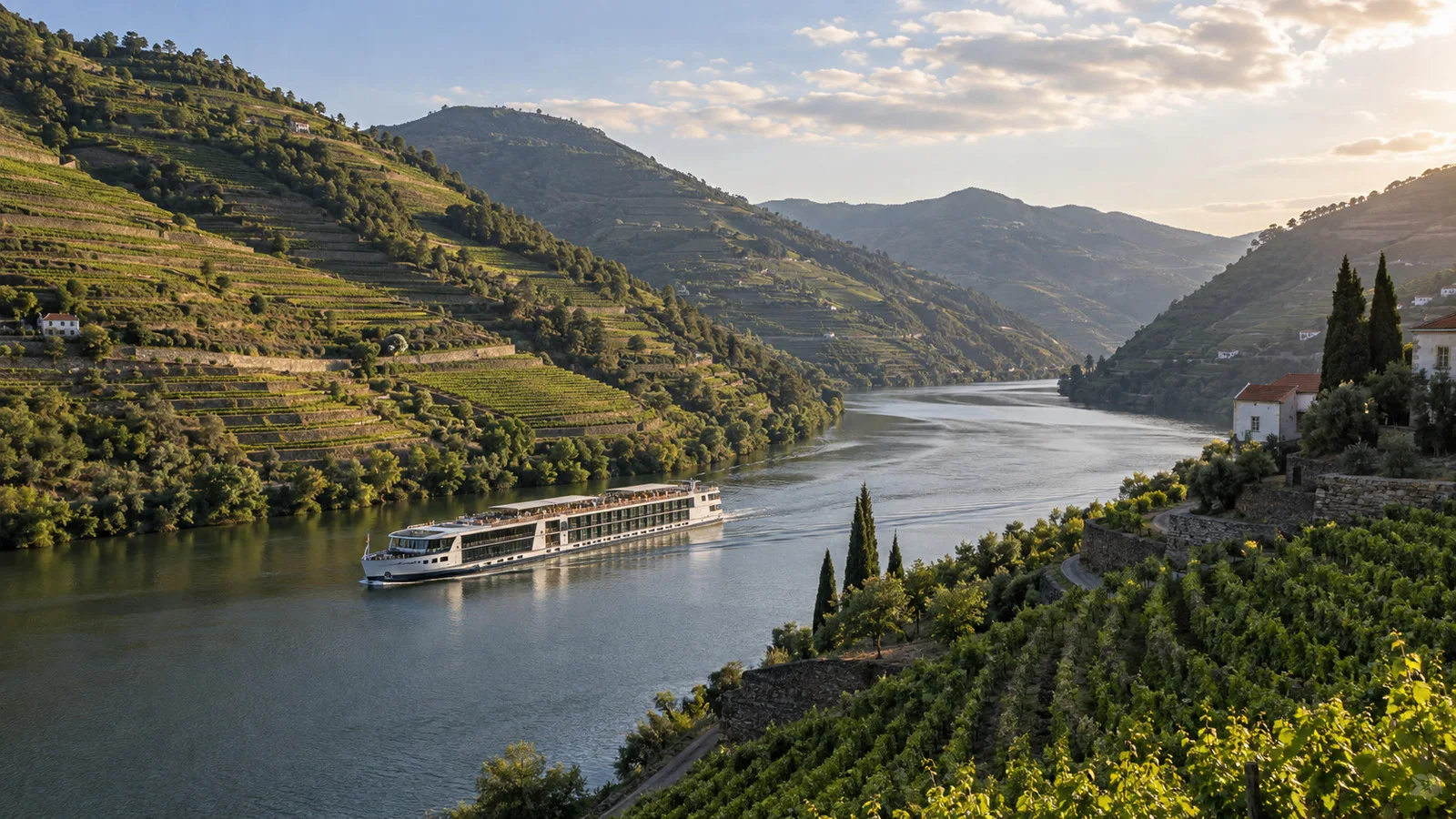
Most classic Douro itineraries begin and end near Porto, sailing upstream toward Barca d’Alva or Vega de Terrón before returning. That gives passengers both directions, but always verify the exact embarkation point and route before booking.
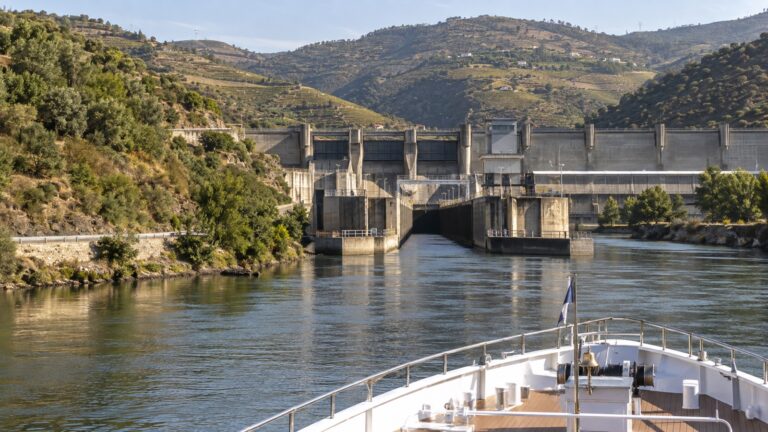
APDL lists five locks on the navigable Douro. Their lifts are about 46 feet at Crestuma, 115 feet at Carrapatelo, and 94 feet each at Régua, Valeira, and Pocinho.
The chambers are about 37 feet wide, which helps explain the slim ships designed for this river. A round-trip itinerary typically passes each lock on the way up and again on the way down.
Douro schedules often include overnight mooring, but do not treat that as a promise of a silent night or a rule covering every sailing. Read the line’s current program and see the detailed guide to the five Douro locks and dams.
How to choose your direction
- Compare the real itineraries: check port order, arrival and departure times, included excursions, scenic-cruising windows, and whether both versions visit the same places. A reversed route is not always an identical product.
- Choose your extra-night city: plan at least one hotel night before embarkation when practical, then add post-cruise time where it best suits your flights, trains, or sightseeing list.
- Ask about the exact ship: if noise or vibration is a concern, request guidance on cabin location for that vessel. My guide to port or starboard cabins explains why the side of the ship rarely solves the bigger location questions.
- Protect the must-see moment: ask when the ship expects to cross the Rhine Gorge, Wachau, or Iron Gates and whether narration is planned. Do not book a direction solely on a sample hour that can change.
- Read the disruption terms: learn what the line may do during high water, low water, lock closures, or berth changes. Direction does not protect an itinerary from river conditions.
The booking questions worth asking
Ask the cruise line or travel advisor for the current day-by-day program for your departure, not just a route map. Confirm the planned scenic-cruising times, overnight sailing, and whether the reverse itinerary has the same port calls and excursions.
Next, price the whole trip from home to home. A direction that saves you an awkward flight, a long transfer, or an expensive hotel can be the better value even if the ship spends more time working against the current.
Finally, check where the ship is expected to dock at the turnaround cities. The guide to where river cruise ships dock explains why the berth shown in a brochure may not be the berth used on your date.
A realistic word on accessibility
Direction alone does not determine whether a gangway will be flat, steep, or crossed through another rafted ship. Water level, berth, ship position, and local infrastructure can change access at any port.
Before paying, ask the line about the exact ship, cabin, gangway arrangements, steps, elevators, tendering, coach access, and assistance available on your itinerary. Also ask what happens if a berth or vessel changes after booking.
If you use a wheelchair, walker, or shoreside vehicle, request port-by-port answers in writing. Allow generous time at both ends, especially where the ship-to-airport or ship-to-station transfer is not included.
When river conditions matter more than direction
There is no single high-water or low-water calendar that predicts every departure. viadonau says high water on the Upper Danube occurs most often from May through August, while the Middle and Lower Danube more often see high water in April and May and low water from August through October.
The Rhine can face navigation interruptions during high water, while low water can limit how deeply a vessel can sit. The CCNR notes that Rhine navigation does not have one universal low-water prohibition threshold, so the vessel’s skipper must judge whether safe passage is possible.
Weather, rainfall, snowmelt, and local river management vary from year to year. Treat any seasonal pattern as context, not a forecast, and check the cruise line’s current notices close to departure.
Quick answers
Is it better to cruise upstream or downstream on the Danube?
Neither direction is universally better, so compare the actual port hours, scenic passage, and travel arrangements at Passau and Budapest.
Which direction is a Rhine cruise from Basel?
Basel to Amsterdam is downstream because the Rhine flows generally north toward the North Sea, while Amsterdam to Basel is upstream.
Do reverse itineraries visit the same ports?
Sometimes, but do not assume they are identical without comparing the current day-by-day listings for port calls, hours, excursions, and scenic cruising.
Does a Douro cruise go upstream or downstream?
A typical round trip from the Porto area does both, but some programs vary, so check the exact itinerary.
Is an upstream cruise noisier?
Direction by itself cannot answer that reliably because vessel design, cabin location, speed, locks, and docking maneuvers all affect noise and vibration.
The last word
The current is real, but it should not make the booking decision by itself. Choose the sailing whose schedule, endpoints, and scenic-cruising plan fit your trip.
Basel is one place where the direction choice connects directly to onward travel, and the Basel river cruise port guide explains its berths and transfers. On the Douro, focus less on choosing a direction and more on the exact route, ship, and Porto-area embarkation point.
Build in a hotel night, save the line’s current itinerary, and stay flexible if the river changes the plan. That is a much better strategy than chasing a supposedly perfect arrow on the map.
How this guide was researched: This guide is based on independent research using official waterway, government, port, and heritage sources, including viadonau, the Central Commission for the Navigation of the Rhine, the German Federal Institute of Hydrology, APDL, and UNESCO. See our Editorial Policy.
More on this topic: browse every guide on river cruise planning.