Douro River Locks and Dams: Five Steps From Porto to the Border
Five locks lift a Douro river ship from the Porto area toward the Spanish frontier. Their scale shapes the scenic day, while waterway slots, dam discharge, maintenance, and daylight operating patterns decide when you actually pass through.
My quick take
The locks are the best free entertainment on a Douro cruise and most passengers watch exactly one of them properly. After that they stop going up on deck, which is a mistake, because Carrapatelo and Valeira are genuinely startling.
My default is to be on the top deck twenty minutes before the ship enters the chamber, on the side the wall will rise on. You want to be in position before the crowd, not shuffling for a rail while the gates are closing.
The thing I would not do is book a Douro sailing expecting Rhine-style scenery all day and evening. The river is spectacular in a slow, dry, terraced way, and the drama is concentrated into five short episodes of concrete.
The quick facts
- How many locks: five, one at each dam, going upstream from Crestuma-Lever, then Carrapatelo, Regua, Valeira and Pocinho. Every one of them is a single chamber, so there is no staircase of small steps anywhere on the river.
- The total climb: the top pool at Pocinho sits roughly 412 feet above sea level, according to the dam records held by the Portuguese national dams commission. Five chambers do all of it between the estuary and the Spanish frontier.
- The deepest chamber: Carrapatelo. EDP gives its navigation lock a 35-meter lift, about 115 feet, and identifies it as the largest in Europe.
- Who runs them: the dams are hydroelectric plants operated by EDP, while the navigable waterway and the lock operations are administered by APDL, the port and waterway authority for the Douro. You do not book anything; your captain does.
- When you sail: Douro programs emphasize daylight navigation and generally moor overnight, but the waterway authority and operator control each lock window. Maintenance, traffic, weather, and dam operations can change the published passage time.
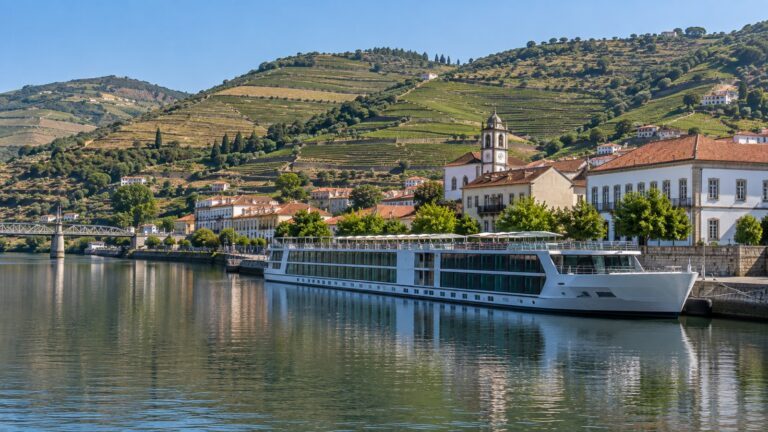
- Ship size: Douro ships are short and low compared with Rhine and Danube vessels, because the chambers and the fixed bridges set the limit. This is why fleets here are purpose-built and cannot simply be moved from another river.
- What can go wrong: high water, dam discharge, debris, traffic, and maintenance can delay a passage or change the itinerary. The practical risk depends on current waterway conditions, so do not assume the Douro will behave like another river.
The five dams, and what each one actually does
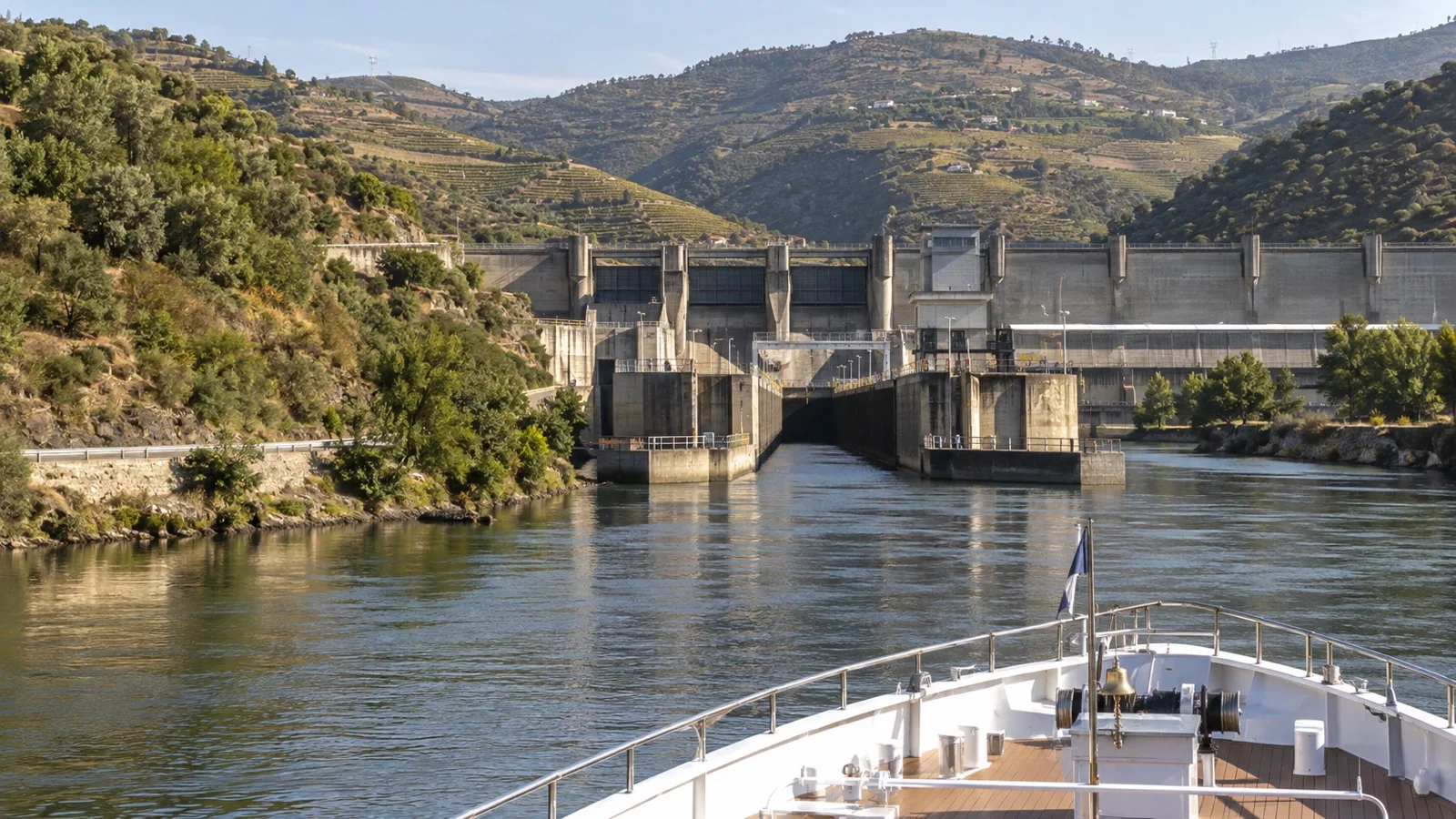
Every one of these structures is a working power station first and a navigation aid second. The lock is bolted onto the side of a hydroelectric plant, which is why you slide past turbine halls and transformer yards on the approach.
The dam records published by the Comissao Nacional Portuguesa das Grandes Barragens, which sits under the Portuguese Environment Agency, list all five with their construction dates and reservoir levels. Carrapatelo came first in 1972, followed by Regua in 1973, Valeira in 1975, Pocinho in 1982 and Crestuma-Lever in 1985.
The reservoir levels are what generate the elevators. Crestuma-Lever holds its pool at about 43 feet, Carrapatelo at about 153 feet, Regua at about 241 feet, Valeira at about 344 feet and Pocinho at about 412 feet, all measured above sea level at full storage.
Subtract each from the next and you get the working lift of each lock, which is the number your ship actually climbs. Real lifts vary a little with river flow and, at Crestuma-Lever, with the tide, so treat every figure as a close approximation rather than a fixed dimension.
Carrapatelo, and why the Douro river locks feel different
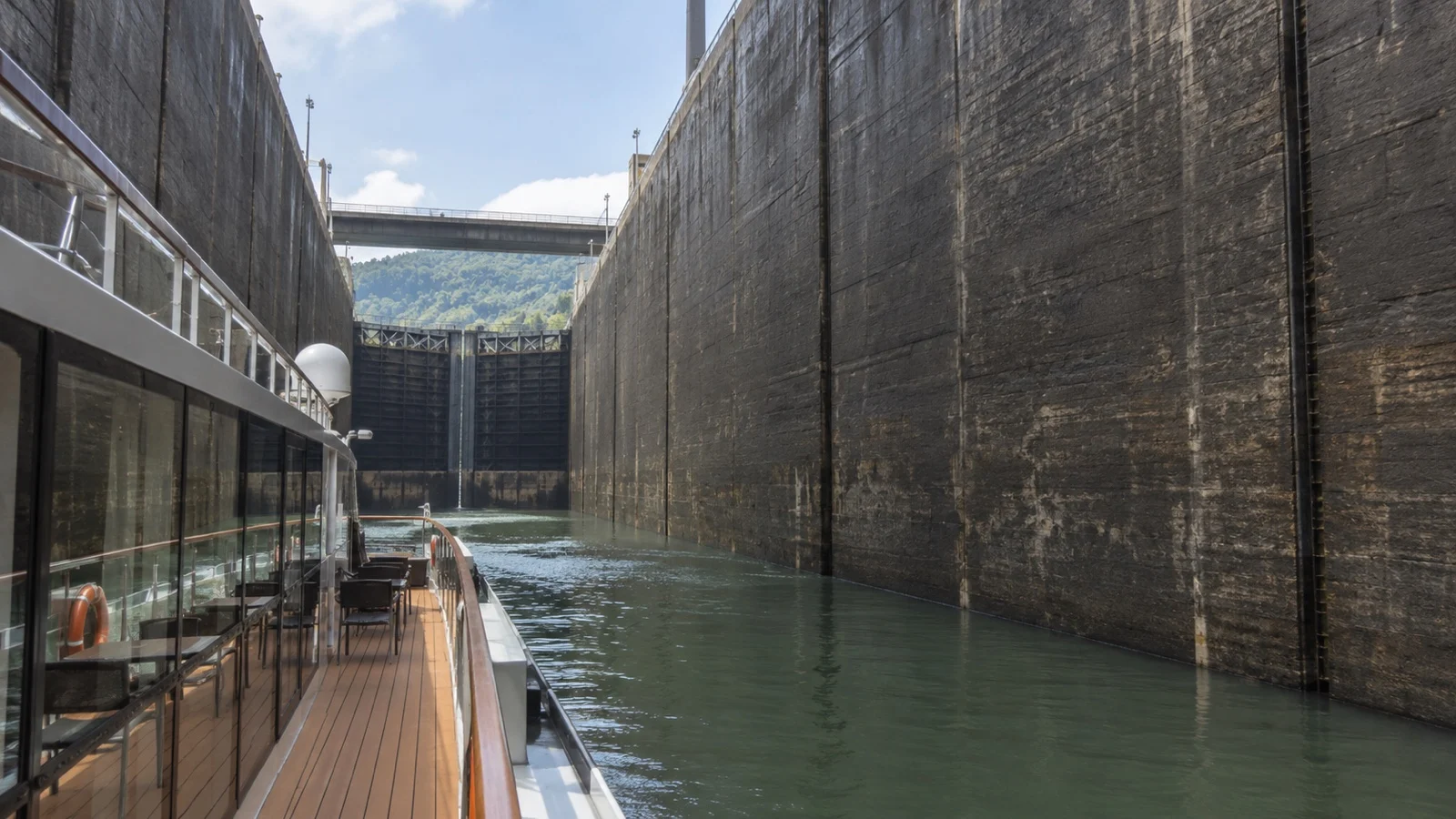
Carrapatelo is the standout. EDP gives its navigation lock a 35-meter lift, about 115 feet, and calls it the largest in Europe.
Going upstream, the ship noses into a slot with the gate towering ahead of it. The scale only registers once you are alongside the wall.
Then the chamber closes and the light changes. The ship rises or falls between tall concrete walls, with only a narrow view of the sky until the gate opens.
Coming downstream is the better experience and almost nobody says so. You start level with the vineyards, then sink into the ground while the world disappears above you, which is far stranger than watching a wall shrink.
Daylight, timing, and what that does to your itinerary
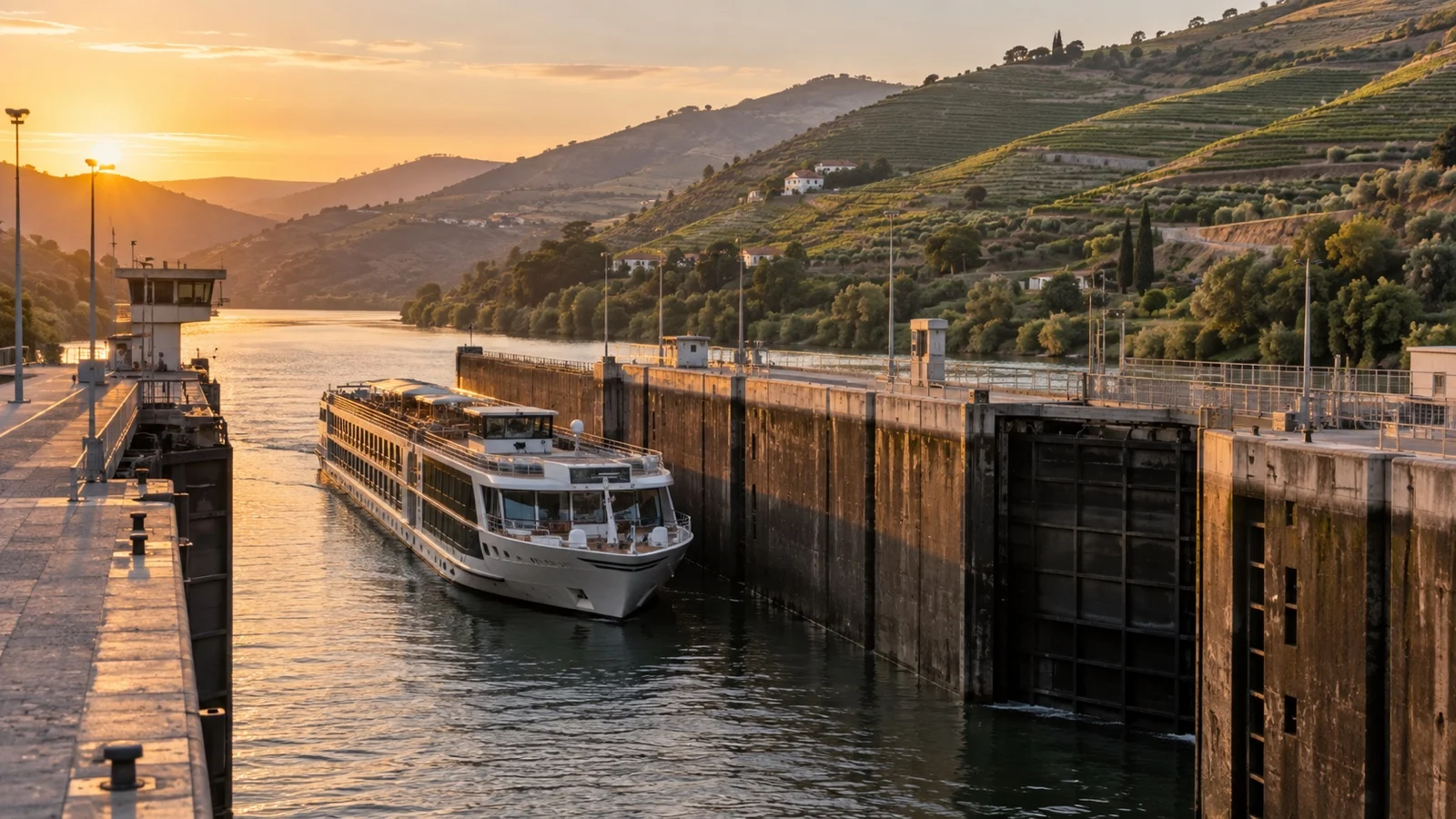
Douro itineraries are built around daylight scenery and normally moor overnight, but this is an operating pattern rather than a promise that the ship never moves in darkness. Lock slots, berth availability, maintenance, water level, and dam discharge can change the day’s sequence.
Locks are another constraint on the clock. APDL says the waterway carries commercial, tourist, fishing, and recreational traffic, so passage timing depends on the authority’s operating plan.
Ask reception the night before for the expected lock times and note them somewhere. Treat them as estimates because traffic and operating conditions can change the sequence.
If you want the wider mechanics of how chambers, lines and gate types differ across the continent, I have written that up separately in my guide to how European river locks work. The Douro is the extreme case rather than the typical one.
What can change the five-lock plan
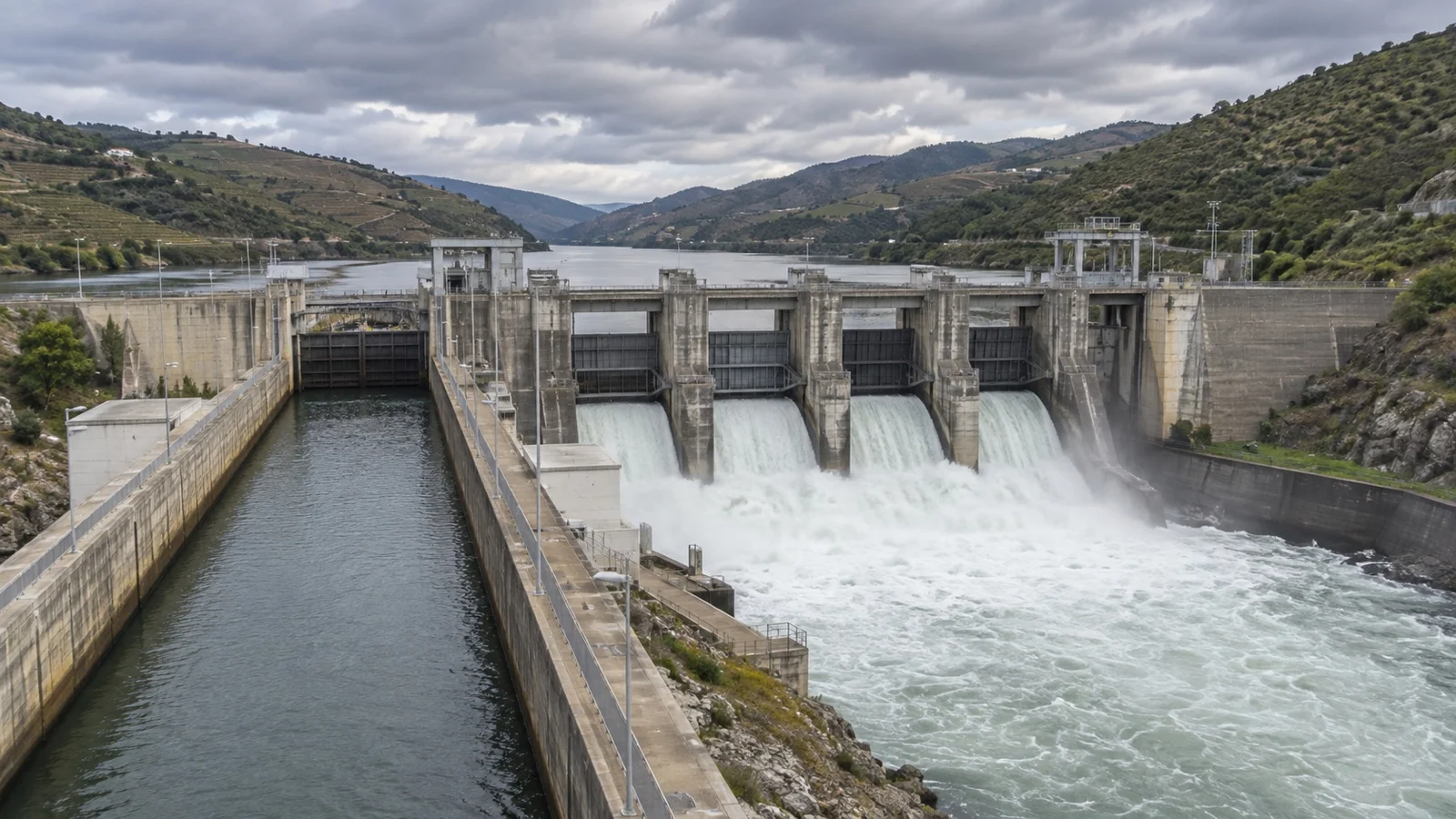
The five chambers do not change, but their timing can. APDL waterway information, scheduled maintenance, commercial traffic, high water, debris, and dam discharge can delay a passage or replace part of the river with a coach transfer.
Ask for the next day’s expected lock and sailing window each evening, but treat it as an estimate. The captain and waterway controllers have to protect the vessel and the lock schedule before a brochure timetable or excursion sequence.
A closed sun deck during a lock or low bridge is a safety restriction, not lost access that the crew can waive. Choose a lounge view if stairs are difficult, and remember that many ship elevators stop below the sun deck while vineyard quays and estates add steep grades, gravel, and steps ashore.
The lock-by-lock rundown
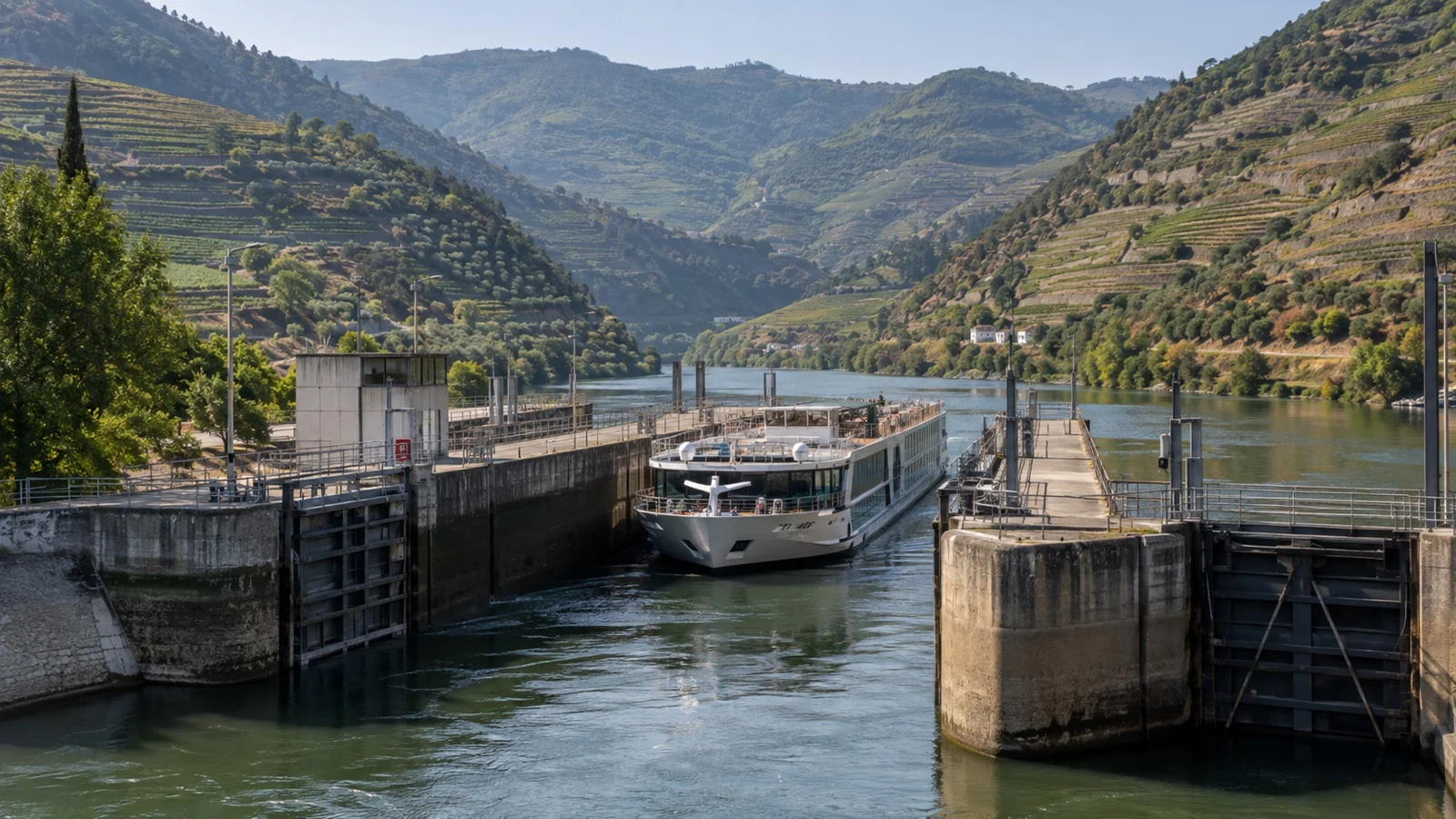
Upstream order, with the lift figure derived from the published full storage levels of each reservoir. Downstream ships meet them in reverse and the experience is quite different.
- Crestuma-Lever: the first one out of Porto, holding its pool at about 43 feet and lifting you off a tidal river. It is the shallowest lift of the five, so treat it as a rehearsal rather than the main event.
- Carrapatelo: about 115 feet according to EDP, and the reason people talk about Douro locks at all. Completed in 1972, it carries three Kaplan turbines and 201 megawatts of installed capacity alongside the navigation chamber.
- Regua: around 89 feet, at the Bagauste site just downstream of Peso da Regua. The lock sits on the left bank next to a fish pass, and the town itself is the practical capital of the wine region.
- Valeira: around 103 feet, in the narrowest and most dramatic gorge on the river. This is the one I would prioritize if the schedule forces a choice, because the setting does half the work.
- Pocinho: around 67 feet, and the last chamber before the upper river. Completed in 1982 and sitting between the districts of Braganca and Guarda, it puts you into the highest and driest stretch.
- The Cachao da Valeira: the gorge just above Valeira dam, where the river was genuinely unnavigable until it was blasted through in the eighteenth century. The reservoir has since drowned the worst of it, which is why your ship glides over water that once wrecked boats.
Fun fact: the vineyards you pass at lock level sit inside a boundary drawn in 1756, which the Instituto dos Vinhos do Douro e Porto describes as the oldest demarcated and regulated wine region in the world. The stone posts marking it went into the ground more than two centuries before any of the five dams existed.
How I would actually decide
If the locks are the reason you are considering the Douro, confirm that the itinerary reaches Pocinho and passes all five structures. A shorter route can turn before one or more of the upper locks.
For position, I would stand at the very front of the top deck on the way in, then move to the side rail once the gates shut. The front gives you the approach and the gate; the side gives you the wall.
If you are choosing between Portugal and a classic European river, the honest comparison is scenery and wine against towns and cities. My roundup of the Douro river cruise ports lays out what you actually get ashore, which is a very different offer from the Rhine.
A realistic word on accessibility
The open top deck often gives the widest lock view, but access varies by vessel. An elevator may stop below that deck, leaving stairs for the final level.
Ask the specific question before booking rather than the general one. The useful phrasing is whether the elevator reaches the open upper deck, not whether the ship has an elevator.
If the sun deck is not accessible, ask which lower open deck or lounge window offers the safest view. Carrapatelo’s tall chamber walls remain visible from lower positions.
Ashore is the harder half, because the Douro quays lead to steep towns and vineyard estates with gravel and steps. I go into the fleet-wide picture in my guide to river cruise accessibility, and the Douro sits at the difficult end of it.
When to go, and the weather
The Douro valley is sheltered from the Atlantic by the Marao and Montemuro ranges, which is exactly why the wine works and why the summers are hard going. The IVDP describes the region as having very cold winters and hot, dry summers.
Average annual temperatures across the demarcated region run roughly 53 to 62°F, with the warmest readings down in the river valley itself. That average hides a lot: standing on an unshaded metal deck in a gorge in July is a different proposition entirely.
Rainfall drops sharply as you go upstream, from about 47 inches a year in the Baixo Corgo to about 15 inches in the Douro Superior. It falls heaviest in December and January, and that winter water is what drives dam discharge.
My preference is late April to early June, or the second half of September into October for the harvest. Those windows give you daylight for the locks, workable deck temperatures, and a river that is neither in flood nor at its most punishing.
Quick answers
How many locks are there on the Douro?
Five, one at each of the dams at Crestuma-Lever, Carrapatelo, Regua, Valeira and Pocinho. Each is a single chamber, so you go up in five big steps rather than many small ones.
Which is the deepest lock on the Douro?
Carrapatelo, which lifts a ship from a pool at about 43 feet to one at about 153 feet, roughly 110 feet in one go. Valeira is the runner-up at roughly 103 feet.
Can you see the locks from your cabin?
You can see the wall, which is most of the effect, but you lose the approach and the gate. The top deck is better if you can get to it.
Do Douro ships sail at night?
Schedules vary by itinerary and operating conditions. Ask your line to confirm the sailing and lock windows for your specific route.
Is it worth getting up early for a lock?
For Carrapatelo and Valeira, yes, without hesitation. For Crestuma-Lever and Pocinho, only if you are already awake.
The last word
The Douro is an engineered river framed by a landscape shaped over centuries, and the five locks make that contrast especially clear. A ship can move from vineyard views into a deep concrete chamber beside a working power station.
That contrast is part of the attraction. The UNESCO listing for the Alto Douro Wine Region was inscribed in 2001 and covers 24,600 hectares, about 60,800 acres, within a landscape shaped by roughly 2,000 years of wine production.
If you are working out where the Douro fits against the rest of the country, my overview of Portugal cruise ports puts the river alongside the ocean calls at Lisbon, Leixoes and Funchal. They are not competing products, they are barely the same vacation.
And if this is your first river sailing, read it next to my wider European cruise ports overview before you commit. The Douro gives you fewer towns, more wine, and the only staircase in Europe that comes with a wine list.
How this guide was researched: Unless a first-hand visit is explicitly identified above, this guide is based on independent research using official port, tourism, transit, government, and attraction sources where available. Lock count and waterway management were checked against APDL, dam and reservoir data against the Comissão Nacional Portuguesa das Grandes Barragens and EDP, and heritage details against UNESCO and the Instituto dos Vinhos do Douro e Porto.
Logistics and time-sensitive details were reviewed on September 12, 2026. See our Editorial Policy.
More on this topic: browse every guide on river cruise planning.