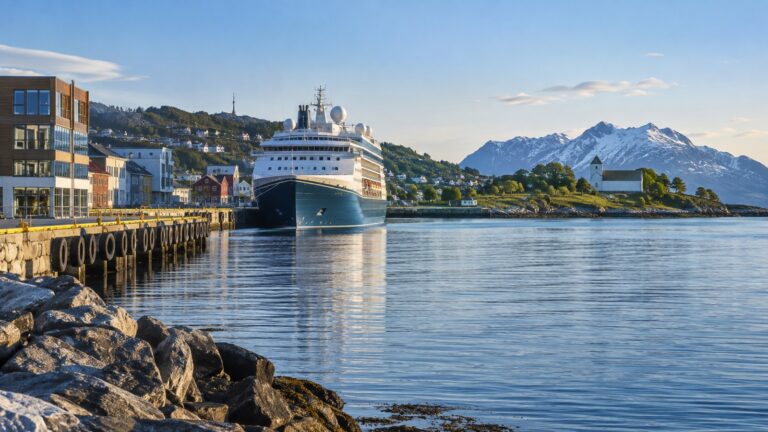
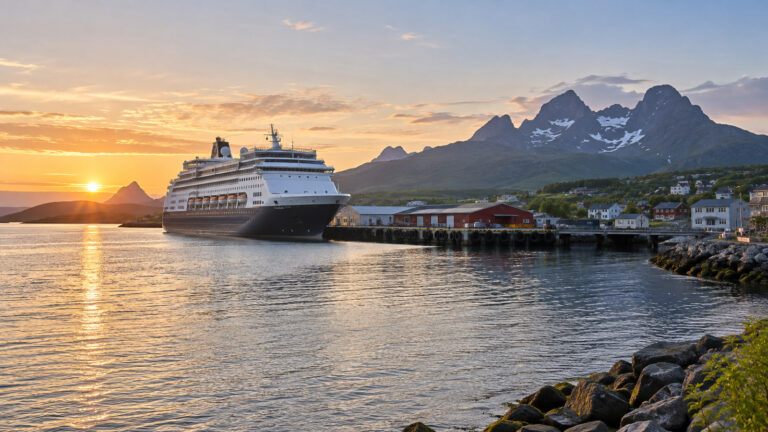
Skjervøy Cruise Port: Fifteen Minutes in an Arctic Fishing Town
Skjervøy will not be the port that sells your Norway cruise. It might be the one you remember.
Hurtigruten stops here for fifteen minutes, twice, on the classic Bergen to Kirkenes run. Here’s what that quarter hour is actually worth.
My quick take
With only fifteen minutes in port, this is not a conventional sightseeing call. Step ashore only when the crew confirms there is time, and stay beside the ship.
That’s not a knock on the town. Skjervøy has a 1728 church, an Arctic dog-sledding legend, and some of Norway’s best winter orca watching, you just won’t see any of it from the gangway.
If Skjervøy is one stop on a longer coastal voyage, read our full guide to Hurtigruten’s ports first. It’ll tell you which calls reward getting off the ship, and which ones, like this one, mostly don’t.
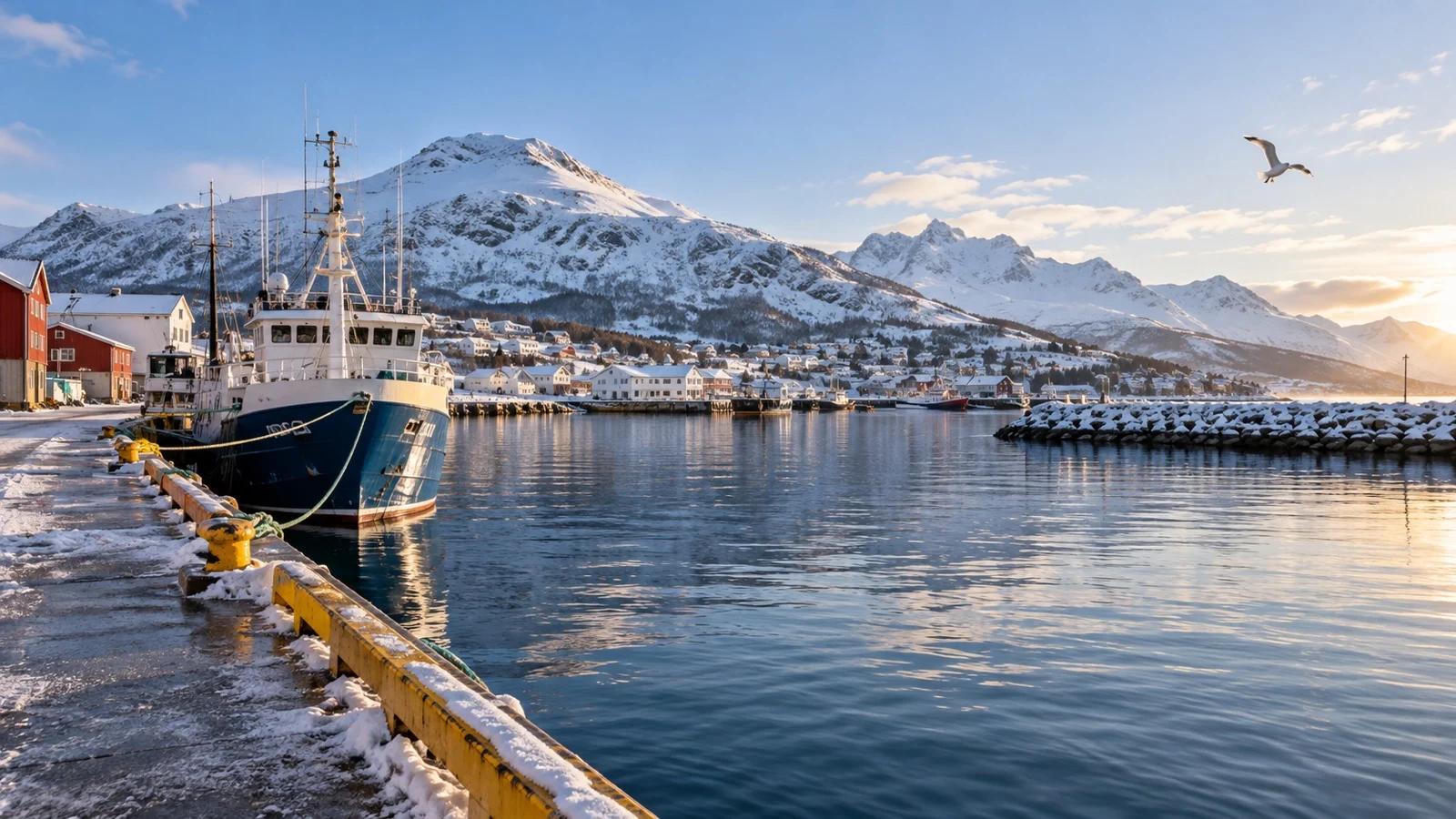
Skjervøy quick facts
- Where you land: Havnegata 18, Skjervøy, on the island of Skjervøya, Troms county, Arctic Norway
- Dock or tender: Alongside the quay, no tendering
- Into town: A short, mostly flat walk from the ship to the village center
- Currency and language: Norwegian krone (NOK), Norwegian, with Sami and Kven heritage in the wider region
- Time zone: Central European Time (UTC+1), CEST in summer
- Operational caution: Treat the fifteen minutes as a working stop rather than a shore excursion, and know that Arctic weather can shorten or skip any coastal call
- Best independent plan: Stay near the gangway for harbor views; the church, Seppalatunet, and whale safaris require a longer visit
Fifteen minutes at the quay
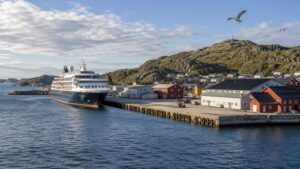
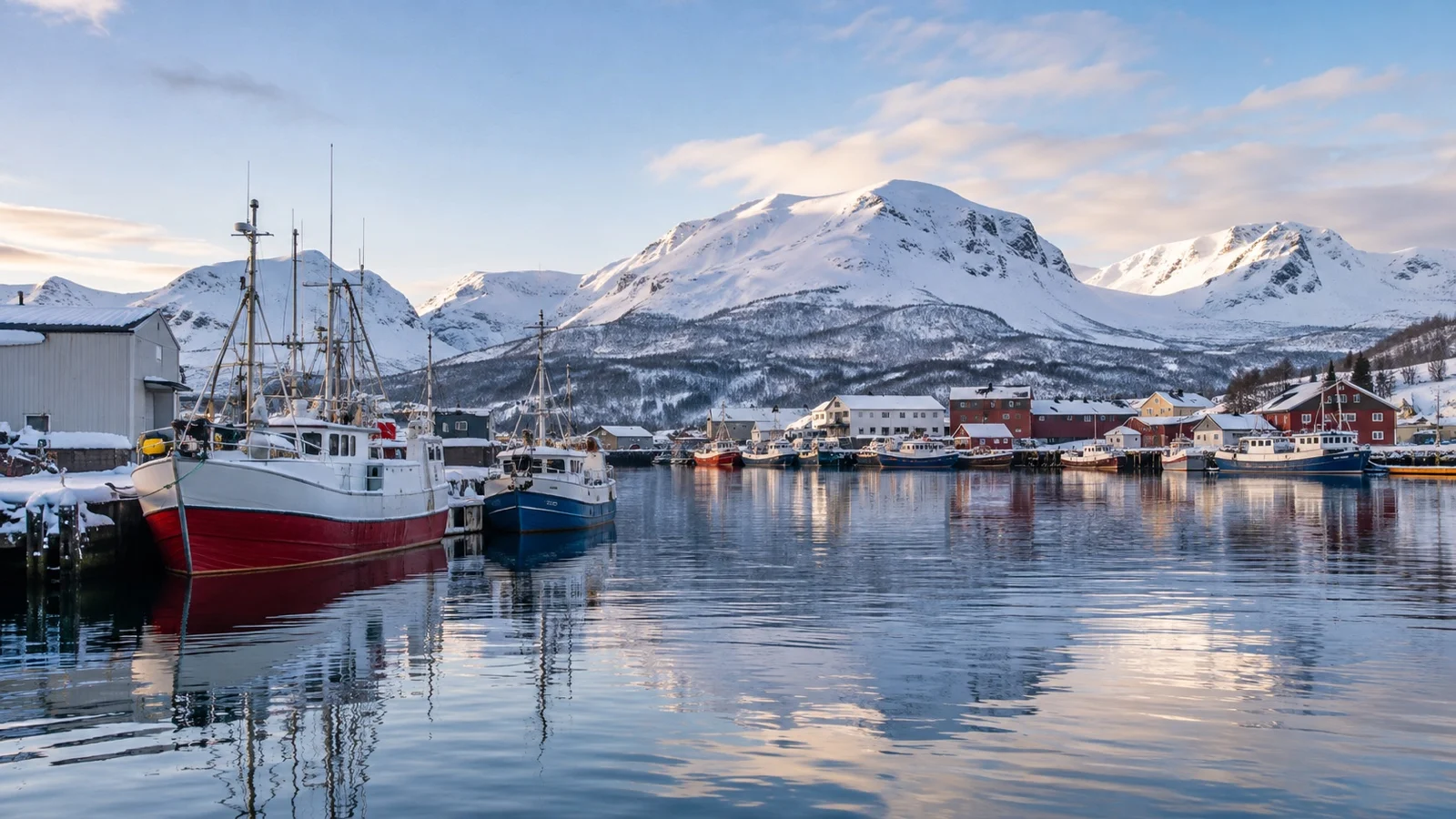
Hurtigruten ships dock directly alongside the quay at Havnegata 18, a working fishing harbor on the eastern shore of Skjervøya. There is no tendering, and the ship ties up long enough to handle cargo and passengers.
The stop runs about fifteen minutes in each direction, northbound and southbound, on the Bergen-to-Kirkenes route. That’s short even by Coastal Express standards, where most calls run under an hour anyway.
The line has called here since 1896, and Skjervøy itself was already a working trading post founded more than two and a half centuries earlier. It’s one of the older continuous stops on the entire route.
By coincidence, 1896 is also the year Fridtjof Nansen’s polar ship Fram returned to Skjervøy after three years trapped in Arctic sea ice during his North Pole expedition. Nothing about that history is visible from the quay today, but it’s part of why such a small harbor has such an outsized name in Arctic exploration circles.
Since 2021, Norway’s coastal route has been split between two companies, Hurtigruten and Havila Voyages, running a mix of ships between Bergen and Kirkenes. If you’re aboard a Havila ship rather than a classic Hurtigruten vessel, the Skjervøy stop is still short, though schedules and exact minutes differ by company and ship.
Getting into what little town there is
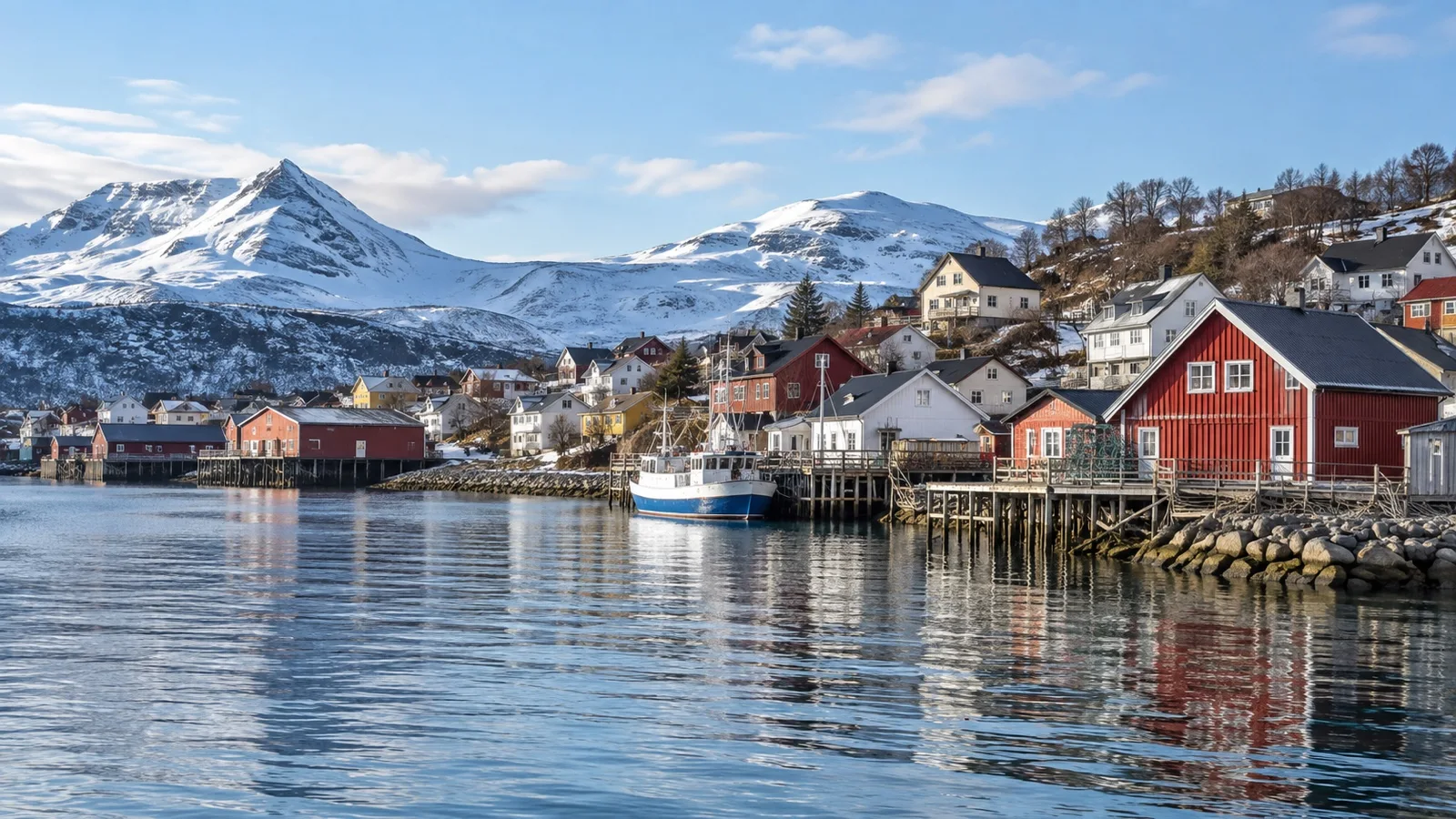
The quay sits at the edge of the village, so the short walk in is genuinely short. Skjervøy’s church, a handful of cafes, and the harborfront are all within a few minutes on foot.
Don’t expect much beyond that in fifteen minutes. This is a village of roughly 2,500 to 2,800 people, not a cruise-terminal town built for turnaround crowds.
Skjervøya is connected to the mainland by the Maursund Tunnel and to neighboring Kågen island by the Skjervøy Bridge, which is how locals and the region’s few visitors actually get in and out day to day. None of that matters for a fifteen-minute call, but it explains why a town this size feels reachable rather than isolated.
The pull of Skjervøy
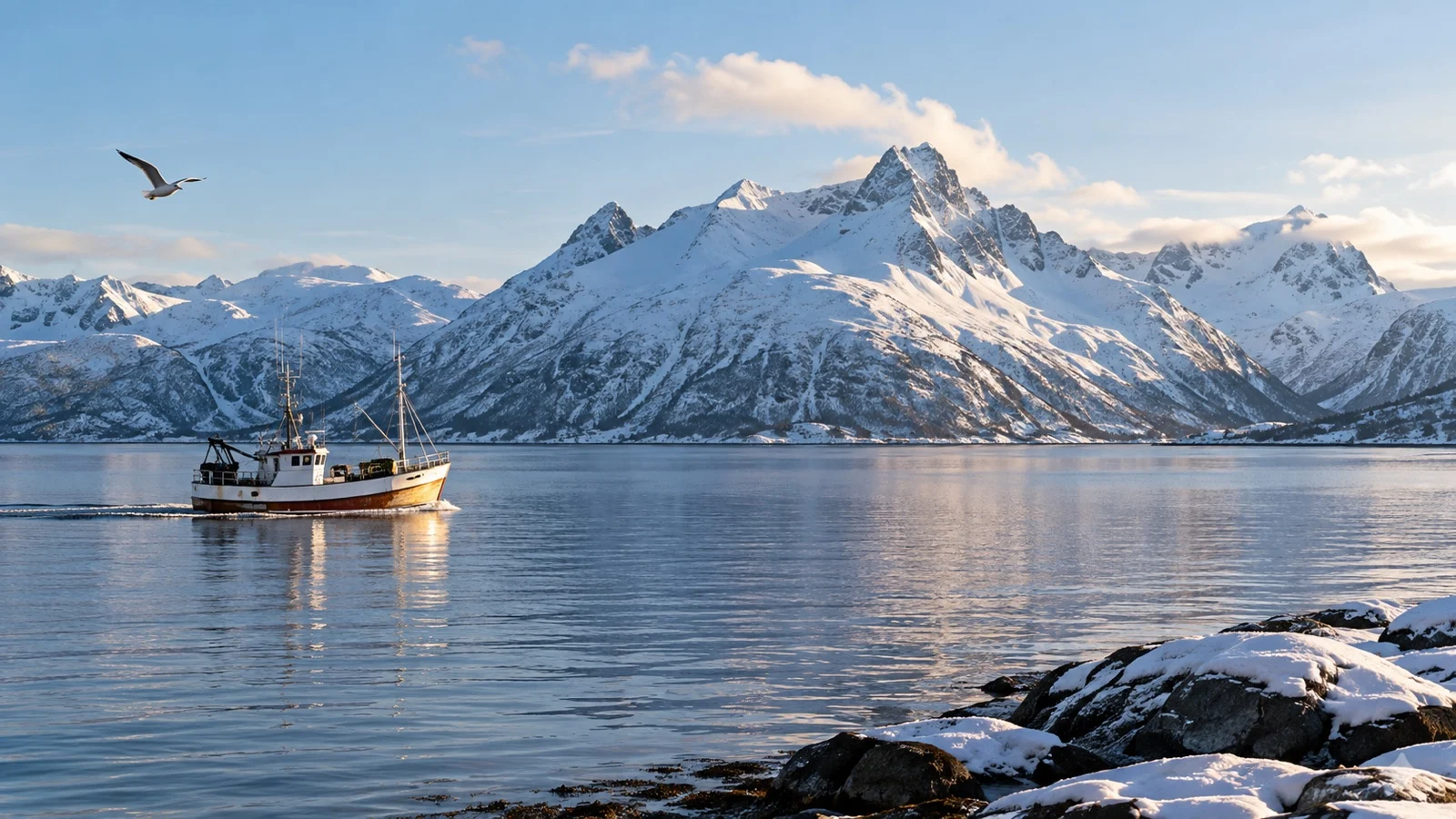
None of what makes Skjervøy interesting fits into a quarter hour, but it’s worth knowing what you’re skipping. Here’s the short version.
Skjervøy Church, the oldest wooden church in Troms
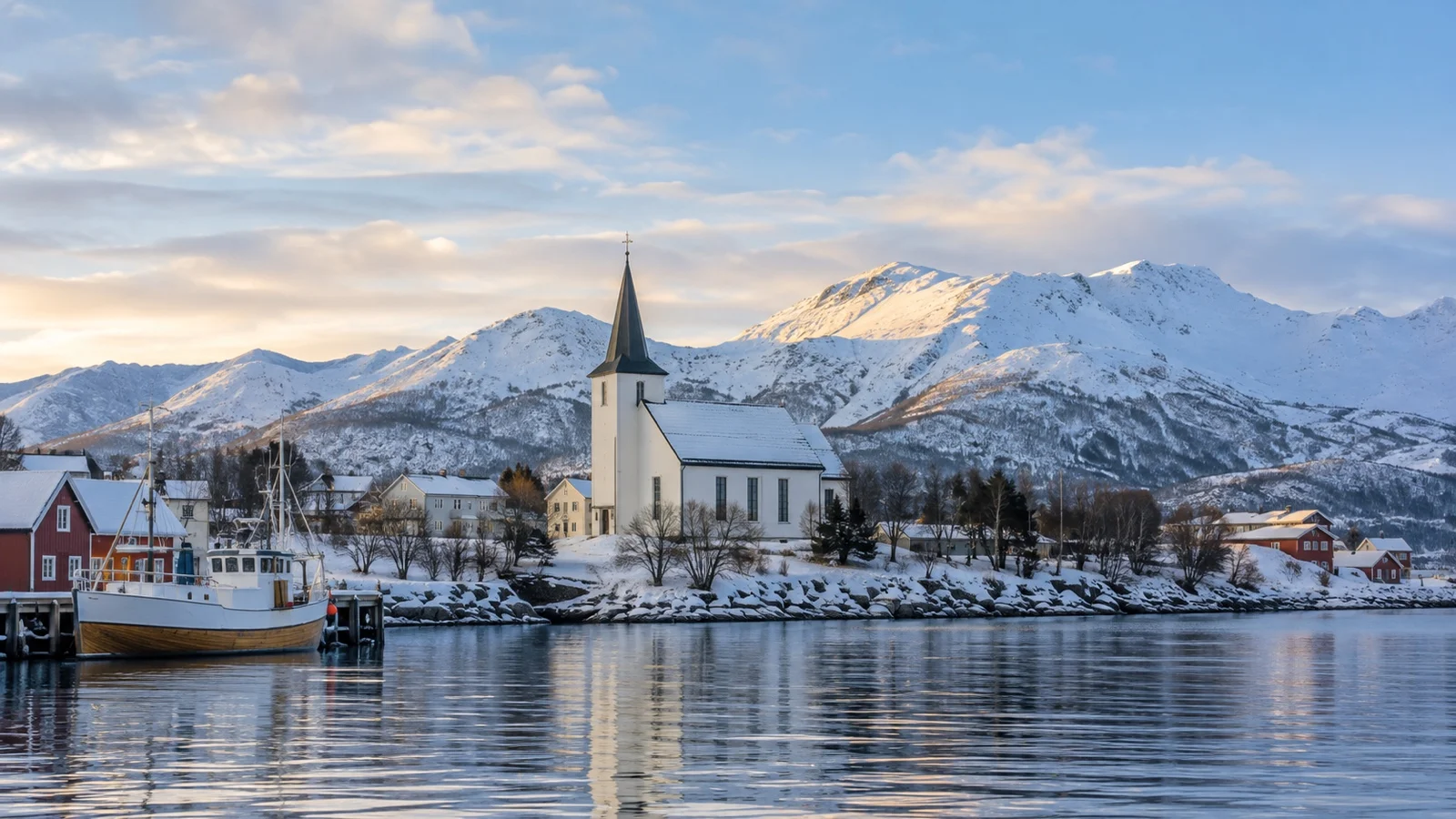
Skjervøy Church dates to 1728, making it the oldest wooden church still standing in Troms county. It sits a short walk from the quay, on the same small island the town takes its name from.
Leonhard Seppala and Seppalatunet
Leonhard Seppala, the fisherman’s son who became one of the most celebrated dog mushers in Arctic history, was born here in 1877. He’s best remembered for his lead role in the 1925 serum run to Nome, and his former home, Seppalatunet, still stands in town.
Winter orcas and humpbacks
Every winter, orcas and humpback whales follow migrating herring into the fjords around Skjervøy, drawing whale-watching boats from town and from Tromsø. Current safaris from Skjervøy take about three hours, so they cannot fit a fifteen-minute port call.
Ship excursion or go it alone
There’s not really a decision to make here. Hurtigruten’s Skjervøy call is too brief for a bookable shore excursion, ship-run or independent.
If whales or the church matter enough to you, the honest move is to plan a separate stay, flying into nearby Sørkjosen or basing yourself in Tromsø for a dedicated whale safari. Treat the port call itself as a bonus, not the reason to book.
Several operators run winter whale safaris based out of Skjervøy itself, timed to when herring and whales are actually in the fjord. Book one as a standalone trip if you are staying independently, not as something to squeeze around a ferry call.
Accessibility, honestly
The quay area itself is flat and manageable, but a fifteen-minute call rarely leaves room for a slow, careful disembarkation. In practice, most passengers with mobility limits will do better watching from the ship’s rail than attempting the dock.
Ramp and gangway details vary by ship, water level, and weather. Ask at reception before assuming you will have time to disembark safely.
Weather and safety
Skjervøy sits north of the Arctic Circle with a subarctic climate. Winter conditions can include snow, ice, strong wind, and very limited daylight.
Norway’s nationwide emergency numbers apply here as anywhere else in the country: 112 for police, 113 for medical emergencies, and 110 for fire. Save them before you go ashore anywhere in Arctic Norway, not just here.
The flip side of the dark, whale-friendly winters is a summer with almost no real night at all, since Skjervøy’s latitude puts it well within midnight sun territory. Which season you sail in changes the town more than the port call ever will.
Timing your return to the ship
Hurtigruten is a working coastal ferry as much as a cruise, and it runs on a real schedule, not a leisure one. With only fifteen minutes in port, there’s essentially no margin for wandering.
Be back at the gangway well before the posted departure time. No independent traveler should assume the ship will wait.
How Skjervøy fits a Norway cruise
Skjervøy works best as one blink in a longer Arctic itinerary, not a reason on its own to book. It pairs naturally with the same winter season that makes the northern lights worth chasing further along the same voyage.
It also sits in the same expedition-style category as Norway’s more tightly regulated waters further north. If strict passenger and landing rules interest you, our Svalbard cruise rules guide covers the far stricter neighbor beyond it.
And if you’re curious how Norway is reshaping cruise access more broadly, see our piece on the country’s zero-emission fjord rules, which don’t apply at Skjervøy but shape plenty of nearby itineraries.
The practical checks I would make before Skjervøy
Treat the published 15-minute Coastal Express call as a working stop, not an excursion window. The ship is alongside at the town quay, but passengers should step off only when crew confirm the gangway and return time, then remain close enough to board immediately.
Whale watching, Seppalatunet, and a proper church visit belong to a longer expedition call or a land stay. Winter safaris take hours and depend on wildlife and weather, so never book one against a standard Hurtigruten stop.
Check Norway and Schengen entry rules, the live sailing plan, winter road and weather warnings, and wildlife-tour policies. Ice, snow, darkness, fishing activity, and a moving gangway can make staying aboard the friendliest and safest recommendation.
Quick answers
Do ships dock or tender at Skjervøy?
Ships dock directly alongside the quay at Havnegata 18. There’s no tendering involved.
How long is the port call?
About fifteen minutes each way on the classic Bergen-Kirkenes route. Treat that as approximate, since weather and cargo can shift port times on this route more than on a typical big-ship itinerary.
Is Skjervøy worth staying aboard for?
If you want a full shore excursion, no, there isn’t time. If you’re happy with a photo from the rail and a bit of Arctic history, yes.
Can I go whale watching from Skjervøy?
Yes, but as a dedicated day trip in winter, not during the port call itself. Boats run from both Skjervøy and Tromsø when orcas and humpbacks are feeding on herring.
What’s the nearest airport?
Sørkjosen Airport is about 26 miles away, roughly 40 to 56 minutes by car, taxi, or bus. Widerøe operates the regional flights, mostly connecting through Tromsø.
What currency and language will I need?
You will use Norwegian krone and hear Norwegian. English is commonly used in visitor-facing businesses, but it is polite to ask before assuming.
The last word
Skjervøy won’t make anyone’s list of must-see cruise ports, and that’s fine, it was never built to be one. It’s a working fishing town that happens to be on the route, and Hurtigruten treats it exactly that way.
Enjoy the fifteen minutes for what they are: a glimpse of Arctic Norway between two much longer stops. For the rest of the voyage, our Hurtigruten ports guide and small-ship ports guide cover where the real time ashore happens.
How this guide was researched: Unless a first-hand visit is explicitly identified above, this guide uses current information from Hurtigruten, Visit Tromsø, Visit Lyngenfjord, and Norwegian authorities. Logistics and time-sensitive details were reviewed on September 12, 2026; reconfirm the sailing plan, weather, accessibility, costs, and final departure under our Editorial Policy.
More on this topic: browse every guide on expedition and alternative cruises.