Aranui Cruise: The Cargo Ship That Takes You to the Marquesas
Aranui 5 is a passenger-cargo ship where the day’s most memorable scene may involve a crane and a village’s supplies. The freight is the reason the route exists, not a novelty added for passengers.
That working schedule shapes landings, time ashore, and itinerary changes. If you want the Marquesas and enjoy the cargo operation as part of the trip, it is a special way to reach them.
Quick take
This is a distinctive French Polynesia trip, but it will not suit every traveler. It reaches the Marquesas, roughly 930 miles northeast of Tahiti, after crossing through the Tuamotu region.
The current 12-day, 11-night round-trip from Papeete calls at all six inhabited Marquesan islands, and that is the reason to go. The freight schedule is what makes this broad island coverage possible.
Treat the cargo work as a central part of the voyage and the excursions as one part of the experience. Watching supplies move between ship and village provides useful context for life on remote islands.
Do not book this expecting a resort-style schedule. There is a pool, spa, and Sky Bar, but freight operations still shape the day.
The quick facts
- The ship: Aranui lists the Aranui 5 at about 413 feet long, with a roughly 72-foot beam and a 17-foot draft. It carries around 230 passengers in 103 cabins, plus a cargo capacity the company gives as 1,226.5 tons.
- Where you start and finish: Papeete, Tahiti, with departure around midday on day one. This is a freight operation, so do not assume the passenger quay in front of town.
- How you get ashore: a mix of wharf walk-offs and boat landings, because several Marquesan villages have no berth deep enough for a roughly 413-foot ship. Aranui’s own blog describes barge landings at islands with no built wharf, and the ship’s boats are known locally as whaleboats.
- How long the cruise is: the current standard Marquesas itinerary is 12 days and 11 nights round-trip from Papeete. Longer special voyages use the same ship for other parts of French Polynesia and occasional calls beyond it.
- How long you get ashore: Aranui quotes roughly 3 to 5 hours per call, tied directly to loading and unloading. Its practical notes say visits ashore are limited to the time required by cargo operators and port restrictions, which is unusually honest phrasing.
- Currency and language: The CFP franc, XPF, and French, with Marquesan spoken in the villages and English widely used on board.
- Time zone: Tahiti runs at UTC-10 and the Marquesas at UTC-9:30, so the clocks go forward half an hour partway through the cruise.
- How often the itinerary changes: often enough that Aranui warns about it in writing. Ports, dates and duration can all vary before departure and while you are at sea.
What an Aranui cruise actually is
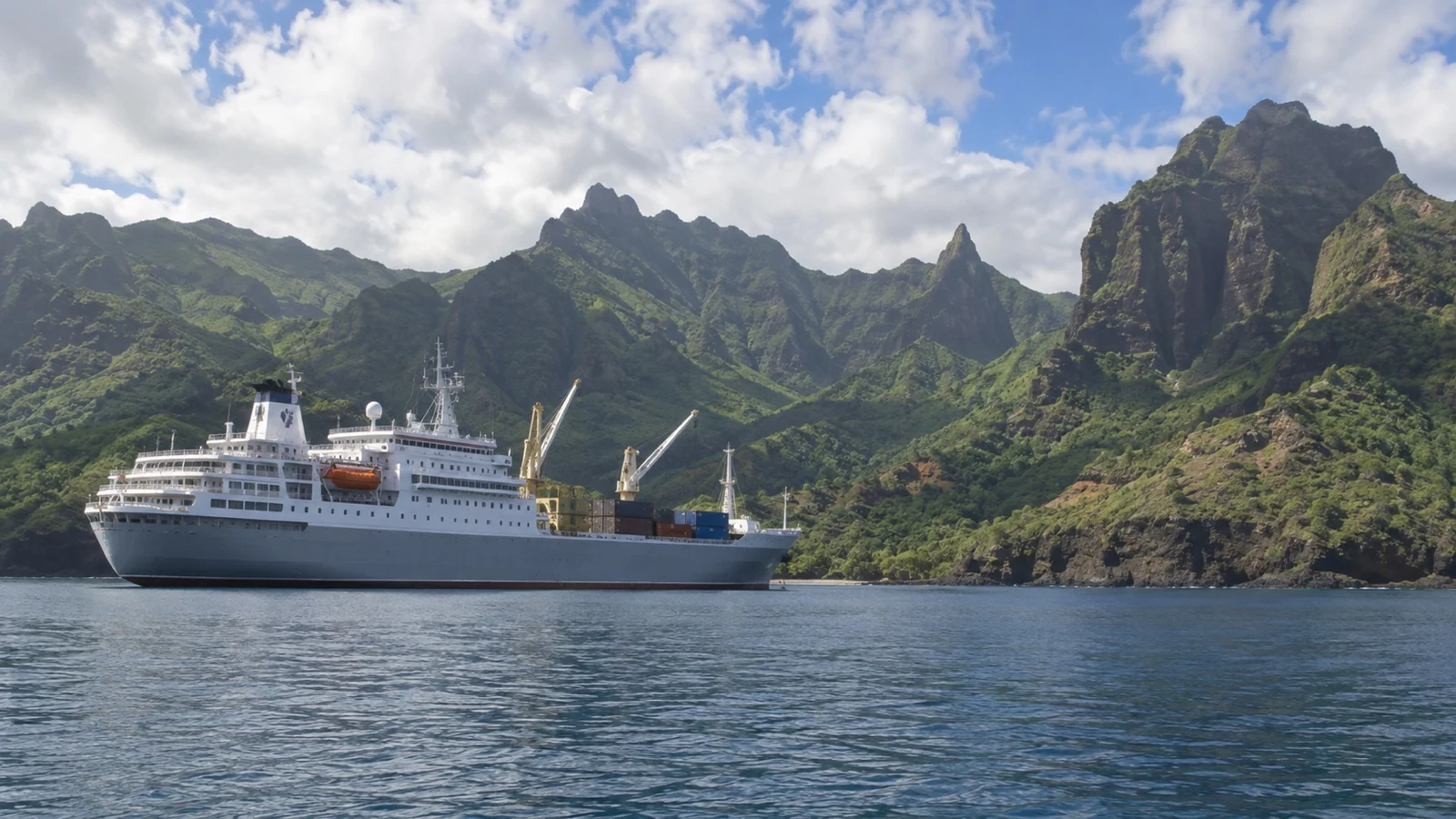
Aranui Cruises has been running freight and passengers to the Marquesas since 1984, and the company describes itself as the primary source of both for the archipelago. That is not marketing puff, it is a supply chain.
The forward half of the ship is a cargo operation with cranes, containers and a deck crew who are working, not performing. The aft half has cabins, a restaurant, three bars, a pool, a gym and a tattoo studio with a Marquesan artist aboard.
Passengers can stand on deck and watch the whole thing, and most do. Building materials, vehicles and food go ashore; copra, dried coconut flesh, comes back on, along with noni fruit, fish and citrus.
Nearly all the crew are Polynesian, drawn from across the five archipelagos, and many have been aboard for decades. They also form the entertainment, the guides and the band, which sounds like a cost-saving measure and is actually the point.
Fares are all-inclusive in a specific and limited way. Meals, shore excursions, lunches ashore, lectures and a shared bottle of wine at scheduled meals are in; alcohol at the bar, gratuities and optional diving are not.
The route, and why it runs the way it does
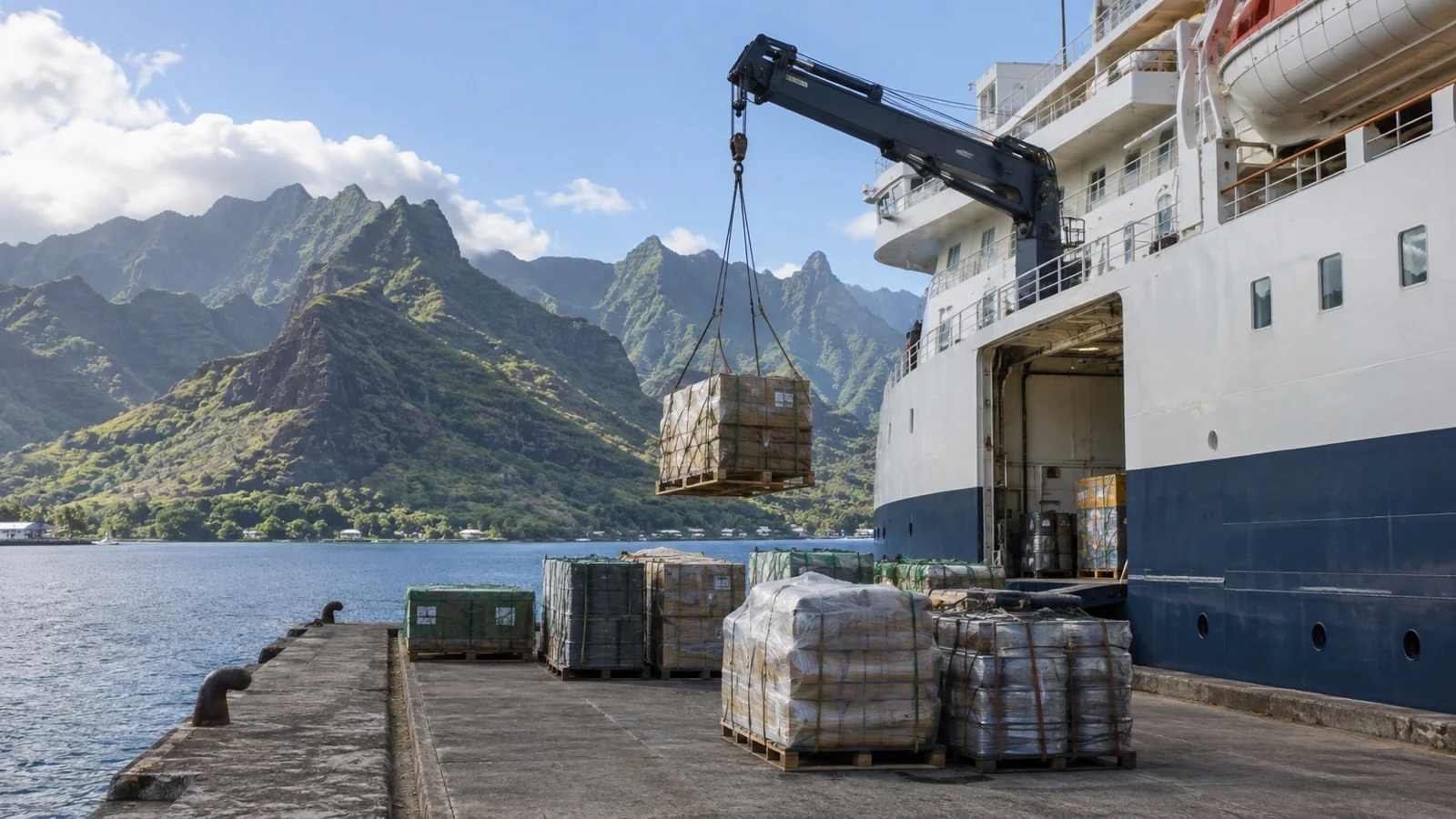
The published Marquesas itinerary leaves Papeete at midday and reaches Fakarava in the Tuamotus the next morning. Fakarava has been a UNESCO biosphere reserve since 2006, and the call is a short one built around the village of Rotoava and the lagoon.
Then comes a full sea day, which is not padding. The onboard lecture program uses the time properly.
Days four to nine are the archipelago itself, in an order that reflects where the freight is going. Nuku Hiva first, then Ua Pou, Hiva Oa, Tahuata, Fatu Hiva and Ua Huka, with Hiva Oa usually appearing twice because Atuona and Puamau are on opposite sides of the island.
The return leg includes another sea day and typically stops at Rangiroa before Papeete, with the precise island sequence set by the dated sailing. Rangiroa is the dolphin and drift-diving stop at Tiputa Pass; Bora Bora is the decompression day on a private motu.
Treat the printed day-by-day as a strong intention rather than a contract. The ship has delivered cargo to these islands for four decades and the villages come first.
Landings, swell and the bit nobody warns you about
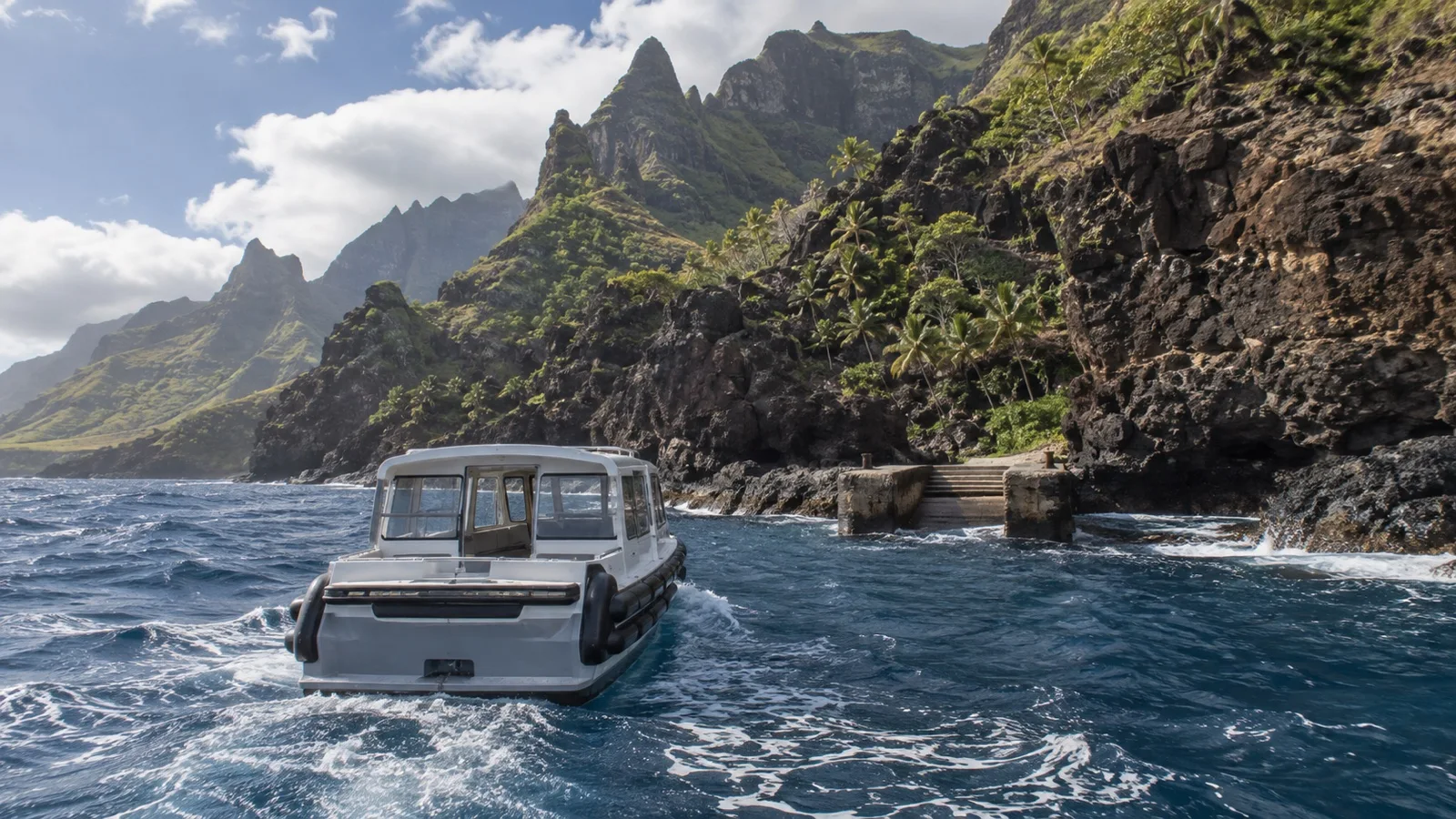
The Marquesas have no barrier reef, which is the single most important physical fact about the archipelago. Ocean swell arrives at the shoreline with nothing to break it, which is why the cliffs are so dramatic and why landings are so variable.
At the bigger villages there is a concrete quay and you walk off. At the smaller ones you transfer into the ship’s boats and go in on a rising and falling gunwale, with crew hauling you across at the right moment.
Vaipaee on Ua Huka is the one people talk about afterward. The bay is so narrow that the ship turns 180 degrees inside it before working cargo, which is the sort of seamanship you normally only see on a tug.
Ask the cruise director at the evening briefing which of the next day’s calls uses a boat landing and which uses a quay. That answer should guide footwear and what you carry.
Stops worth planning for
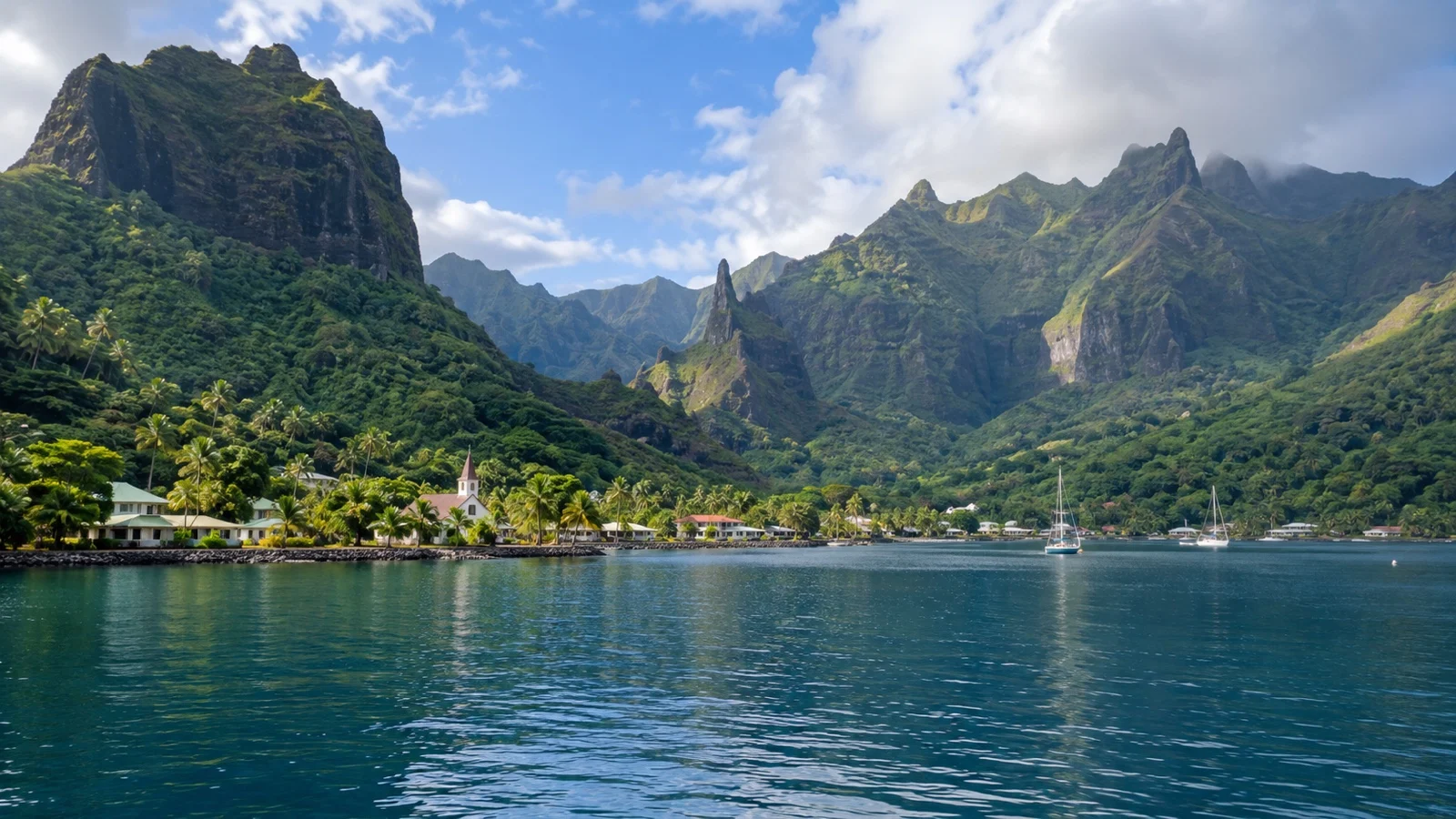
- Nuku Hiva: the largest Marquesan island and the administrative center, with Taiohae, Taipivai and Hatiheu on the program. The Tohua Kamuihei archaeological site at Hatiheu is the one to prioritize, under banyans the size of houses.
- Hiva Oa, Atuona: the Calvary Cemetery above the village holds the graves of Paul Gauguin and Jacques Brel, and it is a steep, hot ten-minute walk up. The Paul Gauguin Cultural Centre and the Espace Jacques Brel sit below it, the latter with Brel’s aircraft.
- Hiva Oa, Puamau: the Iipona site on the far side of the island, reached by a long and rough 4×4 ride. Tahiti Tourisme puts the tallest tiki there at roughly 8 feet 5 inches, which makes it the largest in French Polynesia.
- Fatu Hiva: the Bay of Virgins at Hanavave is the postcard, and the walk or drive over from Omoa is about 9 miles. Omoa is where the tapa cloth is made, beaten from bark rather than woven.
- Ua Pou: Hakahau sits under a row of basalt spires that are usually in cloud. The island has a strong crafts and music scene, with activities varying by the dated sailing.
- Ua Huka: the arboretum and small museums at Hane and Hokatu add context beyond the port. Wild horses and goats roam the dry uplands, a landscape that differs from the wetter islands.
- Tahuata: reachable only by sea from Hiva Oa, with no airport at all. Vaitahu has a church built with Vatican funding and carvers working in rosewood and bone.
- Fakarava and Rangiroa: the Tuamotu bookends, flat, bright and entirely about the water. Rangiroa’s Tiputa Pass is a well known drift dive, and it is an optional extra.
Fun fact: the Marquesas were inscribed on the UNESCO World Heritage List in 2024 as Te Henua Enata, a mixed cultural and natural property covering roughly 1,335 square miles across seven separate components. Mixed sites are rare, and this one was recognized both for Marquesan archaeology from around 1000 CE and for the marine and terrestrial ecosystems around it.
How to plan the day
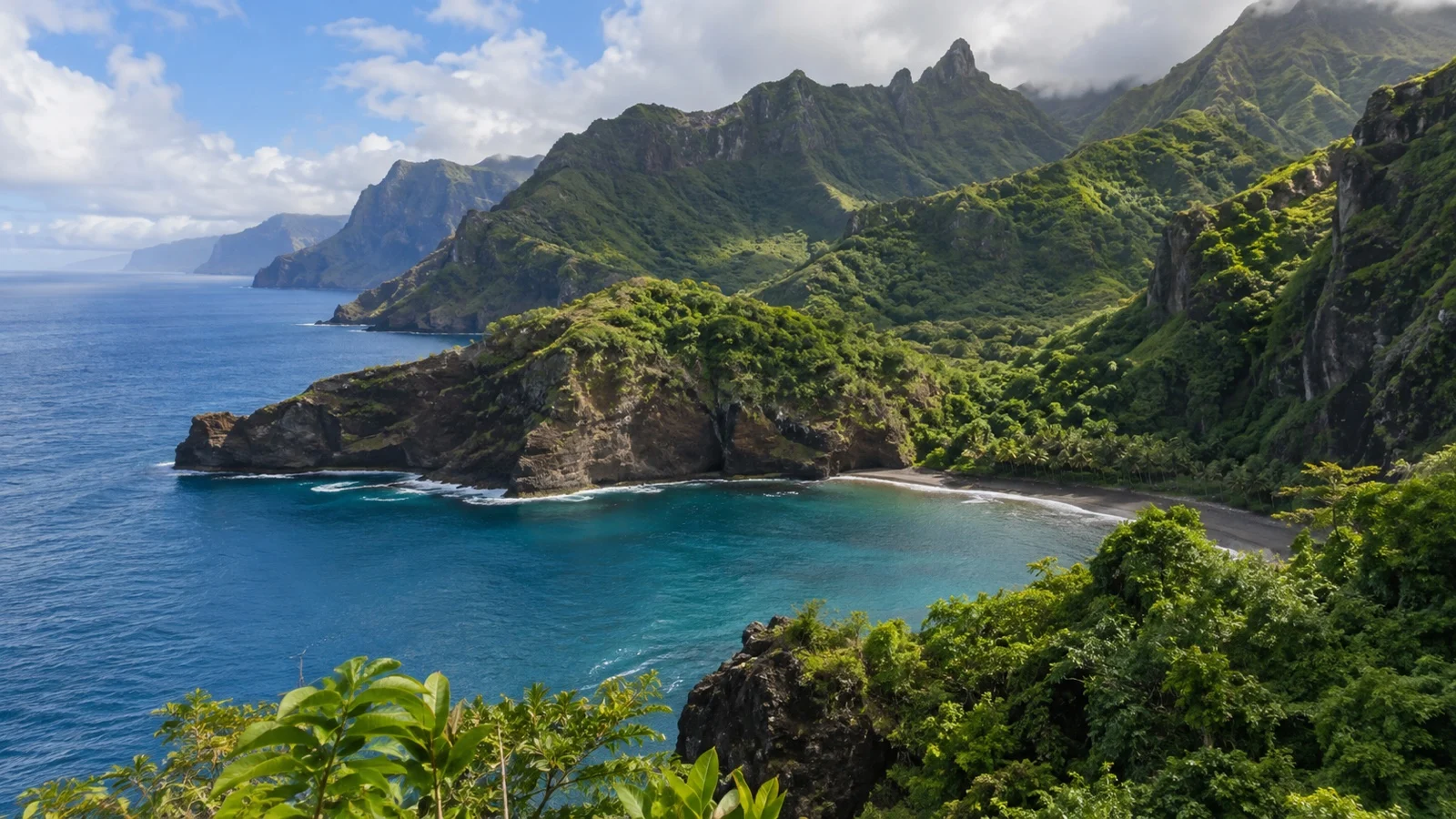
Early arrivals can provide clear views of the bay and cargo preparations. Check the daily program because arrival times can change.
On smaller calls, walking independently may work when the gangway location, weather, and mobility allow. Hakahau on Ua Pou and Vaitahu on Tahuata are compact enough to discuss with the expedition team before choosing an excursion.
Carry cash in CFP francs, in small bills. Carvers, tapa makers and roadside stalls often take nothing else, and there is no ATM on most of these islands.
A realistic word on accessibility
Travelers with significant mobility limitations should review the landing plan directly with Aranui before booking. Some itinerary elements may not be accessible even when the ship itself can accommodate a traveler.
The barriers are structural rather than fixable. Boat landings onto steps, unpaved village roads, 4×4 transfers over mountain tracks and archaeological sites reached across uneven stone are all normal parts of the itinerary.
There is a doctor aboard, which is reassuring given how far you are from a hospital, but the nearest serious medical facility is in Papeete. Aranui asks passengers with existing conditions to consult their own physician before booking, and that request should be taken seriously.
If you use a wheelchair or scooter and still want French Polynesia, the mainstream ships out of Papeete are the sensible answer. The guide to the French Polynesian cruise ports covers alternatives with more conventional port calls.
When to go, and the weather
The Marquesas do not follow the rest of French Polynesia, and this catches people out. Meteo-France Polynesie describes the Marquesan climate as humid tropical with a rainy season running from January to August, and a cool season from September to December.
That is close to the inverse of the Society Islands, where the humid season runs November to April. So the months that are wet in Tahiti are not automatically the wet ones in the Marquesas.
Temperatures barely move all year. The national annual average at Faaa is roughly 79 Fahrenheit, and the Marquesas sit a little warmer and noticeably more humid, so plan for the low to mid 80s Fahrenheit whenever you sail.
If you want a reason to pick a month, humpback whales are around the Marquesas from July to November. September and October can combine the cooler Marquesan season with the latter part of the usual whale period, but sightings are never guaranteed.
Quick answers
How long is the Aranui cruise to the Marquesas?
The current standard round-trip from Papeete is 12 days and 11 nights.
Check the dated itinerary because special Austral, Gambier, Cook Islands, and Pitcairn voyages follow different patterns.
Is the Aranui 5 really a cargo ship?
Yes, genuinely.
It is classed as a dual purpose passenger and freight vessel, and the freight is the commercial reason the voyage exists.
Do I need to be fit?
Reasonably, yes.
Boat landings, steep village walks and long 4×4 transfers are routine, and the archaeological sites are not paved.
Can the itinerary change once I have booked?
Yes, and the company says so plainly in its own conditions.
Dates, ports and duration can all vary before departure and while you are at sea.
Is it worth the money?
It can be for travelers who specifically want the Marquesas and value the passenger-freighter experience.
If lagoons and resort-style sea days are the priority, compare conventional French Polynesia itineraries before booking.
The last word
The Aranui works because it never pretends to be something else. It is a supply ship with good food, a decent bar and a route that no leisure operator would ever run for its own sake.
Book it if you want to see the Marquesas, understand how remote islands are actually fed, and accept that the crane wins every argument. Do not book it because someone told you it was a soft way into the South Pacific.
Arriving a day or two early provides a buffer for flight disruption; the guide to the Papeete cruise port covers where the freight terminal sits relative to town. If the Bora Bora day at the end leaves you wanting more, the Bora Bora port guide explains what the tender day looks like on a conventional ship.
If the appeal is the scale rather than the destination, the roundup of small ship cruise ports offers more options. Aranui remains unusual because its working cargo schedule is part of the passenger experience.
How this guide was researched: No firsthand Aranui sailing, landing, cabin inspection, or island excursion is claimed. Ship specifications, current itineraries, and operating conditions were checked against Aranui Cruises; island information against Tahiti Tourisme; World Heritage details against UNESCO; and seasonal patterns against Meteo-France Polynesie.
Logistics and time-sensitive details were reviewed September 12, 2026. Confirm the dated itinerary, landing arrangements, inclusions, accessibility, and cancellation terms before travel. See our Editorial Policy.
More on this topic: browse every guide on expedition and alternative cruises.