River Cruise Embarkation Ports and the Airport: Basel to Lyon
A European river cruise rarely begins at the airport, and the gap between baggage claim and the gangway is where embarkation-day stress likes to unpack. The solution depends on the city, your final quay, arrival time, luggage, and mobility needs.
Basel, Amsterdam, Budapest, Porto, Paris, and Lyon each have a sensible default, but none has one transfer that works for everyone. Use this guide to choose the route, then confirm live schedules and the berth address in your final cruise documents.
My quick take
Take the train in Amsterdam when your ship is near Amsterdam Centraal and you can manage your bags. Use Basel’s airport bus to reach the city, Budapest’s airport express for a central hotel, and Porto’s metro when you are staying before the cruise rather than rolling straight to a Gaia quay.
Lyon’s airport rail link is efficient to Part-Dieu, while Paris is the city most likely to reward a prebooked door-to-door transfer. In every city, the berth address wins over the destination name printed on the brochure.
River levels, port operations, and local events can move a ship with little notice. Our guide to where river cruise ships actually dock explains why the final transfer should stay flexible.
The quick facts
- Basel: EuroAirport lies in France and has French and Swiss sectors. Bus 50 leaves from the Swiss arrivals area every 7 to 10 minutes and reaches Basel SBB in about 20 minutes.
- Amsterdam: Schiphol’s rail station is directly below the terminal, with eight trains an hour to Amsterdam Centraal and a scheduled trip of about 14 to 17 minutes. Check that the ship is actually in central Amsterdam rather than another regional berth.
- Budapest: The 100E Airport Express runs around the clock between Liszt Ferenc Airport and Deák Ferenc tér via Kálvin tér. The special ticket currently costs 2,500 Hungarian forints, and the ride takes about 40 minutes.
- Porto: Metro Line E links the airport with Trindade, but Douro river cruises generally board in Vila Nova de Gaia across the river. A direct car is easier when heading straight to the ship with luggage.
- Paris: Seine embarkation points vary by line, date, and operating conditions, and some are outside central Paris. A train to the city solves only the first half of the journey.
- Lyon: Rhônexpress links Lyon Saint-Exupéry Airport with Part-Dieu in about half an hour. Continue by taxi or local transit only after confirming the ship’s actual Rhône or Saône landing.
- Included transfers: They depend on the cruise line, air package, dates, and conditions. Viking currently includes coordinated round-trip transfers with Viking Air and sells transfers separately in some other cases.
Get the berth before choosing the transfer
The cruise city is not a terminal address. Basel uses several Rhine landings, Amsterdam sailings can use regional berths, Porto’s Douro ships use Gaia, and Paris or Lyon assignments can change.
Use the address in the final travel documents and check for a same-day message from the line. If the paperwork gives only a quay name, request a street address, map pin, vessel name, and emergency contact.
Do not ask a driver for “the river cruise terminal” unless the line uses that exact name. A city with ocean, river, ferry, and sightseeing docks can send that cheerful phrase in several expensive directions.
Are cruise-line airport transfers included?
There is no industry-wide rule. Inclusion may depend on buying the line’s air, arriving on the scheduled embarkation date, using an eligible airport, and landing within a stated window.
Viking Air currently includes coordinated round-trip transfers to the ship or included hotel when the flight dates fit the cruise itinerary. Viking also says travelers who do not buy its air may be able to purchase transfers separately.
Other lines set different rules, and a complimentary transfer is not necessarily private or immediate. Ask where the representative meets you, how long the group may wait, whether the vehicle is accessible, and what happens if the flight is delayed.
A line transfer’s biggest advantage is not speed. It is that the operator knows the current berth and owns the handoff when a quay changes.
Basel: EuroAirport to the Rhine
EuroAirport Basel-Mulhouse-Freiburg is physically in France but serves France, Switzerland, and Germany through a binational arrangement. For Basel, follow signs to the Swiss sector before leaving arrivals.
EuroAirport says Bus 50 departs the Swiss-sector forecourt every 7 to 10 minutes from about 4:30 in the morning to midnight. The direct ride to Basel SBB takes about 20 minutes.
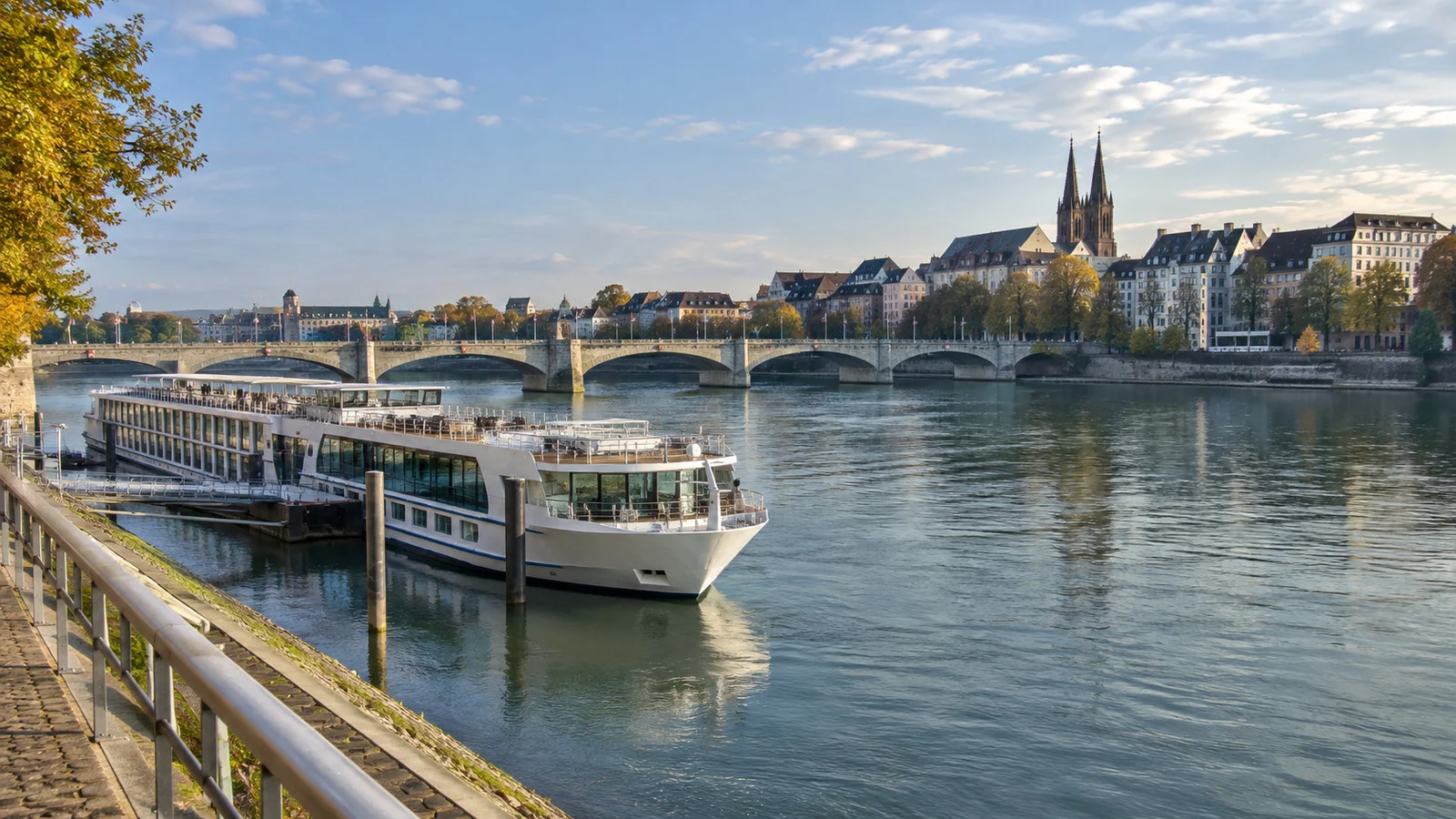
Basel SBB is a transport hub, not the river ship. Continue by tram or taxi only after checking whether your ship is at Saint Johann, Klybeck, Dreiländereck, or another assigned landing.
A direct taxi or prebooked car is simplest with several bags, a late arrival, or a mobility device. Confirm whether the pickup is in the French or Swiss sector because meeting points and payment currency can differ.
Our Basel river cruise port guide explains the common landings and the final leg from the station. Recheck the exact berth because the river keeps no loyalty program.
Amsterdam: Schiphol to the correct city berth
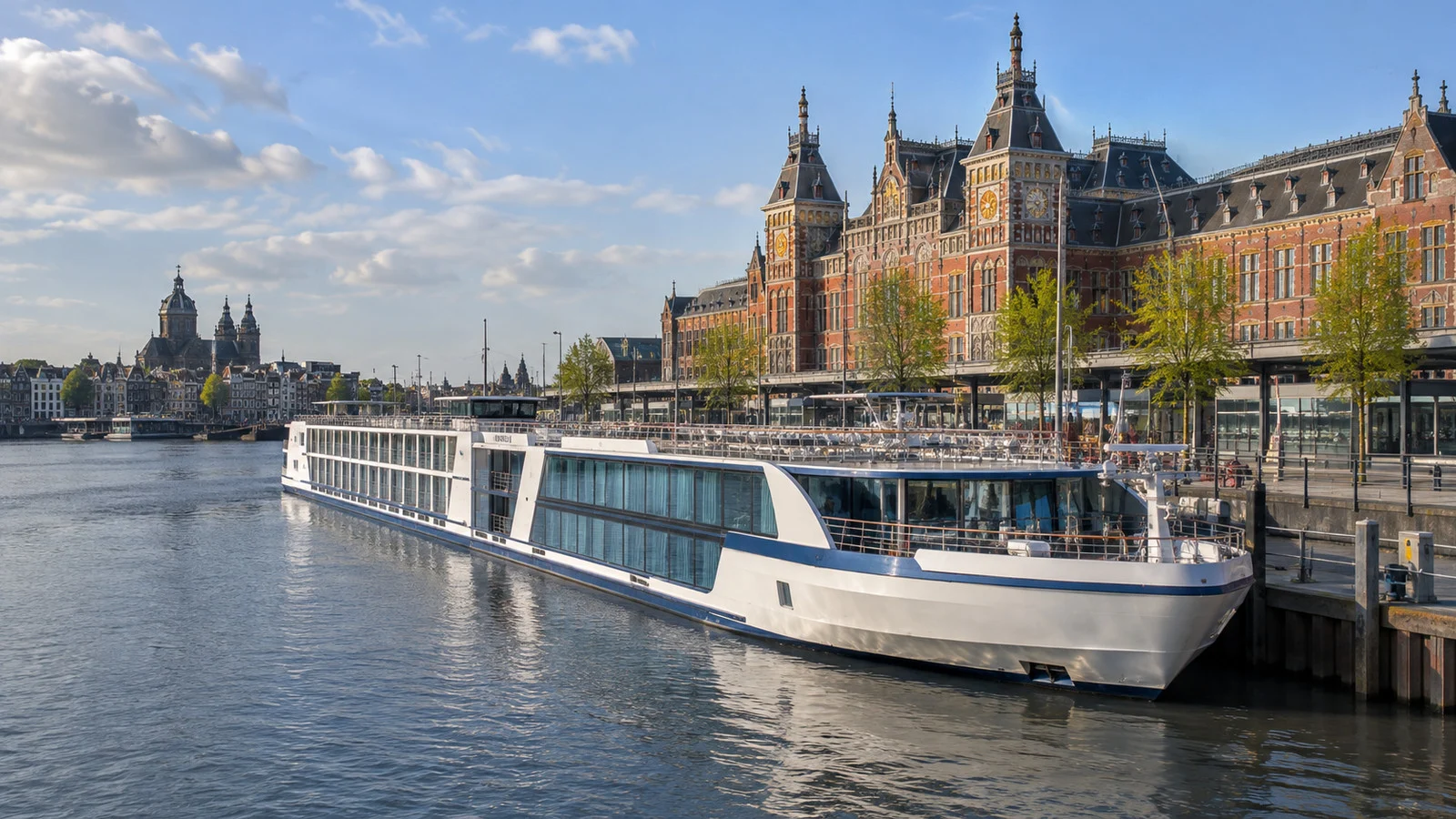
Schiphol makes the first leg wonderfully simple. The airport’s official guide says the station is directly below the terminal and trains reach Amsterdam Centraal in about 14 to 17 minutes.
Schiphol currently lists eight trains an hour on the direct connection, but engineering work and disruptions can change the practical trip. Check the NS journey planner before leaving the baggage hall and tap in and out correctly if using contactless payment.
Many river berths are on or near the IJ side of Amsterdam Centraal, but “Amsterdam” does not prove walking distance. A sailing may use a different city or regional berth, so compare the final address with the station before choosing rail.
Use a licensed taxi or line transfer when the berth is remote, the group has heavy luggage, or stairs and cobbles make the station route impractical. Our Amsterdam river cruise port guide covers central and regional scenarios.
Budapest: airport express first, quay second
The BKK 100E Airport Express runs around the clock between Liszt Ferenc Airport and Deák Ferenc tér via Kálvin tér. BKK lists a 40-minute city-center trip and daytime frequencies as short as 6 to 10 minutes.
The special airport ticket currently costs 2,500 forints and can be bought in BudapestGO or by bank card through Pay&GO on the bus. Check current ticket validity because ordinary passes and airport-bus rules can change.
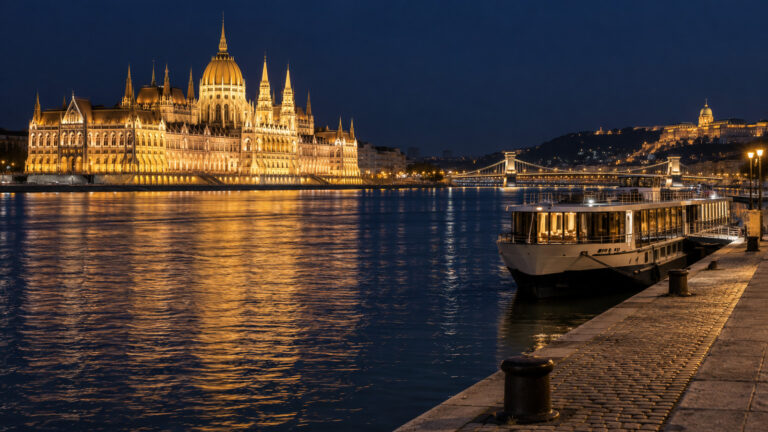
Deák Ferenc tér is useful for a hotel or central connection, but it is not a universal river-cruise stop. Budapest ships line different parts of the Danube, so finish by taxi or transit based on the berth in your documents.
Our Budapest river cruise port guide matches common quay areas to nearby transport. Do not drag luggage along the embankment because the right river view can still be the wrong ship.
Porto: the airport is north, the ship is usually in Gaia
Porto Airport connects to central Porto on Metro Line E, making it a good choice for travelers staying before embarkation. Use the Metro do Porto journey planner for the live route, timetable, and any works.
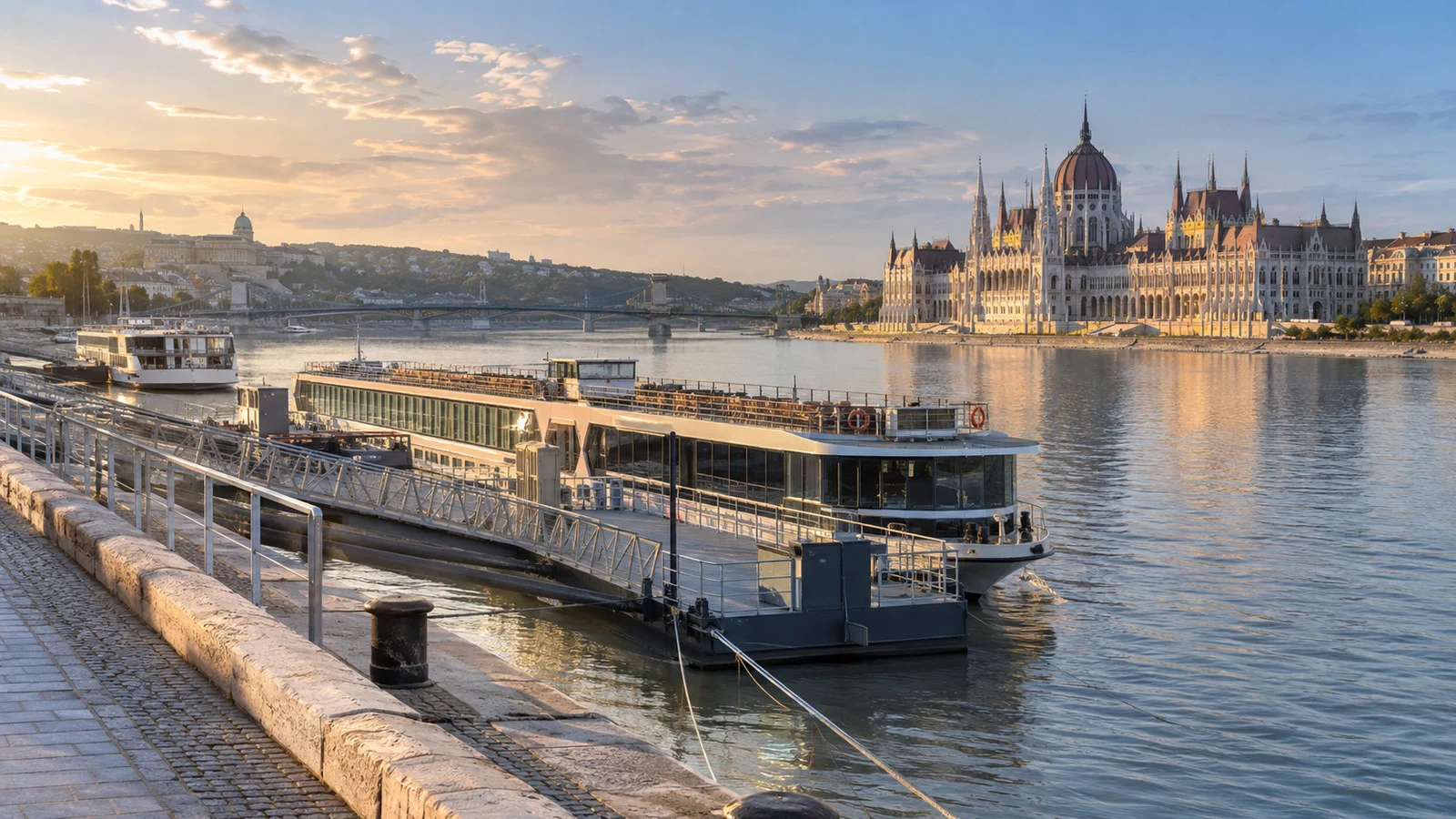
Douro river ships generally board in Vila Nova de Gaia on the south bank, not at Porto’s Ribeira and not at the ocean cruise terminal in Leixões. Gaia has multiple river landings, so “take me to the cruise terminal” is particularly adventurous here.
For a direct airport-to-ship trip, a taxi or prebooked car avoids a central transfer and a river crossing with bags. Give the driver the quay name, vessel, and map pin from the cruise line.
If you stay in Porto first, the metro is efficient and a hotel can store luggage until your embarkation time. Our guides to river-cruise overnight stays and the Porto river cruise port help with the rest of that plan.
Paris: solve the quay before crossing the city
Charles de Gaulle Airport is far from the Seine, and river lines use several central, suburban, or downstream embarkation points. A rail ticket to central Paris is not a complete airport-to-ship transfer when the ship is elsewhere.
Choose the RER or another rail connection when staying in Paris before the cruise and when the hotel route is manageable with luggage. Check the official journey planner on the day because works, strike action, and station accessibility can alter the best route.
For same-day embarkation, the line transfer or a prebooked car is often the lowest-stress choice once the final berth is known. Send the provider the written address and map pin, then ask how a late quay change will be handled.
Some Seine cruises embark outside the center, including locations west or north of the postcard riverfront. Our Paris river cruise port guide explains the common areas, but the final documents remain authoritative.
Lyon: fast airport rail, then a final local leg
Rhônexpress links Lyon Saint-Exupéry Airport with Lyon Part-Dieu in about half an hour. Check the live schedule and fare for your date because frequency, prices, and service arrangements can change.
Part-Dieu is a major station rather than a river landing. Continue by taxi or local transit to the confirmed Rhône or Saône berth, and allow extra time to find the correct station exit.
A direct car becomes competitive for two or more travelers with luggage, but traffic makes the travel time less predictable than Rhônexpress. Price both routes to the actual quay rather than comparing only airport-to-city-center fares.
The transfer decision in four questions

- Where is the ship? Get the street address, quay name, vessel, and map pin from the final documents before buying a nonrefundable ride.
- Can everyone manage the route? Count bags, station changes, walking distance, steps, cobbles, and the gap between the platform and the final taxi pickup.
- What happens after a delay? Check the final boarding time, live-flight policy, transfer contact, and what the line wants you to do if the desk has closed.
- Who owns a berth change? A cruise-line transfer normally has the current operational address, while an independent driver needs a working phone number and change plan.
- Is the saving worth the handling? Compare door-to-door cost for the whole party, not one rail ticket against one taxi meter.
Fly in at least one day early when practical, especially after a long-haul or connecting journey. A hotel night protects the cruise far better than heroic optimism at baggage claim.
If a land extension delivers you to the ship, use its written meeting instructions rather than this airport plan. Our guide to river-cruise land extensions helps decide whether that convenience earns its price.
Accessibility and assistance
Do not assume the cruise-line coach is the accessible option. A standard touring coach may have high steps and a luggage hold but no passenger lift, while an airport train may offer level access and assistance only at booked stations.
Ask the cruise line whether the exact transfer vehicle can carry the mobility device with the traveler seated in it, or whether a step and transfer are required. Provide device dimensions, combined weight where requested, and space needed for a companion.
For rail, request airport and train assistance through the official operator within its stated deadline. Confirm elevators at the arrival station and the step-free path from platform to taxi pickup, because “accessible station” is not a door-to-quay route.
Also ask about the landing itself, including slope, gangway, steps, surface, lighting, and distance to the ship. River levels can change the gangway angle and may force a berth change or ship-to-ship access.
Weather and arrival timing
Bus 50, Schiphol trains, Budapest’s 100E, Porto Metro, and Rhônexpress are year-round services, but maintenance and disruptions still matter. Check the official planner after landing rather than relying on a screenshot saved months earlier.
Heat, rain, or winter cold can make a short luggage walk unpleasant, while fog, storms, and air-traffic restrictions can delay the flight itself. Choose a transfer with enough margin to survive ordinary disruption before worrying about seasonal averages.
Late-night arrivals narrow the public-transport options and can outlast a cruise-line meet-and-greet desk. Get the after-hours number and a backup car plan before flying.
Quick answers
Is the airport transfer included on a river cruise?
Sometimes, usually under line-specific air or package conditions. Verify the eligible airport, travel date, arrival window, hotel rules, accessibility, and delay procedure in writing.
How do I get from EuroAirport to Basel?
Follow the Swiss-sector signs and take Bus 50 to Basel SBB, a ride of about 20 minutes. Continue to the exact river landing by tram or taxi.
How do I get from Schiphol to an Amsterdam river cruise?
The direct train reaches Amsterdam Centraal in about 14 to 17 minutes, but use it only after confirming the ship is near the station. A regional berth may require a different connection or a car.
Does a Porto river cruise board in Porto?
Douro ships generally board across the river in Vila Nova de Gaia. Use the quay address in the cruise documents and do not confuse it with the Leixões ocean terminal.
Should I take the train from Charles de Gaulle to a Paris river ship?
It works well for a pre-cruise hotel stay, but it may be awkward for same-day boarding at an outer Seine berth. Confirm the quay before deciding between rail and a door-to-door transfer.
Is Rhônexpress door-to-door for a Lyon river cruise?
No, it ends at Part-Dieu station. Plan a taxi or local-transit leg from the station to the confirmed ship landing.
The last word
Airport transfers become simple when you stop planning to a city name and start planning to a berth. Get the final address, match the route to the traveler and luggage, and leave enough time for the last local leg.
Basel’s bus, Amsterdam’s train, Budapest’s 100E, Porto’s metro, Paris rail, and Lyon’s Rhônexpress all solve only part of the trip. The gangway is the destination, and it has a habit of moving.
How this guide was researched: Unless a first-hand visit is explicitly identified above, this guide is based on independent research using official airport, transit, and cruise-line sources. Current transport details were checked against EuroAirport, Schiphol, BKK Budapest, Metro do Porto, and Rhônexpress, while transfer inclusions were checked against Viking Air.
Berth assignments remain sailing-specific and should be checked in final cruise documents. Logistics and time-sensitive details were reviewed in September 2026.
See our Editorial Policy.
More on this topic: browse every guide on river cruise planning.