River Cruise Laundry, Wi-Fi, and Power Outlets: What to Pack
Laundry, Wi-Fi, and power outlets can change by river, cruise line, ship, and cabin category. The safest packing plan starts with the documents for your exact vessel rather than a fleet-wide shortcut.
Most travelers can solve all three issues with a small capsule wardrobe, a dual-voltage charging setup, downloaded essentials, and written confirmation of any medical-device needs. The details below show what to verify and what not to assume.
My quick take
Plan as though laundry will be a paid service unless your booking documents name a laundrette or an included allowance. A few fleets do offer self-service machines, but availability and charges can vary by vessel or suite.
For power, photograph every charger’s input label and confirm that it accepts the ship’s voltage. Bring the plug adapter specified by the cruise line, plus a compact multi-port USB charger that the line permits.
Treat onboard Wi-Fi as a convenience rather than guaranteed office infrastructure. Download tickets, maps, entertainment, medication records, and important contact details before embarkation.

The quick facts
- Laundry varies by ship: some vessels offer a self-service room, some provide only paid service, and some include a limited allowance with selected suites. Verify the exact ship and cabin category.
- Do not budget from a generic price: per-item, bag, pressing, express, and suite-inclusion rules can change. Use the onboard or predeparture price list for your sailing.
- Dry cleaning is not the same as laundry: do not assume it is available merely because the ship washes and presses clothes. Leave specialty-care garments at home unless the line confirms service.
- Voltage and plug shape are separate: an adapter changes the physical plug connection, while a converter changes voltage. Many modern phone and laptop chargers are dual-voltage, but the label on your own device is what matters.
- Outlets vary: even ships in the same region can provide different combinations of European, North American, USB-A, and USB-C connections. Confirm the vessel rather than relying on the river.
- Wi-Fi is shared and variable: signal source, terrain, locks, network demand, and the ship’s equipment all affect service. Complimentary access does not guarantee streaming or video-call quality.
- Medical equipment needs advance confirmation: ask about outlet position, extension-cord rules, distilled water, refrigeration, and battery charging before final payment. Put the answers in writing.
Laundry: service, machines, and inclusions
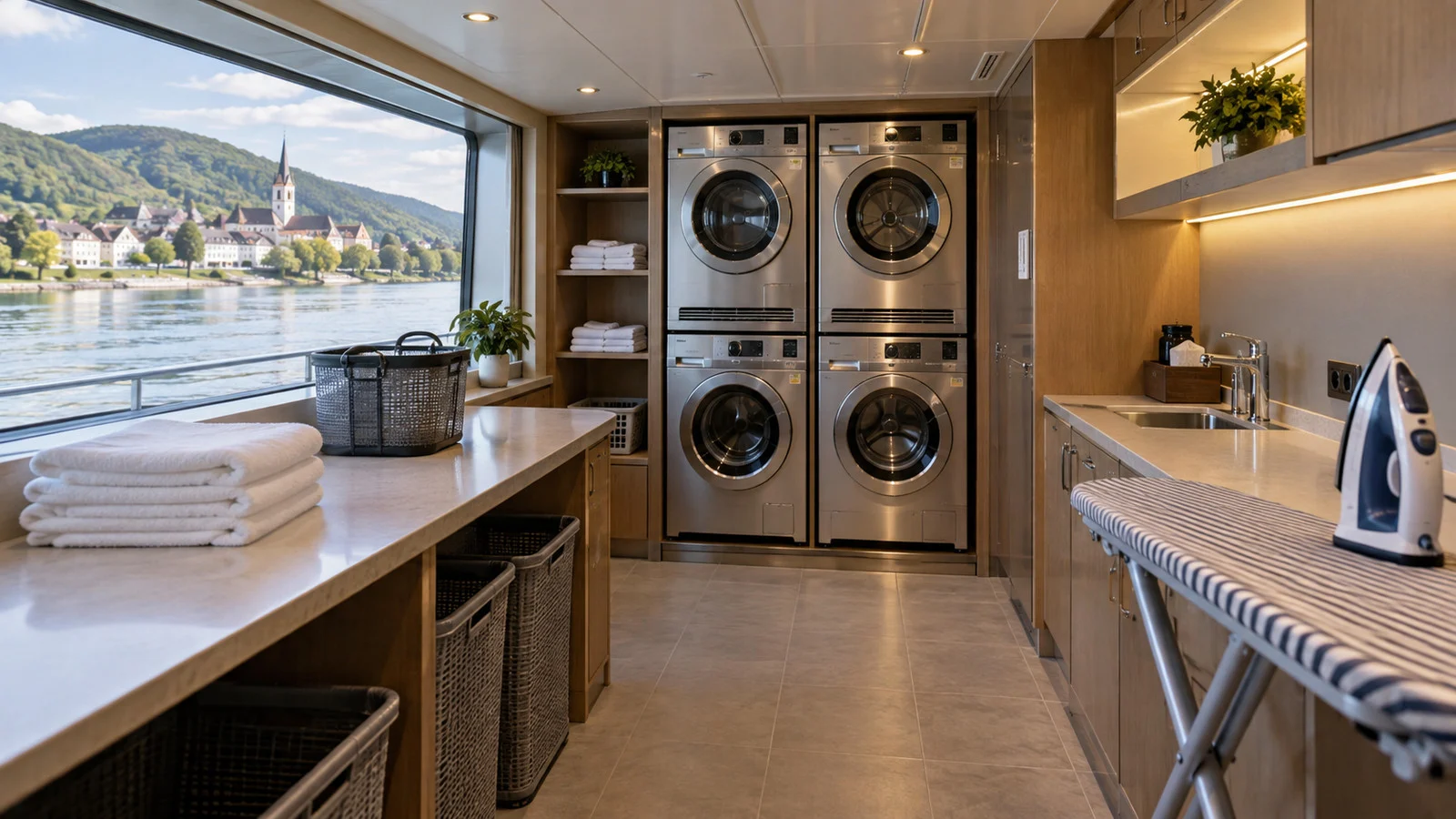
There is no reliable rule that river ships lack self-service laundry. Space is limited on many vessels, but each line makes a different operating and design choice.
Uniworld’s current FAQ says most ships have either a self-serve laundrette with an ironing board or laundry service for an added fee. It directs guests to contact the line to confirm what their ship offers.
Riverside’s FAQ says its fleet has self-service laundry centers with washers, dryers, and an ironing board. It also notes that a charge may apply depending on suite category.
Other lines may use a cabin pickup service rather than guest machines. A statement that one line offers service does not prove the price, turnaround time, or inclusion on every itinerary.
Before booking a long cruise, ask four direct questions: Is there a guest laundrette, is detergent included, what is the service turnaround, and does my cabin receive an allowance? Save the written reply with your travel documents.
What laundry may cost
Many cruise lines show the detailed laundry price list onboard rather than on the public website. That makes a universal per-shirt or per-bag estimate unreliable.
Expect separate treatment for washing, pressing, and express return unless your line says otherwise. Some suite benefits are counted by item or by cruise, while others may provide broader service.
If your booking decision depends on complimentary laundry, find the benefit in the fare description for your category. Do not rely on a review written about a different ship or year.
A practical budget is the line’s current price list multiplied by the items you actually plan to send. Compare that total with airline bag fees before paying much more for a cabin solely to get laundry.
Count backward from disembarkation when choosing the laundry day. Turnaround can be affected by the service schedule, so sending essential travel clothes on the last full day may be a poor bet.
Hand washing without creating a cabin problem
Quick-dry underwear, socks, and base layers can reduce the paid-laundry load. Bring a small amount of travel detergent in a leakproof container and check whether your cabin has a drying line.
Do not hang wet clothes from lamps, sprinklers, balcony fittings, or electrical equipment. Avoid soaking garments that may drip onto woodwork or create a slippery bathroom floor.
Ventilation and humidity vary, so “dry by morning” is not guaranteed. Rotate a compact wardrobe and allow extra drying time before packing or changing ships.
Irons, steamers, and other heating appliances may be prohibited even when an ironing board exists in a supervised laundry room. Riverside, for example, lists clothes irons, steamers, curling irons, and straighteners among items that may not be brought aboard.
Power starts with the device label
Look for the word “INPUT” on each charger or power brick. A label such as “100-240V, 50/60Hz” generally indicates that the charger can accept common international voltages, although you may still need a plug adapter.
A plug adapter does not convert electricity. If a device accepts only one voltage, ask the manufacturer whether a converter is appropriate rather than guessing from the plug shape.
Hair dryers and other high-heat appliances are the easiest items to leave home. Ships commonly provide a hair dryer, and privately owned heating devices may be banned for fire safety.
Do not assume every European river cabin uses only the recessed two-pin Schuko outlet. Uniworld says European electrical current is 220 volts and each stateroom or suite has one 110-volt outlet, while also warning that voltage may vary by ship.
Riverside lists 220 volts on Riverside Mozart and both 220 and 110 volts on Riverside Ravel and Riverside Debussy. That difference within one small fleet is exactly why the vessel name matters.
Adapters, chargers, and power strips
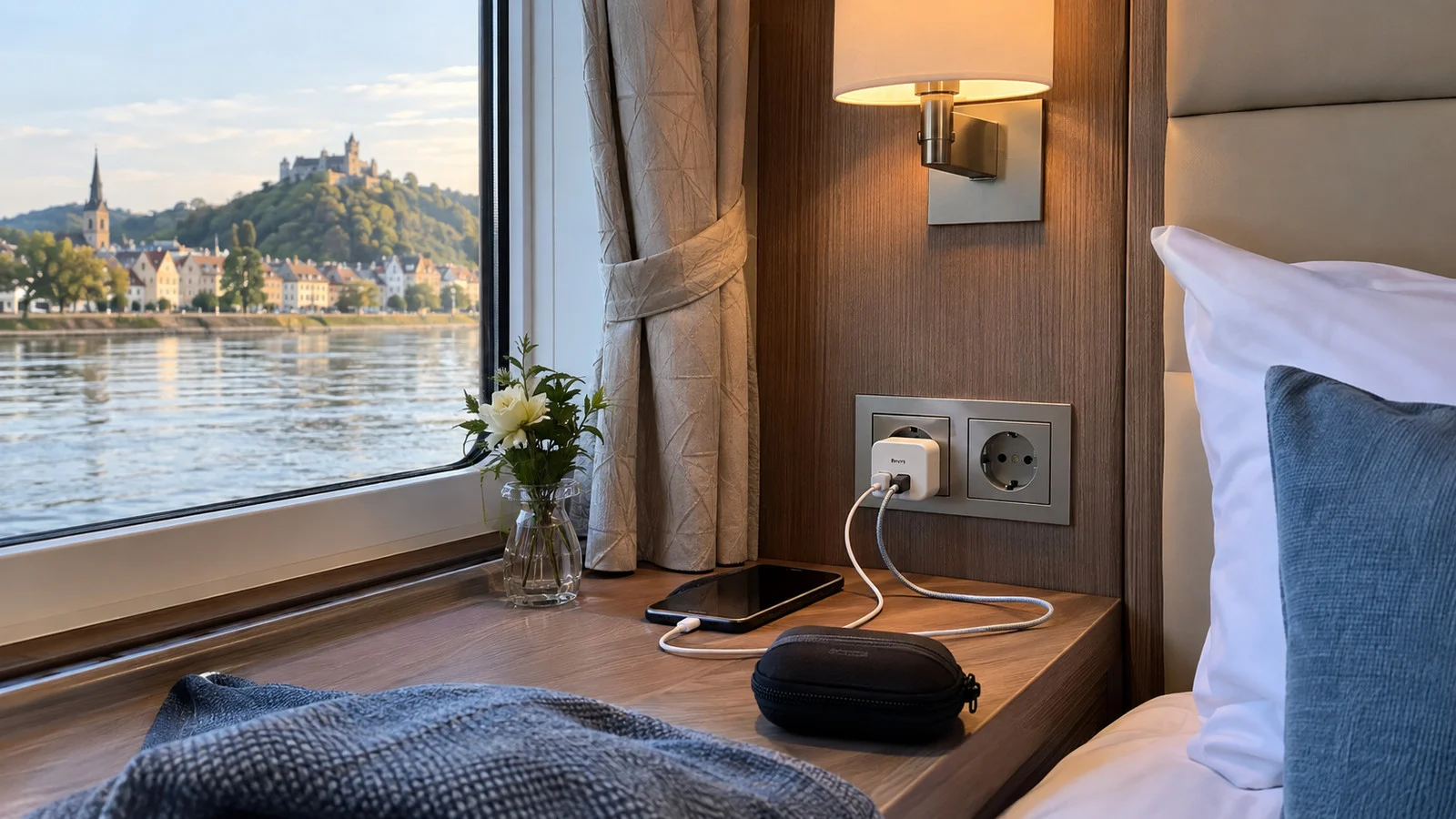
Use the line’s predeparture guide to identify the required plug type for the ship and hotels. An itinerary can cross several countries, while the onboard sockets remain specific to the vessel.
A compact USB charger with several ports can charge phones, watches, and small electronics from one approved socket. Confirm its voltage rating and check the cruise line’s prohibited-items policy before packing it.
Do not bring a household extension strip merely because it lacks an obvious switch. Cruise lines can prohibit surge protectors, extension cords, outlet multipliers, or heating devices even when they are legal in the country ashore.
Two simple plug adapters can be useful when a cabin has several compatible outlets, but they do not create more electrical capacity. Never daisy-chain adapters or cover a charger where heat cannot escape.
Keep a power bank in carry-on baggage and follow your airline’s battery rules. A power bank helps during excursions or a brief outage, but it is not a substitute for confirming overnight medical-device power.
What onboard Wi-Fi can and cannot promise
River-ship internet can use cellular, satellite, or a combination of connections. The service then has to be shared among passengers and operational systems, so performance can change through the day.
Riverside currently says its ships provide complimentary Starlink Wi-Fi. The same FAQ warns that service may be interrupted on certain river stretches and while the vessel transits locks.
Uniworld says select ships offer complimentary Wi-Fi and that service may be interrupted in remote areas, while sailing, or in locks. It also cautions that speeds may be slower than guests use at home.
AmaWaterways’ current public FAQ includes Wi-Fi in the cruise fare, but that inclusion does not create a minimum-speed guarantee. Always separate “included” from “suitable for my task.”
A gorge or lock can affect a connection, but naming a specific stretch as a guaranteed dead zone is too strong. Equipment, carrier coverage, satellite view, weather, and current network configuration can all change.
A realistic connectivity plan
Download airline and rail tickets, insurance details, medication information, maps, books, music, and video before leaving home. Keep essential booking numbers in an offline note or printed copy.
If you need to work, ask the cruise line whether the package permits video calls, VPN use, cloud backups, or large transfers. A line may manage or limit high-bandwidth traffic even when ordinary browsing works.
Schedule important calls while the ship is docked and keep a backup using your own mobile plan. Even that backup depends on the carrier agreement, the country, local coverage, and whether the cabin blocks the signal.
Do not make a deadline depend on connectivity during scenic sailing. The Middle Rhine Gorge and Iron Gates are better treated as possible interruption zones than guaranteed blackouts.
Cellular roaming and eSIMs
The European Union’s roam-like-at-home rules protect eligible subscribers using qualifying EU plans within the covered area. They do not automatically make an American, Canadian, British, or travel eSIM plan free across Europe.
European Parliament guidance explains the EU framework, but your carrier’s contract still determines your charges. Fair-use limits and special network rules can also apply.
Switzerland and Serbia are outside the EU roaming area, but some commercial plans include them voluntarily. Check each country on the provider’s current coverage list instead of assuming inclusion or exclusion from a regional label.
Install and test an eSIM before travel while keeping the activation instructions available offline. Confirm whether it includes voice and SMS or data only, especially if a bank sends login codes by text.
Near national borders, a phone can connect to a network on the opposite bank. Manual network selection or roaming controls may help prevent an unexpected connection, but follow your carrier’s instructions.
What to pack
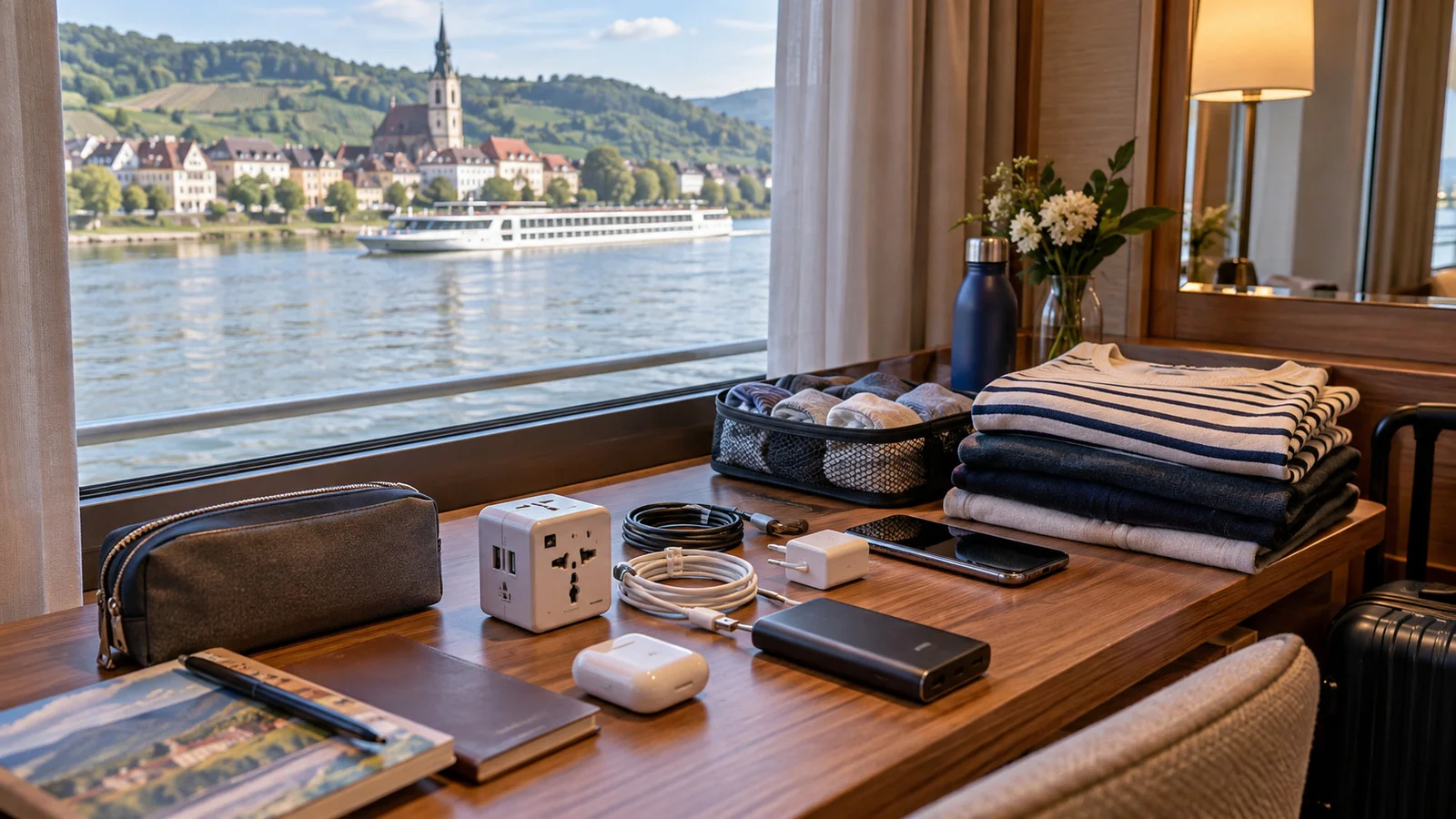
- A seven-day capsule wardrobe: choose layers and quick-dry pieces that can repeat across a longer trip. Adjust the amount for climate, dress expectations, and any land extension.
- A small laundry kit: pack travel detergent, a stain-removal wipe, and a leakproof bag for damp items. Bring clothespins only if the cabin setup allows them.
- The correct plug adapters: verify the ship and hotels rather than buying from the itinerary map alone. Label them so they do not remain in the final hotel socket.
- A permitted multi-port charger: choose a dual-voltage model with enough USB-A or USB-C ports for your devices. Check the cruise line’s electrical policy before packing any outlet multiplier or cord.
- Offline essentials: save tickets, maps, contact numbers, entertainment, and work files before embarkation. Do not wait for the ship’s network to download a large library.
- A carrier-specific mobile backup: verify countries, data limits, hotspot permission, activation, and roaming charges. A plan labeled “Europe” may not cover every river itinerary.
- No unverified heating appliance: leave irons, steamers, kettles, and styling tools home unless the line expressly permits them. Use the ship-provided appliance or approved service.
Fun fact: one fleet can have more than one onboard voltage setup. Riverside’s current FAQ distinguishes the 220-volt Mozart from the Ravel and Debussy, which list both 220 and 110 volts.
How to compare ships before booking
Laundry should rarely justify a suite upgrade by itself. Price the verified onboard service, airline baggage, and cabin difference before deciding which option actually saves money.
If reliable internet is essential, ask for the current policy on your named ship and itinerary. A brand-level statement about satellite service cannot guarantee performance in a lock, gorge, remote reach, or crowded evening.
Power is usually manageable for ordinary dual-voltage electronics once you know the outlet type. It becomes a booking issue when a medical device, mobility battery, refrigerated medicine, or accessible outlet position is involved.
Review the comparison with the broader guide to U.S. river cruises versus Europe. Different vessel rules, shore infrastructure, and domestic electrical standards can change the answer.
Medical devices and accessibility
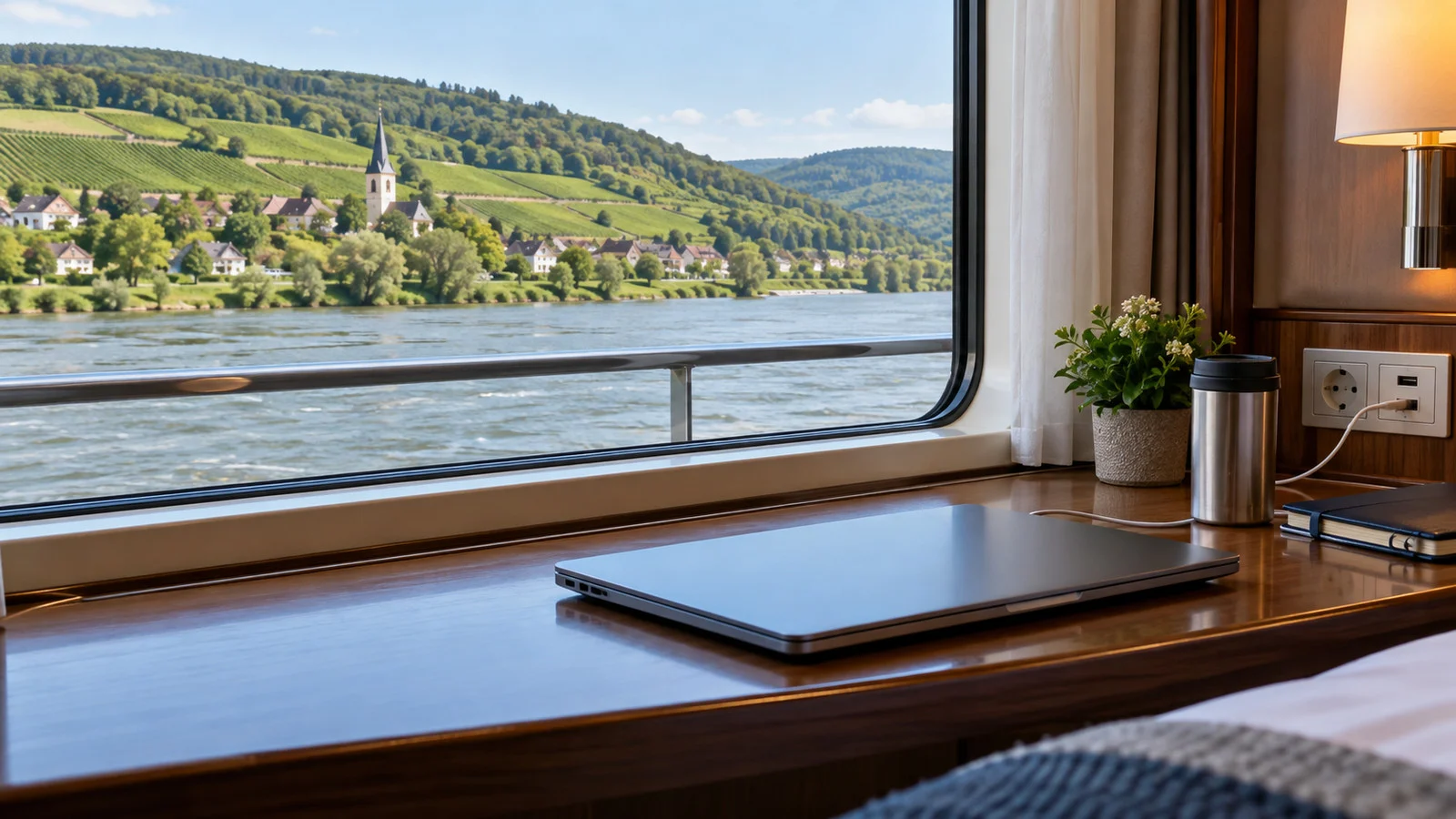
Ask where the outlet is relative to the bed, whether it remains powered when the room is empty, and what plug and voltage it supplies. Request the permitted extension setup directly from the cruise line rather than packing a household cord.
For CPAP or other respiratory equipment, ask whether distilled water can be provided and how far in advance it must be requested. Carry the device, medication, and critical accessories in hand luggage whenever transport rules allow.
For powered wheelchairs or scooters, provide the device dimensions, battery type, charger specifications, and weight. Confirm embarkation, cabin storage, elevator, gangway, and charging rules because permission to charge does not prove the ship can accommodate the device.
Guests who cannot reach a low or hidden outlet should ask for a cabin-specific answer. A generic deck plan rarely shows outlet height, furniture clearance, or the route of a safe cord.
The river cruise accessibility guide covers the larger mobility test. Get critical arrangements in writing and recheck them if the assigned vessel changes.
Weather changes the packing plan, not the ship’s policy
Warm-weather itineraries may increase the amount of laundry, while cool sailings make layers easier to repeat. Use climate normals only to choose fabrics, then check the short-range forecast before flying.
Humidity and ventilation affect how quickly sink-washed clothing dries. Pack enough essentials to allow a second night rather than relying on a fixed overnight drying promise.
Rain, fog, and cloud do not create a predictable Wi-Fi outcome by themselves. The network technology, local infrastructure, terrain, lock transit, and user demand usually matter more to the passenger experience.
A seasonal itinerary can also involve hotels before or after the cruise with a different outlet type. Verify every country and lodging segment, not only the cabin.
Quick answers
Whether river ships have self-service laundry:
Some do and some do not. Uniworld says most ships have either a laundrette or paid service, while Riverside says its fleet offers self-service centers.
How much river-cruise laundry costs:
There is no dependable fleet-wide figure. Check the current onboard or predeparture list and any benefit attached to your exact cabin.
Whether a power adapter is needed in Europe:
Often yes, but the required plug depends on the ship and hotels. Also verify that every device accepts the supplied voltage because an adapter does not convert it.
Whether onboard Wi-Fi is free:
Many lines include access, while availability and package rules can vary. Included service can still be slow or interrupted.
Whether river ships use Starlink:
Some do, and Riverside currently says its ships provide complimentary Starlink Wi-Fi. Confirm the named vessel because a claim about one fleet does not establish the equipment on another.
The last word
The right packing list is built from your ship’s current documents, not a rule about all river cruises. Confirm laundry method and price, outlet type and voltage, internet terms, and every medical-device requirement.
Then pack lighter clothes, approved charging gear, and an offline copy of anything you cannot afford to lose. That small amount of preparation makes weak Wi-Fi or a missing laundrette an inconvenience instead of a trip problem.
For the wider tradeoffs, compare river cruises with ocean cruises and check how far ahead to book. Reverify time-sensitive amenities if the operator changes your vessel.
How this guide was researched: This guide is based on current public information from river-cruise operators and official consumer sources. Laundry, voltage, prohibited items, and Wi-Fi examples were checked against Uniworld, Riverside, and AmaWaterways, while mobile-roaming context was checked against the European Parliament; details were reviewed in September 2026 under our Editorial Policy.
More on this topic: browse every guide on river cruise planning.