Gota Canal Cruise: 58 Locks Across Sweden on a Very Old Ship
A Göta Canal cruise crosses Sweden through 66 locks and two enormous lakes at a deliberately slow pace. The historic ships have tiny cabins and shared bathrooms, so the romance comes with real compromises.
The Göta Canal Steamship Company has operated since 1869, and Juno dates to 1874. This guide explains the route, the old ships, and what the comfort level means before you book.
Quick take
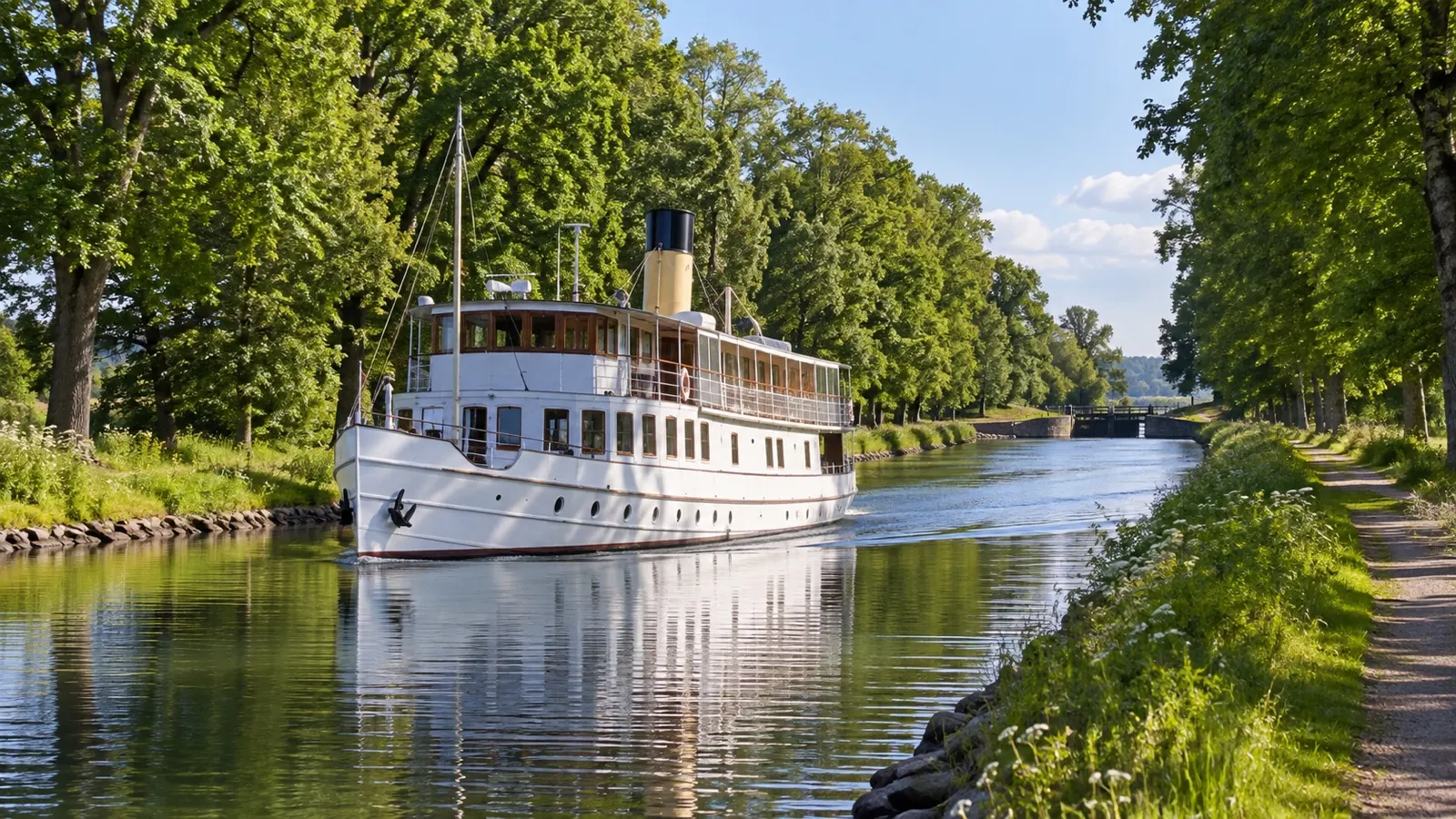
This is a historic small-ship journey with a comfort level very different from a modern river cruise. Juno is roughly 103 feet long, and showers and restrooms are shared.
If a shared bathroom is a dealbreaker, compare the trip with rail travel between Gothenburg and Stockholm. If it is not, the four-day Classic Canal Cruise on M/S Juno makes the historic ship central to the experience.
The six-day Grand Sweden Cruise crosses the full route in daylight and includes guided stops ashore. Compare its extra time and higher fare with the compact cabin arrangement before choosing.
The quick facts
- Where you board: Packhuskajen 10 in Gothenburg, beside the old customs house of 1867, or Skeppsbrokajen 103 in Gamla Stan in Stockholm. Sailings run in both directions, so read your booking before booking flights.
- How you get ashore: a gangway onto a quay or a grass canal bank every time, because nothing on this route tenders. At the lock flights you can normally step off and walk beside your own boat.
- The route: the canal itself runs about 118 miles from Sjötorp on Lake Vänern to Mem on the Baltic, with 58 locks. The full Gothenburg to Stockholm journey adds the Trollhätte Canal, both great lakes and Lake Mälaren, for 66 locks in total.
- The ships: M/S Juno of 1874, M/S Wilhelm Tham of 1912 and M/S Diana of 1931. Juno is roughly 103 by 22 feet, with 29 cabins over three decks.
- Currency and language: The Swedish krona and Swedish, with fluent English everywhere you will go.
- What it costs: these are premium, full-board journeys, and the fare changes by ship, cabin deck, direction, and departure date. Compare the dated price sheet with the bathroom and berth arrangement before treating the trip like a modern river cruise.
- Time zone: Central European Time, UTC+1, shifting to UTC+2 for daylight saving time, which covers essentially the entire canal season.
- The season: the canal authority runs navigation in three phases, from early May to late September, with high season from mid June to mid August. Outside that the locks are shut and the boats are laid up for winter maintenance.
Fifty-eight locks on the canal, sixty-six on the trip
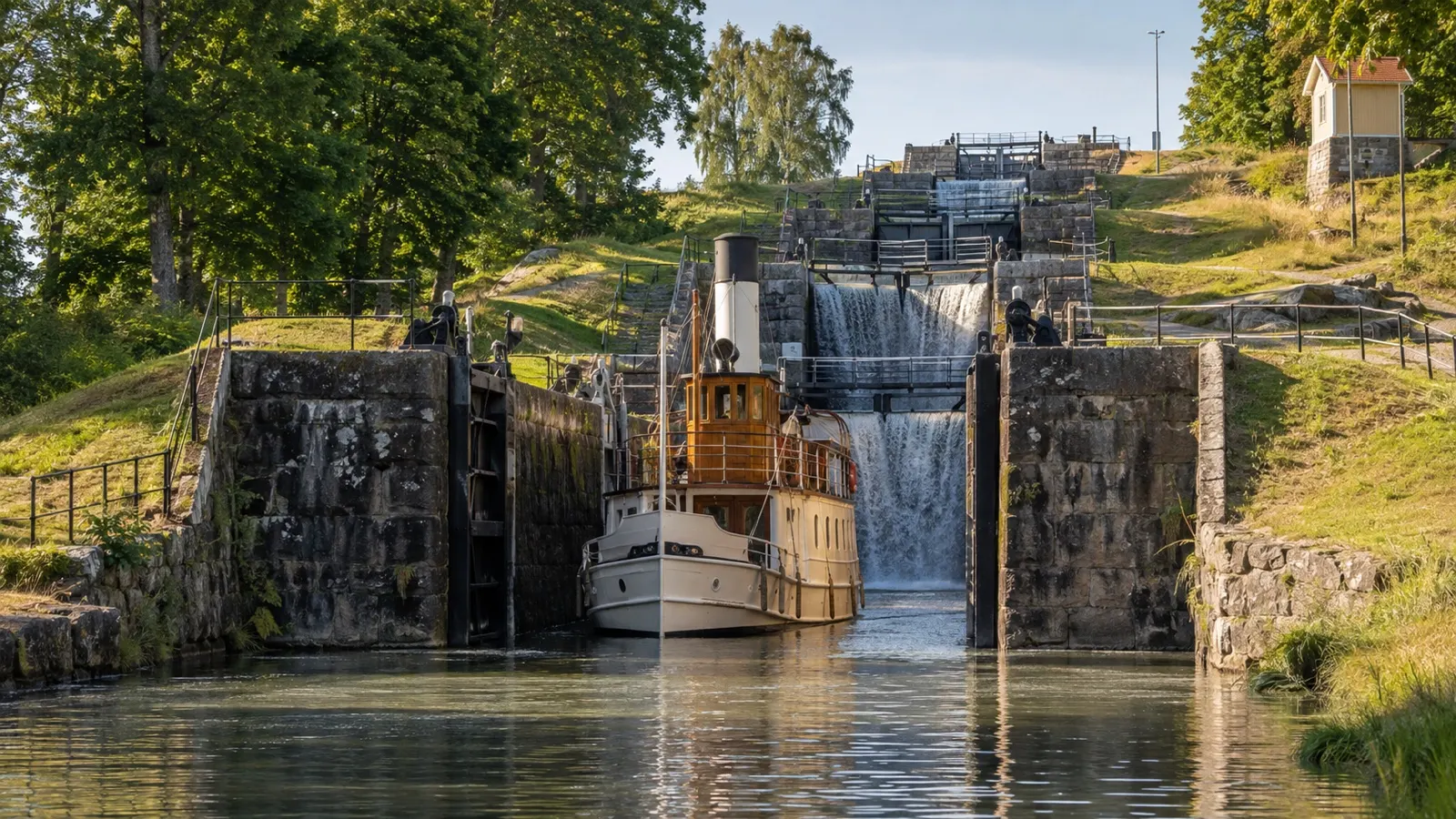
The numbers are the reason people book this, so here they are properly. Göta kanalbolag, the company that owns and operates the waterway, gives the canal as about 118 miles with 58 locks, of which roughly 54 miles was dug out by hand.
Construction ran from 1810 to 1832 under Baltzar von Platen, with design advice from the Scottish engineer Thomas Telford. It was inaugurated at Mem on 26 September 1832, by which point von Platen had been dead for three years.
The canal climbs to around 301 feet above sea level at its summit between the two lakes. That climb is the entire reason for the lock count, and it is why the crossing takes days rather than hours.
A single lockage takes roughly seven to ten minutes and moves about 198,000 gallons of water. A full lock staircase takes about an hour and provides time to watch the operation from shore where permitted.
The canal publishes a normal maximum boat size of about 98 feet long, 23 feet wide, and 9 feet 3 inches in draft, with about 72 feet of air draft. Historic passenger ships such as the roughly 103-foot Juno operate as established exceptions, so use the canal figures for private craft planning rather than trying to reconcile them with Juno’s length.
The ships, and what 1874 actually feels like
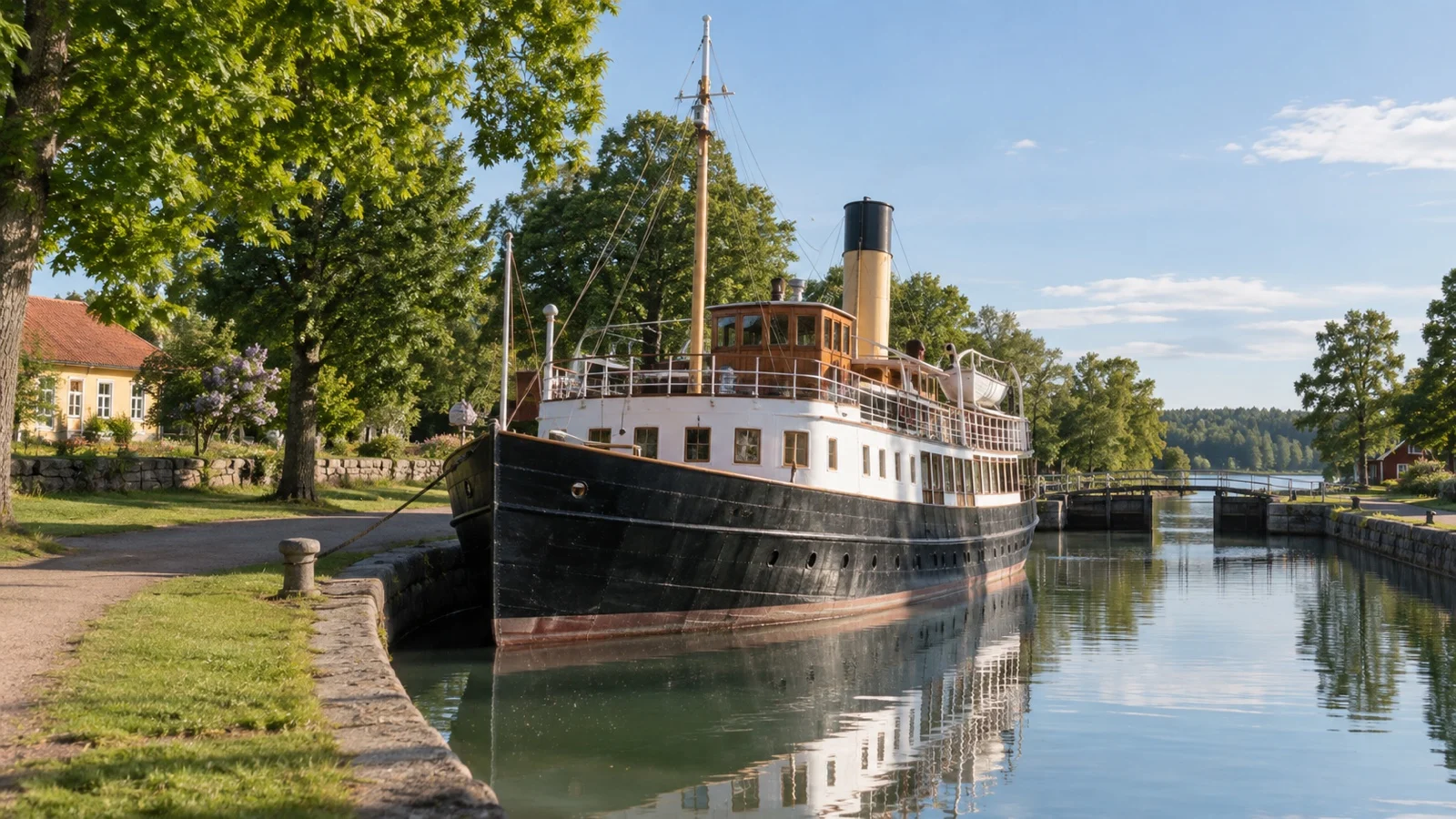
M/S Juno was built at Motala Werkstad in 1874 and is described by her operator as the world’s oldest registered ship still in service with overnight accommodation. Sweden’s National Maritime Museums designated her a historic ship in 2004.
M/S Wilhelm Tham followed from the same yard in 1912, and M/S Diana was built at Finnboda near Stockholm in 1931. All three were built to the lock dimensions, which is why they look like scaled-down ships rather than boats.
The cabins are genuinely tiny, and the operator’s own wording is that they are similar in size to a sleeping compartment on a train. Most have bunk beds, a few have a double, and every one has a washbasin with hot and cold water and a 220V socket.
No cabin has a private bathroom. Showers and restrooms are shared and located on each deck, so plan around peak morning and evening use.
If you are over about 5 feet 9 inches, the company asks you to say so when booking so they can put you in a berth that fits. That instruction tells you more about the scale of these ships than any photograph will.
Walking the towpath while your boat locks through
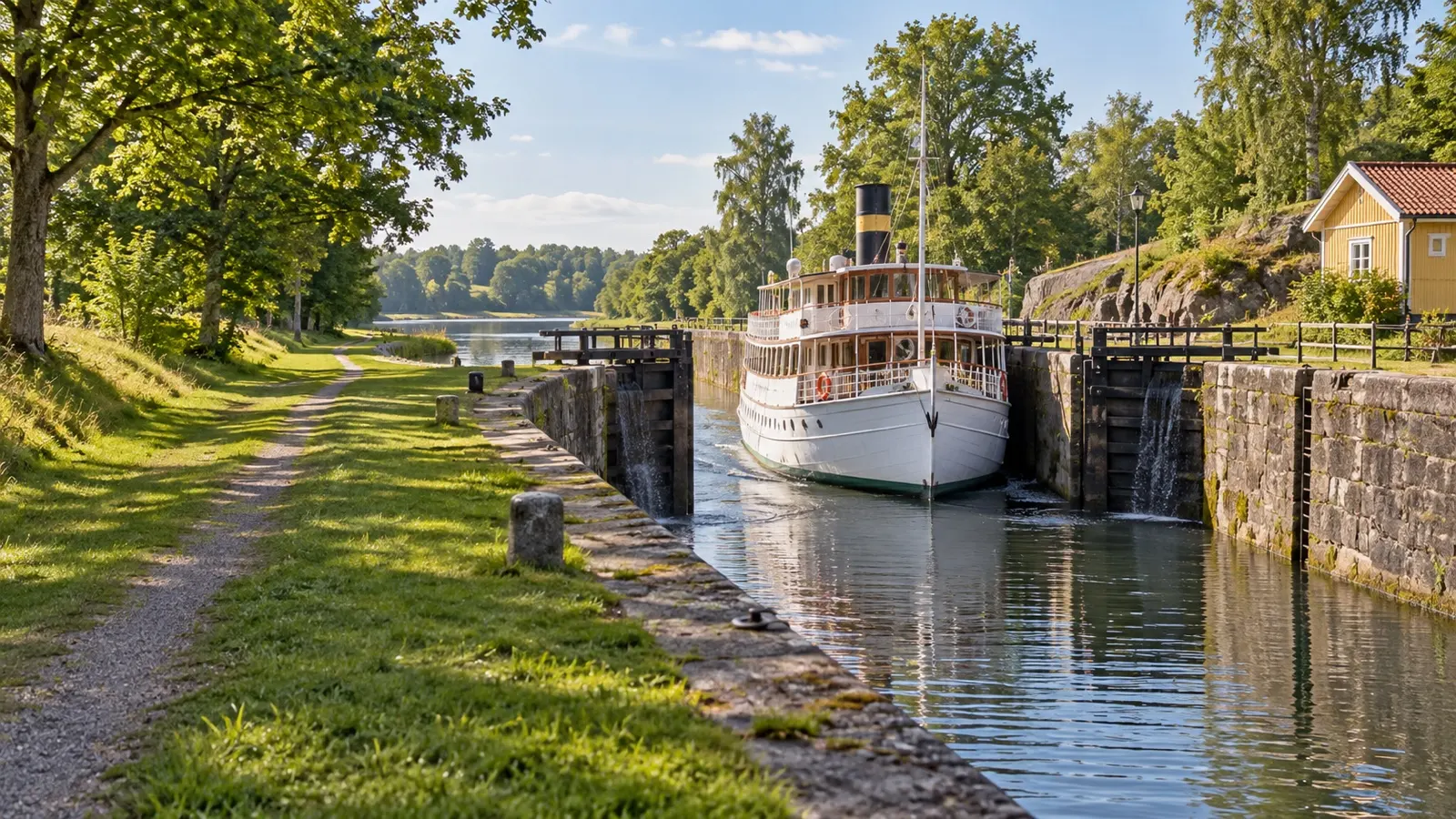
Walking beside the boat at major lock flights is a practical highlight of the trip. When the crew permits it, passengers can step ashore, walk the bank, and watch the ship move through the locks.
Berg, outside Linköping, is the famous one. The operator counts 15 connected locks there lifting or lowering ships by around 94 feet, and it is the canal’s most visited spot for exactly that reason.
At the western end, the Trollhättan flight drops four locks and roughly 105 feet on the Göta river. The Canal Museum in Trollhättan sits alongside and is included as a stop on the longer itineraries.
Borenshult is the steepest staircase on the canal according to Göta kanalbolag, and Forsvik has the oldest lock, opened in 1813. Both offer a close look at different periods of the canal’s engineering.
Is a Göta Canal cruise worth the money?
Per-night pricing is premium for compact cabins and shared facilities. The fare also reflects full board, guided visits, and operation of a historic ship.
A practical comparison is a full-board escorted tour that happens to float. The fare covers every meal, a guide on board, and a string of shore visits that would each cost money and a car to reach alone.
Where it fails is if you want privacy, space, a balcony, or any ability to sleep in. This is a communal trip, and the boat starts locking early.
Stops worth planning for
- Berg lock staircase: 15 locks in a run, plus the 12th century Vreta Abbey a short walk away. If the schedule permits only one longer walk, this is a strong option.
- Trollhättan: the four lock flight on the Göta river with the Canal Museum beside it. The museum and lock flight together provide useful engineering context.
- Forsvik: the canal’s oldest lock, opened in 1813, in one of Sweden’s oldest industrial areas. It is a compact stop with visible early canal history.
- Läckö Castle: a white baroque castle on a headland in Lake Vänern, a guided stop on the longer itineraries. The lakeside setting is especially clear from the water.
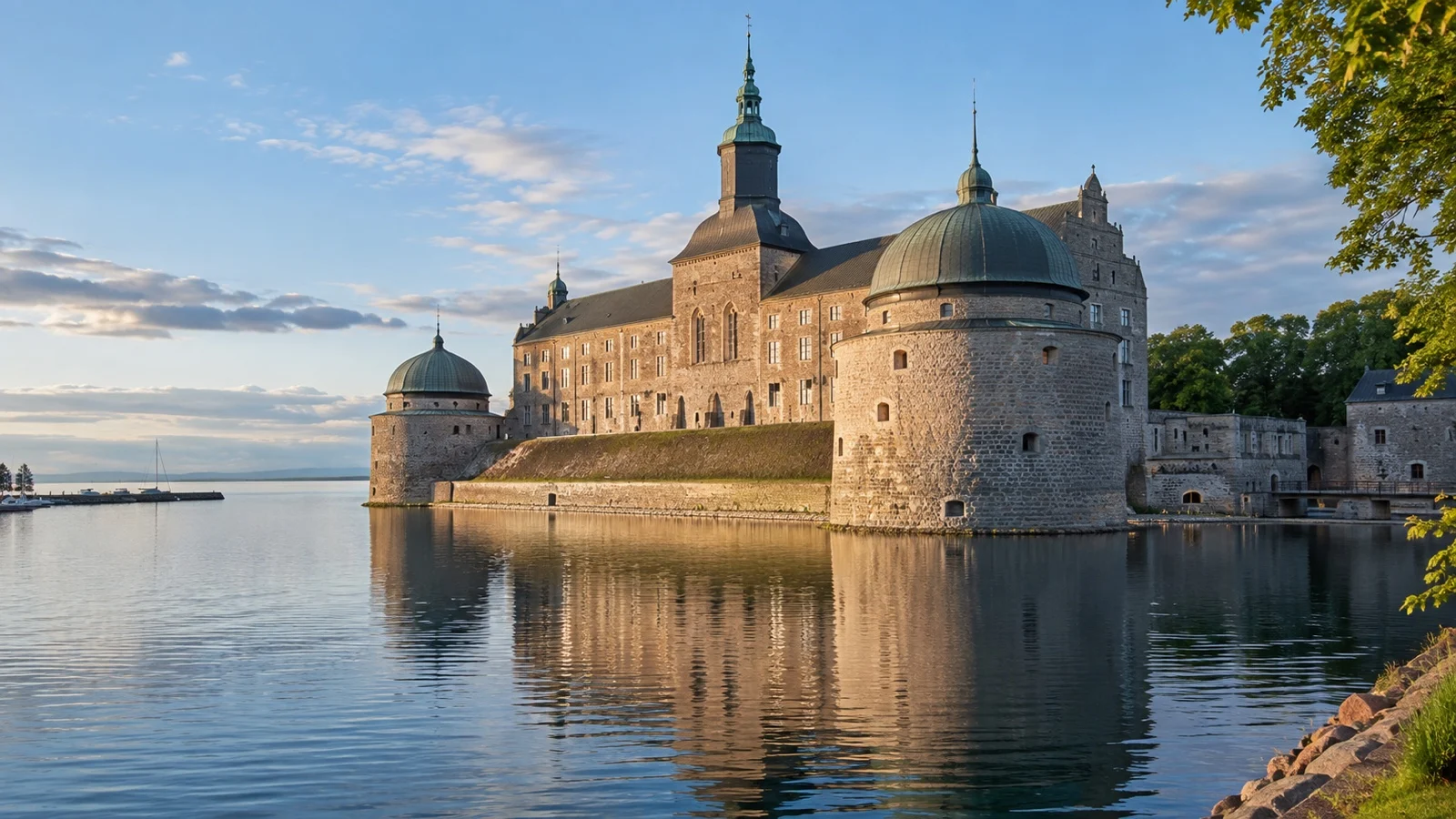
- Vadstena: the abbey town on Lake Vättern, with a Renaissance castle and the abbey church founded on Saint Birgitta’s order. The town itself is small enough to walk in an hour.
- Birka: the Viking Age trading town on Björkö in Lake Mälaren, reached near the Stockholm end. It is an archaeological site with a visitor museum and some reconstructed buildings in the buffer zone.
Fun fact: Birka is not a museum invention but a UNESCO World Heritage Site, inscribed in 1993, and UNESCO records it as one of northern Europe’s most important trading towns between roughly AD 750 and AD 980. It also held Sweden’s first Christian congregation, founded in 831.
How to plan the day
A canal day has a shape you learn by the second morning. Early breakfast, a lock flight or a lake crossing before lunch, a guided walk ashore in the afternoon, dinner, then the quiet stretch.
The lake crossings are the exception. Vänern and Vättern are open water, they can get choppy, and there is nothing to walk to, so that is the afternoon for the book you brought.
Add a night at each end rather than flying in on sailing day. Locks do not run to airline schedules and neither does anything else here.
A realistic word on accessibility
These historic ships have narrow doorways, high thresholds, steep staircases, and no elevator.
The Göta Canal Steamship Company states that passengers with reduced mobility must travel with a companion, and asks you to contact its booking team before you commit. Treat that requirement as a meaningful part of the booking decision.
Wheelchair users will find this route close to impossible on board, whatever the shore side looks like. The towpaths and lock areas are largely flat and manageable; the ship is the barrier.
If stairs are merely awkward rather than impossible, ask specifically for a shelter deck cabin near a bathroom and say how many steps you can manage. Do it at booking, not at check-in, because there are only 29 cabins on Juno and no flexibility once they are sold.
When to go, and the weather
The season is short and that is the main constraint. Navigation runs from early May to late September, and high season, when the locks are busiest, falls between mid June and mid August.
For central Sweden, Visit Sweden gives Stockholm averages around 52 to 68 Fahrenheit in June, 57 to 73 Fahrenheit in July and 55 to 70 Fahrenheit in August. That is pleasant on deck and cold once the wind gets up on the lakes.
May and September are cooler, around 43 to 61 Fahrenheit, with fewer boats in the locks. September can bring fall color along the banks, along with cooler conditions that require warmer layers.
Pack layers, a windproof jacket and rainwear, as the operator recommends. Swedish summer is defined by SMHI as five consecutive days above 50 Fahrenheit, and that tells you everything about how much you should trust it.
Quick answers
How long does it take to cruise the Göta Canal?
Gothenburg to Stockholm takes four or six days by passenger boat depending on the itinerary.
Shorter three-day and two-day sections of the canal are also sold.
How many locks are there?
The canal itself has 58 locks over about 118 miles.
The full coast to coast trip passes 66 locks once the Trollhätte Canal is included.
Do the cabins have private bathrooms?
No, not on any of the three ships.
Every cabin has a washbasin with running water, and showers and restrooms are shared on each deck.
Can I really walk beside the boat at the locks?
Yes, when the crew permits passengers to step ashore and rejoin at a designated point.
The crew tell you where and when to rejoin, and a full lock staircase takes about an hour.
Is the Göta Canal suitable for young children?
Children are accepted from seven years old, each requiring their own bed.
There is no children’s program, so it suits a curious child and bores a restless one.
The last word
The Göta Canal is the rare trip where the transportation is the destination, and where being slow is the product rather than a fault. Six days to cross a country you could drive in five hours is the entire argument.
Book it for the locks, the lakes and the 150-year-old hull, not for the plumbing. If a private bathroom and balcony are essential, compare this with a modern river ship using the guide to how river and ocean cruising differ.
If the appeal is the pace rather than Sweden specifically, compare the hotel barges of France and the Netherlands in the guide to European barge cruises. Cabin arrangements, lock operations, and weather vary by vessel and route.
For ocean-ship arrivals, see the guides to Sweden’s cruise ports and Stockholm cruise port. A big ocean ship and a 29-cabin canal boat can reach the same city on the same morning.
How this guide was researched: No firsthand Göta Canal sailing, cabin inspection, or lock-side walk is claimed. Lock counts and canal information were checked against Göta kanalbolag; current ship, itinerary, fare, and inclusion details against Rederi AB Göta Kanal; Birka against UNESCO; and seasonal context against Visit Sweden.
Logistics and time-sensitive details were reviewed September 12, 2026. Confirm the dated itinerary, cabin facilities, accessibility, inclusions, and cancellation terms before travel. See our Editorial Policy.
More on this topic: browse every guide on expedition and alternative cruises.