Duty Free Ashore or Onboard: Where the Deal Is Real
The sign says duty free, so you buy the bottle without checking, and it turns out to cost more than it does at home. Duty free is a customs term and not a promise about price, and that gap costs people money on every cruise.
My quick take
I buy three things duty free and ignore everything else. Spirits, a fragrance I already wear, and local liquor I cannot easily get at home, because those are the categories where tax makes up enough of the shelf price that removing it actually shows up.
The rest of the shop I treat as a normal store with a nicer view. A watch case does not get cheap because there is a duty free sign above it, and I have never once found a camera or a pair of sunglasses in one of these shops that beat what I could order at home.
The quick facts
- What it means: The price skips the local country’s import duty and local tax, not whatever you owe carrying it home.
- Where it works: Spirits, tobacco, fragrance and cosmetics, because tax is a big share of the normal price.
- Where it does not: Watches, electronics, sunglasses and designer leather, where the margin does the work.
- Your allowance: A returning US resident normally gets $800 of goods and one liter of alcohol, with higher limits from US territories.
- The bottle rule: Liquor bought ashore is usually tagged at the gangway and delivered to your cabin the last night.
What duty free actually means
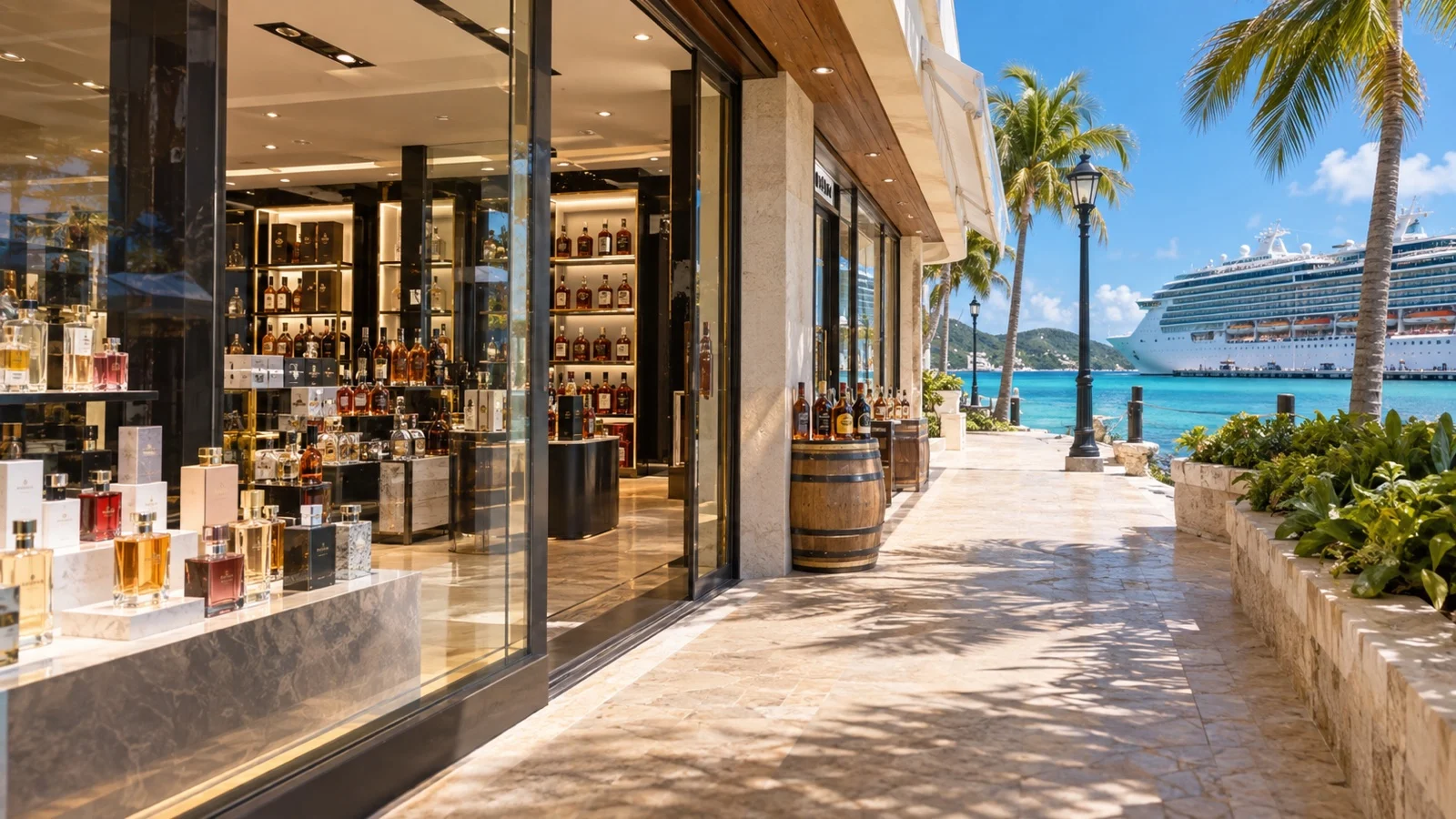
A duty free shop sells goods that have never fully entered the local country’s tax system, on the understanding that you are taking them out again. The stock sits in a bonded space, and the price you see has no local import duty, no local excise tax and no local sales tax baked into it.
That is the whole meaning of the phrase. It describes what the seller did not pay, not what you will pay, and it says nothing at all about what happens when you walk that bottle through the customs hall in your own country.
Why the sign is often not a bargain
For most products, duty is a small slice of the retail price. A handbag or a watch carries a brand margin that dwarfs the import tax, so stripping the tax out barely moves the number on the tag.
Then there is the rent. A shop with a door twenty steps from a cruise gangway is paying for that address, and often paying a commission to be there at all, and that cost lands somewhere.
The last piece is the comparison price. When a tag shows a much higher number crossed out, that reference figure is chosen by the seller, and it is not a market average anyone audited.
The categories where the deal is real
The savings are genuine wherever the tax is the main reason a thing is expensive. That is a short list, and it is the same short list in almost every port.
- Spirits: Excise tax is a large share of a liquor price at home, so removing it is visible.
- Tobacco: Same logic, often more extreme, and heavily limited by what you can legally carry back.
- Fragrance and cosmetics: Frequently the best real discounts in the shop, especially on larger sizes.
- Local production: Rum in the Caribbean, tequila in Mexico, aquavit in Scandinavia, where local supply and no export markup stack together.
- Bottles you cannot buy at home: A distillery release that never reaches US shelves is worth its price on availability alone.
The categories where it almost never is
Electronics, watches, sunglasses, designer leather and jewelry are the ones that catch people. The brands behind them set global prices, and the tax you are skipping was never the thing making them expensive.
Cameras and headphones are the clearest example. Online competition at home has already ground those margins down to almost nothing, and a port shop with one of each model cannot beat that.
How the ship’s shops price against the shops on the pier
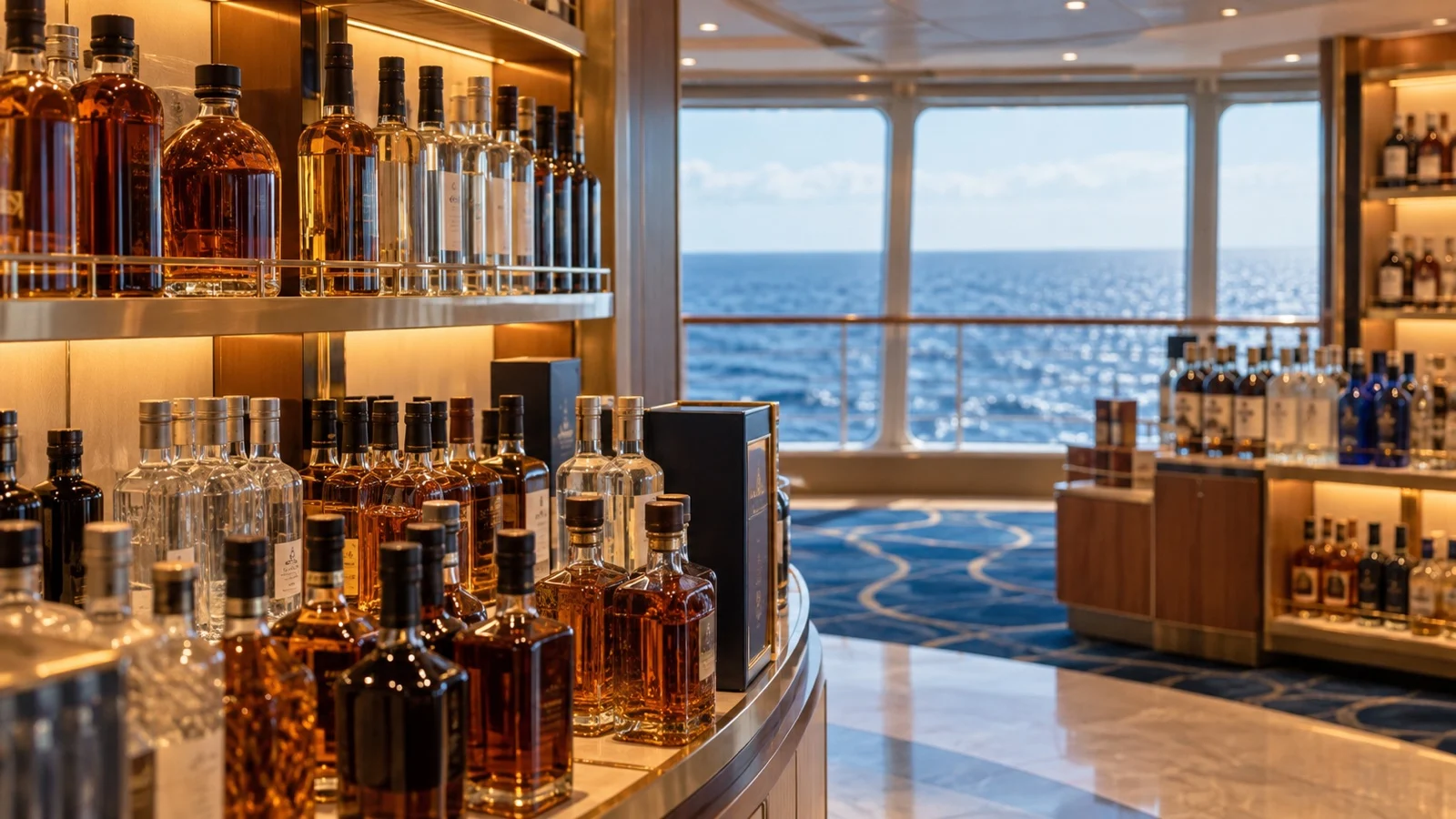
The shop onboard can only legally open when the ship is at sea, which is why the shutters come down before you dock. That single rule shapes everything about how it sells.
It has no local sales tax and no waterfront rent, but it also has a captive audience, limited shelf space and no competitor within a hundred miles (160 km). Those pressures cut in opposite directions, so the ship is sometimes genuinely cheaper on liquor and rarely cheaper on anything branded.
Ships also run sales, and the deepest markdowns usually land on the last sea day. That is useful if you are patient and irritating if you already bought the thing in port on day two.
What your US allowance actually covers
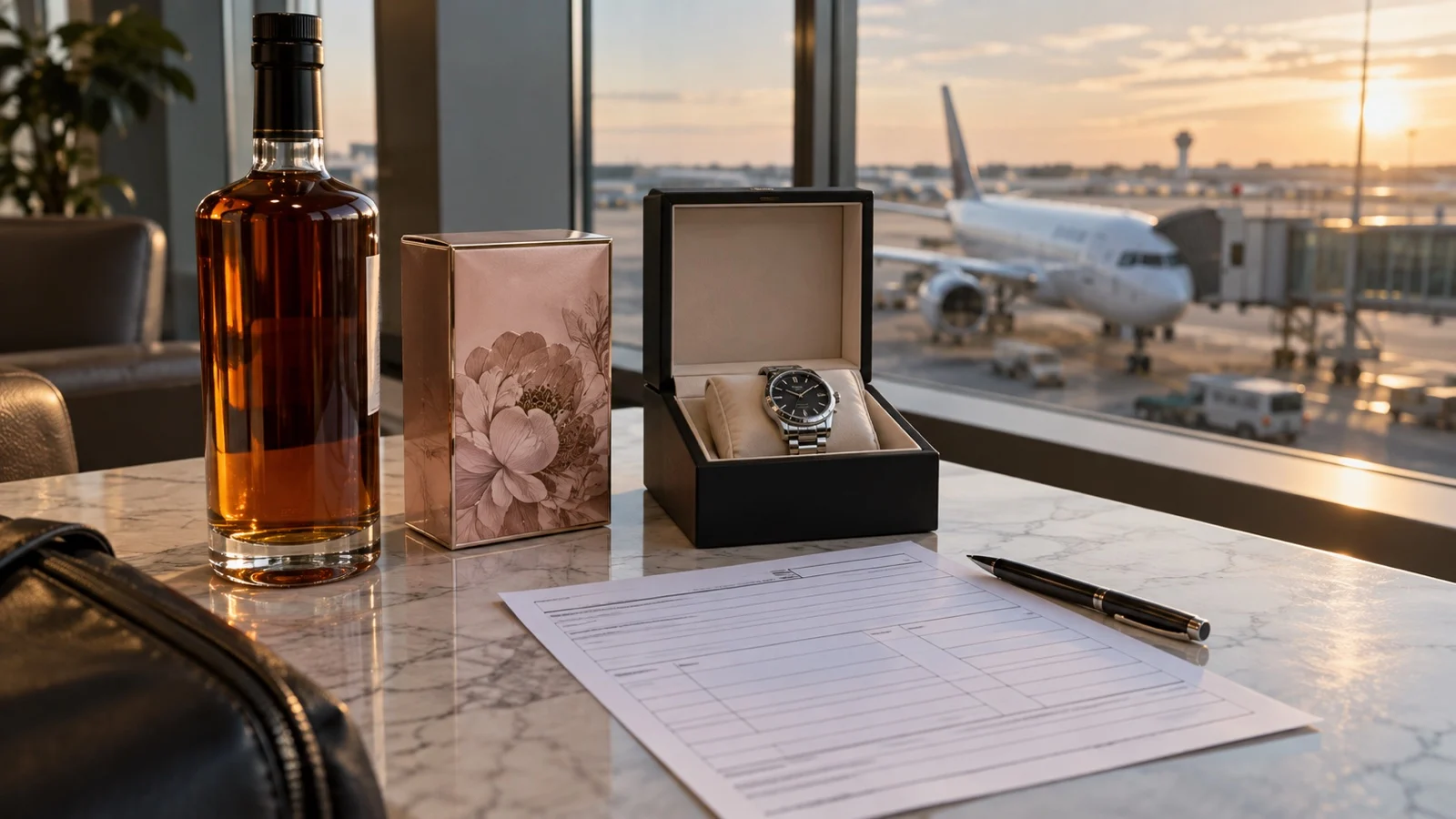
A returning US resident is normally entitled to bring in $800 of goods free of duty, measured at fair retail value in the place you bought them. The rule that sets that figure also raises it to $1,600 if you are arriving from American Samoa, Guam, the Northern Mariana Islands or the US Virgin Islands, with no more than $800 of that acquired anywhere else.
The exemption is per person, and it is not limited to adults. Members of a family living in one household who travel back together can group their exemptions without worrying about whose name is on which receipt, which quietly doubles or triples the number for most cabins.
Two conditions sit underneath all of this. You generally need to have been outside the country at least 48 hours, and you cannot have claimed the exemption within the previous 30 days, which only bites if you are back-to-backing short sailings.
The alcohol and tobacco limits hiding inside it
The dollar figure is not the binding constraint on liquor. The quantity limits are, and they are much smaller than most people assume.
- Standard: One liter of alcoholic beverages, and only if you are 21 or over.
- Caribbean basin countries: Two liters when you arrive directly, if at least one liter was produced in one of those countries.
- US territories: Up to 1.3 gallons (5 liters), with no more than one liter bought elsewhere and no more than four liters produced elsewhere.
- Tobacco: 200 cigarettes and 100 cigars, rising to 1,000 cigarettes from those same territories.
- Your state: State alcohol law can be tighter than the federal allowance, and it is the one people forget.
One liter is a single generous bottle. If your plan involves a case of rum, the plan needs a rethink before you are at the counter with a card in your hand.
Going over is cheaper than people think
Exceeding the exemption is not a disaster and it is not a penalty. The next $1,000 of fair retail value above your allowance is charged at a flat 3 percent, which on a $400 overage is twelve dollars.
What is expensive is not declaring it. Undeclared goods can be seized, and the argument you have at that desk is worth far more than the duty you were trying to avoid.
So keep the receipts somewhere you can reach them, and put the real number on the form. My guide to what you cannot bring back onboard or through customs covers the categories where the answer is a flat no rather than a small fee.
The liquor that gets held until the last night
Buy a bottle ashore and you will usually hand it over at the gangway on the way back in. Security tags it, it goes into a locker, and it reappears outside your cabin door on the final night of the cruise.
This is ship policy, not customs law, and it exists because bar revenue matters. Most lines apply the same treatment to liquor bought in the onboard shop, delivering it at the end rather than letting you carry it to your cabin.
So you cannot drink it onboard, and you will be wrapping glass at eleven at night on the evening you have the least time. I leave a shirt or two loose in the suitcase on purpose when I know bottles are coming.
Getting the bottles home in one piece
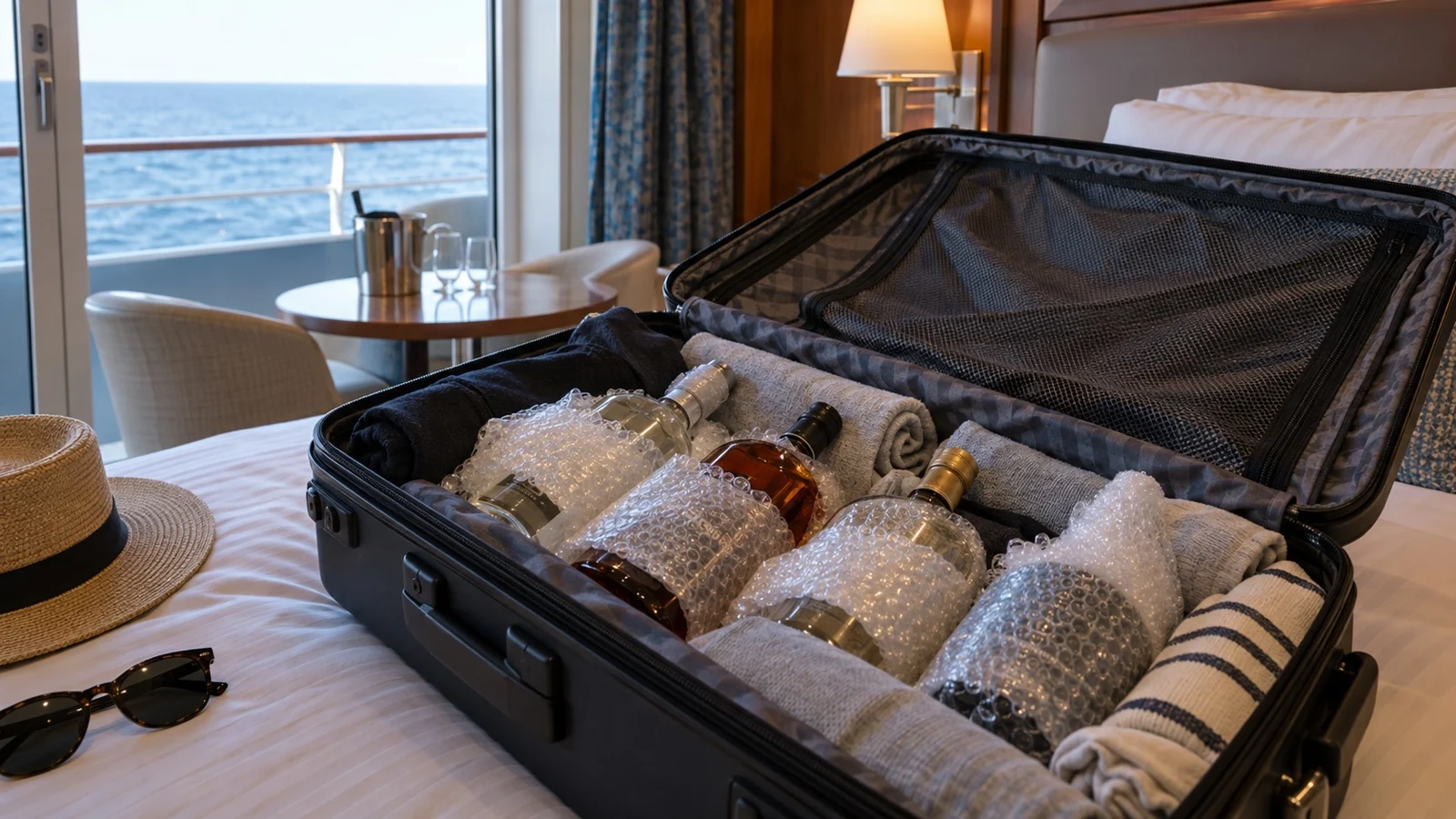
Liquor goes in a checked bag, full stop. Security rules keep anything over 3.4 ounces (100 ml) out of your carry on, and the sealed duty free bag does not change that once you have collected your luggage and re-entered a terminal.
There are limits in the hold too. Drinks between 24 and 70 percent alcohol are capped at 1.3 gallons (5 liters) per passenger in checked bags and must stay in unopened retail packaging, while anything at 24 percent or below is not limited that way.
Then there is weight, which is the one that actually gets people. Three full bottles with their glass add close to ten pounds (4.5 kg) to a bag that was already near the airline limit, and an overweight bag fee will erase your savings in one swipe.
Give yourself room on the back end as well. How late to book your flight home after a cruise matters more when you are checking a bag full of glass and cannot simply walk off with a backpack.

The currency question at the register
Port shops will often offer to charge your card in dollars instead of the local currency. That conversion is done by the merchant’s provider at a rate they choose, and it is almost always worse than the one your card would have used.
Say local currency every time. My notes on carrying cash and cards in port go through where this matters most and why small bills still earn their place in your pocket.
Onboard, everything lands on your folio in dollars, which is simpler. Whether your onboard credit can be spent in the shops depends on the line and on where the credit came from, so check that before you plan a spree around it.
What I do in a duty free shop in about five minutes
I have a short routine and it has saved me from several confident bad purchases. None of it is clever, it just slows the moment down long enough to price the thing properly.
- Name the category: If it is not liquor, tobacco or fragrance, I assume no saving until proven otherwise.
- Price it at home: Same brand, same size, on my phone, before I get in line.
- Do the per liter math: Larger bottles hide most of the real discounts.
- Count what I already have: One liter each is the ceiling, and it fills faster than you expect.
- Pay in local currency: Every time, no exceptions, even when the screen pushes dollars.
Quick answers
Is duty free actually cheaper on a cruise?
On spirits, tobacco, fragrance and cosmetics, usually yes, because tax is a big part of what those cost at home. On electronics, watches and designer goods, usually no.
How much alcohol can I bring back to the US from a cruise?
One liter per adult is the standard duty free amount, with two liters allowed on a direct return from many Caribbean countries and up to 1.3 gallons (5 liters) from US territories. Your state can set a tighter limit than the federal one.
Why did the ship take my duty free bottle at the gangway?
Because almost every line stores alcohol brought aboard and returns it on the last night, to protect bar sales. It is not confiscation and you will get it back.
Is the ship’s shop cheaper than the shops in port?
Sometimes on liquor, rarely on branded goods, and the biggest onboard markdowns tend to arrive on the final sea day. Comparing the two on your phone is faster than guessing.
Do I have to declare duty free purchases when I get home?
Yes, everything you bought abroad goes on the declaration, whether or not it fits inside your exemption. Being over the limit costs a small flat percentage, while not declaring can cost you the goods.
Final word
Duty free is a customs status that got adopted as a marketing word, and the two meanings have drifted a long way apart. Treat the sign as information about the seller’s tax position and nothing more, and the whole thing becomes easy to navigate.
Buy the local rum you cannot get at home and the fragrance you were going to repurchase anyway. Walk past the watch counter, keep your receipts, declare what you bought, and leave a little space in the suitcase for the bottles that turn up outside your door on the last night.
How this guide was researched: Personal duty free exemptions, alcohol and tobacco quantity limits, the flat duty rate above the allowance and the airline rules for carrying bottles home were checked against current federal regulations and official guidance in November 2026. Allowance figures, cruise line alcohol policies and shop pricing change without much notice, so confirm the limits and your own line’s rules before your sailing. See our Editorial Policy.
More on this topic: browse every guide on port logistics and timing.