What Does a Cruise Ship Medical Center Cost?
Cruise lines generally bill medical-center care to the onboard account, and the total can include separate charges for the consultation, tests, medication and treatment. Emergency transport or care ashore is billed separately and can cost far more.
Major lines generally do not publish a complete price list, so ask about charges before nonurgent care when circumstances allow. In an emergency, seek care first and request an itemized bill and records afterward.
What this actually costs
I could not find a complete public fee schedule from the major cruise lines reviewed on September 10, 2026. Carnival instead describes a customary fee that varies by ship and time of day.
Carnival’s published medical services page says its physicians are independent contractors entitled to charge a customary fee, that the fee varies by ship and by time of day, and that a basic consultation does not include medication, tests or treatment. Those last seven words are where the bill grows.
Holland America’s published guidance uses the same language, saying a customary fee will be charged for services and for medications dispensed. Norwegian Cruise Line states that fees are billed directly to your stateroom account with an itemized receipt for possible insurance reimbursement, and that direct insurance billing is not available.
So the structure is consistent even though the numbers are not published. You pay a consultation fee, then a separate line item for every test, injection, dressing, tablet and hour of observation on top of it.
The time of day matters because Carnival says so outright. A call to the cabin at two in the morning is not priced the same as walking in during posted consultation hours.
Do not use an equipment deposit as a guide to clinical prices. A refundable deposit for a medication cooler is not the cost of a doctor visit, test, medication or emergency response.
The timeline, step by step
For nonurgent care, follow the ship’s directions for contacting or visiting the medical center and take your cruise card, medication list and insurance details. Billing procedures vary, so ask how charges and receipts will be handled on that line.
Expect the consultation, medication, laboratory work, imaging, treatment and observation to be itemized separately when the line uses fee-for-service billing. Ask for an estimate before optional or nonurgent services when the medical situation allows.
Charges are generally posted to the onboard account, but timing and the way they appear in an app or statement vary. Review the account while still onboard so billing questions can be raised before disembarkation.
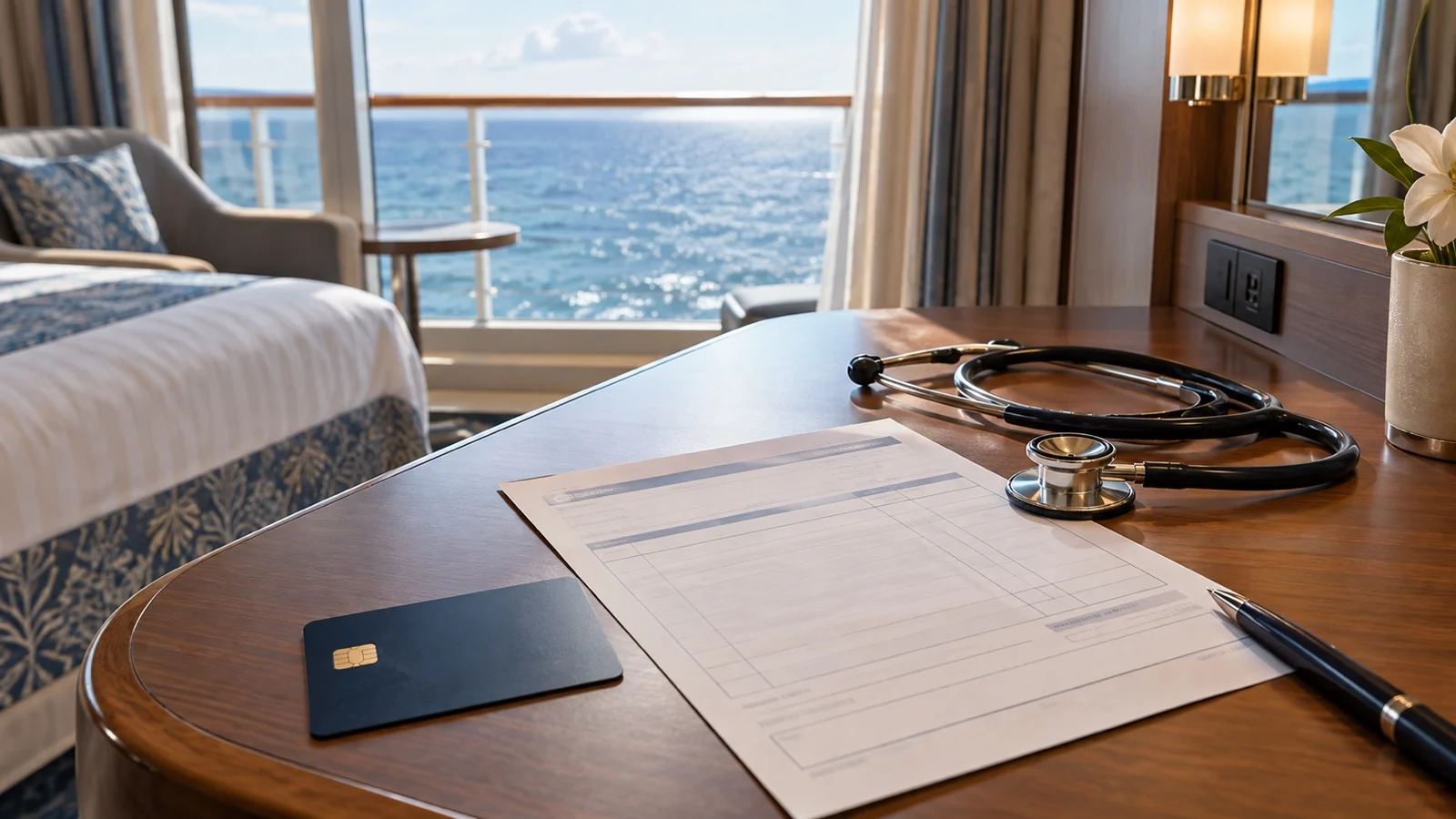
The onboard account usually settles through the payment method registered for the cruise. Keep enough available credit for upfront payment because ship clinics generally do not bill a land-based insurer directly.
Before disembarking, request an itemized bill, medical notes and any diagnostic reports or images the insurer may need. Ask the medical center what identifying information appears on the claim documents rather than assuming a particular tax form or records timeline.
What is actually in a shipboard medical center
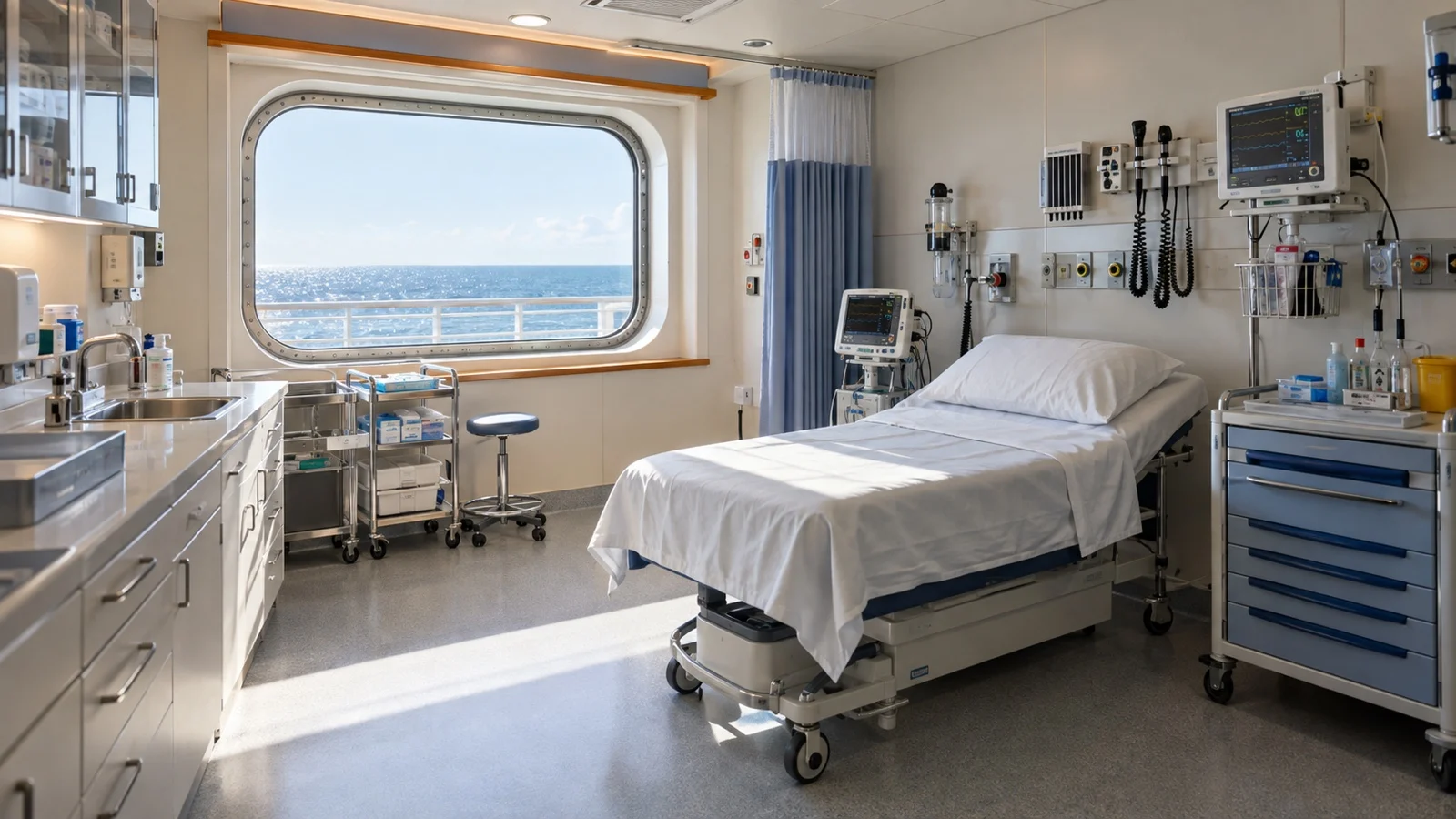
More than people expect, and less than a hospital. Royal Caribbean’s published description lists cardiac monitors, automated external defibrillators, ventilators, x-ray machines and processors, laboratory equipment, a formulary of acute care medications, and minor surgical and orthopedic supplies.
Royal Caribbean also says its facilities are built, staffed, stocked and equipped to meet or exceed the guidelines of the American College of Emergency Physicians Cruise Ship and Maritime Medicine Section. The CDC’s Yellow Book chapter on cruise ship travel notes that most major lines follow those guidelines.
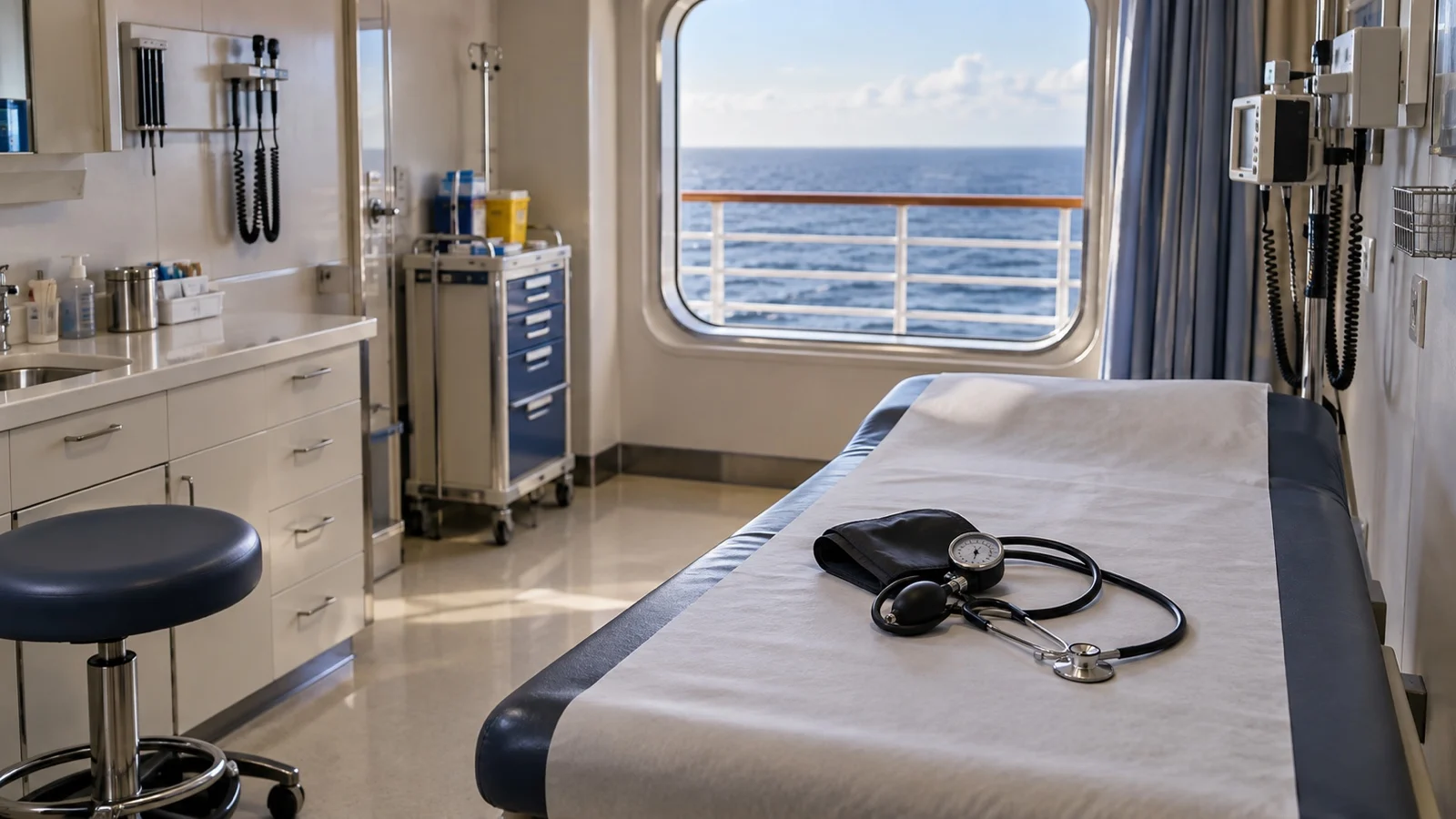
The CDC says ship medical centers typically provide ambulatory care and may have stronger capabilities on some vessels, but they are not full hospitals. Equipment, staffing and services vary by ship, itinerary and medical contractor.
Do not assume a specific scanner, blood product, operating room or pharmacy item is present or absent fleetwide. If a condition might require specialized diagnostics or treatment, ask the line and your clinician whether the ship and itinerary are appropriate.
Most routine illness and injury can be assessed onboard, while a serious or specialized case may require transfer or evacuation. The deciding factors include the patient’s condition, ship capability, distance, weather and the quality of available shoreside care.
Who staffs it, and when the door is open
Staffing varies with the cruise line, ship size, route and medical contractor. Lines may publish typical doctor and nurse numbers, but those figures are not a guarantee for every sailing.
Carnival describes a range from one physician and three nurses up to two physicians and five nurses, and requires current advanced cardiac life support certification. Royal Caribbean requires the same certification of its doctors and nurses.
Posted consultation hours vary by line, ship and day, while emergency response is available outside routine clinic hours on major lines. Check the daily program and call immediately for urgent symptoms rather than waiting for a cheaper time slot.
After-hours care may cost more, but price should not delay urgent evaluation. For a nonurgent concern, ask when regular consultation hours begin and what charges apply.
One limit that surprises families: Holland America states that its medical staff are not available for daily care unless you are hospitalized, and that guests must be able to care for themselves, including dressing, eating and attending the ship’s safety drills. The medical center is not a nursing service, which is why oxygen, CPAP and dialysis run on their own forms.
What triggers a diversion or a transfer ashore
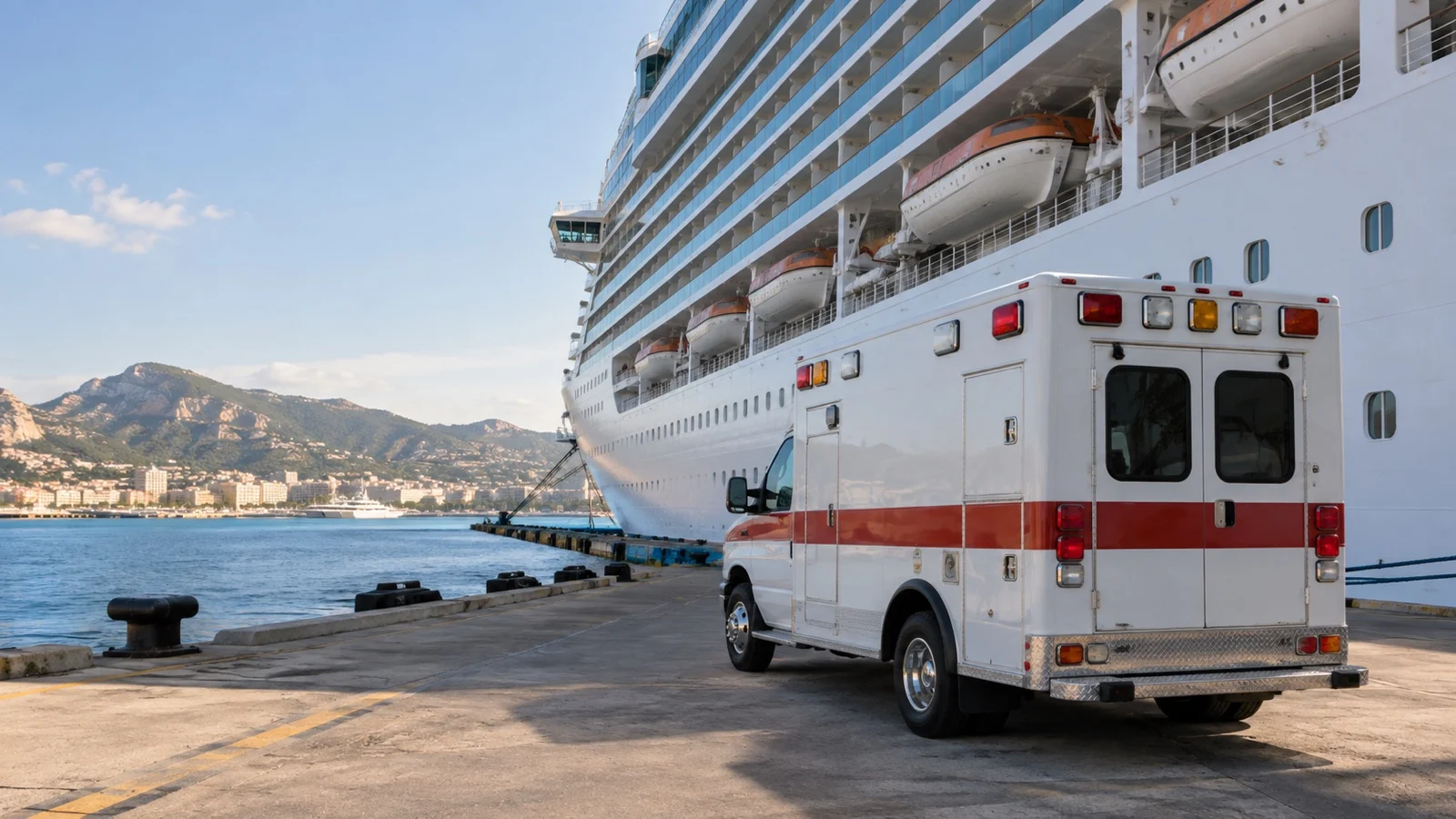
Royal Caribbean describes the goal of its medical centers as stabilizing the patient first and, when necessary, evacuating them to an appropriately equipped shoreside facility. Holland America says the same in different words, that you will be transferred to facilities ashore when your needs exceed what the ship can do.
The mechanics vary with where you are. Near a coast the ship may increase speed toward the next port, put a patient onto a pilot boat or a national coast guard vessel, or accept a helicopter winch if one is in range and the weather cooperates.
Helicopter range is the constraint nobody thinks about. I could not find a published fleetwide figure, and it depends entirely on the aircraft and the rescue service, but the middle of an ocean crossing is beyond any of it.
A diversion is a commercial decision as well as a clinical one, and it can cost the rest of the ship a port. My roundup of the ports most likely to be missed or canceled covers the other reasons a call disappears from the itinerary.
Once a patient transfers ashore, the receiving provider and insurer drive the next stage. Ask who will communicate with your emergency contact, how baggage is handled and whether the ship’s port agent can assist, because the vessel may need to sail.
Why ordinary health coverage may not be enough

Medicare and many private plans limit or exclude care at sea, foreign medical treatment or evacuation. Read your own policy and ask the insurer about shipboard care, foreign hospitals, evacuation and repatriation in writing.
Royal Caribbean says it does not accept land-based health insurance plans onboard, and that you may be eligible to submit a claim afterward. Norwegian says direct insurance billing is not available.
In each of those cases you pay the ship first and argue with your insurer later. That sequence is the thing to plan around, because it means the money has to be available on your card at the end of the sailing.
Medicare has a narrow exception that is worth knowing precisely. Medicare’s own guidance says Part B may pay for medically necessary services on a ship if the doctor is legally allowed to provide medical services on the ship and the ship is in a US port or no more than six hours away from one.
Do not draw the six-hour boundary on a map yourself. Medicare says coverage generally stops when the ship is more than six hours from a U.S. port, and provider and service requirements still apply, so confirm the claim with Medicare or the plan administrator.
The U.S. State Department warns that the U.S. government generally does not pay overseas medical bills and recommends considering insurance for medical care and evacuation. Costs vary enormously, so compare policy limits, exclusions and the destinations on your itinerary rather than relying on one headline estimate.
This post covers cost, policy and logistics only, and it is not medical advice. Confirm current fees and what is covered in writing with your cruise line, check your own policy documents with your insurer, and talk to your own doctor about whether a particular itinerary suits your health.
The ports where care ashore is realistic, and where it is not
The ship is only half of the answer. What actually determines your outcome is the map, because a transfer ashore is only as good as the place you are transferred to.
Major homeports often have advanced hospitals nearby, while remote islands and expedition routes may require another transfer. Distance alone is not enough, since capability, bed availability, language, payment rules and immigration logistics also matter.
Small island and remote calls are a different conversation. Many Caribbean, South Pacific and Alaskan communities have a clinic rather than a hospital, and serious cases move again by air to a regional center, which is the leg your insurance either covers or does not.
Expedition itineraries are the extreme. A Drake Passage crossing to Antarctica puts you two days of open ocean from Ushuaia, and the Northwest Passage ports are hamlets with nursing stations rather than hospitals.
Ocean crossings sit in the same category for a different reason. A transatlantic crossing or repositioning sailing has consecutive days where no diversion is quick, and the ship’s own team is the whole system for a while.
What I would actually do with the money
- Compare emergency medical, evacuation and repatriation limits separately from trip cancellation. A large trip-cancellation limit does not show what the policy will pay to reach suitable care or return home.
- Read the per-person medical and evacuation limits plus the exclusions, preauthorization rule, pre-existing-condition terms and definition of an adequate facility. A cruise line’s optional plan may suit one trip and be too limited for another.
- Check what your credit card provides, but read the full benefits guide and activation requirements. Card benefits can be secondary, conditional or narrower than the marketing summary.
- Ask your own insurer the ship question directly: the phrase you want is coverage for care received aboard a vessel outside US territorial waters, and you want the answer in writing. A plan that covers foreign hospitals does not automatically cover a shipboard clinic.
- Spend a little on paperwork: a photo of your insurance card, your policy number, your medication list and your doctor’s contact details, stored offline on your phone. It costs nothing and it is what the medical center will ask for at the desk.
- Budget for the shoreside leg: if you are put ashore, the ship’s charges stop and a foreign hospital’s begin, often with payment or a guarantee required up front. That is the expense that ruins people, not the consultation fee.
How to avoid duplicate or inadequate coverage
Do not assume a short Bahamas cruise stays inside Medicare’s six-hour rule or close enough for a simple transfer. Coverage and evacuation decisions depend on the scheduled route, location, weather and available care.
If you already have annual travel insurance, employer or retiree coverage, Medigap, Medicare Advantage or card benefits, compare them before buying another plan. Overlapping policies may coordinate benefits, and exclusions can still leave a gap.
Pay closest attention on itineraries with consecutive sea days, remote ports or limited local hospitals. A clinician can help assess medical suitability, while the insurer must explain what transport, treatment and repatriation the policy will fund.
Quick answers
How much does a cruise ship doctor visit cost?
No major line publishes a rate, and Carnival describes it as a customary fee that varies by ship and by time of day; Expect a consultation charge plus separate itemized charges for tests, medication and treatment.
How do you pay the ship’s medical center?
Charges go straight onto your onboard account, which Carnival calls the Sail and Sign account, and Norwegian bills directly to your stateroom account; The balance settles against your registered card at the end of the cruise.
Does Medicare cover a cruise ship doctor?
Medicare’s published guidance says Part B may pay for medically necessary services on a ship only if the doctor is legally allowed to provide services on that ship and the ship is in a US port or no more than six hours from one; Outside that window, Medicare generally does not pay.
What can a ship’s medical center not do? It is not a full-service hospital, and capabilities vary by vessel; Serious or specialized cases may be stabilized and transferred ashore, so ask about the named ship if a particular diagnostic or treatment capability matters.
Do I need separate travel medical insurance for a cruise?
Holland America states that Medicare and many health insurance plans do not cover care at sea, in foreign countries, or air evacuation, and recommends travel medical insurance; Check what your own policy and credit card already provide before you buy another one.
The last word
A shipboard medical center is designed for acute assessment, treatment and stabilization, not to replace a full hospital. It usually bills separately from your cruise fare, and the capabilities and charges vary by line and vessel.
The number that should shape your decisions is not the consultation fee. It is the cost of getting home from wherever the ship happens to be when something goes wrong.
That is why I think of this as a port question rather than a ship question. Reading the itinerary for distance from a real hospital tells you more than any brochure page about the medical center, and my guide to planning port days for someone who cannot walk far comes at the same map from the other direction.
How this guide was researched: Billing and capability information was checked against current official pages from Carnival, Holland America, Royal Caribbean and Norwegian, with medical context from the CDC and coverage rules from Medicare and the U.S. State Department. Details were rechecked on September 10, 2026, but fees, staffing, equipment and insurance terms vary, so confirm them with the line, insurer and clinician.
More on this topic: browse every guide on accessible and family cruise planning.