Accessible Cruise Cabins: How Few There Are and How to Get One
Accessible cabins are limited inventory and can sell earlier than standard rooms on popular sailings. The right strategy is to book the specific features you need, not simply the first cabin marked with an accessibility symbol.
Here is the booking walked through in order, and the things I would pin down in writing before final payment.
Why this is worth ten minutes
Princess publishes the number on its ship fact sheets, and the number is small. Sky Princess carries 3,660 guests on lower berths in 1,830 staterooms, and 38 of those staterooms are wheelchair accessible.
That is a little over 2 percent of the rooms on this particular ship. It shows why early booking matters, but it should not be treated as the ratio on every line or vessel.
The practical result is that a suitable cabin may disappear well before other categories. Book as early as your plans allow, especially for fixed dates, then monitor the exact room number through every reprice or itinerary change.
What you are actually looking at
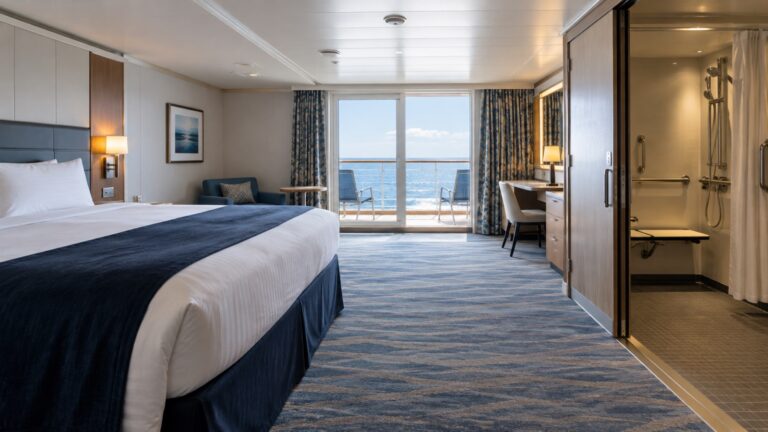
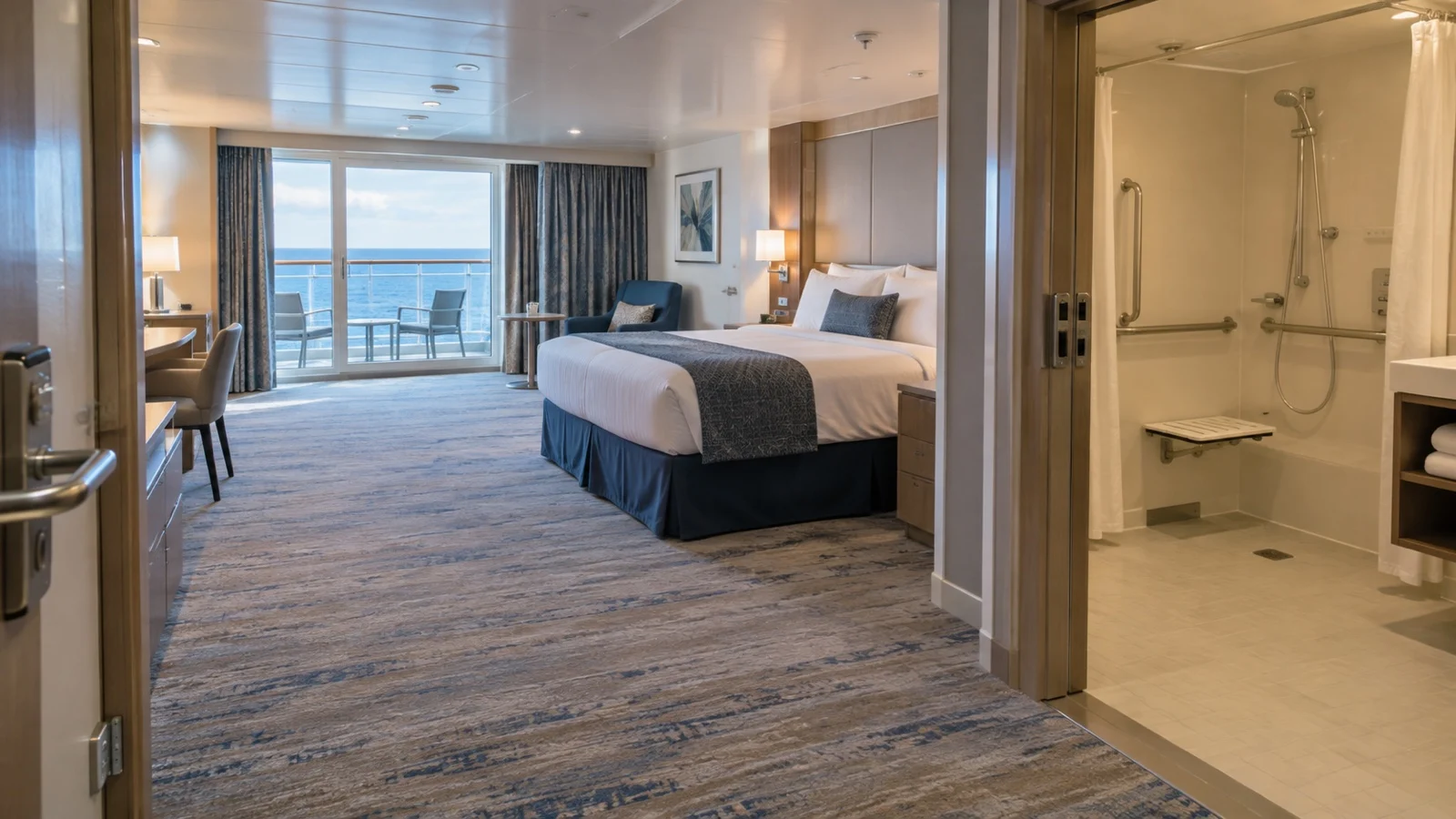
An accessible stateroom is a room designed around clear floor space rather than square footage, so do not assume it doubles as one of the cabins that sleep five or more. Royal Caribbean’s published specification describes accessible staterooms of 159 to 298 square feet with a five-foot turning radius in the sleeping area, the bathroom and the sitting area.
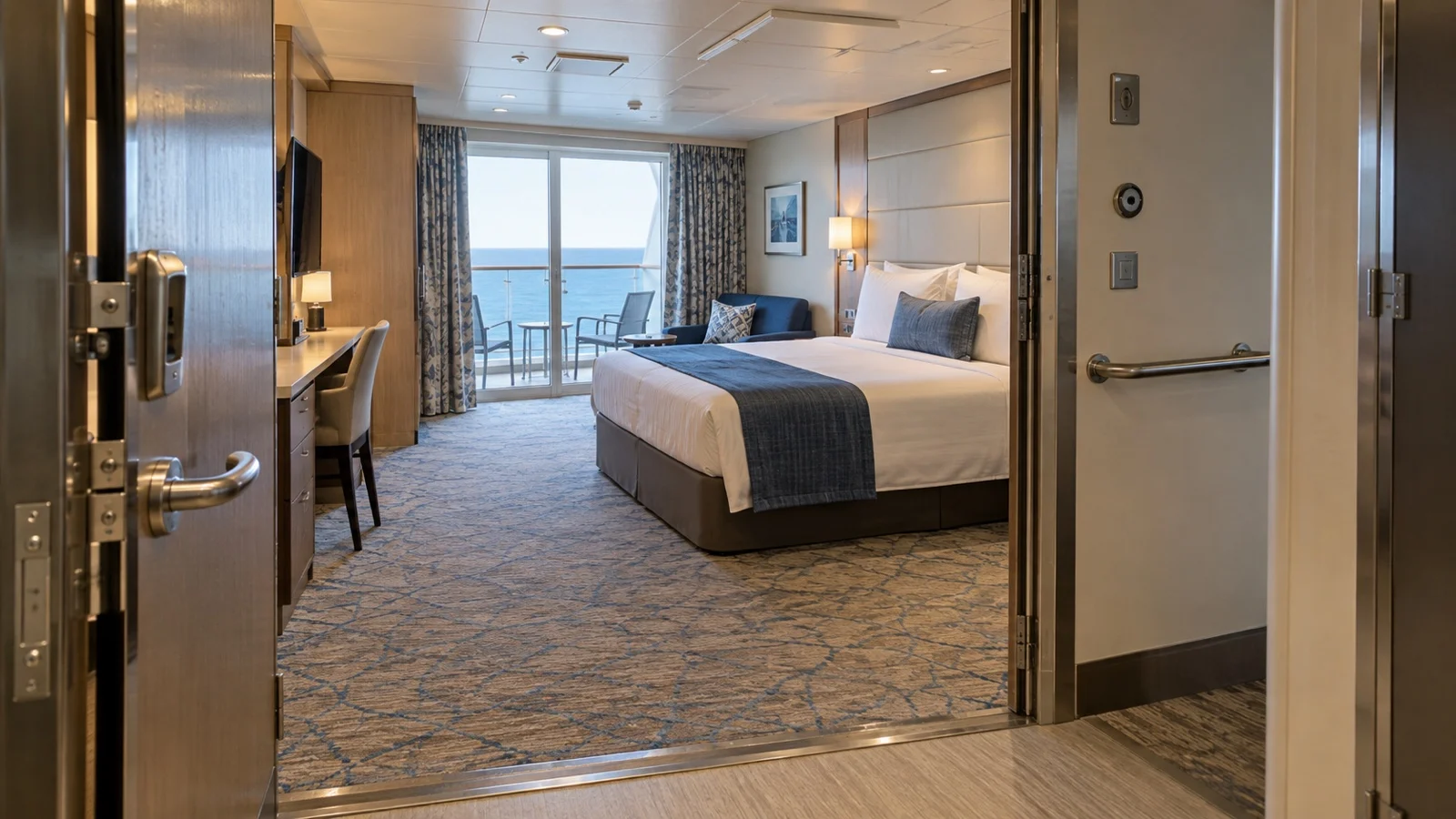
The doorways are the other half of it. Royal Caribbean lists stateroom and bathroom doors of 32 to 34 inches depending on the vessel, no doorsill at the stateroom entry, and ramped bathroom thresholds.
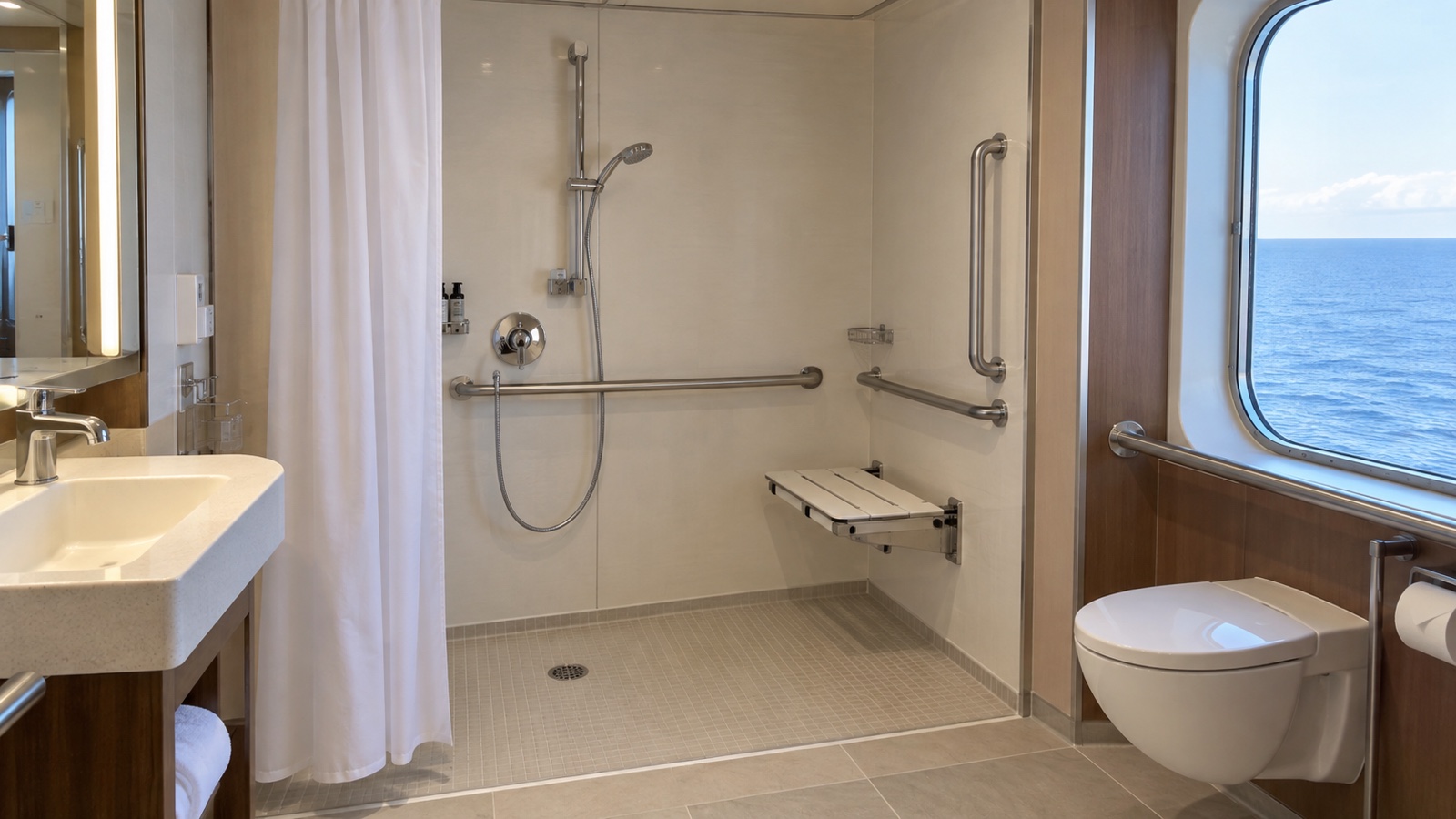
Disney Cruise Line describes its own accessible staterooms in similar terms, with a stated minimum 32 inch doorway, a ramped bathroom threshold and a roll-in shower with a fold-down seat. Where the room has a verandah, Disney says the threshold out to it is ramped too.
Step one, count the accessible cabins on your ship
Princess makes this easy, because its ship fact sheets carry a line item for wheelchair accessible staterooms. Sky Princess lists 38 in 1,830 rooms, Sun Princess lists 51 in 2,157, Discovery Princess lists 40 in 1,830, and the older Coral Princess lists 20 in 1,545.
These Princess figures show substantial variation by ship and do not prove that every newer hull has a higher accessible-cabin ratio. Use the fact sheet for the named vessel rather than age as a shortcut.
I could not find a published per-ship count on the accessibility pages of Royal Caribbean, Carnival, Norwegian, MSC or Disney as of September 10, 2026. Each of them says accessible staterooms exist and that availability is limited, none of them prints the figure, so ask the access desk directly and ask them to put the number in the reply.
A 2015 U.S. Justice Department agreement required 3 percent accessibility across specified cabin categories on 49 Carnival Corporation ships. It is a historical settlement benchmark for those vessels, not a current industry-wide minimum.
Step two, work out which category you are actually booking
This is where most of the damage happens, because accessible is not one thing. Carnival publishes four cabin classifications and only two of them are built around a wheelchair.
Carnival describes Fully Accessible Cabins for guests with highly limited or no mobility who use a wheelchair or scooter, with a wider doorway and an accessible bathroom containing grab bars and a shower seat. Fully Accessible Single Side Approach is the same room with clear floor space on only one side of the bed.
Carnival’s Ambulatory Accessible Cabins are the ones that catch people out. They are meant for guests who do not use a wheelchair regularly, and Carnival’s own page describes an eight inch lip into the cabin bathroom and a four inch lip into the shower stall.
Holland America uses the same three names for the same three things, and says plainly that its ambulatory rooms may not have wide doors and pathways for a wheelchair or scooter. Princess splits its inventory into fully accessible and ambulatory accessible, and states that its ambulatory cabins have a step into the bathroom and narrow door widths.
If you regularly use a wheelchair or scooter, do not assume an ambulatory accessible cabin will work. Carnival’s ambulatory category can retain standard-width access and substantial bathroom and shower lips, while its fully accessible categories are designed around wheelchair or scooter use.
Step three, sign the form the line actually wants
Documentation rules vary by line. Royal Caribbean says it does not require medical certificates or disability placards, but it does require a Guest Special Needs Form acknowledging the need for the accessible room.
Celebrity Cruises puts the same idea in a signature line on its own Guest Special Needs Form, where the guest signs to say they require an accessible stateroom because of a mobility disability or another disability that requires the accessible features. That signature is the documentation, and it is an attestation rather than a medical record.
Carnival runs eleven separate pre-cruise forms rather than one, including a Mobility Devices Form for anyone bringing a wheelchair or scooter aboard. Holland America asks for its Special Requirements Information form immediately after booking, or at least 45 days before departure.
Disney Cruise Line asks for its Special Services Information Form at least 60 days before the sailing date. MSC Cruises asks for its Accessibility and Medical Requests Form 30 days ahead, while Norwegian points you to its Access Desk and an accessibility questionnaire instead.
Fun fact: the reason these numbers are creeping upward is partly legal history rather than market demand. The 2015 Carnival Corporation agreement was the first time the Justice Department made a cruise company commit to a minimum share of accessible cabins and a ship by ship remediation plan, covering 42 vessels already in service and seven then still on the drawing board.
Step four, do not take a guarantee fare
A guarantee booking means you buy a category and the line assigns the room later. For most cruisers that is a reasonable gamble, and for an accessible cabin it is the wrong instrument entirely.
Royal Caribbean says accessible staterooms are held for people with disabilities until all other non-accessible staterooms in that category are reserved. Carnival says a guest who books an accessible stateroom without needing its features may be moved to a non-accessible stateroom at any time in order to accommodate a guest with a disability.
Book the room number, get it printed on the confirmation, and read the confirmation again after any price adjustment or upgrade offer. Accepting a free upgrade is the quiet way people lose an accessible cabin they already had.
Step five, read the deck plan around the cabin
The cabin is one door in a long corridor, and the corridor is what decides your week. Distance to the nearest elevator bank matters far more on day four than the square footage does.
Princess publishes a deck by deck accessible route description for each ship, and it is the most useful free document in this entire process. It names which decks have wheelchair accessible restrooms, which lift rooms connect the forward and aft hallways, and which venues need crew assistance to enter.
On Sky Princess that document says the accessible staterooms sit on decks 8 through 15, and that none of those stateroom decks has a publicly available wheelchair accessible restroom. That is worth knowing before you choose a deck.
Step six, get the dimensions in writing before final payment
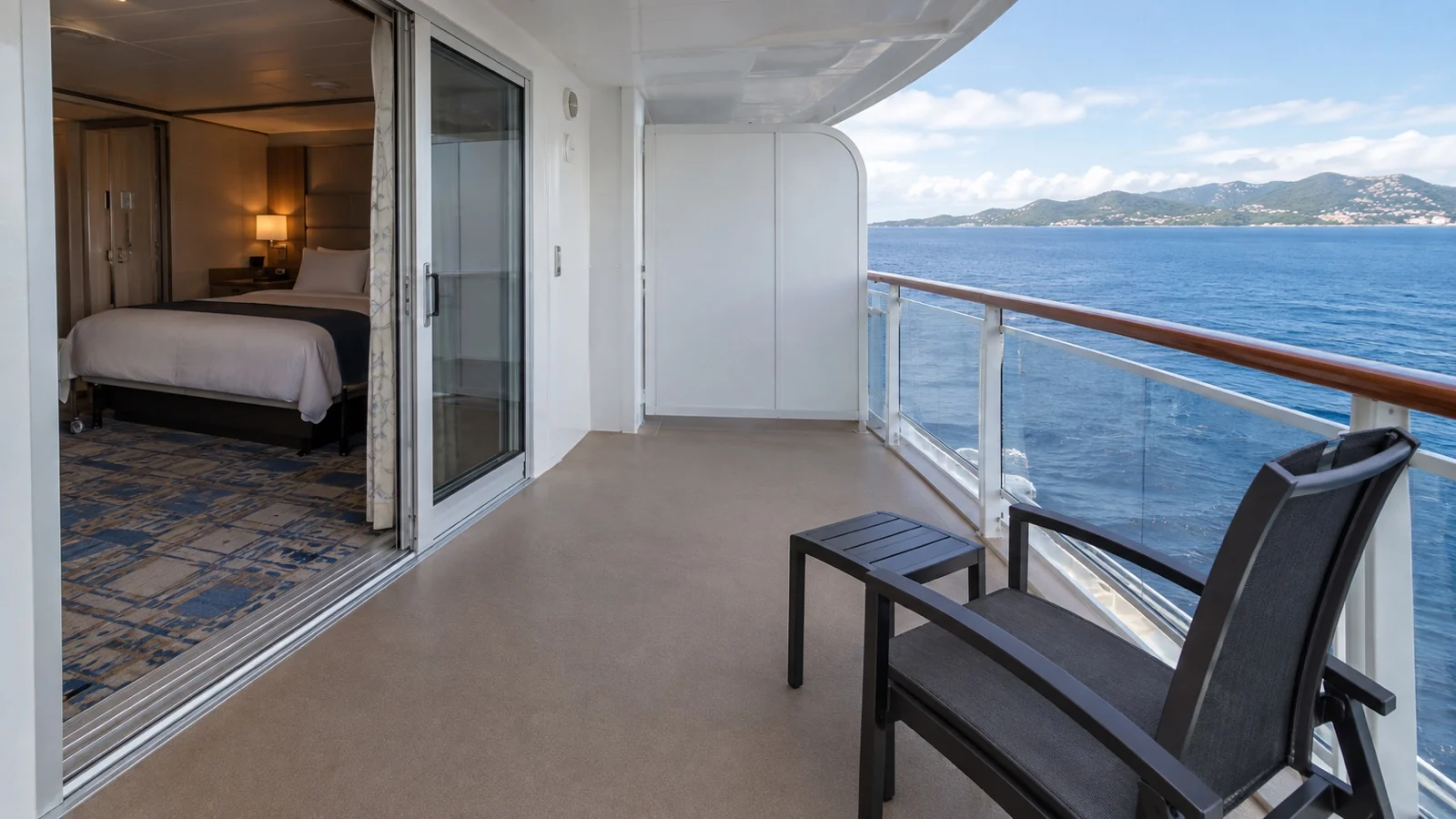
Ask for the clear width of the entry door and the bathroom door on your exact ship, because Royal Caribbean’s own published range of 32 to 34 inches varies by vessel. Ask for the threshold height at the bathroom and at the balcony, the bed height, and whether the bed frame is open underneath for a portable lift.
Ask whether the shower is a roll-in or a transfer seat, and whether the fold-down bench is fixed or removable. Ask for the turning space in the bathroom rather than in the room, because the bathroom is where a five-foot circle usually disappears.
Get all of it by email, keep the thread, and carry a printed copy to the pier. Confirm every one of these details in writing with the line before final payment, and if any part of the trip depends on a medical device or a treatment schedule, clear the plan with your own doctor first.
The details that matter most
- The category name, not the symbol: a deck plan symbol tells you a room is in the accessible family, not which branch of it. Ambulatory accessible and fully accessible are different rooms with different doorways, and Carnival and Holland America both publish the distinction in plain words.
- The room number on the confirmation: if the confirmation says a category code and not a cabin number, you have a guarantee whether or not anyone used the word. Fix that before you pay the deposit.
- The form and its deadline: notice periods vary by line and service, and submitting late may limit what can be arranged even when it does not cancel the cabin. Use the current form for your sailing and keep the confirmation.
- The bathroom, not only the bedroom: request the clear door width, threshold or lip heights, shower setup, toilet transfer space and turning room. Those measurements determine whether the cabin works for your specific device and transfer method.
- The upgrade trap: a complimentary upgrade or a price-drop rebooking can move you out of an accessible room and into a standard one. Tell your travel advisor in writing that you decline all automatic upgrades.
What I check first, in order
First, the count. If the line publishes a per-ship figure, as Princess does, I know within a minute whether this is a 20 room ship or a 51 room ship.
Second, the category, because a fully accessible room and an ambulatory accessible room can sit two doors apart on the same deck plan. Third, whether the fare is a guarantee, which I would rule out immediately.
Fourth, the form, its name and its deadline for the specific line. Fifth, the corridor, meaning elevator distance, deck neighbors and the nearest accessible public restroom, and last of all the dimensions in writing.
A realistic word on accessibility
Booking the right cabin solves the ship and none of the shore, where what an accessible excursion actually means is a separate question. A roll-in shower on deck 11 does nothing about a tender at anchor, a cobbled quay or a gangway that pitches with the tide.
If your itinerary is heavy on tender calls, the cabin is not the deciding factor. My roundup of the most wheelchair-friendly cruise ports is the better filter at that stage, and the guide to planning a port day for someone who cannot walk far covers the shape of the day once you are ashore.
River ships are a separate problem with a separate answer, and I have written about how accessible river cruising actually is rather than repeating it here. The short version is that the cabin math is tighter still and the gangway math is much worse.
Quick answers
How many accessible cabins does a cruise ship have? There is no reliable fleetwide percentage; Princess publishes ship-specific counts, including 38 wheelchair-accessible staterooms on Sky Princess, 51 on Sun Princess and 20 on Coral Princess.
Do I need to prove I have a disability?
Royal Caribbean states it does not require medical certificates or disability placards, only that you complete a Guest Special Needs Form acknowledging the need; Celebrity asks you to sign a similar attestation on its form.
What is the difference between fully accessible and ambulatory accessible?
Carnival and Holland America both use fully accessible for rooms built around wheelchair and scooter maneuvering, and ambulatory accessible for guests who do not use a wheelchair regularly; Carnival’s ambulatory rooms have an eight inch lip into the bathroom.
Can I book an accessible cabin on a guarantee fare?
I would not, because a guarantee hands the cabin choice back to the line; Book a specific room number and check it survives every later rebooking or upgrade offer.
How far ahead should I book? As early as practical once you know the cabin features you need; Inventory varies by ship and sailing, so request a specific room number and keep checking it after any reprice, upgrade or ship change.
The last word
The scarcity is the whole story here, and it is not a secret the lines are hiding so much as a number most of them decline to print. Princess prints it, which is why a Princess fact sheet is the fastest way to understand what two percent feels like in practice.
Then plan the ports separately, because the ship is the easy half. My notes on port-day activities that work with limited mobility pick up where the deck plan stops, and the cabin you fought for is worth a lot more when the shore day is built to match it.
How this guide was researched: Cabin specifications, categories, forms and ship counts were checked against current official information from Royal Caribbean, Carnival, Holland America, Princess, Disney, Norwegian, MSC and Celebrity, with the historical settlement figure from the U.S. Department of Justice. Details were rechecked on September 10, 2026, but inventory and rules vary, so confirm the exact room and features in writing before paying.
More on this topic: browse every guide on accessible and family cruise planning.