Pregnancy and Cruising: What the 24-Week Rule Means
Count forward to every day of your trip, not just embarkation. Most major cruise lines will not carry a guest who reaches the 24th week at any point during the cruise, and a long sailing can move an otherwise acceptable date past the cutoff.
The cutoff is simple, but the paperwork, cruisetour dates, cancellation terms, and medical planning are not. Here is how I would check all four before paying.
The short answer
Royal Caribbean, Carnival, Norwegian, Princess, Holland America, Celebrity, and Disney Cruise Line all publish versions of the same basic rule: you cannot enter the 24th week during the covered cruise or cruisetour. A medical letter may document fitness and dates, but it does not extend the cutoff.
This post covers published boarding policy, documents, money and port logistics. It is not medical advice, and whether to travel at all is a conversation for you and your own doctor.
Every policy below was checked on the line’s own site on September 10, 2026. Confirm the rule under the contract attached to your booking, because document and refund terms can differ by sales market.

How it actually works
The safest calculation is based on the entire trip. Count the cruise and any cruisetour days named in your line’s policy, then leave a buffer for uncertainty in dating rather than aiming for the final eligible day.
Norwegian words it as not having entered the 24th week of pregnancy when the cruise ends. The Princess Cruises passage contract says guests who will enter the 24th week by the last day of the cruise agree not to book the cruise or board the vessel.
Royal Caribbean says it cannot accept a guest who will be more than 23 weeks pregnant at any time during the cruise or CruiseTour. Celebrity publishes the same cruise-and-CruiseTour scope in some market terms, while Holland America says you may cruise only if you have not entered the 24th week at any point during the voyage.
The practical result is that you must remain below each line’s cutoff throughout every part of the trip it covers. Do not round weeks, guess from months, or assume embarkation is the only date that matters.
What each line actually says
Royal Caribbean’s U.S. FAQ says it cannot accept guests who will be more than 23 weeks pregnant at any time during the cruise or CruiseTour. It uses a public health questionnaire and warns that no obstetrician or gynecologist is available onboard, although booking-market terms may add documentation requirements.
Carnival says a guest may cruise only if she has not entered the 24th week at any time during the voyage. Its pregnancy guidance says the guest should carry a physician’s letter covering the health and fitness to travel of parent and baby, the estimated delivery date, and any ultrasound results if an ultrasound was performed.
Norwegian’s current FAQ says a guest must not have entered the 24th week when the cruise ends, but that page does not state a certificate requirement. Princess sets the same cutoff in its U.S. passage contract, while its UK package terms require a doctor’s or midwife’s letter, so use the terms tied to your booking.
Holland America’s answer is especially clear. You may cruise only if you have not entered the 24th week at any point, and its suggested physician letter covers parent and baby health, fitness to travel, the estimated delivery date, and any ultrasound results.
Disney Cruise Line refuses passage if a guest has entered the 24th week by embarkation or will enter it during the cruise. A physician’s statement or liability waiver cannot override that cutoff, although Disney’s UK contract separately allows the line to request a medical certificate at any stage of pregnancy.
The letter, and what has to be in it
Do not use one generic checklist for every line. Carnival and Holland America advise a physician letter that covers fitness to travel, the estimated delivery date, the health of parent and baby, and ultrasound results if an ultrasound was performed.
If your line or booking contract requires a letter, ask which professional may sign it, what it must say, and how recently it must be dated. Use letterhead, keep the dates consistent with your medical record, and do not assume a letter accepted by one line satisfies another.
Carry the original and a copy, and keep one in your hand luggage rather than the bag that reaches your cabin four hours after check-in. A document you cannot produce at the pier does the same work as no document at all.
Ask the line’s access or special services team whether it wants the document before travel or only at check-in, then save the written answer. Carry the original and a copy in your hand luggage, exactly as you would with a minor’s consent letter.

The itineraries the rule quietly removes
Because the cutoff applies across the covered trip, length can remove an itinerary that looks acceptable on embarkation day. A 3-night Bahamas cruise and a 14-night transatlantic leaving in the same week are two completely different calculations.
Repositioning crossings, world-cruise segments, long South Pacific routes, and extended South America itineraries use the most margin. Ask the line in writing how it will assess back-to-back reservations rather than assuming two booking numbers create two separate eligibility decisions.
The same itinerary check matters later if you plan to cruise with the baby. Royal Caribbean generally requires an infant to be 6 months old, but raises that to 12 months for transatlantic, transpacific, Hawaii, select South American and other selected cruises or CruiseTours, plus any cruise with three or more consecutive sea days.
Disney’s infant rule: the minimum is 6 months for most itineraries and one year for South Pacific, transatlantic, Hawaii, and Panama Canal repositioning cruises. Treat that as a separate eligibility rule rather than trying to infer the medical reason behind each itinerary category.
Deposits, cancellation and your own insurance policy
Cancellation depends on the fare, sales market, and contract attached to the reservation. Do not assume either that pregnancy guarantees a refund or that every line automatically keeps the full fare.
Princess’s UK package terms, for example, provide a conditional pregnancy-related refund when the issue was not reasonably foreseeable at booking and the passenger notifies Princess promptly. That protection is market-specific and should not be treated as a promise for a U.S. booking.
A refundable deposit or flexible change rule can be worth pricing when you book far ahead. Read exactly when the deposit becomes nonrefundable and what happens to the companion’s fare if one guest becomes ineligible.
On insurance, read your own policy wording rather than a summary page. Look for how it treats a normal pregnancy, what it says about pre-existing conditions, and whether a cancel for any reason upgrade is offered on your plan.
Then put the question to your insurer in writing and keep the answer. Ask separately about pregnancy-related cancellation, medical treatment abroad, care for a newborn, and emergency evacuation because one “covered” answer may not apply to all four.

The port day itself

The cruise line’s cutoff answers whether it will carry you, not whether a particular trip is medically appropriate. The CDC Yellow Book recommends a pre-travel obstetric review, a copy of prenatal records, insurance that addresses pregnancy-related care, and advance planning for emergency obstetric care at the destination.
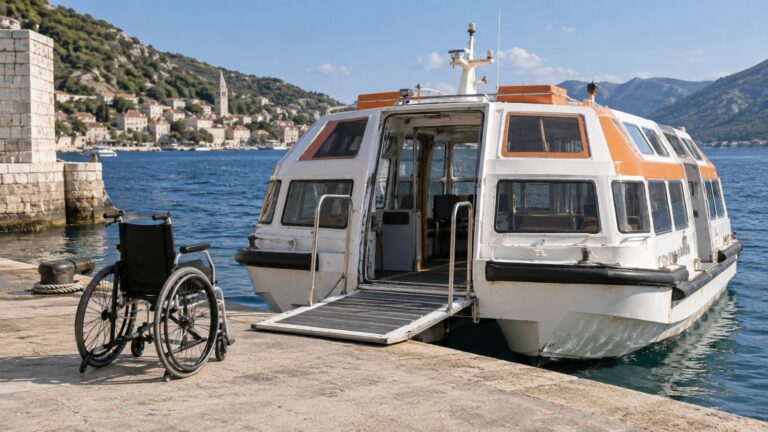
Tender ports add a moving transfer between ship and shore, and the crew can stop transfers when sea state makes them unsafe. If balance, stairs, or a long wait are concerns for you, ask your doctor and the line about that specific itinerary instead of assuming every port day works the same way.
Heat is the second. Mediterranean summer afternoons run into the 90s Fahrenheit with very little shade at the archaeological sites people book, and my guide to how extreme heat should change your Mediterranean port plans covers where that is worst.
Restrooms, shade, seating, and the distance back to the ship decide whether a port plan is comfortable. Mark reliable stops before leaving the terminal and keep a simple return option in reserve.
Distance and gradient are the last pair. My roundup of port day activities that work with limited mobility and the guide to planning a port day for someone who cannot walk far are both organized around short walks and flat ground.
Four situations, and what I would do in each
- 18 weeks at embarkation, 7-night Caribbean: the dates appear to remain below the listed cutoff, but confirm the calculation and document rule with the line. Carry any requested letter in your hand luggage rather than assuming it is optional.
- 21 weeks at embarkation, 14-night transatlantic: this sits uncomfortably close to the cutoff and leaves little room for a dating difference. Get the line’s written calculation before final payment rather than relying on rough week-counting.
- Booked 14 months ago, now sailing at 26 weeks: the guest is outside the policies compared here, and a doctor’s letter does not waive the cutoff. Call before final payment if possible, ask about moving the booking, and read the cancellation and insurance terms before accepting a loss.
- Booking now with an uncertain schedule: compare refundable deposits, change rules, and shorter itineraries before choosing the cheapest fare. More flexibility is useful, but only your contract can tell you what “refundable” covers and until when.
Where people get burned
The first is counting from embarkation day. Norwegian, Princess and Holland America all word the limit against the end of the voyage, so a two week itinerary costs you two weeks of margin.
The second is treating a doctor’s letter as a waiver. Disney states plainly that neither a physician’s medical statement nor a waiver of liability will be accepted, and no letter extends anyone’s cutoff.
The third is the cruisetour. Royal Caribbean applies its limit across the cruise or cruisetour, so an Alaska land segment tacked onto the sailing counts toward the same clock.
The fourth is a due date or clinical assessment that changes after the letter is written. Contact the line, follow your clinician’s advice, and replace any document that no longer matches the current record.
A realistic word on accessibility
Book an accessible stateroom when you genuinely need its features, not as a generic comfort upgrade. Pregnancy itself does not answer the question, but a pregnancy-related functional need may make a wider doorway, roll-in shower, grab bars, or extra turning space necessary.
Royal Caribbean says it does not require medical proof of disability, but it does require guests to acknowledge the need for an accessible stateroom through its Guest Special Needs Form. Describe the feature you need and let the access team assess the request rather than arguing from a diagnosis label.
For comfort rather than an accessible-feature need, compare a midship cabin, a shorter route to elevators, and any medically necessary refrigerator arrangement. Ask the access desk what it can confirm because cabin location and equipment requests are separate from pregnancy eligibility.
Ashore, the tools that help anyone moving slowly help here too. My list of the most wheelchair friendly cruise ports is built around flat ground, short distances and reliable restrooms, and those three things carry a port day for a lot of people.

Quick answers
How many weeks pregnant can you be on a cruise?
The major lines compared here generally do not accept a guest who enters the 24th week during the covered cruise or CruiseTour. Check the exact wording and every covered travel date under your own booking.
Is the limit measured at boarding or at the end of the cruise?
Norwegian measures it at the end of the cruise, and Princess and Holland America word it so that it applies at every point in the voyage. Disney applies it at the embarkation date and during the cruise, so on a long itinerary the last day is almost always the number that matters.
Do I need a doctor’s letter to cruise while pregnant?
It depends on the line and booking market: Carnival and Holland America advise detailed physician letters, Princess’s UK terms require a doctor’s or midwife’s letter, Royal Caribbean’s U.S. FAQ uses a health questionnaire, and Disney may request a certificate even though no letter can waive its cutoff.
What happens if I am turned away at the pier?
You may lose the right to sail, but the financial result depends on your fare, contract, sales market, and insurance. Princess’s UK terms contain a conditional pregnancy refund, which is exactly why I would read the contract attached to the reservation instead of assuming every fare is lost.
Which itineraries are hardest under the 24 week rule?
The long ones, because the cutoff runs to the final day. Transatlantic and transpacific repositioning, world cruise segments and extended South America and South Pacific sailings all lose you two weeks or more of margin before you start.
The last word
The 24-week rule is a carrier eligibility limit, not proof that every trip before it is medically appropriate. Royal Caribbean notes that there is no obstetrician or gynecologist onboard, while the CDC warns that cruise travel can involve delayed care at sea.
Check every covered travel date, get the exact document your line or contract asks for, and keep it in your hand luggage. Then confirm the result in writing before final payment because the details differ by line and sometimes by booking market.
Everything in this post is policy, paperwork and port logistics, which is the part I can help with. The question of whether to sail belongs to you and your own doctor, and no cruise line policy page is a substitute for that conversation.
How this guide was researched: Unless a first-hand visit is explicitly identified above, this guide is based on independent research using official cruise line and public-health sources. Pregnancy policy was checked against Royal Caribbean International, Carnival Cruise Line, Norwegian Cruise Line, Princess Cruises, Holland America Line, Celebrity Cruises, and Disney Cruise Line.
Infant ages were checked against Royal Caribbean and Disney Cruise Line, while travel-health guidance was checked against the CDC Yellow Book. Policies and time-sensitive details were reviewed on September 10, 2026.
Reconfirm the terms attached to your booking before paying or sailing because policies can change. This guide covers policy and logistics only and is not medical advice.
See our Editorial Policy.
More on this topic: browse every guide on accessible and family cruise planning.