How Old Does a Baby Have to Be to Go on a Cruise?
Two numbers decide whether your baby sails: six months and twelve. Which one applies depends on how many sea days your itinerary strings together, not on how ready you feel.
Here is the rule line by line, then the shape of an actual port day.
Why this is worth ten minutes
An infant who misses a published age minimum by a week does not get an exception at the terminal. Royal Caribbean’s age policy says guests traveling with an infant who does not meet the requirement will be denied boarding, and that no refunds are provided.
That single sentence is why this post exists. The rule is enforced at check-in by a person reading a birth certificate, and the ship sails either way.
Meeting the cruise line’s minimum age does not mean a particular itinerary is suitable for every infant. Heat, long transfers, consecutive sea days and limited medical care are separate questions for the baby’s pediatrician.
Everything below is policy and logistics, not medical advice. Confirm with the line in writing before final payment, and talk to your own doctor and the baby’s pediatrician about whether the trip suits your child.
What you are actually looking at
There are two separate systems here and people mix them up constantly. One is the minimum sailing age, which is a hard boarding rule tied to your itinerary.
The other is everything the ship offers once you are aboard, which carries its own age floors. Disney Cruise Line’s nursery takes children up to three years old, and its water rules are stricter still.
Disney’s published pool guidance says only toilet trained children may enter its swimming pools, hot tubs and spas, and that swim diapers are not permitted in any of them. Children four and younger may use the designated water play areas in a swim diaper instead.
The six month floor, and the lines that publish it
Carnival’s ticket contract states that infants must be at least 6 months of age at the time of embarkation in order to sail. You can read that language yourself in the Carnival terms and conditions, and it is the baseline across the mainstream lines that carry babies at all.
Royal Caribbean sets the same six month floor and establishes it as of the first day of the cruise. Norwegian’s published age requirements ask for at least six months of age on the day of boarding.
Disney puts it plainly: for most itineraries the minimum age to sail is 6 months at time of embarkation. Holland America uses almost identical wording about being 6 months of age at the time of embarkation.
Princess is the outlier in how the rule is written. Princess sets the minimum at 6 months on Alaska, Canada and New England, Caribbean, Europe, Mexico and Trans-canal cruises, and 12 months on all other cruises.
When six months becomes twelve
Cruise lines publish a 12-month minimum on specified longer or remote itineraries, but do not assume every line uses the same destinations or explanation. Royal Caribbean applies it to transatlantic, transpacific, Hawaii, select South American and other selected cruises, plus sailings with three or more consecutive sea days.
Norwegian draws the line at the same place, requiring twelve months on the day of boarding if the cruise has three or more consecutive days at sea. Carnival words it from the other direction, asking for 12 months on transoceanic voyages and remote itineraries where there are more than 2 consecutive sea days.
Norwegian, Carnival and Holland America use similar consecutive-sea-day triggers, while Disney names South Pacific, transatlantic, Hawaii and Panama Canal repositioning cruises. The lists are not interchangeable, so check the policy for the exact sailing.
The practical move is to read your itinerary as a count of consecutive sea days. A seven night Eastern Caribbean loop rarely trips the rule, and a repositioning crossing is built almost entirely out of the days that do.
Fun fact: the same physical ship can carry two different minimum ages inside a single season. Disney accepts a six month old on most itineraries but requires a one year old on its Panama Canal repositioning sailings, so the rule follows the gap between ports rather than the vessel, the crew or the nursery.
How the age is measured, and why your booking date does not help
Every line I checked measures the age at boarding. Royal Caribbean says the infant’s age is established as of the first day of the cruise, and Carnival, Norwegian, Disney and Holland America all use embarkation or boarding day in their own wording.
That cuts both ways. A baby who turns six months on day three does not qualify, and a baby whose half birthday lands on embarkation morning does.
Carry the citizenship, identity and relationship documents required by the cruise line and every destination. A passport does not replace every consent or custody document, while a birth certificate does not let a U.S. citizen fly home from a foreign port.
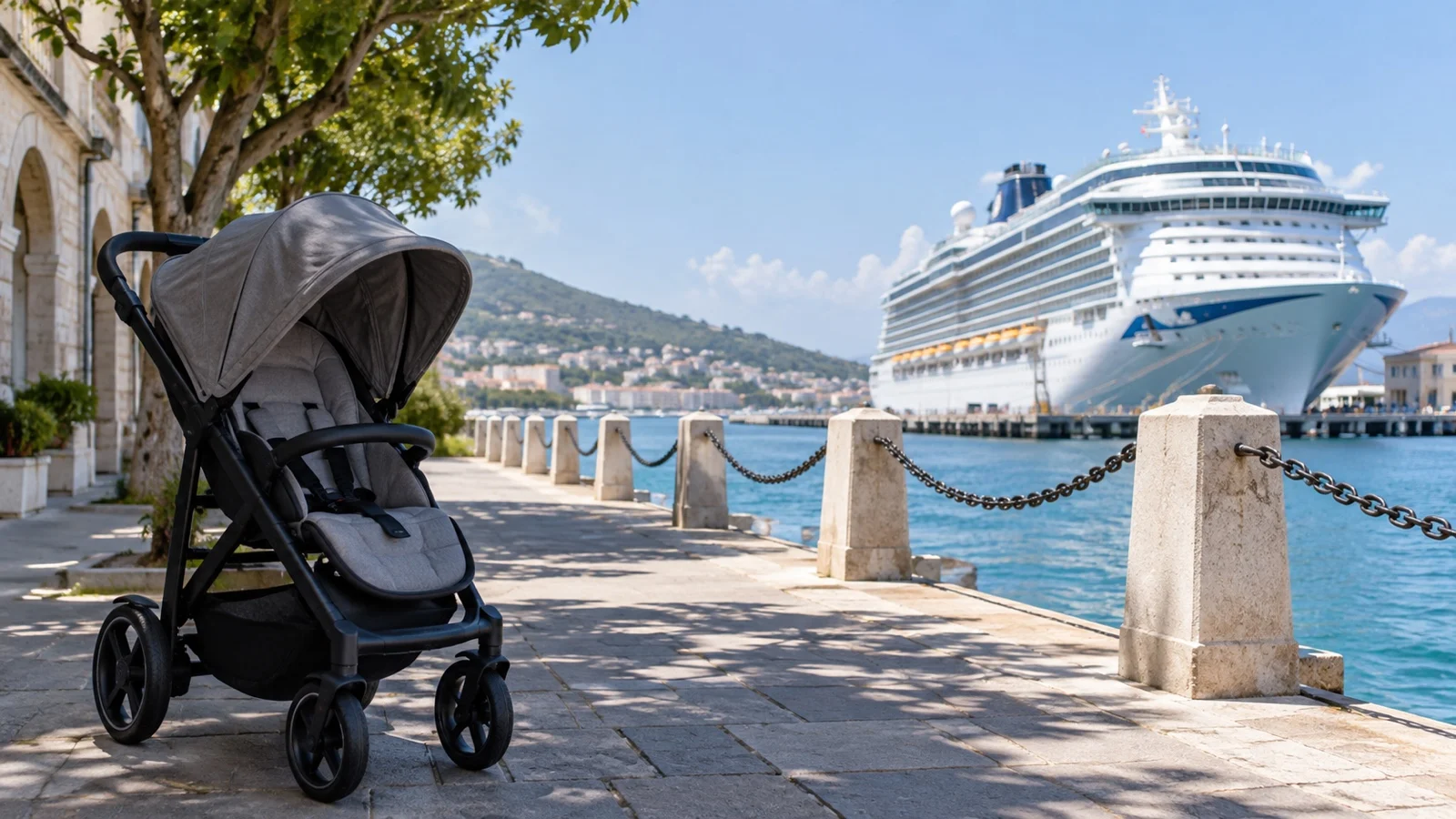
Off the ship: strollers, carriers and the pier itself
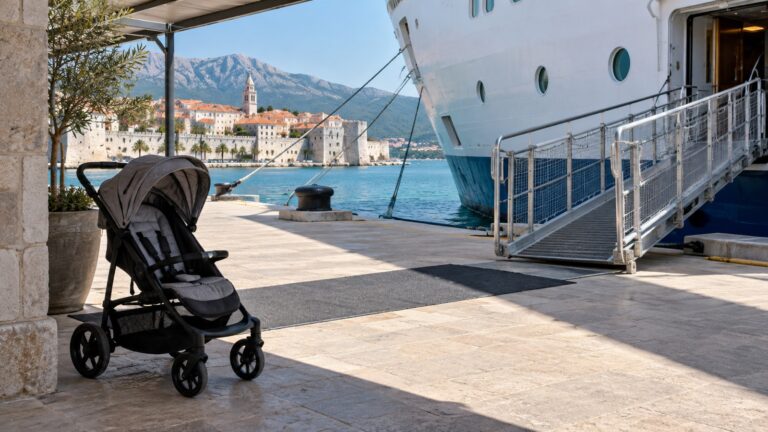
The gangway is the first decision of the day and it is usually made for you. Many berths hand you a long steep ramp or a flight of steps down to the quay, and a stroller has to be folded and carried on the steps.
A soft carrier can help with stairs, cobbles and narrow spaces, while a stroller supports naps and carries supplies. Choose only equipment the caregivers can handle safely, and follow the pediatrician’s and manufacturer’s guidance.
On a docked day, taking both may provide flexibility if the route and gangway allow it. At a tender port, ask the line about the actual transfer and stroller rules before deciding, since crew may not be permitted to lift people or equipment.
Changing facilities ashore are the thing nobody plans for and everybody needs by eleven. The larger Caribbean cruise terminals usually have them somewhere inside the shopping area, and an old town in Europe frequently does not.
The reliable fallbacks are museums, department stores, larger chain cafes and main transit stations. At several Caribbean piers the terminal restroom nearest the ship is the best option you will get all day, which is an argument for planning the day around the pier rather than away from it.
Milk, water, shade and the middle of the day
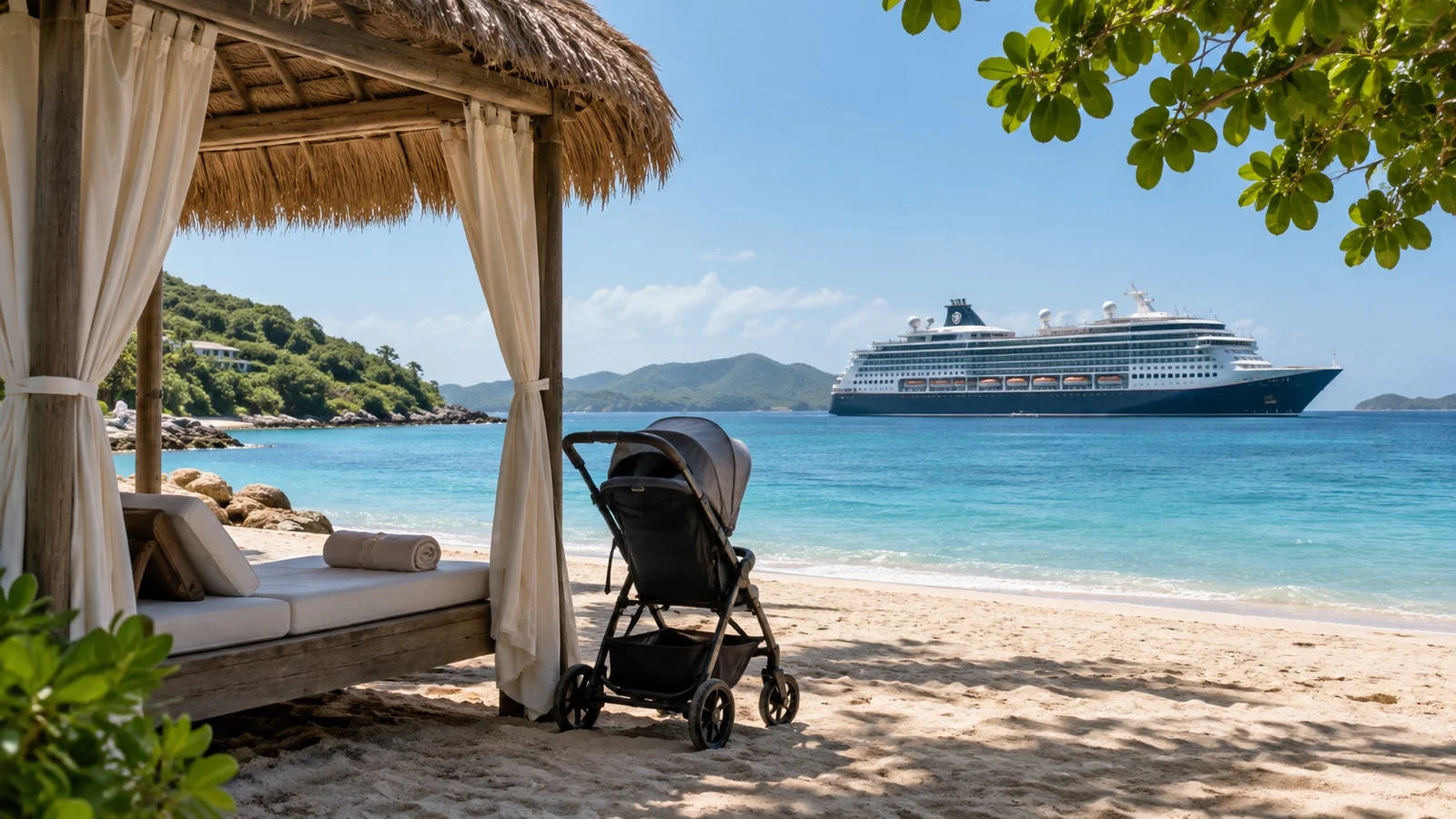
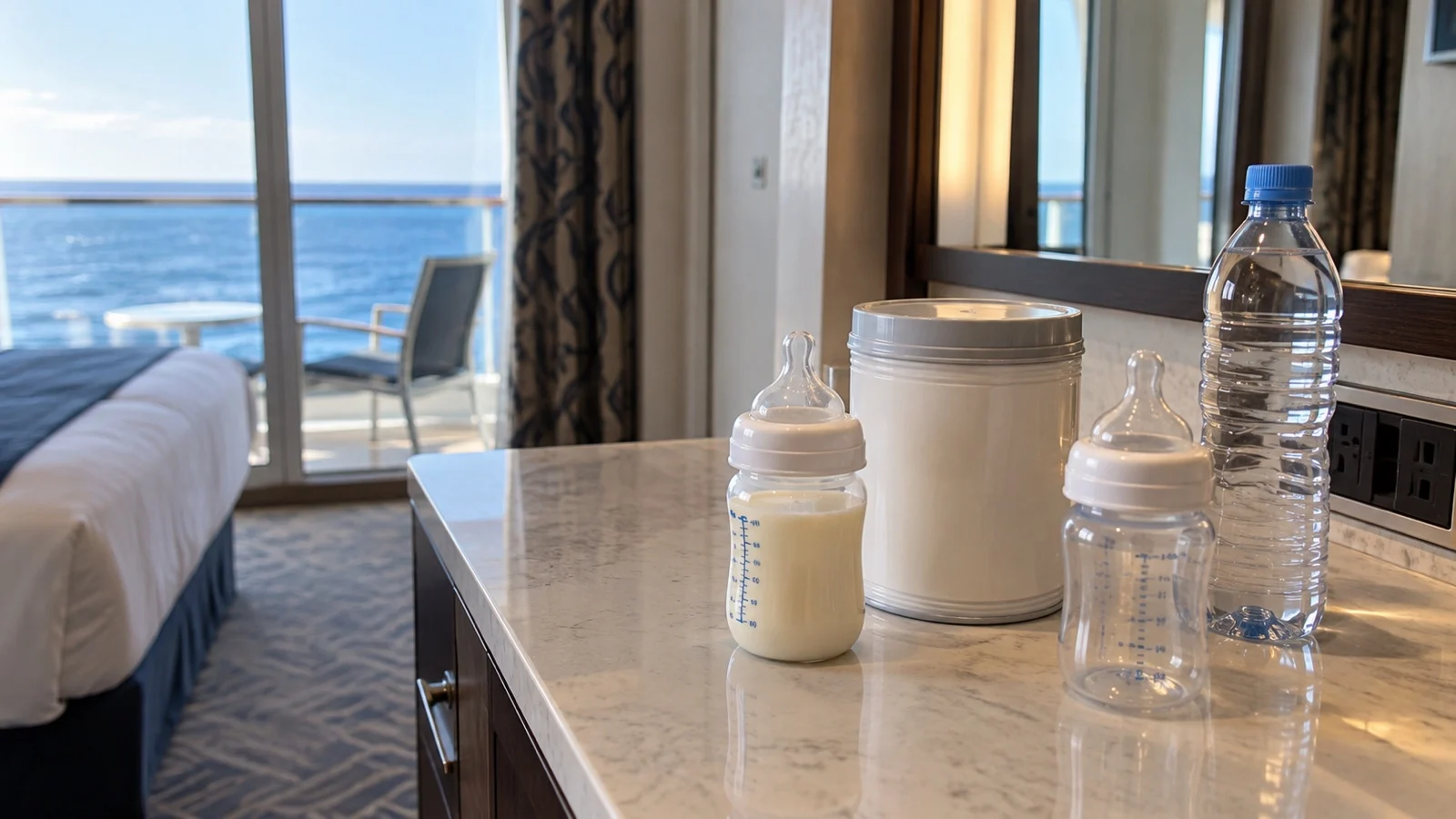
Take formula, bottled water and diapers from home rather than counting on a shop near the pier. Brands and formulations differ country to country, and a pharmacy in a small port town is not a US supermarket.
Shade is the part that reshapes the whole day. A pier apron at noon in the Western Caribbean is an unshaded concrete field, and there is nothing to be done about that except not be standing on it at noon.
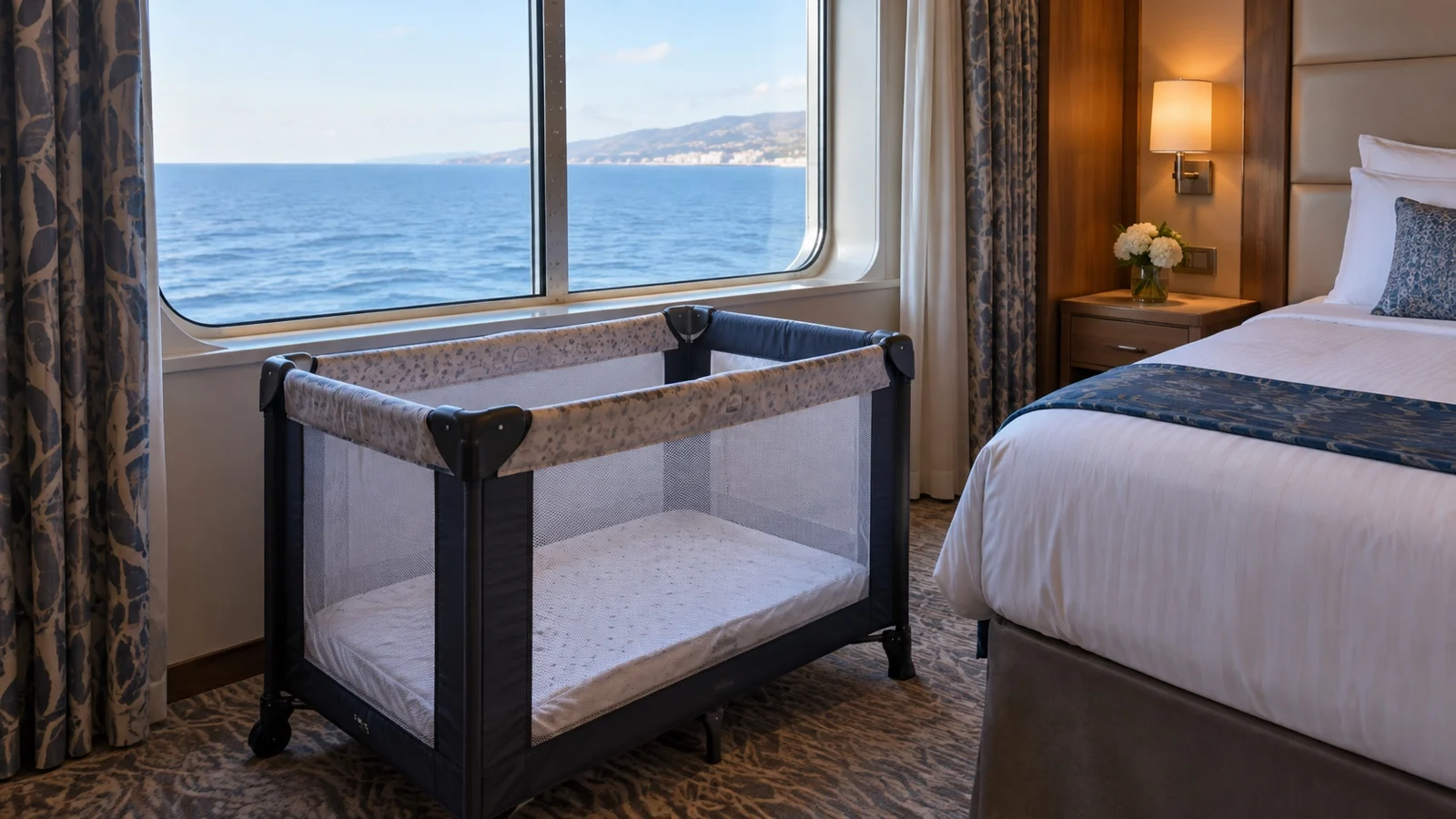
A midday return to the ship can provide a cooler, quieter reset near the crib and supplies. At a tender port, however, the round trip may be slow or unavailable, so build the day around the actual boat schedule.
Then go out again at three if the ship is in port late. Two short outings beat one long one at this age, and my post on whether Cozumel is worth leaving the ship for runs the same arithmetic with a slightly older child.
The details that matter most
- The trigger is sea days, not glamour: Royal Caribbean and Norwegian both key the twelve month rule to three or more consecutive days at sea, and Carnival and Holland America say more than two consecutive sea days, which is the same boundary described backward.
- Princess is the exception to check separately: Princess lists qualifying regions instead of counting sea days, setting 6 months on Alaska, Canada and New England, Caribbean, Europe, Mexico and Trans-canal sailings and 12 months everywhere else.
- Age is fixed at embarkation: Royal Caribbean establishes it as of the first day of the cruise, so a birthday during the voyage does not rescue a booking.
- The penalty is denial of boarding: Royal Caribbean states that guests traveling with an infant who does not meet the requirement will be denied boarding and that no refunds are provided.
- The nursery has its own floor: Disney’s nursery takes children up to three years old, and hours vary by day, so check the app rather than assuming a port morning is covered.
- Pools are not an infant amenity: Disney permits only toilet trained children in its pools, hot tubs and spas and bars swim diapers from all of them, allowing swim diapers only in designated water play areas for children four and younger.
What I check first, in order
First, I count the consecutive sea days on the itinerary rather than trusting the region name in the brochure. Three in a row is the number that moves most of these lines to twelve months.
Second, I read the specific line’s own page rather than a summary of it. Princess writes its rule as a list of regions, and a region list and a sea day count do not always produce the same answer.
Third, I work out the baby’s age on the embarkation date, not on the booking date and not on the return date.
Fourth, I email the line with the sailing date and the child’s date of birth, and I keep the reply. A phone call is not a document at a check-in counter.
Fifth, I look at the port list with the middle of the day in mind. Tender ports, long unshaded pier walks and terminals a shuttle ride from town are the days I would plan to stay aboard, and my guide to the easiest cruise ports with a small child sorts them roughly that way.
A realistic word on accessibility
A stroller is not a wheelchair and I do not want to blur the two. What they share is the pier surface, and that is where a port day stops working for both.
Cobblestones, a raised threshold at a terminal door, a shuttle bus with three steep steps and no ramp: those are the same obstacles in both cases. If you are traveling with a grandparent who uses a walker and a baby in a stroller on the same morning, plan the day around the slower of the two.
Tender ports require a separate decision. Ask whether the stroller must fold, whether the adults must carry it themselves and how the child boards, since weather, steps, boat movement and crew-assistance rules vary.
My guide to planning a port day for someone who cannot walk far covers the mobility side properly. Do not assume a port that works with a stroller works with a chair, because ramp gradients and curb cuts are not the same problem as a bumpy sidewalk.
Quick answers
What is the minimum age for a baby to go on a cruise?
Carnival, Royal Caribbean, Norwegian, Disney and Holland America each publish six months at embarkation as the baseline for most itineraries; Princess sets 6 months only on a named list of regions and 12 months on everything else, so check your own line rather than a general figure.
Why do many transatlantic cruises require a 1-year-old? Several lines use consecutive sea days or named long-distance itineraries as the trigger, but their lists and wording differ; Check the exact cruise rather than assuming one line’s explanation applies to another.
Does the age rule use the booking date or the sailing date?
The sailing date; Royal Caribbean establishes the infant’s age as of the first day of the cruise, and the other lines here use embarkation or boarding day, so a birthday that falls mid voyage does not count.
Can my baby go in the pool?
On Disney, no; Disney’s published guidance permits only toilet trained children in pools, hot tubs and spas, bars swim diapers from all of them, and directs children four and younger to designated water play areas in a swim diaper instead.
Stroller or carrier for a port day? A stroller can support naps and supplies, while a carrier can help on stairs and uneven streets; Tender rules, safe carrying, heat and the child’s needs decide the answer, so do not treat “carrier only” as a universal rule.
The last word
The age rule is the easy part once you stop reading it as a destination rule and start reading it as a sea day count. Get that right at booking, put the confirmation in writing, and the terminal becomes a formality rather than a risk.
The port day is the part that actually needs thought, and it needs less of it than people fear. Shade, a nap plan and a willingness to walk back up the gangway at noon will carry you through most Caribbean and Mediterranean calls.
If the trip is a wider family gathering, the babies are rarely the constraint. My guide to choosing port activities for a multigenerational family is the one I would read next, because the compromise that suits a six month old often suits a grandparent too.
How this guide was researched: Infant minimum ages were checked against current official policies from Royal Caribbean, Carnival, Norwegian, Disney, Princess and Holland America, with Disney’s own nursery and water-play rules used for those examples. Details were rechecked on September 10, 2026, but rules vary by itinerary, so confirm the exact sailing with the line and discuss medical suitability with the child’s clinician.
More on this topic: browse every guide on accessible and family cruise planning.