Rent or Bring Your Own Mobility Equipment on a Cruise?
Bring your own chair if you can get it to the pier undamaged, and rent if the trip involves a connecting flight or a scooter you could not replace quickly. That is the verdict, and the rest of this is why.
The verdict up front
Your own equipment fits you and nothing rented will. That is the whole argument for bringing it, and it is a strong one for a drive-to homeport like Galveston, Baltimore or Port Canaveral.
The argument on the other side is the airplane. Federal reporting shows mishandled wheelchairs are common enough to plan around, and a damaged power chair in Fort Lauderdale on a Saturday morning is a problem with no good same day fix.
Renting trades a personal fit for a machine that is already sitting in your cabin and is somebody else’s problem when it fails. Holland America, Princess and Norwegian all point guests to outside suppliers rather than supplying equipment themselves.
If you are flying, and especially if you are connecting, I would rent the scooter and bring the manual chair. That splits the risk instead of stacking it all on one baggage handler.
What actually differs
Four things separate the two choices, and price is the least interesting of them. Fit, the width of your cabin door, how the equipment travels, and who fixes it when it stops working.
Fit is where your own equipment wins outright. A rental is a size rather than a fitting, and seven days in a seat that does not suit you is a long week.
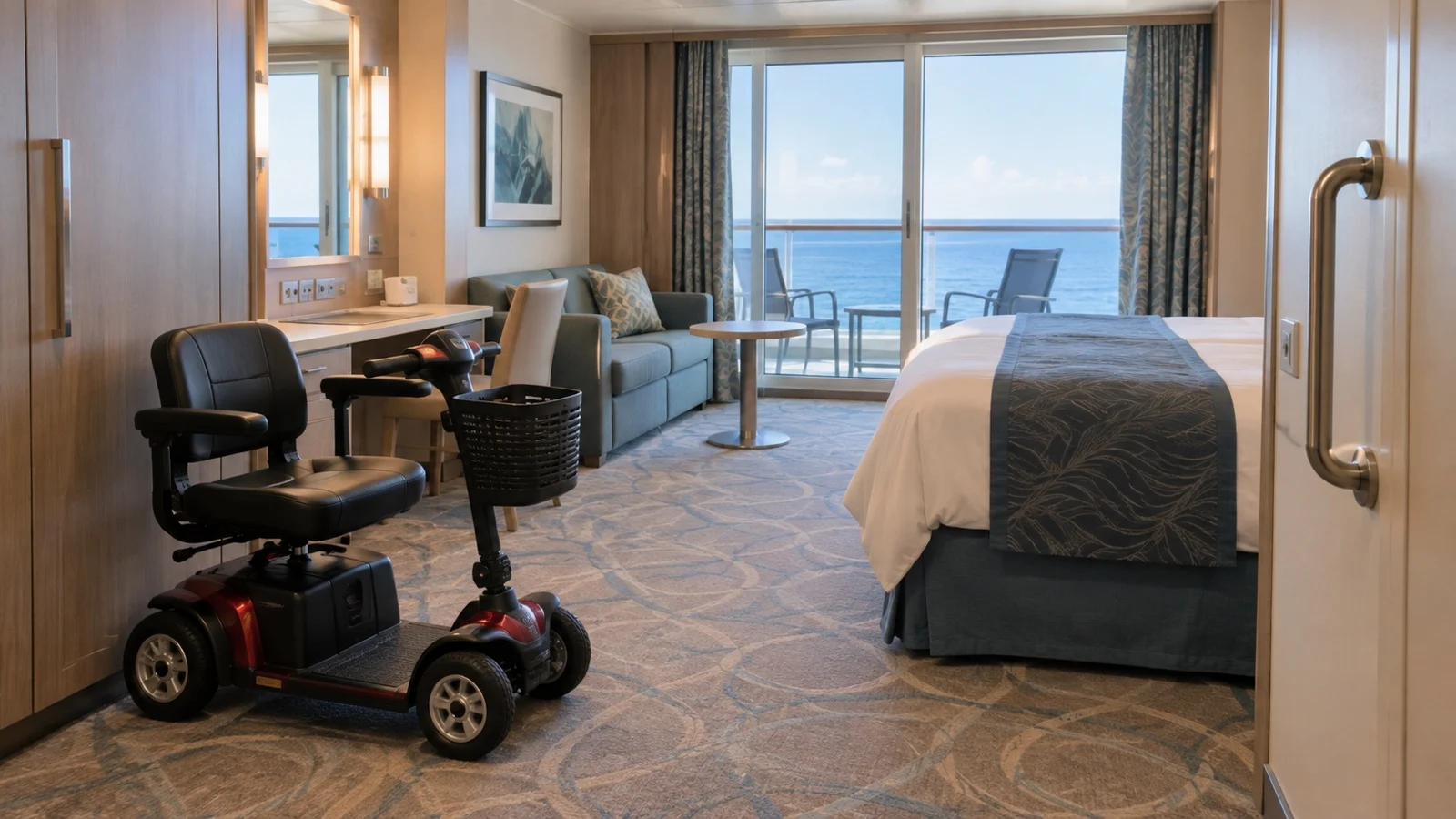
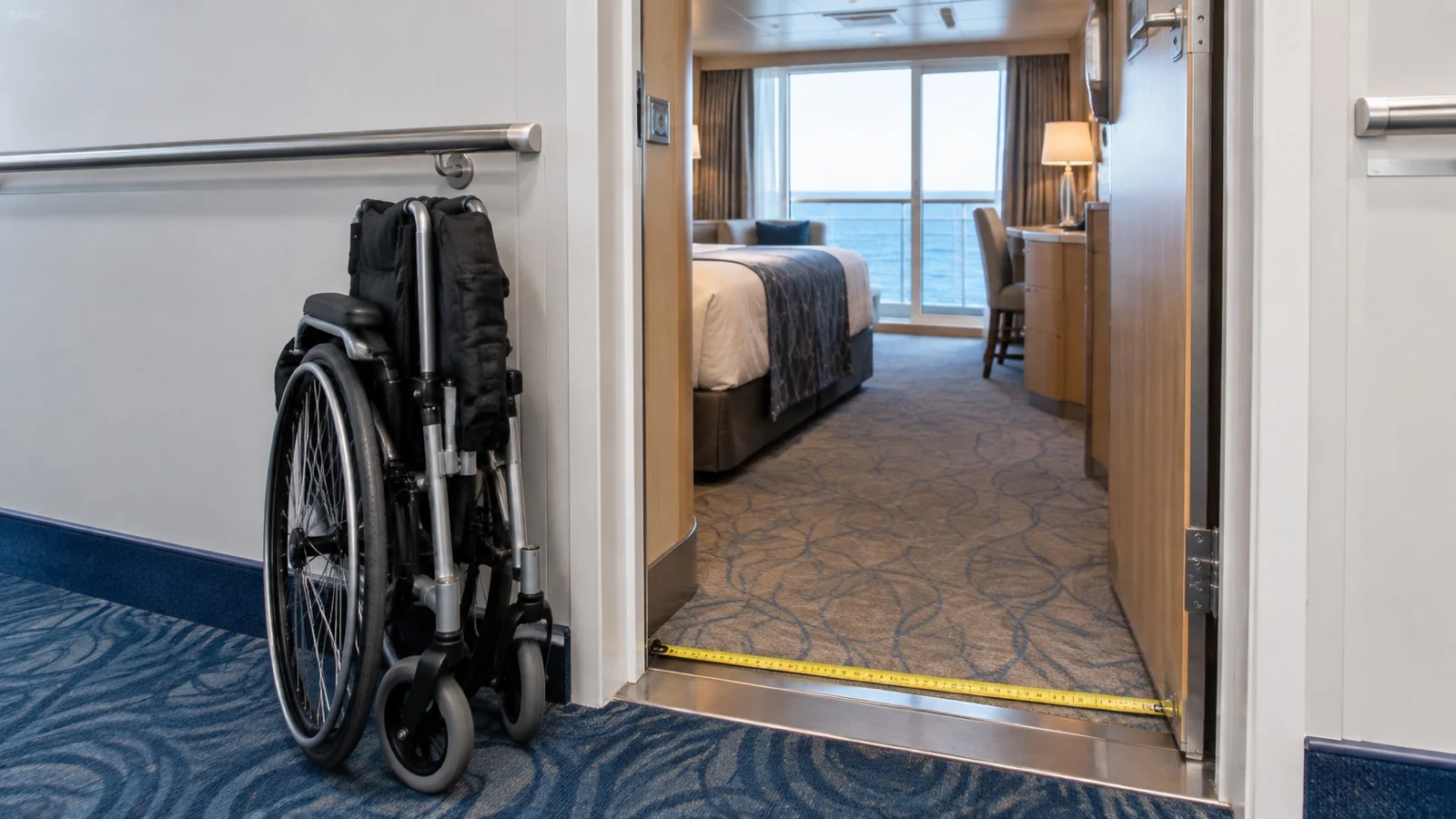
The cabin door is where your own equipment can lose. Royal Caribbean’s guest special needs form puts standard stateroom doorways at a minimum of 23 inches and accessible ones at 32 inches, and a wide scooter will not pass the first number.
Travel and repair are the two categories almost nobody prices in. They are also the two that decide most trips.
Dimensions, doorways and the number that decides it
Every line publishes this differently and the numbers are not close to each other. Carnival says scooters wider than 21 inches require a fully accessible stateroom with a 32 inch doorway.
Norwegian Cruise Line’s published guidance says motorized wheelchairs and scooters in non-accessible staterooms must not exceed 26 inches wide. Princess sets 22 inches for standard and ambulatory accessible cabins and 31 inches for its fully accessible ones.
Disney Cruise Line lists a minimum 32 inch door on its accessible staterooms. Those are four different thresholds for the same piece of equipment, which is the reason you measure your own device rather than trusting a category name.
Measure the widest fixed point, usually the armrests or the tiller housing, and not the seat. Then send that number to the line in writing and ask them to confirm it against the specific ship and cabin category, because claiming one of the few accessible cabins is its own process.
Storage is the companion rule to the door. Carnival states that mobility devices cannot be stored in corridors or public areas, and Norwegian says all scooters and wheelchairs must be stored in the stateroom.
Carnival publishes a 600-pound combined guest-and-device limit for hydraulic lifts used on certain North American airport transfers. That is a transfer-vehicle limit, not a Princess cabin or shipboard-device limit, so confirm every transfer separately.
Batteries, chargers and cabin power
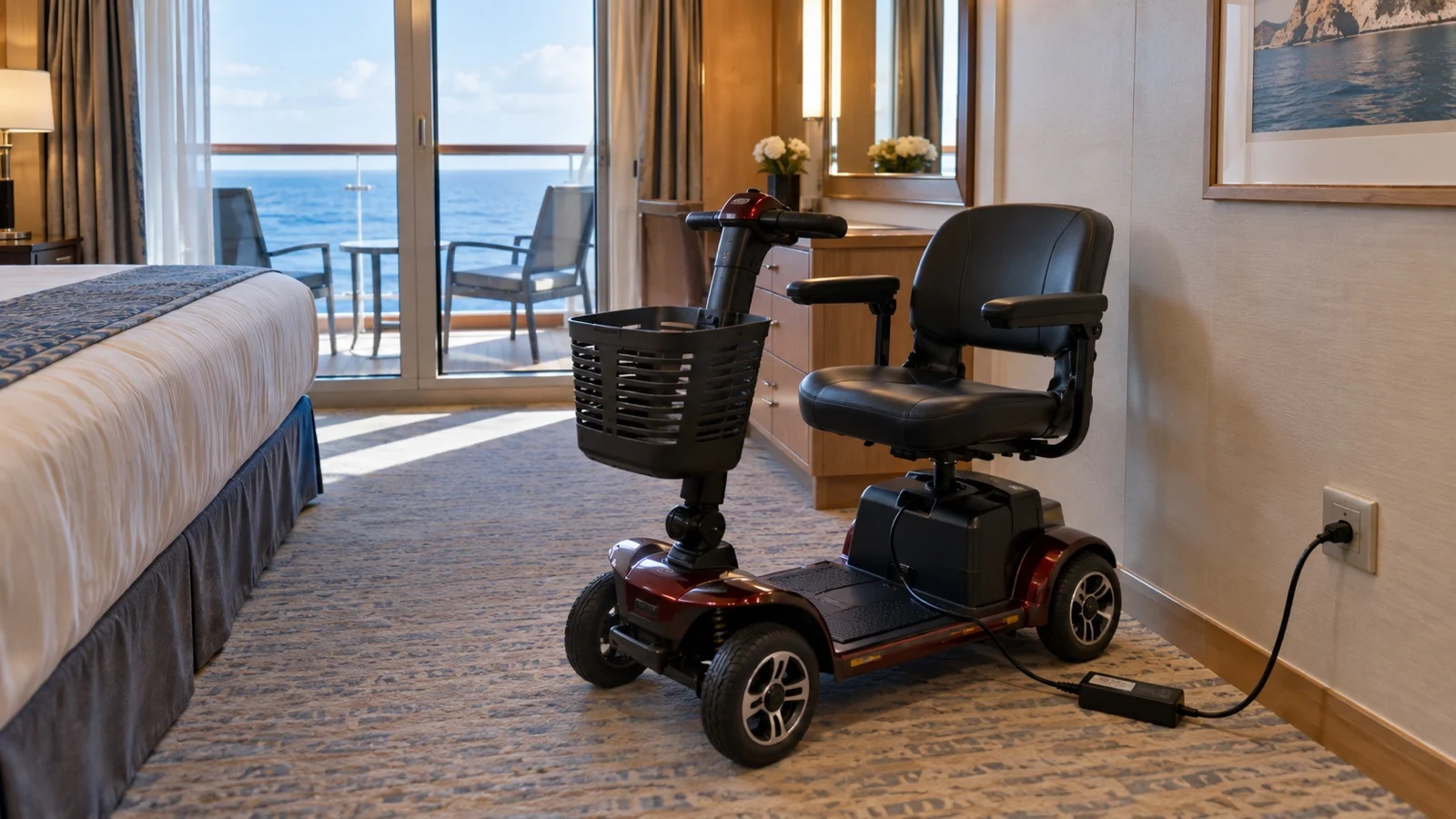
Battery chemistry is the rule most likely to catch a traveler out at the gangway. Carnival permits gel, dry cell, absorbed glass mat and lithium-ion batteries, and requires that batteries be charged in the guest’s stateroom.
Norwegian’s mobility guidance calls for gel-cell batteries with chargers compatible with 110 volts. Royal Caribbean’s form instead asks you to declare whether your battery is gel cell, dry cell or wet cell.
A wet cell battery is the one to ask about early, because it is the type most often questioned. If your device uses one, get an answer in writing before you book rather than at the pier.
A rental from a cruise line’s approved vendor can simplify battery and delivery questions, but it does not remove them. Confirm the battery type, charger, cabin fit and port-clearance approval for the exact model.
Getting it there, and the airline problem
Air travel adds a real damage and delay risk for mobility devices, even though U.S. carriers must report mishandling and follow federal handling and notification rules. Photograph the device, attach handling instructions and ask the airline how it will be stowed on each aircraft.
A connection creates another loading and unloading cycle, so a nonstop flight usually reduces handling risk. If the device is essential at embarkation, arrive early enough to address a delay or consider renting a suitable backup at the port.
For U.S. flights, Department of Transportation rules require prompt assistance, status information and repair or replacement handling when a wheelchair is mishandled. Compensation can differ between domestic and international itineraries, so report damage before leaving the airport and keep receipts and photographs.
International claims may be governed by the Montreal Convention or another treaty as well as local rules, and recovery may not equal the device’s full value. Ask the airline and insurer how a high-value chair is covered before travel.
A December 2024 Department of Transportation rule added a presumption that the airline is liable for damage that happens in its care, which the airline can rebut. None of that puts a working chair on the pier on embarkation morning.
What a rental actually buys you
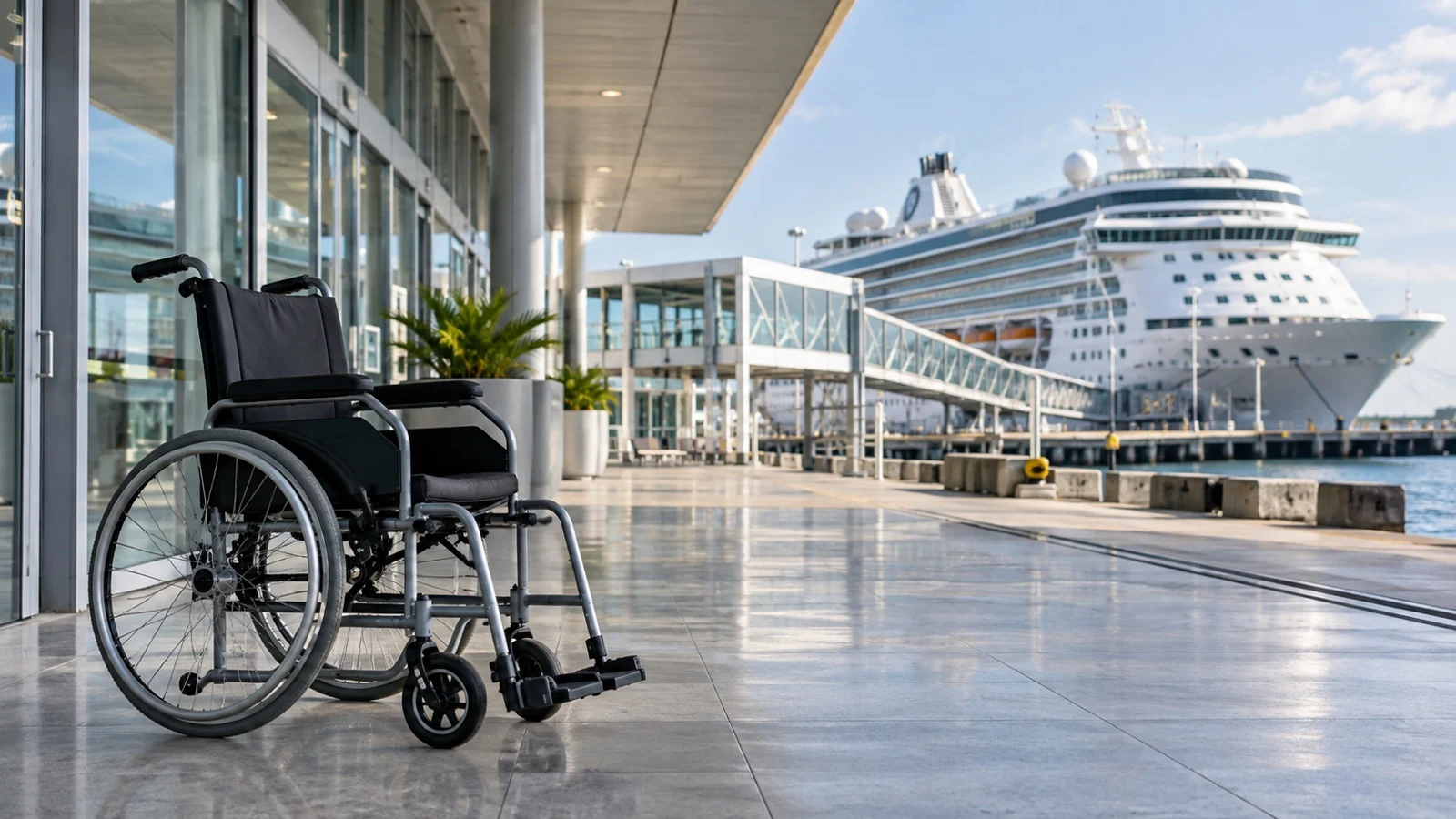
A rental buys you a pre-arranged device and a supplier contact if it fails. Delivery may be to a cabin, terminal or other approved point depending on the line and port, so confirm the handoff instead of assuming it will be waiting in the room.
What you are really buying is the delivery and the recovery. If a rented scooter dies on day three, replacing it is the supplier’s contractual problem rather than yours.
I could not find a published rate card from a primary source I would trust to still be current in September 10, 2026, so I am not going to quote you a weekly price. Ask for a written quote that names the ship, the sailing date and the failure terms.
Fun fact: an accessible cabin is defined by its doorway before it is defined by its floor space, which is why Royal Caribbean’s form leads with 23 inches for a standard door and 32 inches for an accessible one. A scooter that is one inch too wide is not a small problem, it is a different cabin category.
Two questions decide whether a quote is any good. Does the price include delivery to and collection from the cabin, and is a replacement unit provided during the sailing rather than a refund afterward?
When your equipment breaks in a foreign port
This is the part the brochures skip, and it is why I lean toward renting on long or remote itineraries, the same reason the itinerary decides more than the ship does. A power chair is an everyday medical device in the United States and a specialty item in a lot of cruise ports.
Where a repair is realistic: big European homeports and cities with a mobility retail trade, so Barcelona, Southampton, Civitavecchia for a Rome call, Copenhagen, Sydney and Vancouver. Even there you are looking for a shop with a battery or a tire in stock, not a service center for your model.
Where it is not realistic: most Caribbean and South Pacific island calls, the small Alaska towns, the smaller Greek islands, and anywhere you arrive by tender. Parts do not reach a port in time for a ship that sails at five.
The workable answer on a long trip is a manual backup. A folding manual chair in the cabin is heavy, unglamorous and the best insurance I know of against this exact problem.
Ask your line what it can lend before you sail, and get the answer in writing. Norwegian’s own guidance says its wheelchair inventory is limited and held mainly for boarding and disembarking, with a few units available for emergency rental on a first come, first served basis.
Tenders, gangways and the day neither option helps
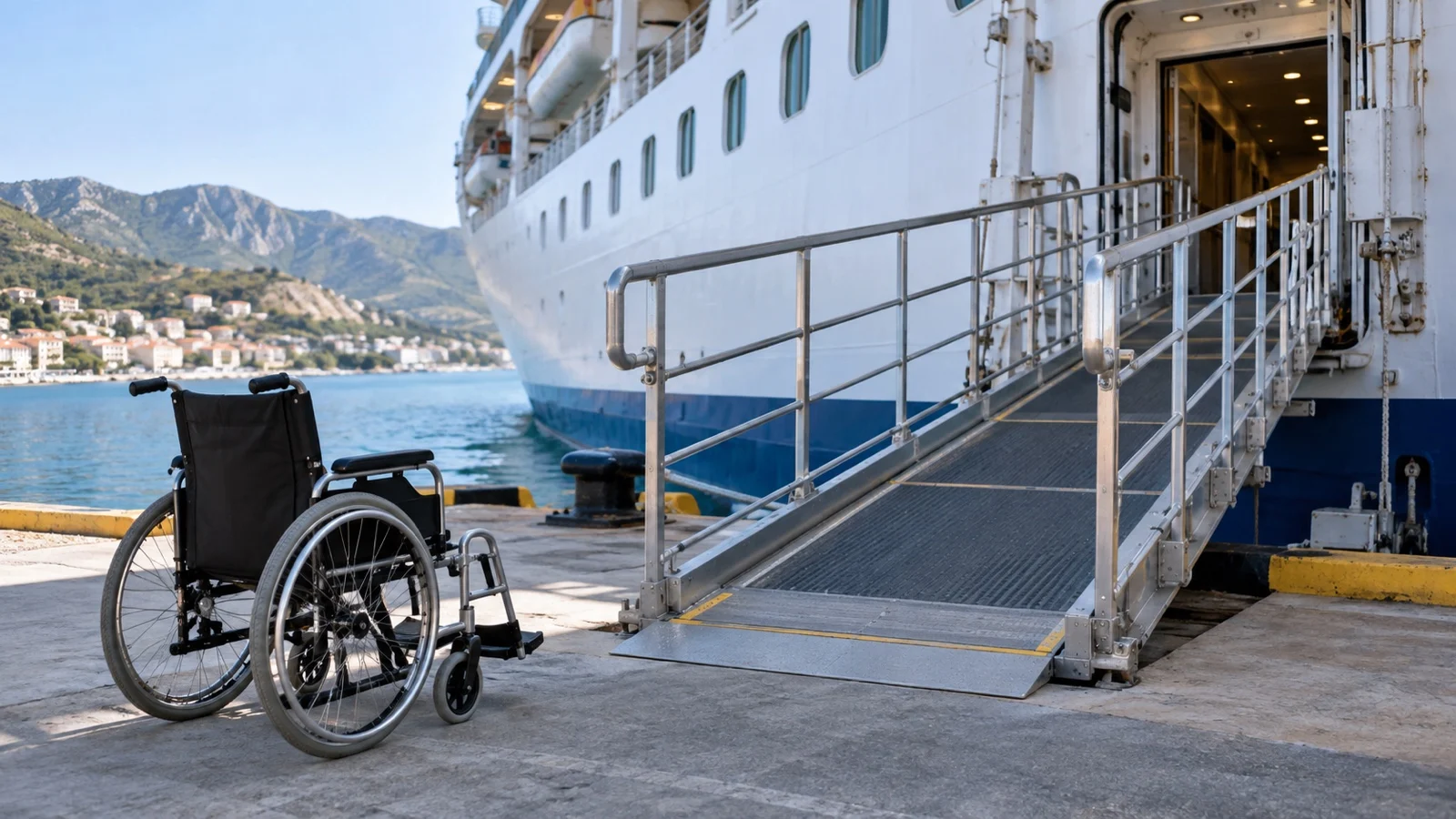
There is a category of port day where the rent-or-bring question stops mattering, because which tender ports refuse a wheelchair decides it for you. Royal Caribbean’s form notes that power wheelchairs and mobility scooters may face restrictions at certain ports, particularly with tenders, unless roll-on capability is available.
A folding manual chair may be accepted on some tenders that cannot take a power chair or scooter, but crew generally cannot lift or carry guests or heavy equipment. The user’s transfer ability, the chair, the tender design, weather and the captain’s decision all matter.
The call is made on the day by the captain, based on sea state, so no line can promise a tender transfer in advance. My roundup of tender ports that still feel easy is the short list where the odds are better than average.
River cruising is its own version of the same trade. I have written separately about river cruise accessibility, where the gangway arrangement matters more than the cabin door does.
Who each one suits
- Bring your own if you drive to the port: Galveston, Port Canaveral, Baltimore and Cape Liberty are realistic drives for a lot of American cruisers, and a car removes the single biggest risk in this comparison.
- Bring your own if the fit is medical rather than convenient: a custom seat, a specific cushion or a chair set up for your posture is not something a rental replicates. Bring it, insure it, and photograph it before it leaves your hands.
- Consider renting if you are flying, especially with connections: it avoids aircraft handling, but only if the rental model meets your seating, control and support needs. Confirm the delivery plan and failure support before paying.
- Rent if you need a scooter only for the ship: long corridors and a big promenade deck are why many people rent, and seven days of use is a very different decision from owning equipment year round.
- Plan extra redundancy for a long or remote itinerary: renting may simplify repairs, but a scooter still may not board a tender. Compare supplier support, port access and your need for custom seating before choosing.
- Consider a folding manual chair as backup if it fits you and your companion can manage it safely. Measure its widest point, and remember that no folding chair is guaranteed tender access.
The mistakes to avoid
The most common mistake is measuring the seat instead of the widest fixed point of the device. People book a standard cabin against a 21 inch seat and arrive with a 27 inch scooter.
The second is treating the accessible cabin as a nice-to-have upgrade. If your device is wider than the line’s published standard doorway figure, the accessible cabin is not an upgrade, it is the only cabin that works.
The third is assuming a tour labeled accessible will take your specific device. Ask for the vehicle’s ramp width and the lift capacity before you book, and my guide to choosing excursions across different activity levels covers how to ask.
The fourth is leaving all of it to a travel agent. Confirm the dimensions, battery type and storage rules in writing with the cruise line itself, and where your health is part of the decision, talk it through with your doctor before you commit.
Quick answers
Will my scooter fit through a standard cabin door?
It depends on the line and the ship, and the published numbers vary a lot; Royal Caribbean puts standard stateroom doorways at a minimum of 23 inches, Carnival requires a fully accessible cabin above 21 inches, and Norwegian caps non-accessible cabins at 26 inches.
Can I leave my scooter in the hallway overnight?
No; Carnival states that mobility devices cannot be stored in corridors or public areas, and Norwegian says all scooters and wheelchairs must be stored in the stateroom.
Who rents mobility equipment for cruises?
Holland America, Princess and Norwegian all name Scootaround and Special Needs at Sea in their own published guidance; Those lines generally do not rent devices themselves for personal use on board.
What happens if the airline damages my wheelchair? Report it before leaving the airport, ask for the complaint resolution official and get the claim in writing; U.S. rules cover assistance and repair or replacement handling, while compensation rules differ on international journeys.
Is a manual chair or a scooter better for port days? A folding manual chair may fit more vehicles and tenders, but it still requires a safe transfer and may require a companion to push; A scooter can be easier over long, smooth distances yet face stricter size, storage and tender limits.
The last word
The honest summary is that this is a risk trade rather than a comfort trade. Your own equipment is better every hour you have it and worse on the two travel days when it can be taken away from you.
Pick the option that keeps you moving on embarkation morning, then plan the ports around whatever you chose. My running list of the most wheelchair-friendly cruise ports is where I would start that half of the planning.
Get the cabin door width, the battery type and the storage rule confirmed in writing with your cruise line before final payment. Where your health is part of the decision, confirm with your doctor as well, because I can tell you what a line publishes and not what suits you.
How this guide was researched: Device dimensions, battery rules, storage and rental guidance were checked against current official information from Carnival, Royal Caribbean, Norwegian, Princess, Holland America and Disney, with airline rights from the U.S. Department of Transportation. Details were rechecked on September 10, 2026, but equipment and transport rules vary, so confirm every dimension and handoff in writing.
More on this topic: browse every guide on accessible and family cruise planning.