Northern Lights Cruises: How to Actually Improve Your Odds
A northern lights cruise does not guarantee a better view than a land trip, but it can improve your odds by moving toward clearer skies. This guide explains how to choose the route, timing and onboard strategy; my northern lights cruise ports guide covers where these itineraries call.
That single fact should shape everything about how you book. Pick the wrong month, the wrong latitude, or a three-day hop, and no amount of onboard enthusiasm will fix it.
My quick take
Book long, book dark, and book north. A voyage of ten nights or more above the Arctic Circle beats a short break in Tromso by a wide margin, purely because you are buying more independent rolls of the dice.
My default is the full Bergen to Kirkenes round trip on the coastal route, in October or in February, and not in a hurry. Those shoulder months give you dark nights without the deepest weather, and the equinox periods are statistically the busier ones for geomagnetic activity.
The thing I would not do is buy a cruise on the strength of a sighting guarantee. The terms are narrower than the marketing, and I will go through them properly farther down.
The quick facts
- The season: Visit Norway puts the viewing season from late August to late March. Hurtigruten runs its aurora season from 20 September to 31 March.
- The latitude you want: under the auroral oval. NOAA’s Space Weather Prediction Center puts the best viewing band between about 60 and 75 degrees north, which covers everything from Bodo upwards.
- Best hours: within an hour or two of local midnight, so roughly 10pm to 2am. Displays do happen outside that window, and stronger storms widen it in both directions.
- Why a ship helps: it moves. A fixed hotel is stuck under whatever cloud sits over it, while a ship covers a few hundred miles of coast overnight and often finds a hole.
- The wake-up service: the coastal lines announce sightings over the public address system, and Havila runs an opt-in northern lights alert you have to switch on yourself. Ask at reception on day one rather than assuming it is automatic.
- Forecast horizon: short. NOAA’s aurora model gives 30 to 90 minutes of warning, because that is how long the solar wind takes to travel from the L1 satellite position to Earth.
- The guarantee: real, but conditional on long voyages, specific dates and the ship’s own record of a sighting. Read the operator’s page before you rely on it.
- What blocks a sighting: cloud, ship or shore lighting, and weak activity. Moon phases are predictable; bright moonlight can reduce contrast in a faint display but does not stop a strong aurora.
Why a moving ship beats a fixed base
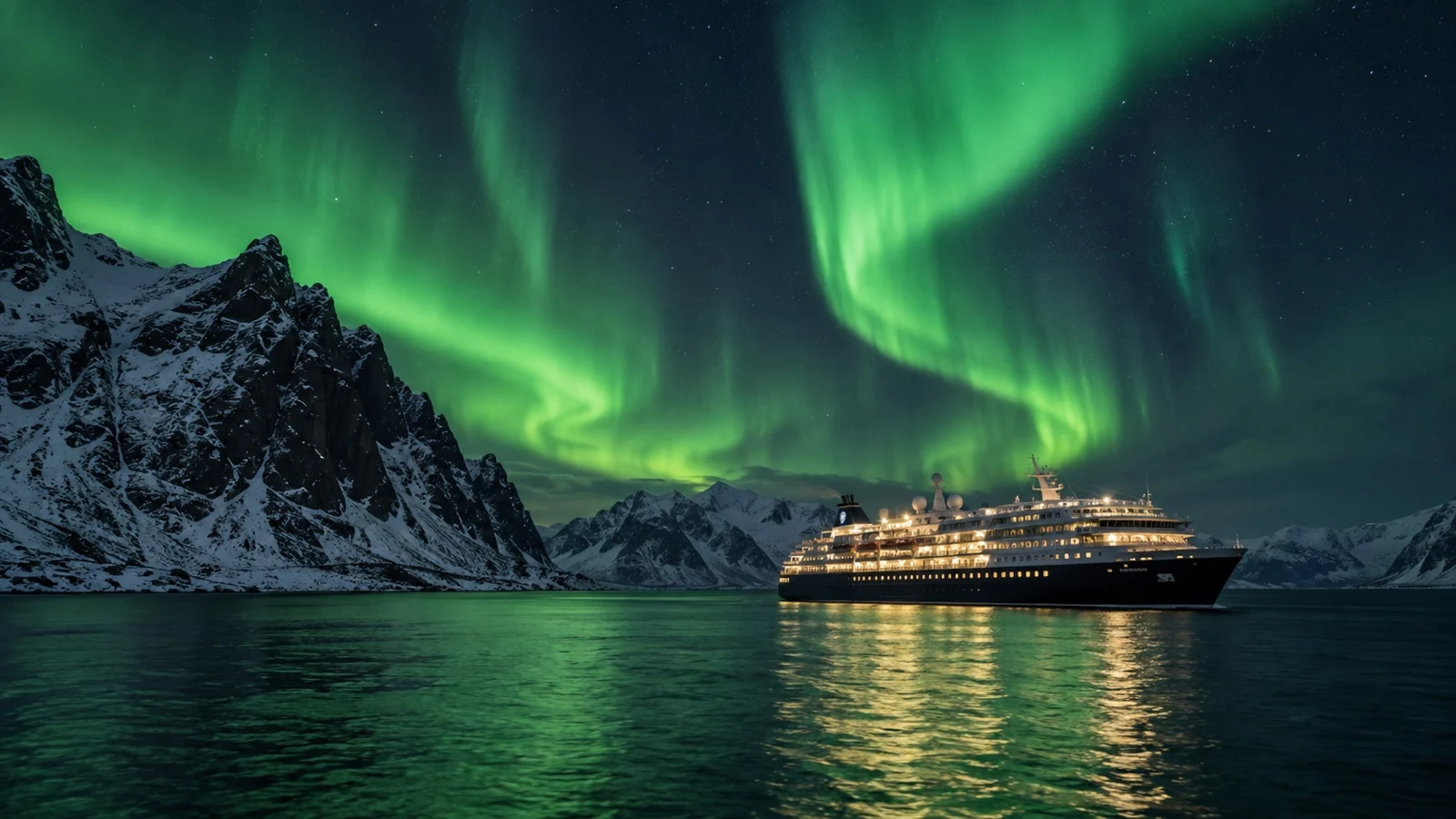
This is the whole argument, and it is worth being precise about it. The aurora over northern Norway is active on most clear nights of the season, so the variable that decides your trip is whether you can see the sky.
Coastal Norway in winter takes a steady procession of fronts off the North Atlantic. Cloud cover is patchy rather than uniform, and the gaps can be dozens of miles across.
A coastal ship covers ground while you are asleep, without asking anything of you. Over a twelve-day round voyage you are sampling a strip of coast roughly 700 miles long, in a dozen different weather systems.
The second advantage is darkness. NOAA tells aurora watchers to get away from city lights and find an open view north, which describes a ship’s foredeck in a fjord rather well.
The trade-off is that you do not choose where you are. If the clear sky is inland over the Finnmark plateau and your ship is in a cloudy fjord, you lose that night and there is nothing to be done.
Kp, the solar cycle, and what you can actually use
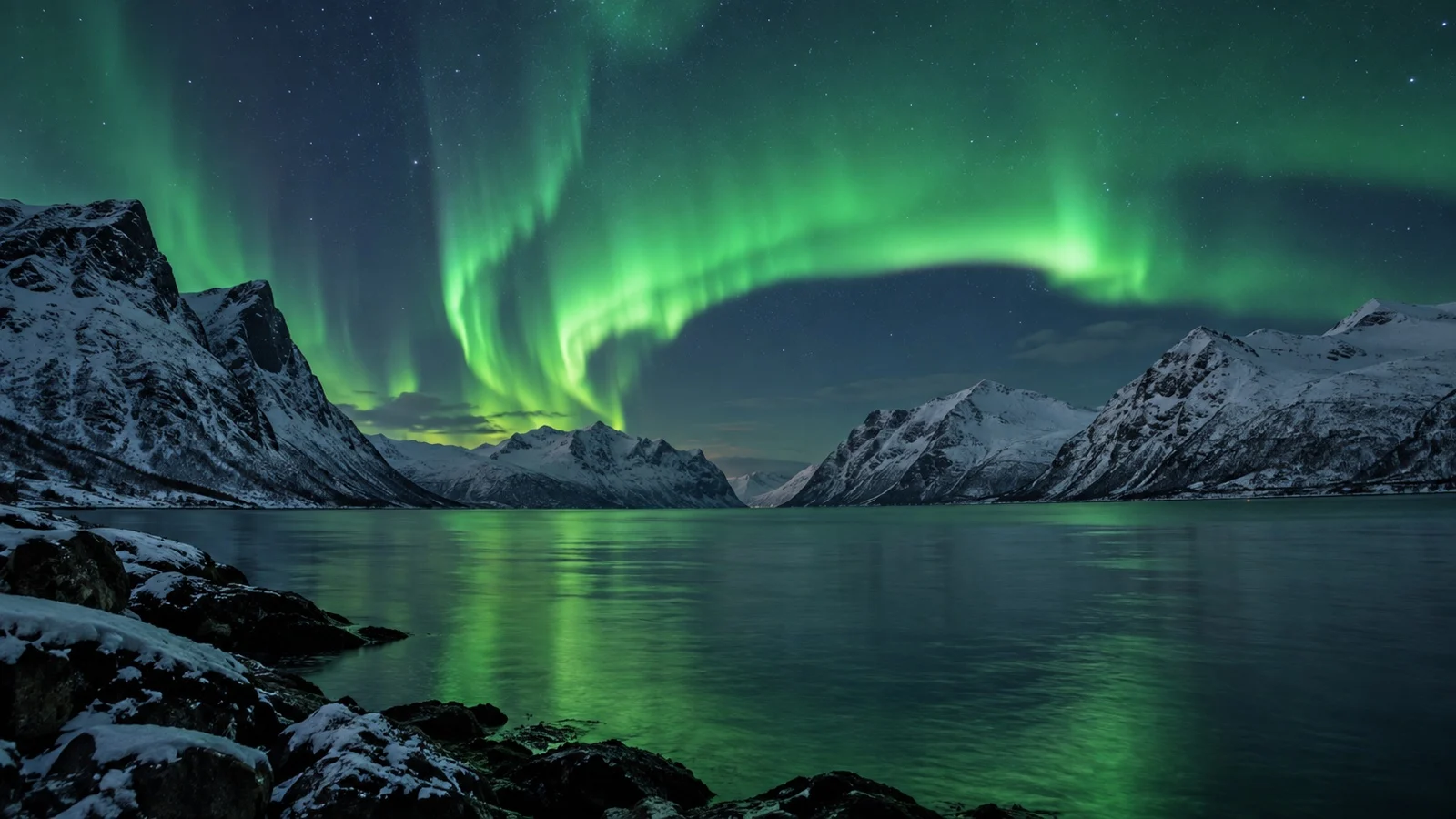
The Kp index is the number everyone quotes and the one most often misused. It runs from 0 to 9 and measures global geomagnetic disturbance, which tracks how far south the auroral oval has pushed.
Here is the part that matters for a Norwegian voyage. If you are at 69 degrees north you are already under the oval, so you do not need a big number; the Space Weather Prediction Center describes Kp 3 to 5 as bright and active with good viewing if you are well placed.
The solar cycle is the longer rhythm, roughly eleven years from minimum to minimum. NASA and NOAA announced in October 2024 that the Sun had reached the solar maximum period of Solar Cycle 25, but the exact peak month can only be identified after activity declines.
What I would actually use on board is narrow. Check the NOAA Space Weather Prediction Center 30-minute aurora forecast before bed, look at a satellite cloud image for the coast ahead of you, and then go outside anyway.
For a regional view, the Norwegian Centre for Space Weather at UiT in Tromso publishes nowcasts and one-hour and four-hour aurora forecasts for Norwegian locations. It is a better tool for tonight than any three-day number.
The sighting guarantee, and what it really covers
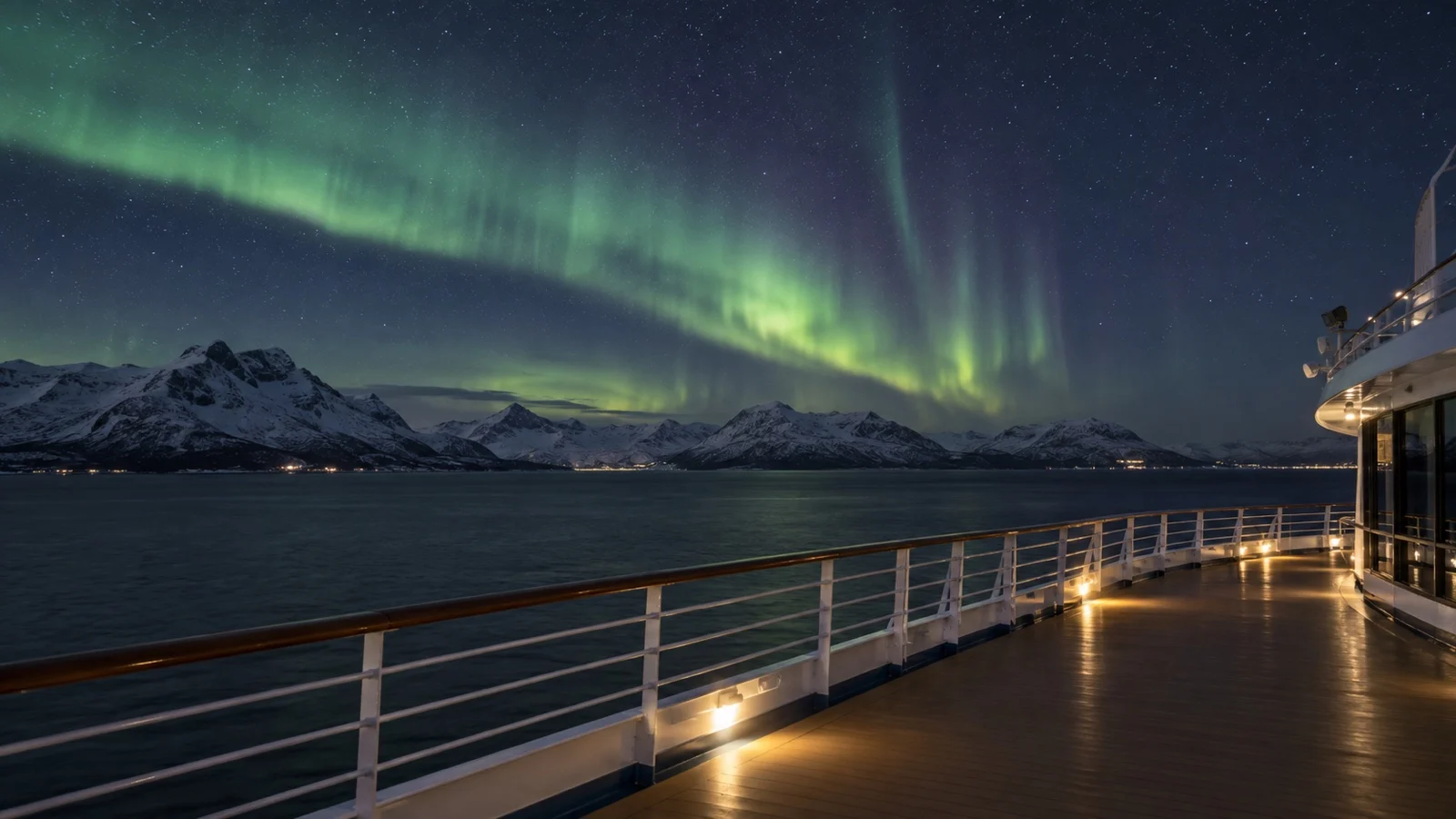
Hurtigruten’s Northern Lights Promise applies to new bookings of voyages of 11 days or more on the Coastal Express and the North Cape Line, departing between 20 September and 31 March. If the aurora does not appear, you get a Coastal Express classic voyage in an unspecified inside twin cabin on full board, free of charge, in the following season.
The definitions are where it tightens. Hurtigruten counts a sighting as one seen from the ship, recorded by the deck officers and announced to passengers, and states that the ship’s decision is final.
Havila’s Northern Lights Promise covers the 12-day Bergen to Kirkenes to Bergen round voyage departing between 1 October and 31 March, and pays out as a free 6 or 7-day Voyage North or Voyage South in the following season’s promise window. It must be redeemed within one month of your return, in an inside cabin, on SAVER fare conditions that cannot be changed.
Havila’s terms carry two clauses worth reading twice. The promise is only valid if you have activated the onboard northern lights warning system, and the ship determines whether an aurora event occurred regardless of weather conditions and actual visibility.
Read plainly, these are not promises that you will see the lights. They are promises that if the ship never logs an aurora at all across eleven or twelve nights above the Arctic Circle, which is rare, you get another go.
The ports I would actually stay up for
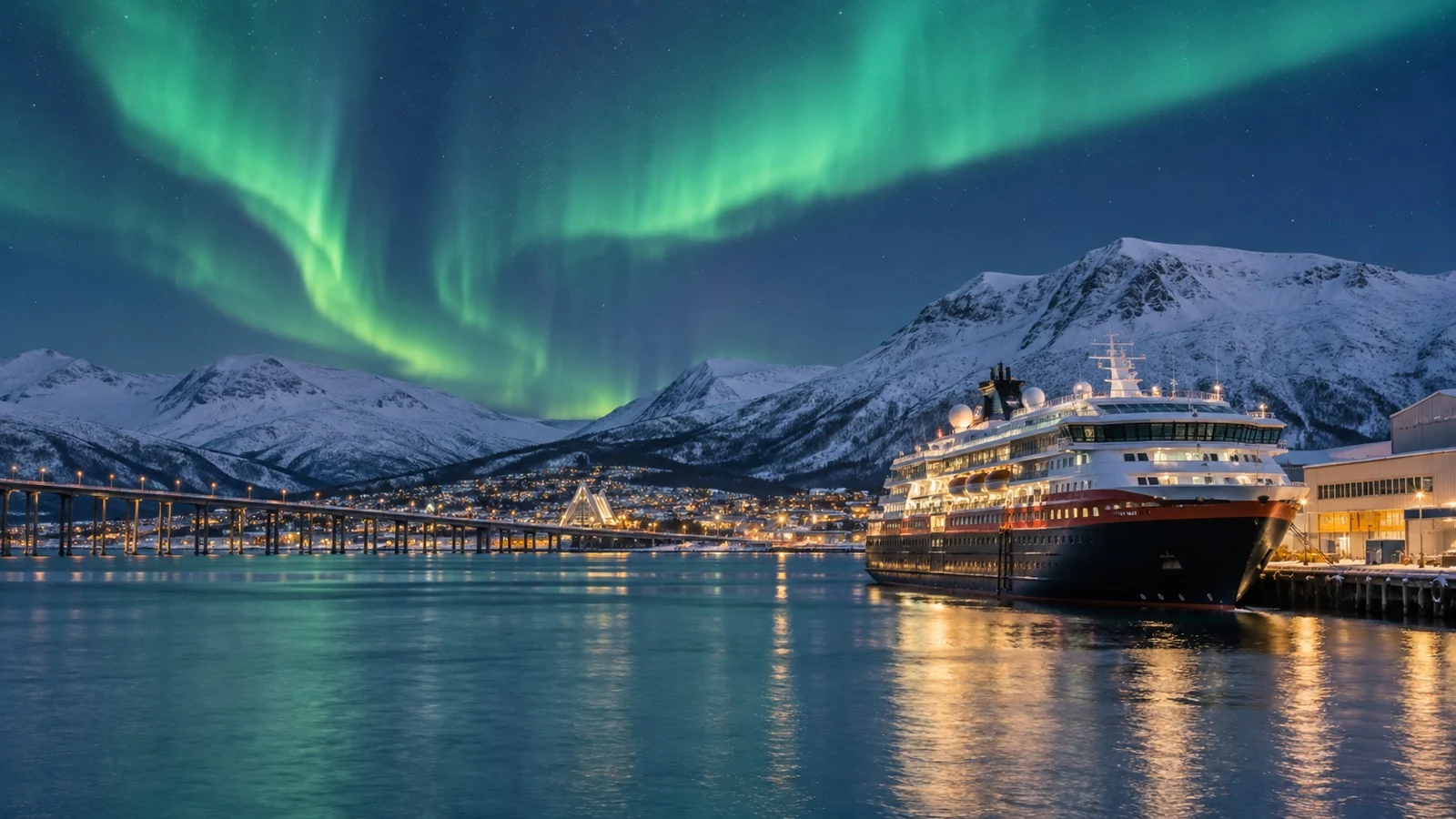
Every port north of the Arctic Circle sits under or near the oval, so this is about darkness, shelter and how long the ship stays. Roughly south to north.
- Svolvaer and the Lofoten islands: the mountains give you a foreground that most aurora photos lack. Short calls, so this is more about what you see from the deck than what you do ashore.
- Tromso: at 69.65 degrees north, about 220 miles north of the Arctic Circle, and the one place with real infrastructure for aurora chasing. The downside is light pollution and crowds, so the good tours drive well out of town.
- Skjervoy and the Lyngen area: narrow fjords, high peaks, and almost no artificial light. Passing through here at night is one of the better hands you can be dealt.
- Alta: inland at the head of a long fjord, which usually means drier air and clearer skies than the outer coast. Colder too, and that is the trade.
- Honningsvag: the North Cape port, and about as far north as scheduled ships go on this coast. Exposed and windy, which clears cloud fast and also removes any interest in standing outside.
- Kjollefjord and Berlevag: tiny Finnmark calls in the small hours, often minutes alongside. Set an alarm, step onto the quay, look up.
- Kirkenes: the turnaround at the eastern end, close to the Russian border. Continental rather than coastal in feel, and often the coldest and clearest night of the voyage.
Fun fact: the aurora forecast you refresh on deck is not really a forecast of the sun, it is a measurement of the wind already past you, and NOAA notes the lead time exists only because the solar wind takes 30 to 90 minutes to travel from the L1 observation point to Earth. That is your entire warning window, which is why the ship’s PA system beats any app.
How I would actually decide
Start with nights, not days. Count the hours of darkness above the Arctic Circle an itinerary actually gives you, and treat that as the product you are buying.
A twelve-night round voyage gives you eleven or twelve chances; a four-night Bergen to Trondheim hop gives you almost none, because most of it is south of the oval. The published guarantees exist at eleven and twelve days for exactly this reason.
Then pick the month, and check the moon. October and March give long dark nights and less brutal weather, and a full moon flattens the faint displays, so shifting a booking by a week is free now and impossible later.
On clothing, you will be standing still outdoors in wind, which is the hardest thing to dress for. Wool base layer, a real insulated outer layer, mittens rather than gloves, and boots you can stand in for an hour.
On cameras, a phone from the last few years genuinely works in night mode, braced against a railing. If you have a camera with manual control, my starting point is the widest aperture you have, ISO somewhere around 1600 to 3200, and an exposure of two to ten seconds with the focus set manually to infinity.
A realistic word on accessibility
The coastal ships are reasonably good inside, with elevators, step-free public decks and adapted cabins on the newer vessels. The aurora happens outdoors, on decks that ice up and have sills and cambers designed around nothing of the sort.
That matters more here than on a summer sailing, because the thing you booked for happens outside at night in ice and wind. Nobody will say so in the brochure.
Ask specifically which deck and which lounge has north-facing windows that open or a sheltered viewing area at your level. Some ships have a panoramic lounge that solves this entirely, and it is worth choosing your ship on that basis.
Shore excursions are the harder half, since aurora chases involve minibuses, gravel pull-offs and standing in snow. If that rules them out, the ship is genuinely the better option for you, and my guide to wheelchair-friendly cruise ports covers the wider fleet picture.
When to go, and the weather
The usable window runs from about 20 September to 31 March, which is when both coastal operators run their aurora seasons. Outside it there is simply too much daylight, and by late April the sky above the Arctic Circle never gets properly dark.
Polar night is the extreme end of this. Visit Norway describes the polar night in Tromso as starting at the end of November, with the sun not fully rising again until late January, which gives you enormous darkness and also the worst of the weather.
Coastal temperatures are milder than the latitude suggests, because the North Atlantic Current keeps these harbors ice-free all winter. A winter night in Tromso is usually around 23 to 36 Fahrenheit, with inland Alta and Kirkenes often roughly 18 Fahrenheit colder.
Wind is what actually hurts, and an open deck at 20 knots in February will drive the felt temperature well below anything the thermometer says. Rain and sleet on the outer coast are common in fall, and the crossing of Vestfjorden can be genuinely rough.
Improve the odds without believing a guarantee
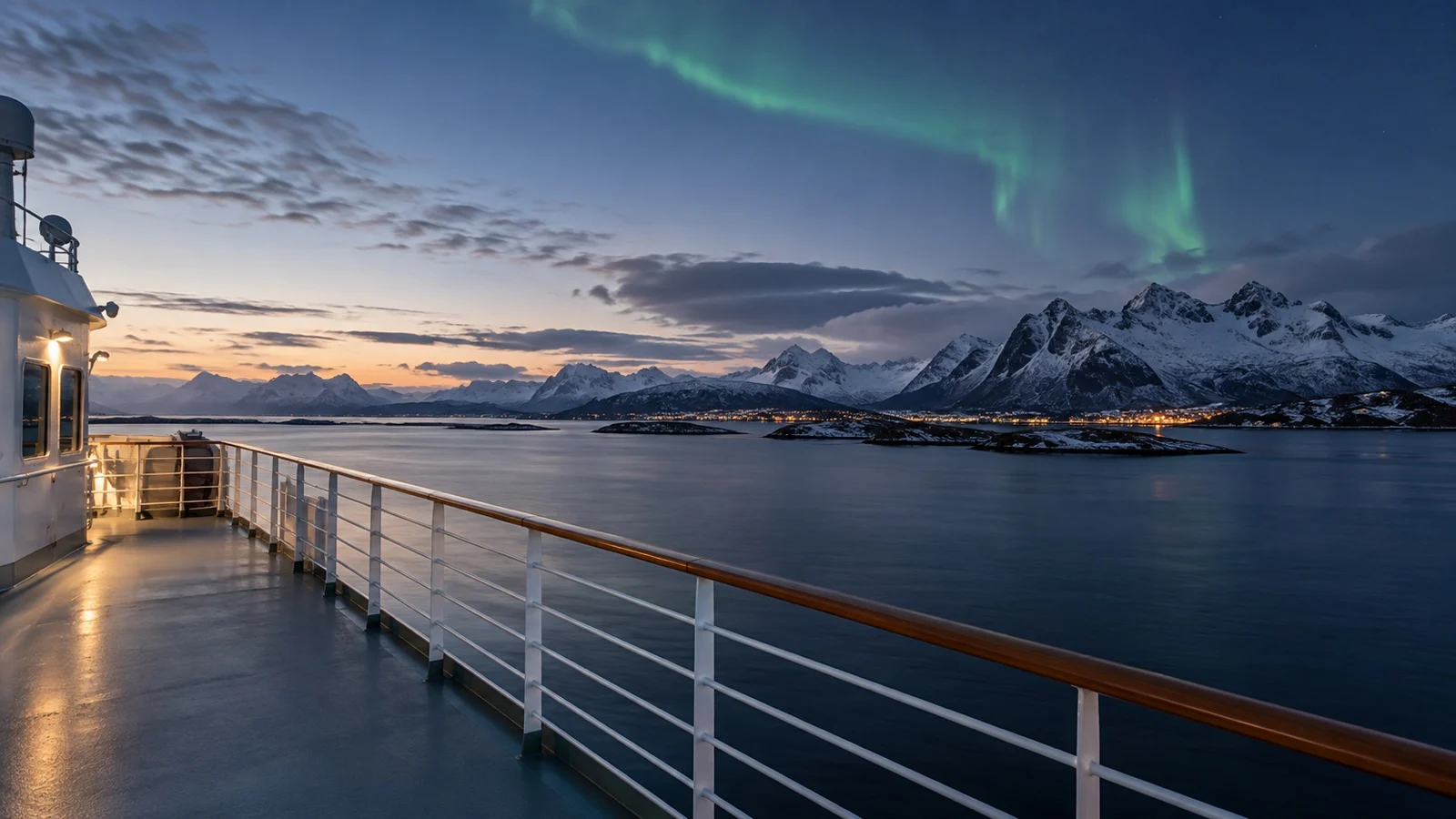
A coastal ship samples more nights and locations, but it follows a working route rather than chasing holes in the cloud. Choose the longest eligible winter itinerary you can enjoy without aurora, then treat every clear, dark hour as an opportunity rather than expecting one scheduled show.
Cloud and local lighting are the practical visibility problems, while solar activity is reliable only close to the event. Moon phases are predictable, and a bright moon may reduce contrast in a faint display but does not stop a strong aurora.
Turn on the ship’s aurora alert, learn which exterior deck has the least light, and keep boots and layers ready beside the bed. Ice, wind, darkness, and door sills can make a late-night dash difficult, so ask the crew for a safer viewing position if balance or mobility is limited.
Read every promise as a fare condition because eligible dates, voyage length, reporting rules, and the replacement voyage vary by operator. The remedy is usually another qualifying voyage rather than cash, and it does not repay your flights, hotels, or the winter trip you just completed.
Quick answers
What are my chances of seeing the northern lights on a cruise?
Nobody can give you a percentage honestly, but a voyage of eleven nights or more above the Arctic Circle in season is very likely to log at least one display. A three-night hop in the south is not.
Do ships wake you up for the aurora?
The Norwegian coastal lines announce sightings over the public address system, and Havila runs an alert you must activate yourself. Confirm at reception on your first evening, because the cabin announcement setting is not always on by default.
Is the northern lights guarantee worth booking for?
Not on its own. Hurtigruten requires 11 days or more between 20 September and 31 March, Havila requires the 12-day round voyage between 1 October and 31 March, and both leave the sighting decision to the ship.
What Kp number do I need in northern Norway?
Less than you think, because you are already under the oval. NOAA describes Kp 3 to 5 as bright and active, and that is a perfectly good night at 69 degrees north.
Which month is best for a northern lights cruise?
October or March if you want a balance of darkness and tolerable weather. December and January give more darkness but a higher chance of storms and canceled excursions.
The last word
You are not buying a sighting, you are buying attempts. Everything that improves a northern lights cruise comes down to more nights, farther north, with a hull under you that can move.
If you want to compare specific calls rather than whole voyages, my roundup of the best northern lights cruise ports goes port by port, and the Tromso port guide covers the one stop where you might reasonably book a land-based chase as well.
For the shape of the whole coast, including the summer version of the same route, start with the Norway cruise ports overview. The port-by-port breakdown of the coastal express route is the useful companion if you are choosing between the round trip and a one-way leg.
And if you get eleven cloudy nights in a row, you will have spent them sailing through Arctic Norway in winter, which is not the worst consolation prize on offer. The lights are a bonus, not the itinerary.
How this guide was researched: This guide was checked against current official port, waterway, immigration, transit, attraction, operator, and weather information. Operational and time-sensitive details were reviewed September 12, 2026; confirm the live berth, daily program, entry rules, accessibility, and cancellation terms before travel.
See our Editorial Policy.
More on this topic: browse every guide on weather, crowds and conditions.