Debarkation Day and US Customs: Allowances, Face Scans and the Fastest Way Off
The ship is quiet at 6:30am, your bags left the hallway ten hours ago, and a lounge full of people is waiting to hear a color called. Debarkation day is short, rigid, and completely predictable once you know how the pieces fit together.
My quick take
I take self assist almost every time I am allowed to, because the part of the morning I control is the part that goes well. Handing your bag to the hallway means handing over your departure time along with it.
The customs half worries people far more than it deserves. For a normal cruise with a normal amount of shopping, walking off a ship in a US homeport is quicker and calmer than clearing a mid-size airport.
The quick facts
- Standard allowance: Usually $800 per person of goods, duty free, after 48 hours abroad.
- Insular bump: Usually $1,600 per person if the itinerary included the US Virgin Islands, Guam or American Samoa.
- Alcohol: Around one liter per adult duty free, with more allowed on some Caribbean and Virgin Islands routings.
- Face scan: A camera photo now stands in for handing over your passport at many US cruise terminals.
- Earliest flight: Noon is the earliest most people should book out of a US homeport, and later is safer.
The night before is where the whole morning gets decided
Everything about debarkation day is settled between roughly 6pm and 10pm the evening before. That is when you pick your departure method, when your bags go into the corridor, and when the ship prints the tag that fixes your place in line.
Cabin accounts close overnight, so this is also the last sane moment to query a charge. Doing it at the guest services desk at 7am, behind forty people with flights to catch, is the version that costs you the morning.
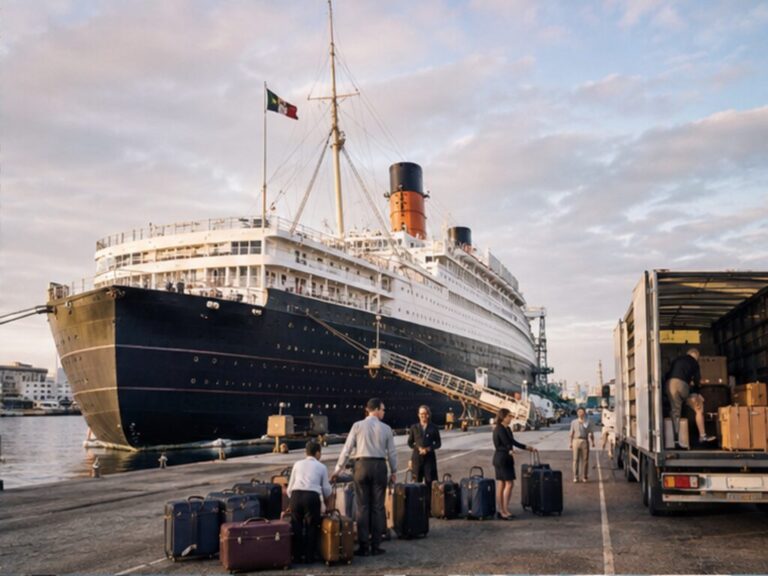
Keep a small bag with medication, chargers, documents and one change of clothes. Whatever leaves your cabin at 10pm is genuinely gone until you see it standing on the terminal floor.
Self assist, and who it actually suits
Self assist, often called express walk off, means every bag stays in your cabin overnight and you carry it off yourself the moment the ship is cleared. No tags, no waiting lounge, no baggage hall.
It suits people who packed light, who can manage their own luggage down a stairwell, and who are willing to be awake and moving around 7am. It does not suit families with strollers, anyone who needs wheelchair assistance, or anyone who bought four bottles of rum and a ceramic bowl.
The catch is that everyone else who packed light had the same idea, so self assist is frequently the longest single line on the ship. Elevators are the real bottleneck, and if you cannot get your bags down several flights of stairs it quietly stops being fast.
The colors and numbers on your luggage tag, decoded
If you use the standard service, your bags go outside the cabin door the night before wearing a tag showing a color, an animal, a number or some combination of the three. Each group is offloaded together and stacked under its matching sign in the terminal.
Groups get called in sequence starting somewhere around 7:30am, and most ships are empty by 9:30 or 10am. Lines generally assign the earliest groups to passengers with the earliest verified flights, then to suite and loyalty tiers, then to everyone else.
You can usually request a different group at guest services on the second to last day. Asking for a later one is easy, and asking for an earlier one works far better when you have a boarding pass to show them.
What the allowance actually covers
The standard personal exemption is $800 per person of goods brought back for personal use, as long as you have been out of the country at least 48 hours. It drops to $200 if the trip was shorter than that, or if you have already used a full exemption once in the previous 30 days.
Family members living in one household and traveling together can pool their exemptions. Two adults and two kids gives you $3,200 of headroom, and it does not matter whose suitcase the items are sitting in.
Going over the line is not a crime, it is a bill. The next $1,000 above the exemption is charged at a flat 3 percent, and only above that do ordinary tariff rates start to apply.
So a couple who spent $2,000 between them owes something in the region of twelve dollars. The published exemption tiers are worth two minutes of your attention if you plan to shop seriously.
The Virgin Islands math, and the Caribbean exception
If your cruise called at the US Virgin Islands, Guam or American Samoa, the exemption rises to $1,600 per person. That is a large part of why so many Caribbean itineraries put St. Thomas on the schedule and why the jewelry shops cluster so tightly around the pier.
There is a second, smaller break attached to a long list of Caribbean and Andean countries. It lifts the alcohol portion of the $800 exemption to two liters, provided one of those liters was produced in one of the listed countries.
Not every island qualifies, which is the part people get wrong. Several that travelers assume are included, the Cayman Islands and Turks and Caicos among them, are not on that list at all.
The liquor they deliver to your cabin on the last night
Anything you buy in the ship’s shop or ashore that counts as alcohol goes into a secure hold and reappears outside your cabin on the final evening. That timing is a drinks policy decision by the cruise line and has nothing to do with customs.
Those bottles count toward your allowance exactly like anything else you carry. Duty free on a ship means free of the selling country’s tax, not free of yours.
The usual allowance is around one liter per traveler aged 21 or over, rising to two liters on qualifying Caribbean and Andean routings and as high as five liters coming back from the US Virgin Islands, with conditions attached. Beyond that, extra bottles are dutiable at a low flat rate plus federal excise tax, which in practice comes to a few dollars a bottle.
State law is the part that catches people out, because your arrival state can set its own limit regardless of the federal one. Two bottles has never been the thing that starts a conversation, but a case of wine is a different situation.
The face scan that replaced handing over your passport
At a growing number of US cruise terminals you now walk up to a camera, pause for a second, and keep walking. The photo is compared against the passport or visa image already held on file for you.
The move to biometric facial comparison replaced the manual document check, where an officer took your passport, looked at you, and looked back down again. The match takes about two seconds and the stated accuracy is above 98 percent.
US citizens are allowed to decline and ask for a manual document check instead. It costs you a minute and nobody makes a scene about it.
Carry your passport in your hand regardless, because the camera does not match everyone and the fallback is the old process. If you sailed on a birth certificate under the closed loop documentation rules, you want that paperwork immediately reachable rather than in a checked bag.
Global Entry and Mobile Passport at a cruise terminal
This is the question I see answered wrong most often, usually by someone repeating what works at an airport. A cruise terminal is a different animal, and your trusted traveler card does not automatically buy you a shorter line.
Mobile Passport Control is the more useful of the two here, and it currently covers a small handful of seaports rather than all of them. The seaport list is short and includes Miami, Port Everglades, Palm Beach and San Juan, and it is open to US and Canadian citizens.
Global Entry is patchier again. A few terminals have run a dedicated line for members at times, PortMiami hosts an enrollment center for people applying, and plenty of ports offer nothing at all for arriving passengers.
Check your specific terminal rather than assuming, because this varies port by port and gets quietly rearranged. I would not build a tight airport connection around either program working on the day.
The declaration, and why the form may never appear
For years, every cabin got a paper customs form on the last night. On a lot of sailings now nothing arrives at all, and people quietly panic about it over breakfast.
At several large US homeports, the declaration is now made by choosing a lane. Walking into the nothing to declare channel counts as your declaration, and the items to declare channel puts you in front of an officer for a spoken one.
That setup runs at ports including Miami, Port Everglades, Port Canaveral, Galveston, Norfolk and Bayonne, with more expected to follow. If a paper form does turn up in your cabin, fill it in, because your ship and your terminal decide which system you are in.
One form covers a household traveling together, so do not fill out four of them for a family of four. Do not leave the value boxes blank hoping nobody looks either.
The agricultural rules people trip on
Food is where ordinary travelers get fined, not watches. You are required to declare all meat, fruit, vegetables, plants, seeds, soil and anything made from a plant or an animal, and declaring costs nothing.
Fresh fruit is the classic mistake. The banana or apple you grabbed at the breakfast buffet is agricultural material, and it belongs in the bin on the gangway rather than in your day bag.
- Fresh fruit and vegetables: Almost always taken off you, buffet fruit very much included.
- Plants, cuttings and seeds: Heavily restricted and often prohibited outright.
- Meat and most animal products: Frequently prohibited, and that includes jerky and cured sausage.
- Baked goods and hard cheeses: Generally allowed through, but declare them anyway.
- Wooden carvings, shells and coral: Inspected, and some of it is not coming home with you.
The penalty for failing to declare agricultural items runs as high as $1,000 for a first offense in personal quantities. Declaring something you turn out not to be allowed to keep costs you the item and nothing else, which is the whole point of declaring.
Most of this mirrors the screening you already walked through in port. My guide to what you cannot bring back onboard covers the same fruit, alcohol and coral problems from the other direction.
Why the flight is the part that ruins the day
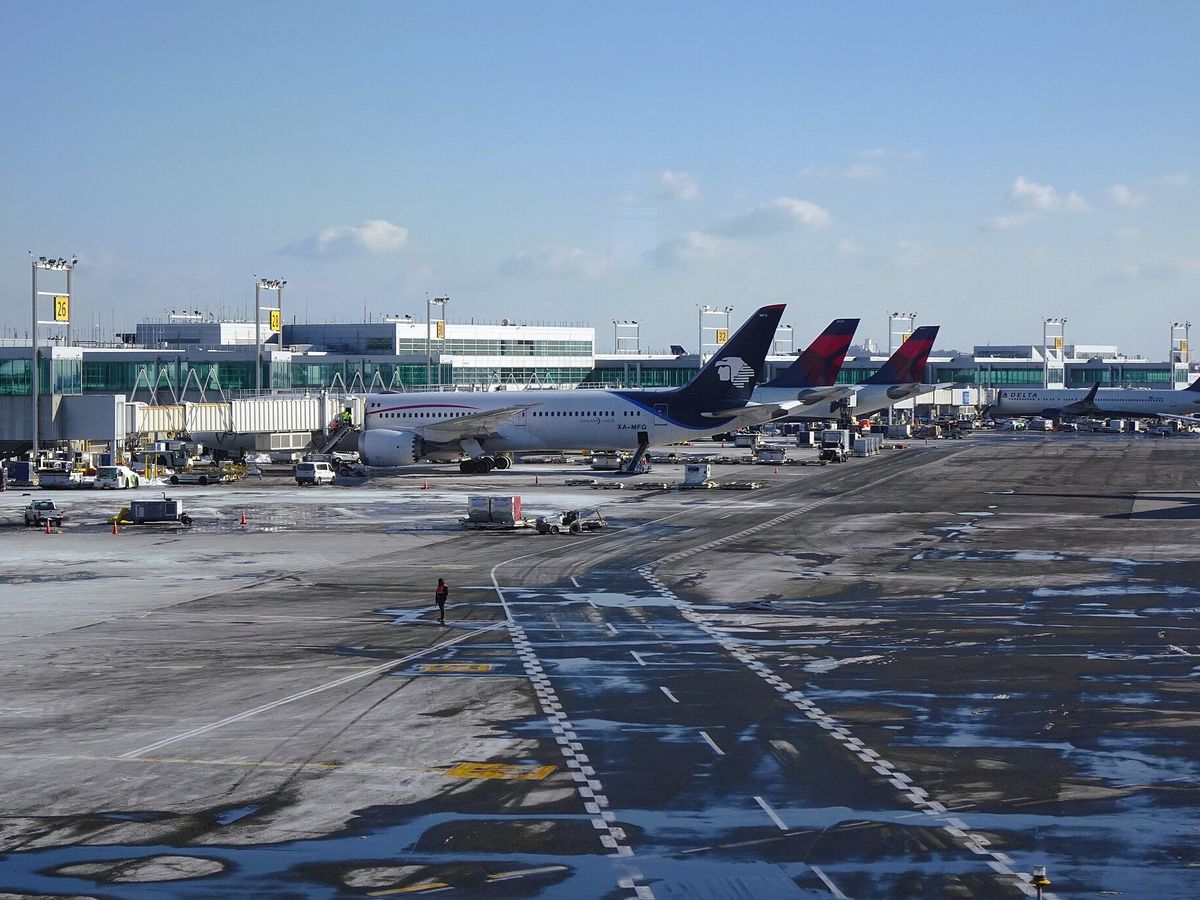
The ship’s arrival time is not your departure time, and treating the two as the same thing is how people miss flights. Between clearance, your group being called, finding your bags and reaching the airport, the realistic gap is three to four hours.
Noon is the earliest departure I would consider out of most US homeports, and I would rather hold a 1pm flight and drink a coffee than a 10:30am flight and adrenaline. My longer breakdown of how late to book your flight home goes through the port by port math properly.
Airline schedules matter as much as the cruise schedule here. A single 11am flight with no later option that day is a far worse bet than a noon flight on a route that runs every hour.
When something goes wrong on the terminal floor
The most common problem is a missing bag, and it is almost always sitting in the wrong color group rather than genuinely lost. Walk the entire hall before you report anything, because tags get shuffled constantly during the offload.
The second most common is a referral to secondary inspection. It is a room, a table and some questions, and it usually ends in a few minutes if you have been straightforward about what you bought.
If your ship docks late, call the airline rather than the cruise line. Late arrivals happen for weather, medical diversions and berth traffic, and nobody on the ship can move your flight for you.
Keep receipts for anything expensive in your carry on. Being able to show what a thing cost turns a long conversation into a short one.
Ending in a foreign homeport instead
If your cruise finishes in Vancouver, Southampton, Barcelona or Sydney, you clear that country’s immigration on arrival and there is no US customs involved at all. The allowance question moves to the airport on your way home instead.
The offload itself is identical, with colors, groups, lounges and a self assist option. What changes is the immigration line, which can be considerably slower where facial comparison is not in use.
Build in more time than you would at a US homeport, and confirm whether you need a visa or an entry authorization for the country you step off into. I cover the ports where a passport alone is not enough separately, and disembarkation ports are exactly where that bites.
Quick answers
What is the duty free allowance for a cruise?
Usually $800 per person of goods after at least 48 hours abroad, rising to around $1,600 if the itinerary included the US Virgin Islands, Guam or American Samoa. Family members in one household can pool their exemptions.
Do I still fill out a customs form after a cruise?
Often not. At several large US homeports your declaration is made by choosing the nothing to declare or items to declare lane, though some sailings still hand out a paper form the night before.
Does the liquor I bought on the ship count against my allowance?
Yes. Bottles bought in the ship’s shop or ashore, held for you and delivered on the last night, are treated exactly the same as anything packed in your suitcase.
Can I use Global Entry to get off a cruise ship faster?
Sometimes, at a small number of terminals, and it is not something to count on. Mobile Passport Control covers a short list of seaports and is the more reliable of the two, but neither should be assumed to work at your port.
What time do you actually get off the ship?
Self assist normally starts around 7am to 7:30am once the ship is cleared, and tagged groups are called through until roughly 9:30am or 10am. Ships want everyone off well before the next set of passengers arrives.
Final word
Debarkation day rewards decisions made the night before and forgives almost nothing decided at 7am. Pick your method honestly based on how much you are carrying and how early you can genuinely be moving, then let the ship run its process without you.
The customs half is simple if you declare everything and keep your receipts together in one place. If the morning feels like a rerun of what happens on embarkation day played backward, that is because it mostly is.
How this guide was researched: Personal exemption tiers, alcohol allowances, agricultural declaration rules, biometric processing at cruise terminals and the current lane based declaration arrangements were all checked against official guidance in September 2026. Which terminals offer expedited entry programs and which ports run lane based declarations both change regularly, so confirm the details for your own homeport before you sail. See our Editorial Policy.
More on this topic: browse every guide on choosing a cruise.