The Best Months to Cruise the Caribbean
Every Caribbean itinerary looks the same in a brochure, and the difference between a February sailing and a September one is not the ports. It is the wind, the price, and how much of the printed itinerary you actually get.
My quick take
If you made me pick one week for a first Caribbean cruise with nothing else to go on, I would take the second half of May. Spring break is finished, school is not out yet, the dry season has not fully let go, and the fares have not woken up.
The week I would skip is not in September. It is the last week of December, when you pay the highest fare of the year to share every beach in the region in the windiest stretch of the calendar.

The quick facts
- Season length: The Caribbean sails all twelve months, so there is no opening or closing week to work around.
- Driest stretch: Roughly December through April, which is also when fares run highest.
- Hurricane season: June 1 through November 30, with most of the activity packed into mid August through mid October.
- Windiest weeks: Late November into February, when the trades stiffen and tender ports start getting canceled.
- Cheapest weeks: Late August into early October, plus the first two weeks of December.
The Caribbean does not have a season, it has moods
Alaska has an opening week and a closing week. The Caribbean does not, and that trips people up when they try to apply the same logic to it.
Ships sail here in every month of the year, the islands stay open, and the beach bars do not board up in October. What actually changes across the calendar is wind, rain, storm risk, water clarity, and how many other people booked the same week you did.
January and February: bright, dry, and windier than you expect
This is the postcard version of the Caribbean. Daytime highs sit in the low to mid 80s (around 28 to 30 C) across most of the eastern and southern islands, rain comes in short bursts if it comes at all, and the humidity is as low as it gets.
The Bahamas run cooler than people picture. A January cold front can leave Nassau in the low 70s (around 22 C) with a hard north wind, which is fine for walking around and less fine for the pool deck you paid for.
The catch in these two months is the wind, not the temperature. Late January and February are the peak of the stiffened winter trades, and that is the exact thing that cancels tender ports.
March and April: the best weather sold at the worst crowd level
March is close to perfect on paper. It is still dry, the wind is easing off its February peak, and the water has warmed back up past the point where you hesitate at the ladder.
It is also the middle of spring break, and that runs for weeks rather than one tidy week because school districts do not coordinate. Easter moves between late March and late April depending on the year, which drags a second wave of families in behind the first.
The result is full ships, full beaches and a tender line that behaves like a holiday weekend. If you are going anyway, my notes on the busiest ports and how to get ahead of the crush are worth ten minutes before you sail.
May and early June: the window I would book
May is the month I recommend most often and the one fewest people ask about. The wet season is technically starting, but early in it that usually means a hard shower in the afternoon rather than a lost day.
Water temperatures are into the low 80s (around 28 C), the winter wind has dropped, and tender ports run closer to as advertised. Storm risk in May and the first half of June is low enough that I do not build a plan around it.
Late June through July: hot, loud, and honestly fine

Summer in the Caribbean is hot in a way that changes how you plan a port day. Highs push toward 90 degrees (32 C) with the humidity to match, and the sun at noon on a concrete pier is a real consideration for anyone traveling with small kids or older parents.
Storm risk is still low through most of July even though the season is technically open. What you are really paying for in these weeks is the school calendar, because family demand lifts fares well above May without lifting the weather.
August into early October: cheap, and cheap for a reason
These are the lowest fares of the year outside the first half of December, and the discount is not a trick. It is priced risk, and the risk is genuine rather than theoretical.
Mid August through mid October is when the Atlantic does most of its work, and the climatological peak of the season lands on September 10. Sea temperatures are at their warmest, usually into the mid 80s (around 29 C), which is lovely for swimming and is also the fuel supply.
I would not tell anyone to avoid these weeks outright. I would tell them not to book a September cruise if a reordered itinerary would ruin the trip for them.

What hurricane season actually does to your cruise

Here is the part the scary headlines leave out. A typical Atlantic season produces about fourteen named storms, seven hurricanes and three major hurricanes, spread across six months and an ocean far larger than your seven day loop.
Ships move. The overwhelming majority of hurricane season disruption is a reordered or substituted itinerary, not a canceled cruise, and full cancellations mostly happen when the homeport itself shuts.
I also used to treat the whole season as one block to avoid, which is too blunt to be useful. The month by month storm climatology shows June and July carrying very little of the risk, and it will change which weeks you shortlist.
In practice a September sailing is fine for a flexible traveler and wrong for someone who booked to see one specific island. The full picture of what changes when a storm is in the forecast is worth reading first, and the live tropical outlook is the page to watch the week before you sail.
Two habits carry most of the load. Buy travel insurance the day you book rather than later, because a storm becomes a named and therefore foreseeable event, and fly in the night before so a thinned flight schedule does not cost you the cruise.
Late October and November: the stretch nobody talks about
The back half of October and the first three weeks of November are, to me, the most underrated weeks of the Caribbean year. Storm activity drops sharply after the September peak, the heat has eased, and holiday pricing has not started.
You also get the capacity shift in your favor. Ships that spent the summer in Europe reposition across in the fall, so the Caribbean deployment gets bigger right as demand is still soft.
Thanksgiving week is the exception and it is a sharp one. Prices jump, families fill the ship, and the week after Thanksgiving falls off a cliff again.
December is two different months wearing one name
The first two weeks of December are among the cheapest and calmest weeks you will find all year. Weather is turning dry, the wind has not fully set in, and almost nobody with school-age kids can travel.
Then it flips. From roughly the week before Christmas through the first days of January, you are looking at the highest fares of the calendar, the fullest ships, and beach clubs quoting holiday rates.
If your dates are fixed by school, that is simply what it costs and there is no clever workaround. If they are not, moving one week earlier is the single biggest saving available in Caribbean cruising.

The Christmas winds are the part that ruins port days
People book winter for the weather and then lose a port to wind, which feels deeply unfair the first time it happens. From late November into February the northeast trades strengthen, and long-period north swell rolls down out of Atlantic winter storms on top of that.
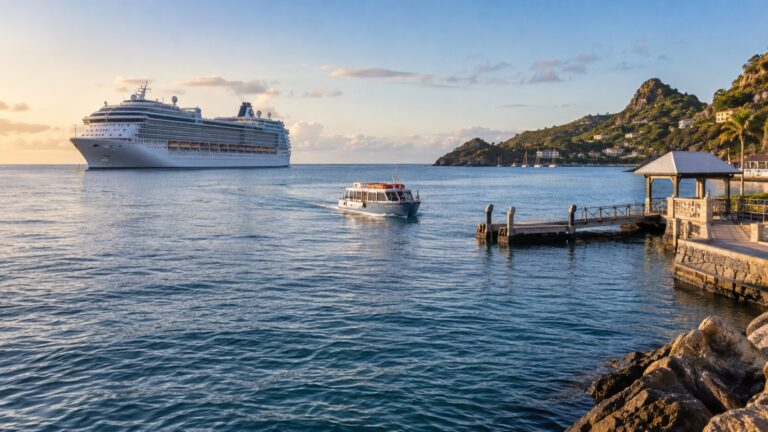
None of that stops a docked ship. It stops tenders, because a tender platform that is rising and falling on a twelve second swell is not a safe place to load a few thousand people.
So in January and February I count the tender ports on an itinerary before I look at anything else. The mechanics of it are laid out in the guide to why winter wind cancels Caribbean tender days, and the regional marine advisories and small craft warnings will usually tell you the night before whether the morning is in doubt.
Two practical moves if your winter cruise is tender heavy:
- Book through the ship on tender days: A canceled port refunds the ship tour automatically and does not refund the independent one.
- Do not stack them: An itinerary with three tender calls in February is three chances to lose a day.
Sargassum runs on its own calendar
Sargassum is the brown floating seaweed that has been washing up in serious volume across the western Caribbean since about 2011. On a good beach it is a line of weed at the tide mark, and on a bad one it is a knee-deep mat that smells like sulfur.
The rough planning window for the Mexican Caribbean is April through October, with the worst arrivals usually in the middle of that range. It is a planning range and not a switch, because where the belt actually lands depends on currents and wind in the days before you arrive.
This mostly matters for Cozumel, Costa Maya, Roatan and the Riviera Maya beaches, and much less for the southern islands. The honest approach is the one in the guide to deciding between the beach, the ruins or staying onboard, which is to check recent photos a few days out and keep an inland option in your pocket.
The genuinely cheap weeks, named
Caribbean fares follow the American school calendar more closely than they follow the weather. Once you see that, the cheap weeks are obvious and they repeat every year.
- The first two weeks of December: Good weather, low wind, nobody available to travel.
- Late August into early October: The cheapest weeks of all, and the ones carrying real storm risk.
- The last week of April and most of May: Spring break over, summer not started, weather still excellent.
- The week after Thanksgiving: A hard price drop that lasts until the holiday surge.
- Early to mid January: After New Year the ships empty out, though this is the windy stretch.
The pattern behind all of this is the same one that makes edge weeks cheap everywhere. It is worth understanding why the unpopular weeks are priced the way they are before you assume a low fare means a bad ship.
The best month depends entirely on who you are
Anyone who hands you a single best month without asking a question first is guessing. Here is how I would actually split it.
- Best for perfect weather with no budget limit: February and early March, accepting the wind and the tender risk.
- Best for value with good conditions: May, or the last week of April.
- Best for families tied to school breaks: Late June and July, which beat August on storm risk.
- Best for the lowest possible fare: Early September, if a changed itinerary would not upset you.
- Best for a first cruise with older travelers: Late October or November, when the heat and the crowds have both dropped.
- Best for snorkeling and clear water: March through June, before the summer weed and after the winter chop.
My own bias is toward May and November, because both give you most of the winter weather at a fraction of the winter price. I would take either over a February sailing I paid double for.
Quick answers
What is the cheapest month to cruise the Caribbean?
September is usually the cheapest, with early December close behind and far less storm exposure. If you want a low fare without the risk, take the first two weeks of December.
Is it safe to cruise the Caribbean during hurricane season?
Yes, because ships move away from storms and captains have days of warning. The risk you are actually taking is a reordered itinerary, not a dangerous one.
What month has the best weather in the Caribbean?
February and March are driest and least humid, which is why they cost the most. If you weigh calm seas heavily, March beats February because the winter trades have started to ease.
When is sargassum worst on a Caribbean cruise?
The heavy arrivals in the western Caribbean generally fall somewhere between April and October and vary a lot year to year. It affects Mexican and Central American beach days much more than the eastern and southern islands.
Which weeks should I avoid for a Caribbean cruise?
Christmas week and New Year week if you care about price or crowds, and mid September if a changed port would ruin the trip. Spring break in March is the third one, for crowds rather than weather.
Final word
The Caribbean rewards people who are honest about what they are optimizing for. Weather, price and crowds pull in different directions here, and no single week gives you all three.
Pick the one that matters most to you, then take the trade-off with your eyes open. My money goes on May and the back half of November, and I have never once regretted skipping the last week of December.
How this guide was researched: Storm climatology, seasonal wind and swell patterns, sargassum outlooks and Caribbean cruise deployment were checked in October 2026. Fares, school break dates and seaweed conditions all move from year to year, so confirm the specifics for your own sailing dates before you book. See our Editorial Policy.
More on this topic: browse every guide on weather, crowds and conditions.