Where to Find Accessible Restrooms in Cruise Ports
This list covers where a wheelchair user can reasonably expect to find an accessible restroom on a cruise port day, grouped by region.
It deliberately leaves out anything I could not tie to an official source, because a guessed restroom is worse than no restroom at all.
Why this list exists
The restroom question shapes a port day more than the sights do. It sets how far you go, how long you stay and whether you accept the excursion that runs four hours without a scheduled stop.
The published detail varies sharply by port, and silence on a website does not prove that no accessible restroom exists. It means you should ask the terminal or venue for a current location, opening hours and access route.
Nassau Cruise Port’s own passenger questions page tells guests seeking wheelchair assistance to engage with their shipboard team, which is a polite way of saying the ship is your resource and not the pier. That is a real answer, and it is worth knowing before you disembark.
How to use this list
Treat every entry as a starting point rather than a promise, and reconfirm before you rely on it. Terminals get rebuilt, attractions renovate, and a facility that existed last season may be behind hoarding this one.
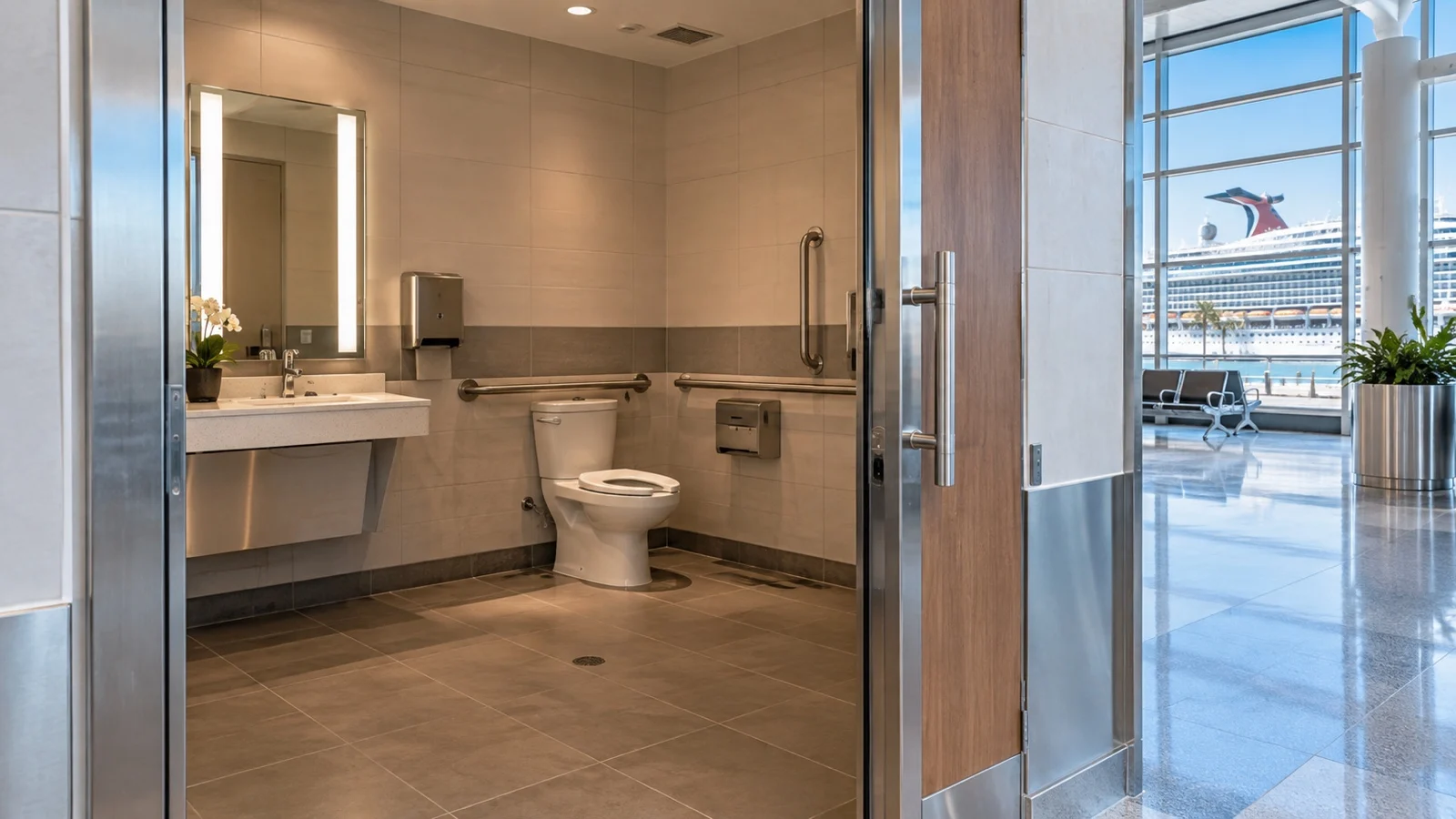
One structural note that applies everywhere, and it is the same trap as the way accessible cabins are categorized. A restroom marked accessible is a standard accessible cubicle with grab bars and turning space, and it is not the same thing as a facility with an adult-size changing bench and a hoist.
United States and Canadian homeports and terminals
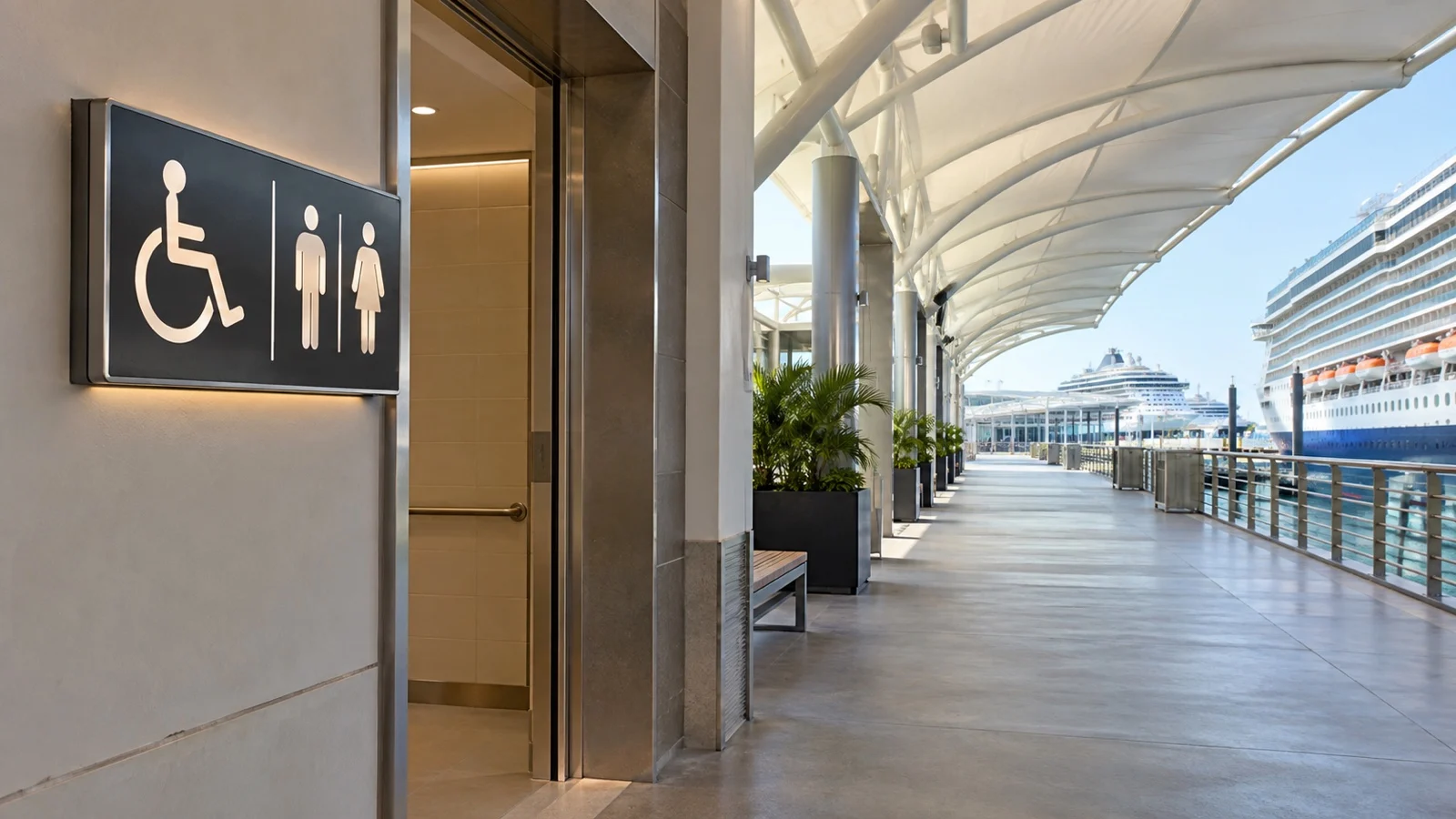
- PortMiami: the clearest published statement I found anywhere. PortMiami states that accessible restrooms are located throughout its cruise terminals, that the signs use recognizable pictorial symbols, and that toilet compartments are ADA accessible including grab bars.
- Canada Place, Vancouver: the operator’s own visitor information page says there are accessible washrooms on all levels of the facility, and that most of Canada Place sits at street level. For a homeport day with a late flight, that plus the accessible parking stalls in the parkade makes it one of the easier North American starts.
- Port Everglades and Seattle: both publish accessible parking detail and nothing about terminal restrooms, with Port Everglades offering a phone number and an email address for accessibility questions. I would call ahead at either rather than assume.
- The Canadian backstop: the Vancouver Fraser Port Authority notes that the cruise terminal is subject to the federal Accessible Transportation for Persons with Disabilities Regulations. That is a regulatory floor rather than a facility list, but it is more than most ports offer.
The Caribbean, Mexico and the Bahamas
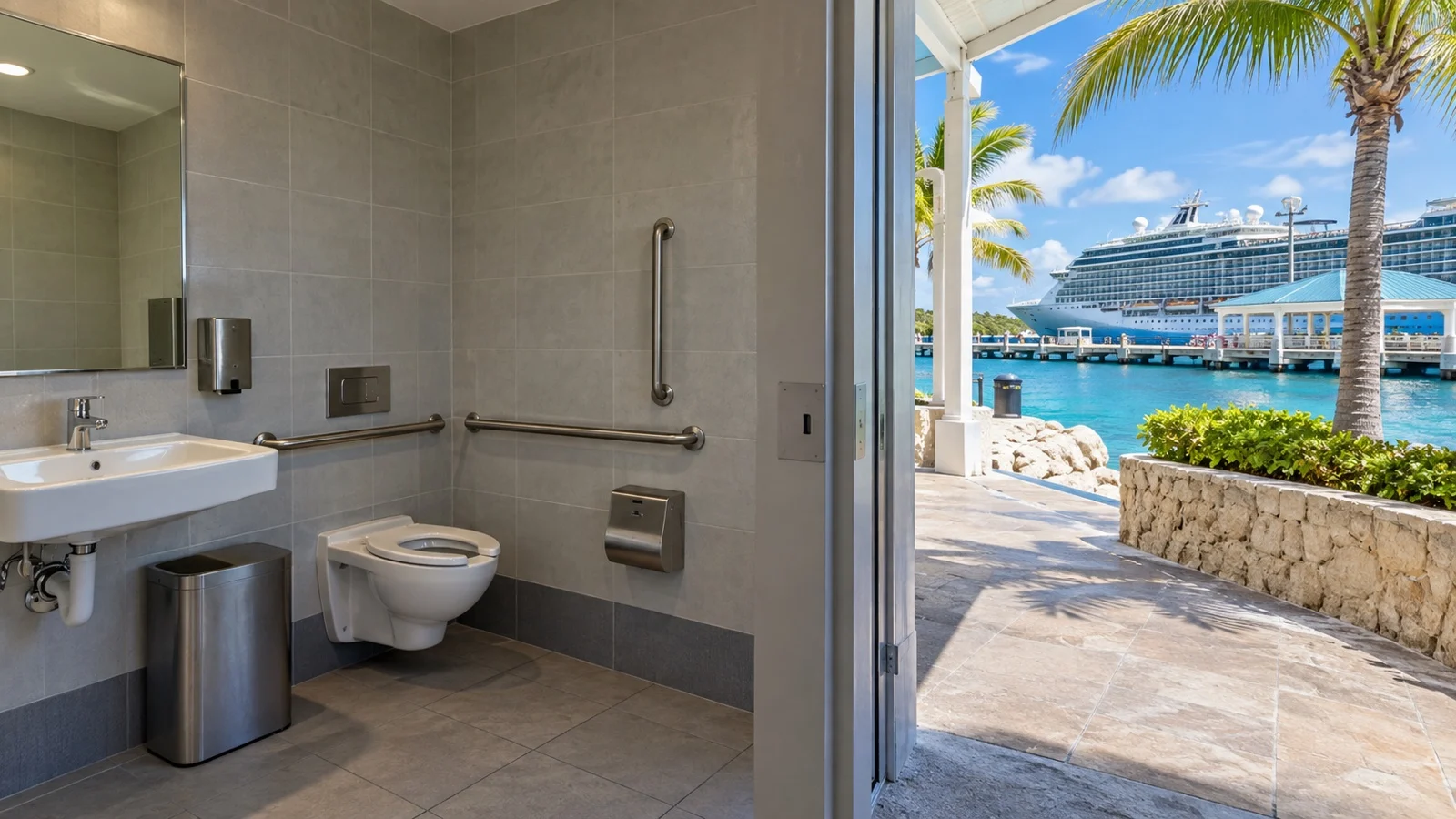
- Nassau Cruise Port: the rebuilt Prince George Wharf complex is modern and level, and its published passenger questions page still directs wheelchair requests back to the ship. I found no published restroom detail, which is the pattern across the region rather than the exception.
- Beach clubs and day passes: a paid beach club or resort day pass buys a restroom you can plan around, which is often the real value of booking one. Ask specifically about the path from the parking area to the facility, because sand and boardwalk steps undo a lot of good intentions.
- Tender calls: on a tender day the terminal option usually disappears along with the pier, and going back to the ship costs a round trip on a small boat. My guide to port-day activities that work with limited mobility covers how to shape the day around that.
- What I could not verify: I could not find published accessible restroom information from the pier operators at Cozumel or Philipsburg. Treat any specific claim about those berths, including mine, as something to check on the day.
Northern Europe and the British Isles
- Southampton’s cruise terminals: the city’s official visitor site states that each cruise terminal is equipped with accessible entrances, toilets and seating areas, along with assistance for wheelchair users and people with limited mobility. It describes the five terminals collectively rather than one by one, so confirm for your berth.
- The RADAR key across the United Kingdom: the National Key Scheme provides independent access to locked accessible public toilets at many shopping centers, stations, cafes and other locations. Buy the genuine key only if eligible, and use a current location directory rather than relying on an old national total.
- Changing Places facilities: these include extra space plus an adult-size changing bench and hoist, features a standard accessible toilet does not provide. Use the official Changing Places map for a current location instead of relying on an old national count.
- Denmark and the Access label: VisitDenmark points visitors to a national finder for the nearest accessible toilet anywhere in the country, and to the Access Denmark labeling system covering seven user groups including wheelchair users and visitors with visual or hearing impairments. Copenhagen and Aarhus are unusually well documented by European standards.
- Museums on the waterfront: newer museums can be good candidates for elevators and accessible restrooms, but “new” or “waterfront” is not proof. Check the attraction’s official accessibility page, admission rules and opening hours before making it the restroom plan.
The Mediterranean and the old towns
- The terminals publish very little: the official Civitavecchia terminal page lists a VIP lounge, a bar, a panoramic terrace and a check-in hall with 23 desks, and says nothing about toilets or reduced mobility services. I could not find a published accessible restroom inventory for the cruise terminals at Barcelona either.
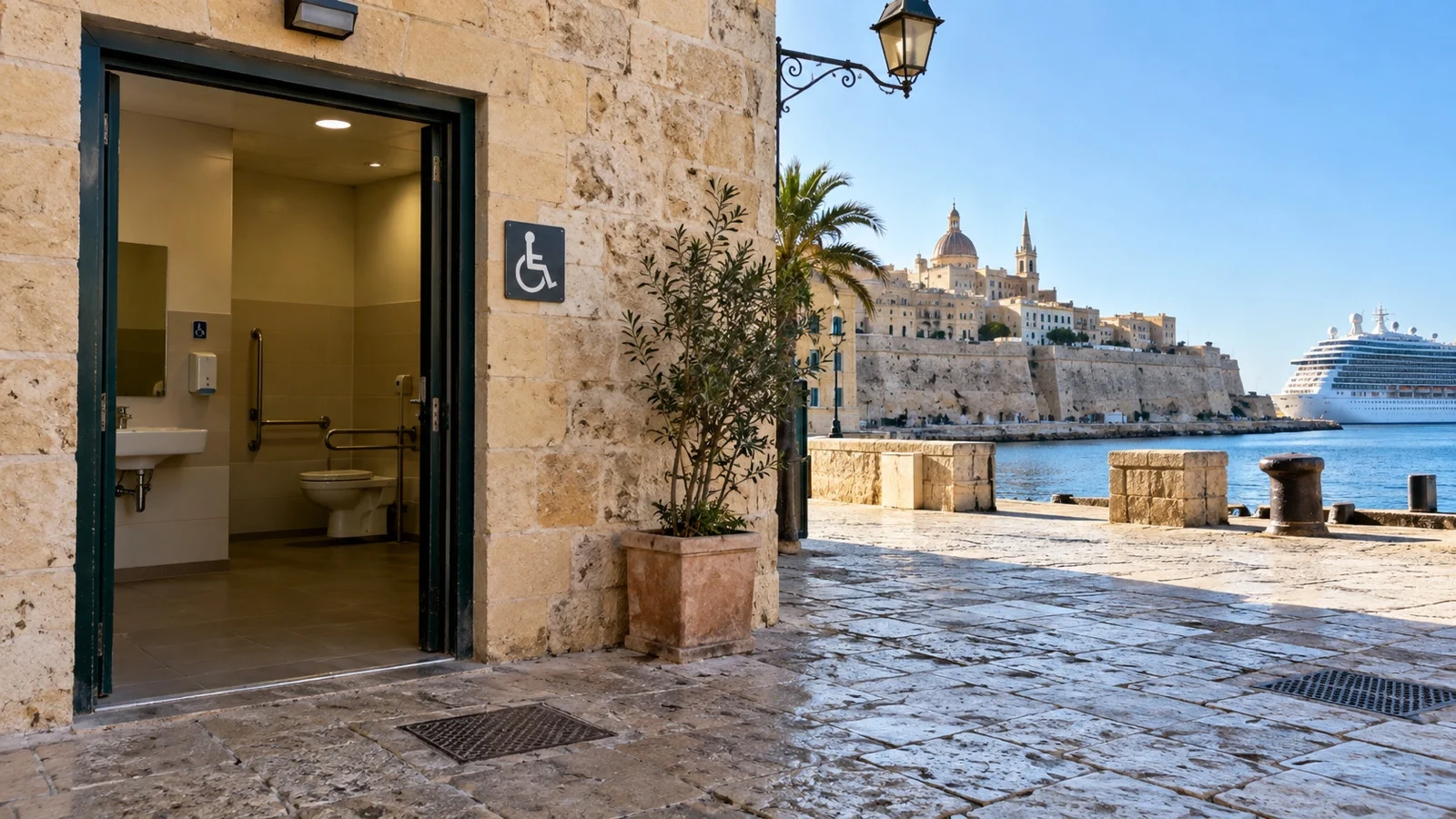
- The old town is the hard part: Dubrovnik, Kotor, Rhodes and Taormina are stone, steps and slope, and the historic core is where published information runs out entirely. Plan the restroom stop around the modern edge of town rather than the walled part.
- Paid and attended restrooms: fees and payment methods vary by city and operator in Italy, Spain, Greece and Croatia. Carry small change plus a card, and check a current city or venue page when a restroom is essential.
- Department stores, museums and transit halls: these can be useful candidates, but none is a guaranteed fallback. Verify the step-free entrance, restroom location, customer or admission rule and opening hours.
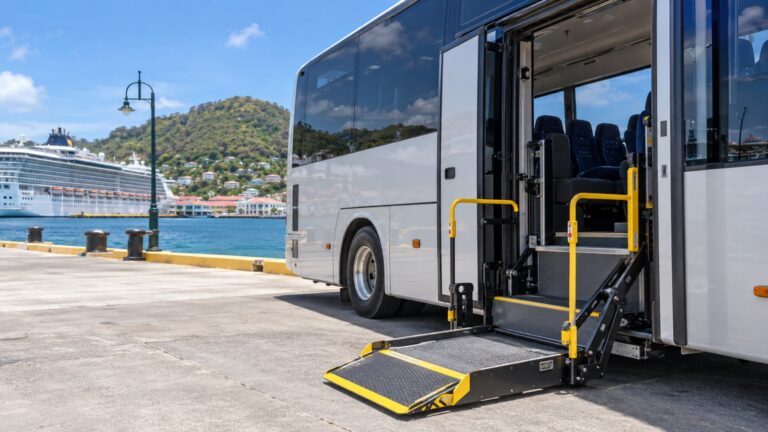
- The excursion gap: a lift-equipped bus does not mean a restroom stop, and archaeological sites are frequently the worst offenders. Ask the shore excursion desk where the tour stops and for how long, and see my notes on choosing excursions across different activity levels for the questions that get real answers.
Alaska, the small ports and everywhere remote
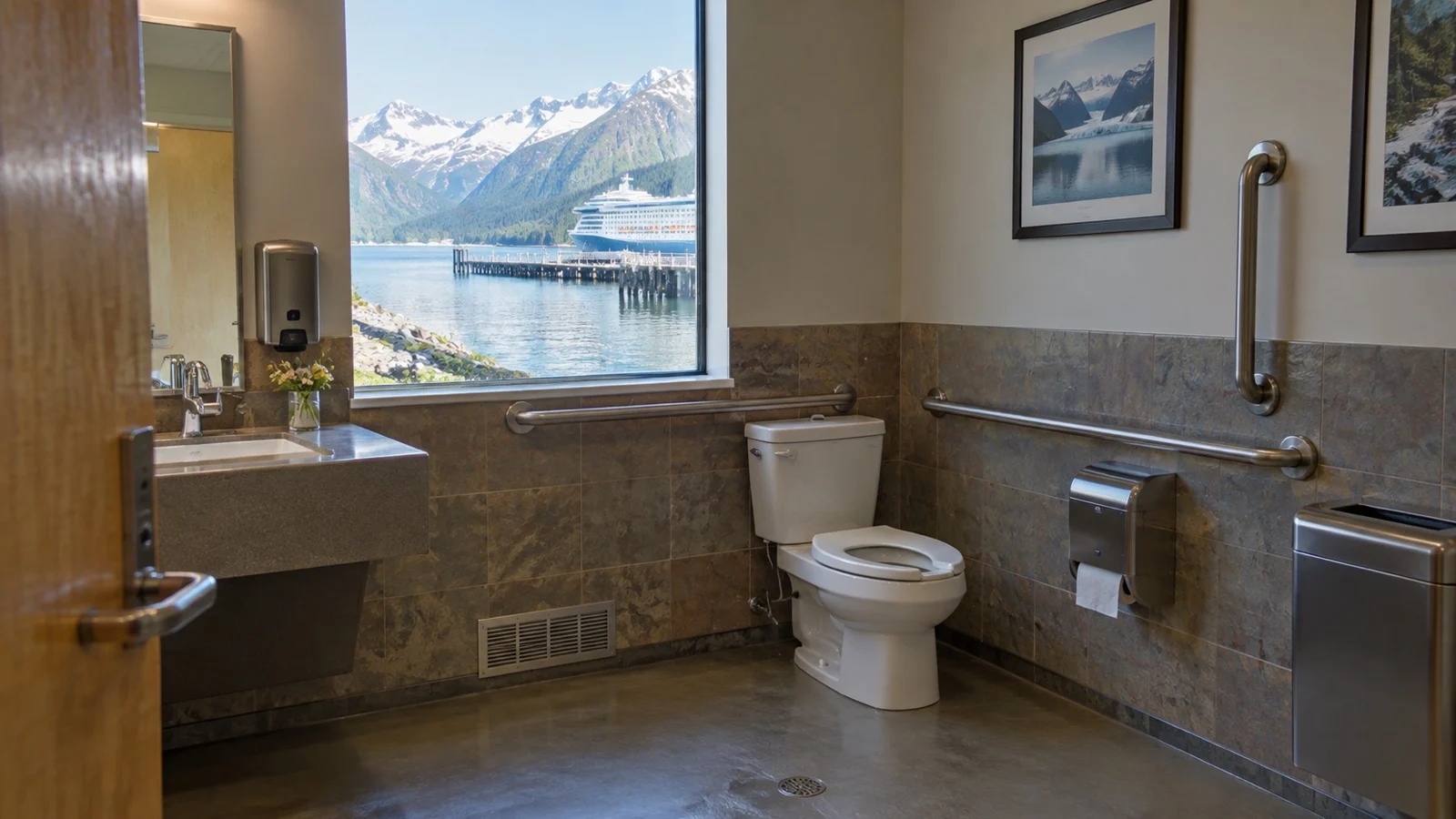
- Juneau: the City and Borough of Juneau publishes a visitor access guide stating that unless otherwise indicated, downtown buildings and restrooms are wheelchair accessible, and it names Centennial Hall, the US Forest Service Information Center, the Alaska State Museum, the Juneau Douglas City Museum, the State Capitol and the State Office Building. That Juneau access guide dates from 2019, so treat the building list as a starting point.
- Ketchikan and Skagway: both are compact, level and busy, and neither borough publishes an accessible restroom inventory that I could find. The visitor centers near the docks are the sensible first ask.
- Genuinely remote calls: in Greenland, the Marquesas or the Solomon Islands the ship is the practical answer and it is not a failure of planning to say so. Build the day around one shorter trip ashore rather than a full day out.
Fun fact: the British RADAR key exists because of a lock. The National Key Scheme was launched in 1981 as a partnership between the disability charity RADAR and a lock manufacturer, so that accessible toilets could be left locked against misuse while still being opened by anyone who held one standard key.
The exceptions worth knowing
- The two European key schemes are separate: the British National Key Scheme and the continental Euroschlüssel are different locks with different keys and different eligibility rules. A key that opens a facility in Liverpool will not open one in Hamburg.
- The Euro key takes planning: the continental Euroschlüssel has its own eligibility and ordering process, separate from the British scheme. Check the issuing organization’s current documents, cost and delivery estimate well before travel.
- Accessible is not the same as Changing Places: a standard accessible cubicle does not necessarily include an adult-size bench or hoist. Map the exact facility you need through an official directory, because availability varies widely within and outside the United Kingdom.
- The terminal may be one-way: at some berths the security layout means that once you walk out into town you are not readmitted to the terminal building until you return through the ship’s gangway line. Ask at the gangway before you decide the terminal is your safety net.
- Tender ports complicate the fallback: the landing may have limited facilities and returning to the ship requires another boat transfer. Check the operating schedule and allow plenty of time rather than assuming the round trip takes a fixed hour.
What I would check before I book
Start with the itinerary and mark calls expected to use a tender, then recheck near sailing. A port can switch between a berth and tendering, and the captain still makes the final safety decision for water-shuttle boarding.
Order any key scheme well ahead and verify eligibility before paying. Delivery estimates and the list of participating facilities can change, especially for international shipping.
Last, put the question to the shore excursion desk in writing before you book a tour, because the accessible label describes the vehicle rather than the stops. Confirm the answer with the line rather than with a tour operator’s brochure.
Where this gets hardest
Medieval old towns are the worst case, and they are also the reason most people booked the cruise. Dubrovnik, Kotor and Rhodes were built centuries before anyone thought about turning circles, and the modern facilities sit outside the walls.
Tender calls are the least predictable of all, because the decision to tender is made on the day. My guide to planning a port day for someone who cannot walk far works through the trade between a short trip ashore and staying aboard.
Traveling with a child in diapers adds a separate problem, because a changing table is not standard equipment in an accessible cubicle. The roundup of stroller-friendly cruise ports covers where that is easiest.
Quick answers
Do cruise terminals have accessible restrooms?
Many do, but very few port authorities publish it; PortMiami states that accessible restrooms are located throughout its cruise terminals, and Canada Place says there are accessible washrooms on all levels, while several large ports say nothing on the subject at all.
What is a RADAR key and do I need one? It is the key for the British National Key Scheme, which opens participating locked accessible public toilets; It can be useful on a multi-port UK trip, but check eligibility, delivery and current locations first.
Does a RADAR key work in continental Europe? No, the continental Euroschlüssel is a separate system with its own key, locations and eligibility rules; Apply well ahead using the issuer’s current instructions.
Are public restrooms free in Mediterranean ports? Policies vary by city, operator and venue, and some staffed facilities charge while others accept cards or are free to customers; Carry small change, but verify the exact facility instead of assuming every port or country works the same way.
Should I just go back to the ship?
In tender ports and remote calls that is frequently the sensible plan rather than a defeat; Build a shorter trip ashore around it and you will enjoy the day more than you would stretching a facility gamble across six hours.
The last word
The honest summary is that the information you need mostly does not exist in published form, and the ports that do publish it are the outliers. PortMiami and Canada Place answer the question in one sentence each, and I wish more ports followed them.
When a port’s published information is thin, returning to the ship can be the practical fallback, especially at a docked call. At a tender port, allow for the boat schedule and boarding conditions before treating that as a quick restroom option.
How this guide was researched: Terminal facilities were checked against current official port and visitor information, and key schemes against Disability Rights UK, CBF Darmstadt and VisitDenmark. Details were rechecked on September 10, 2026, but facilities, hours and berth access can change, so confirm each planned restroom directly.
More on this topic: browse every guide on accessible and family cruise planning.