How Late Should You Book Your Flight Home After a Cruise?
The safest flight home is not chosen from the ship’s scheduled arrival time alone. Build it from the time you can realistically reach the airport, then add the airline’s own check-in, bag-drop, security, and boarding requirements.
For many cruises, a later same-day flight can work. If missing the flight would be expensive or difficult to recover from, spending one night near the port is the calmest option.

Quick Facts
- Best starting point: Ask the cruise line for the earliest recommended flight for your exact ship, date, homeport, and airport.
- Do not use: The itinerary’s port-arrival time as your expected walk-off time.
- Add separately: Ship clearance, disembarkation, luggage, border formalities, ground travel, airport processing, and a disruption buffer.
- Self-assist: Consider it only if the cruise line offers it and everyone in your party can safely handle every bag without help.
- Lowest-risk choice: Fly the next day when the same-day timeline has little room for a delay.
Calculate the flight instead of memorizing a clock time
There is no reliable universal rule such as “book after noon” or “five hours after arrival.” A noon flight may be sensible in one homeport and reckless in another.
Start with the latest plausible time you will be outside the cruise terminal. Add the realistic trip to the correct airport terminal, your airline’s required arrival window, and extra time for disruptions.
Use this planning formula: latest plausible terminal exit + buffered ground travel + airport processing requirement + disruption margin = earliest sensible departure time. Treat every part as its own estimate so one optimistic assumption does not hide another.
Run the calculation with current information shortly before final payment and again before sailing. Port assignments, airline schedules, road conditions, and cruise-line procedures can change.
The itinerary arrival time is not your curbside time
A ship scheduled to arrive at 6:00 a.m. may still need to berth, receive clearance from local authorities, organize luggage, and release guests in groups. Weather, medical events, immigration procedures, port traffic, and operational delays can move that timeline.
The useful number is not when the ship reaches port. It is when your party can reasonably expect to be outside the terminal with every bag and ready to leave.
Ask the cruise line for the earliest recommended flight for your specific sailing. That recommendation is a practical floor for planning, not a promise that a delay cannot happen.
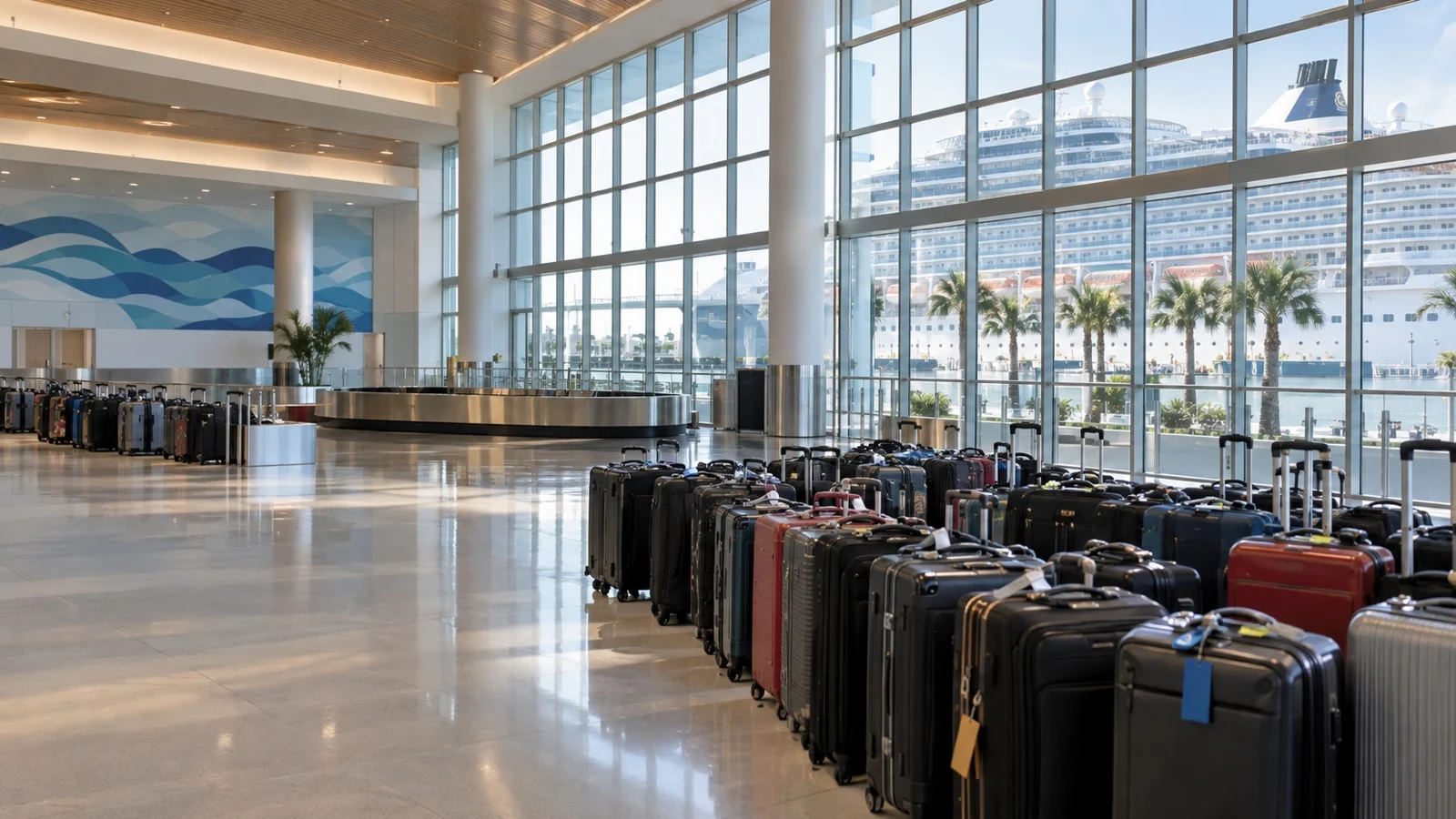
Build every step into the timeline
1. Ship clearance and your walk-off group
Allow time between scheduled arrival and the start of disembarkation. Then account for your assigned group, elevators, corridors, gangways, luggage collection, and any assistance your party needs.
Self-assist can put you in an earlier group on lines that offer it, but it is not a magic express lane. Use it only when each traveler can safely move all luggage through the ship and terminal without crew help.
2. Luggage and border formalities
If you leave bags out for crew collection, you will need time to find them in the terminal. Passport or customs processing may be quick, or it may produce a queue that no traveler can control.
Keep passports, medication, valuables, flight details, and anything needed that morning in your carry-on. The site’s guides to face-to-face immigration and what you cannot bring back can help you prepare.
3. Travel from the port to the correct airport terminal
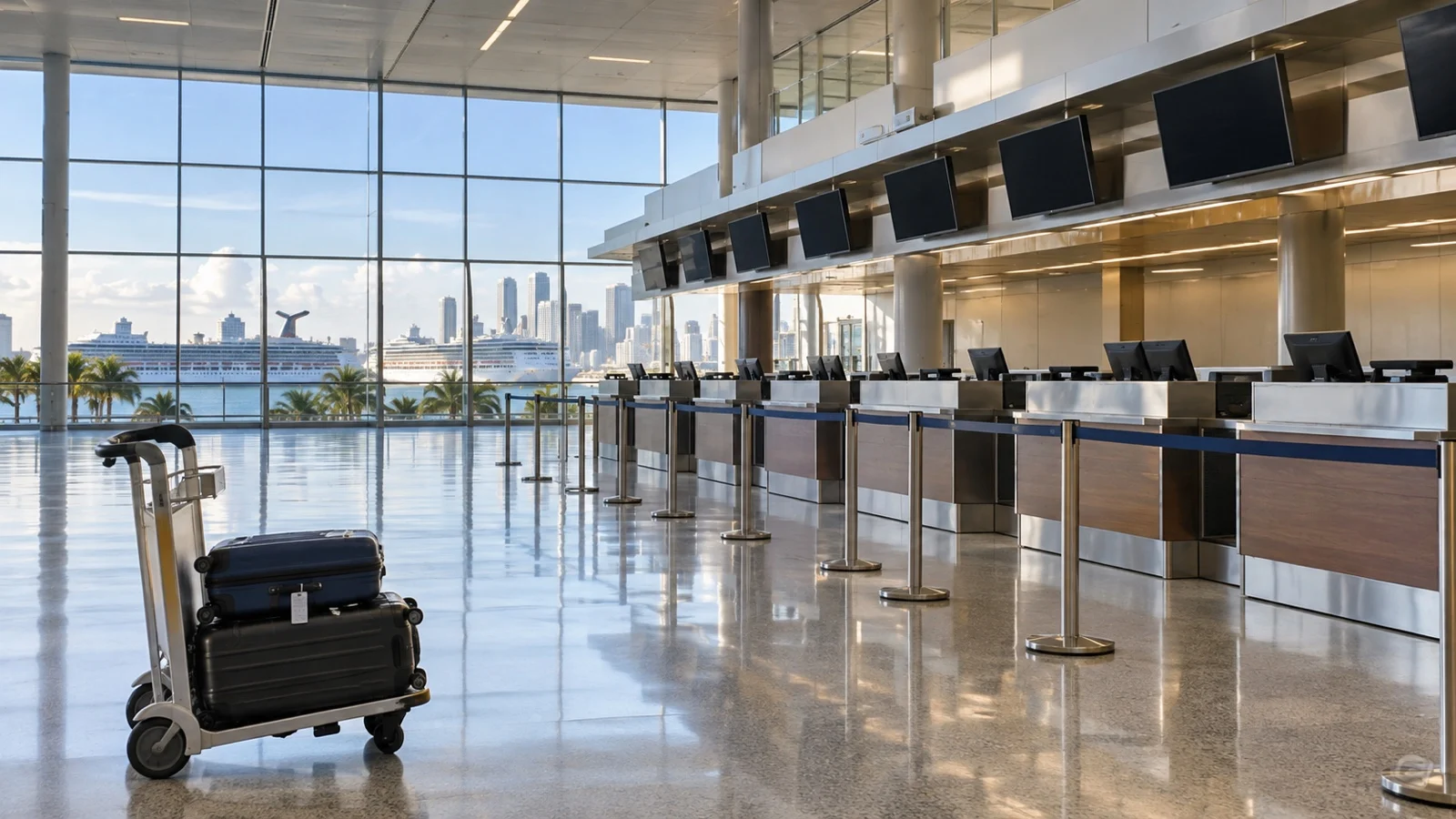
Check the actual cruise terminal and airport, not just the city names. A port area may serve several terminals, while a city may have more than one airport.
Map the trip for the same weekday and time of day, then add a traffic cushion. Also allow for the time needed to reach a pickup area, wait for the vehicle, load bags, and move between airport terminals if required.
A taxi, private car, train, rental car, and cruise-line coach each create a different timeline. The quickest option depends on local traffic, party size, luggage, accessibility, and whether transportation can be reserved.
4. Airline deadlines and airport processing
Check the operating airline’s rules for your exact airport and flight. Online check-in time, checked-bag acceptance, document checks, security, passport control, and the boarding-gate deadline are separate constraints.
For one example, American Airlines publishes general arrival guidance and airport-specific check-in cutoffs. Its page also notes that partner-operated flights use the operating carrier’s times, which is an important detail for codeshares.
Do not schedule your arrival at the airport for the bag-drop cutoff. That cutoff is the point after which the airline may refuse a bag, not a comfortable target.
5. Add a real disruption margin

Once the best-case chain fits, add time for ordinary trouble: a late ship clearance, a long passport line, unavailable rides, road congestion, or a slow airport queue. The tighter the connection and the higher the replacement-flight cost, the larger this margin should be.
Cruise-line transfer times are useful, but read them correctly
Cruise lines often publish the earliest return flight accepted for a post-cruise airport transfer. Those cutoffs can vary by homeport, airport, and scheduled ship arrival.
For example, Carnival’s transfer page lists different minimum flight times for different port-airport pairs. That variation is exactly why a single nationwide “noon flight” rule does not work.
A transfer cutoff tells you whether that transportation product fits the booking. It does not automatically guarantee the flight, erase airline deadlines, or cover every consequence of a missed departure.
Before paying, read the transfer’s current terms and confirm the pickup procedure. If protection for a missed flight matters, rely only on the written terms of the cruise line’s air program, transfer, travel insurance policy, and airline ticket.

Families and travelers who need assistance
Families should add time for elevators, stroller handling, bathroom stops, car-seat arrangements, and keeping everyone together in luggage and passport lines. Prebook suitable ground transportation if local rules or your child’s needs require a car seat.
Travelers using wheelchairs or mobility devices should request disembarkation assistance in advance and confirm where it begins and ends. Assistance can make the morning safer, but it may also affect which departure group you can use.
Arrange an accessible vehicle from the terminal and wheelchair or mobility assistance with the airline separately. Do not base the flight on a self-assist plan if carrying luggage safely would be difficult.
When a next-day flight is worth it
An overnight stay is the strongest way to remove ship-clearance and same-morning road uncertainty from the flight decision. It is especially attractive after a distant homeport, before a long-haul flight, during a busy travel period, or when rebooking would be costly.
Compare the hotel, meals, and transportation cost with the financial and practical impact of missing the same-day flight. The next-day option can also make an early airport departure easier because you begin near the airport rather than inside a cruise terminal.
If your flight is already too early
Try to change it before the cruise instead of planning a sprint. Compare the airline’s change options, fare difference, same-day change rules, and any coverage actually provided by your travel insurance or cruise-line air booking.
Contact the cruise line about its recommended flight time and available disembarkation options, but do not expect staff to override port clearance or airline deadlines. Reserve transportation if possible and keep the airline’s contact tools ready.
If a delay puts the flight at risk, contact the airline as soon as you can. Rebooking, standby, and fees depend on the carrier, ticket, route, and circumstances, so none should be assumed to be free.
A practical booking checklist
- Confirm the ship, disembarkation date, scheduled arrival, cruise terminal, and airport.
- Ask the cruise line for the earliest recommended flight for that exact sailing.
- Check whether arrival requires immigration, passport control, or customs processing.
- Choose regular luggage collection or self-assist based on what your whole party can safely manage.
- Price and reserve realistic transportation, including an accessible vehicle or child seat when needed.
- Check the operating airline’s airport arrival, check-in, bag-drop, security, document, and boarding deadlines.
- Add a disruption margin, then move to a later flight or the next day if the result is tight.
- Recheck the plan before sailing because terminals, schedules, procedures, and transfer rules can change.
Quick answers
What is the earliest flight I should book after a cruise?
There is no universal clock time. Use the cruise line’s recommendation for your exact sailing as a floor, then verify that your full terminal-to-gate calculation leaves a meaningful buffer.
Can I get off at the arrival time shown on my itinerary?
Do not plan on it. Scheduled arrival is not the same as clearance, the start of disembarkation, or the moment you exit the terminal.
Does self-assist guarantee an earlier airport arrival?
No. It may provide an earlier walk-off opportunity when offered, but ship clearance, lines, transportation, traffic, and airport processing can still delay you.
Should I use the cruise line’s airport transfer?
It can be convenient and may simplify luggage and pickup logistics. Check the eligible flight times, departure method, accessibility, refund terms, and who carries responsibility if plans change.
Will the cruise line or airline pay if I miss the flight?
Only the written terms can answer that. Review the airline ticket, cruise-line air or transfer program, and insurance policy instead of relying on an assumption.
Final word
Choose a flight that works when the morning is merely ordinary, not only when every step goes perfectly. If the timeline still feels fragile after you add all the required pieces, book later or fly the next day.
CruisePorts.co reviews sources carefully, but schedules and operating procedures change. See the Editorial Policy, then confirm current details with your cruise line, airline, port, airport, and transportation provider before booking.
More on this topic: browse every guide on port logistics and timing.