Greenland Cruise Gateways: Nuuk Cruise Port, Ilulissat and Kangerlussuaq
Greenland is the only cruise destination I know where the airport matters more than the harbor. Nuuk cruise port calls used to be an afterthought on an Iceland itinerary, and then Nuuk opened an international airport in November 2024 and the whole turnaround map moved west.
The practical stake is this: where your ship starts and ends now decides how much of your vacation is spent in transit. Get that wrong and you lose two days to a gravel runway in the middle of nowhere.
My quick take
For decades Kangerlussuaq was the front door, because the Americans opened an air base there in 1941 and nobody else had a long runway. It is a fjord-head airstrip with musk oxen, a road to the ice cap, and very little else.
Nuuk’s new international airport changed that overnight, while Ilulissat’s replacement airport was not yet open at this review date. If you have a choice, I would favor a currently operating direct gateway, but only after checking the exact airport and flight included by the line.
The second thing I would fix in my head before booking is that Greenland is an expedition destination pretending to be a port-day destination. Almost everything ashore arrives by Zodiac, and the sea decides whether it happens at all.
Pick the ship for its Zodiac operation and expedition team, not its balcony. A 200-passenger ship gets everyone ashore in an hour; a 900-passenger ship in Greenland is a line with a view.
The quick facts
- How you get ashore: Zodiac, almost everywhere, usually a dry landing onto a jetty in the towns and a wet landing at wilderness sites. Nuuk, Sisimiut and Qaqortoq have real harbors where a smaller ship sometimes comes alongside, but those are working cargo quays and the berth is never guaranteed.
- Where you land: the gateways are Nuuk in the southwest, Ilulissat on Disko Bay, Kangerlussuaq at a fjord head, and Ittoqqortoormiit for Scoresby Sund in the east. Southern calls cluster around Qaqortoq and Narsaq.
- Roads between towns: there are none. Visit Greenland states flatly that no road connects two towns in Greenland, so every transfer is a flight, a helicopter or a boat.
- Currency and language: The Danish krone, and Greenlandic with Danish and widely spoken English in the towns.
- Passport rules: Greenland is not in the EU and not in the Schengen area, and Visit Greenland is explicit that a Schengen or Danish visa does not get you in. Most British, American and EU passport holders are visa free, but check your own nationality rather than assuming Denmark covers it.
- Time zone: Most of the west coast including Nuuk and Ilulissat runs on UTC minus 2.
- How often the call is missed: No reliable systemwide percentage is published. Fog, ice, and wind can make an approach or landing unsafe.
- Ferry backup: the Arctic Umiaq Line vessel Sarfaq Ittuk works the west coast between Qaqortoq and Ilulissat for much of the year. It is not a cruise ship, but it rescues a missed connection.
Nuuk cruise port, and the airport that redrew the map
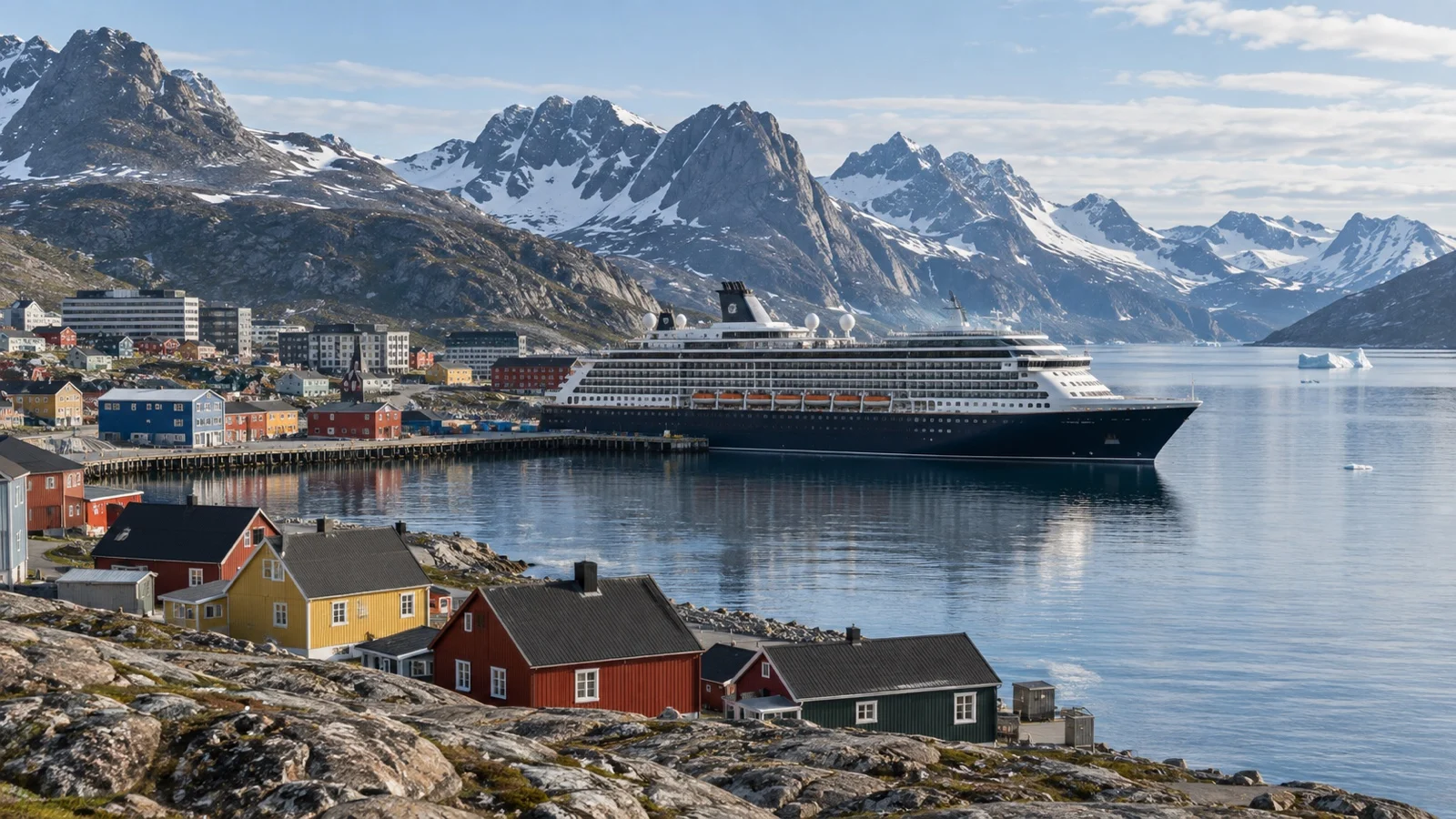
Nuuk is the capital and largest town, and Statistics Greenland counted 20,384 residents on July 1, 2026. It still has traffic lights, a shopping center and a serious restaurant scene.
The airport sits less than ten minutes from the center by car, which is the detail that changed expedition cruising here. A long runway close to town means widebody-capable turnarounds without a domestic connection bolted on each end.
Kangerlussuaq has not vanished, but direct international service is now more limited and itinerary-specific. But it has gone from the only door to one of several.
Ilulissat is next. Greenland Airports scheduled Qaqortoq Airport for April 16, 2026, and the new Ilulissat airport for later in 2026; Qaqortoq opened on schedule while Ilulissat remained under construction at this review date.
The upshot is that a Disko Bay start stops being a two-flight proposition. If your quote includes a Kangerlussuaq positioning night, ask whether a Nuuk or Ilulissat version exists.
Ilulissat and the Kangia icefjord
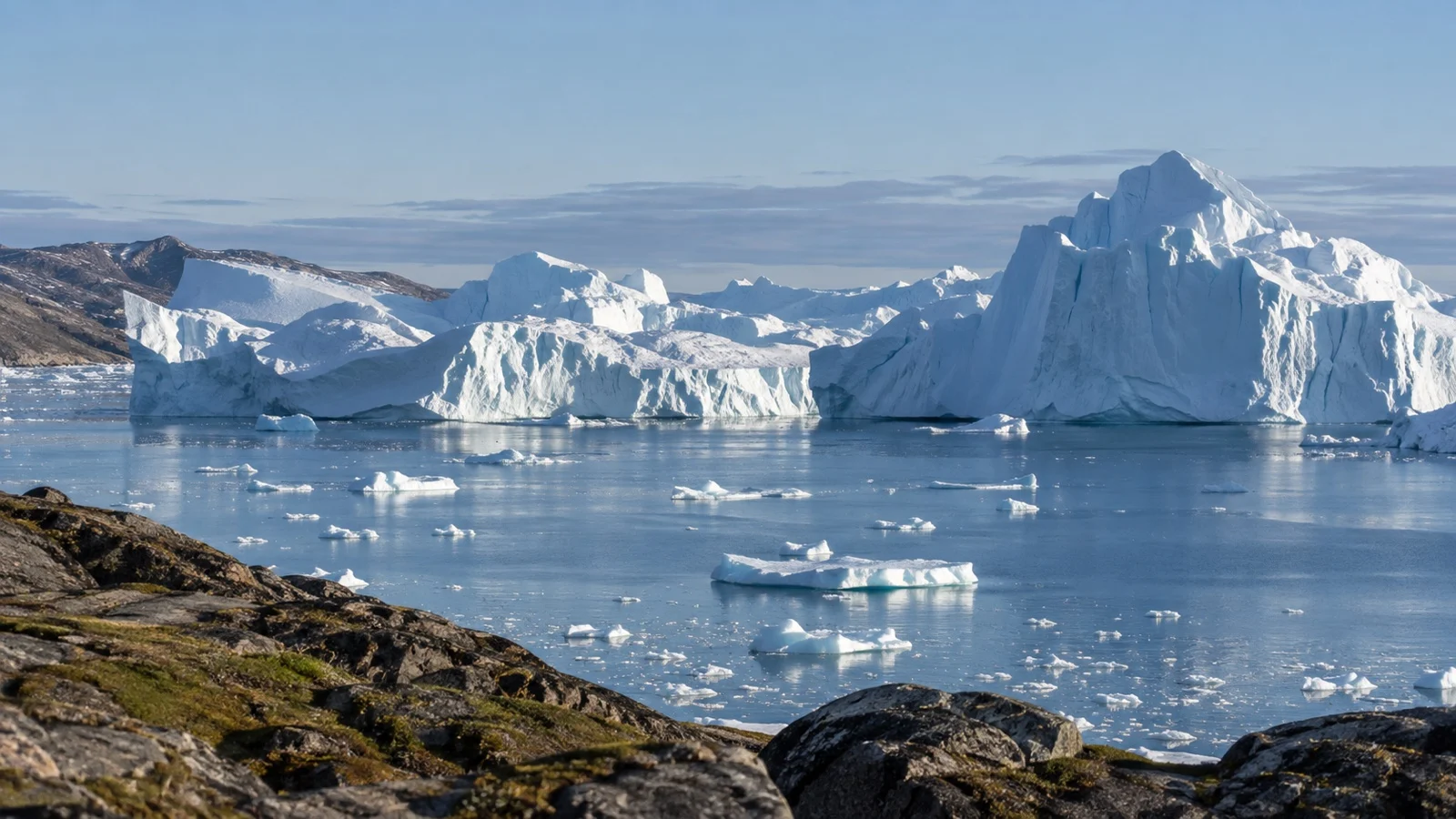
Ilulissat is the reason most people come to Greenland, and it earns it. The icefjord on its doorstep, Kangia, was inscribed on the World Heritage list in 2004 and covers just under 1,550 square miles.
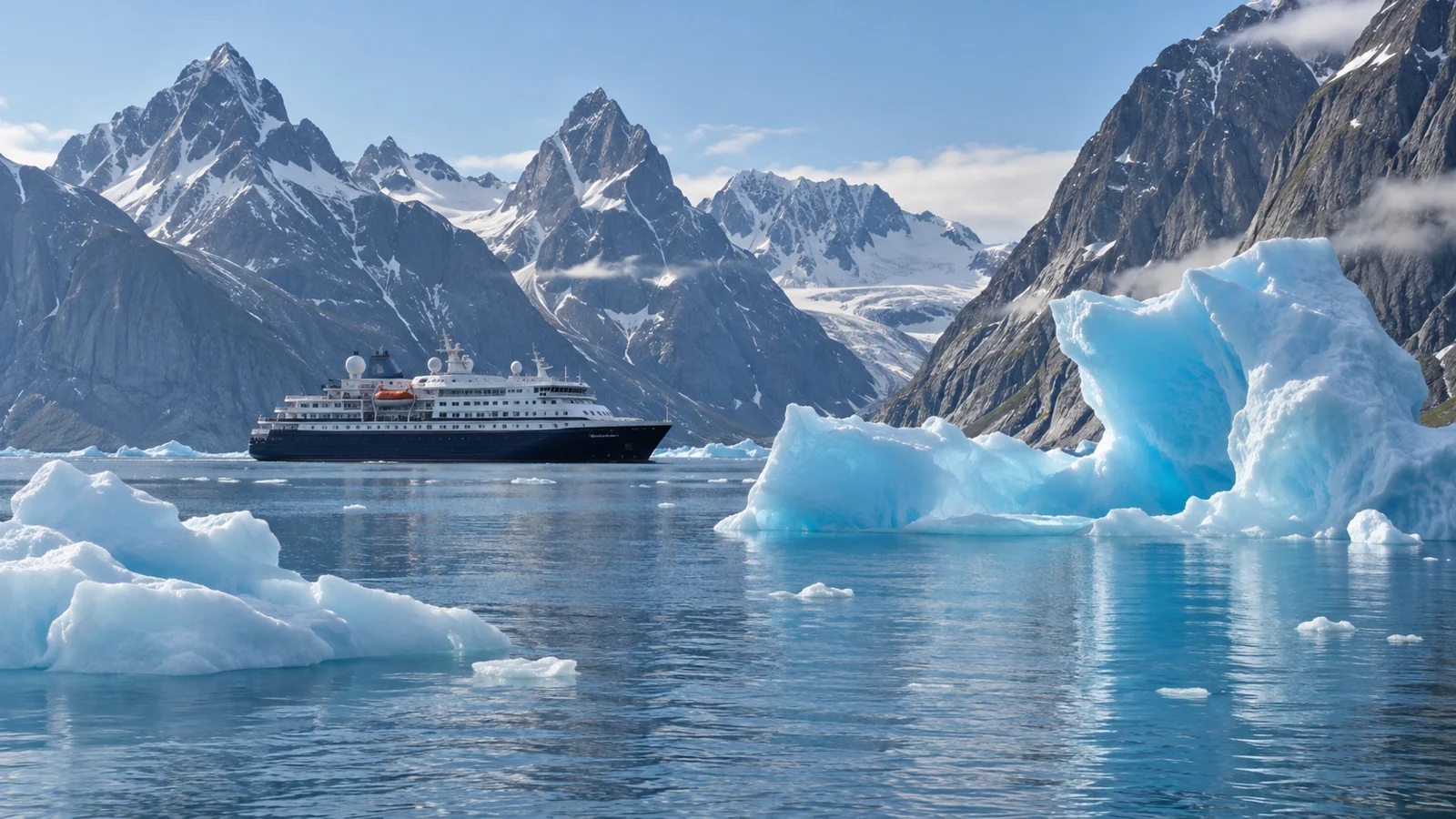
The ice comes from Sermeq Kujalleq, which UNESCO describes as one of the fastest moving and most active glaciers in the world, running at around 130 feet a day. It calves about 11 cubic miles of ice a year, which is around a tenth of everything Greenland sheds.
That output goes into Disko Bay. On a bad week the water in front of town is a solid raft of bergs and brash, and small boats do not sail.
Ilulissat boat operations can be canceled when ice blocks safe access. If your heart is set on the icefjord boat trip, book an itinerary with two Disko Bay days.
The land option usually works when the water one does not. The boardwalk from the Icefjord Centre through the old Sermermiut settlement site puts you on the lip of the fjord, level, wooden and spectacular.
The Icefjord Centre itself, designed by Dorte Mandrup, opens daily through midsummer and its roof is walkable. Do the boardwalk first and the exhibition afterward.
Sisimiut, the south, Uummannaq and Scoresby Sund
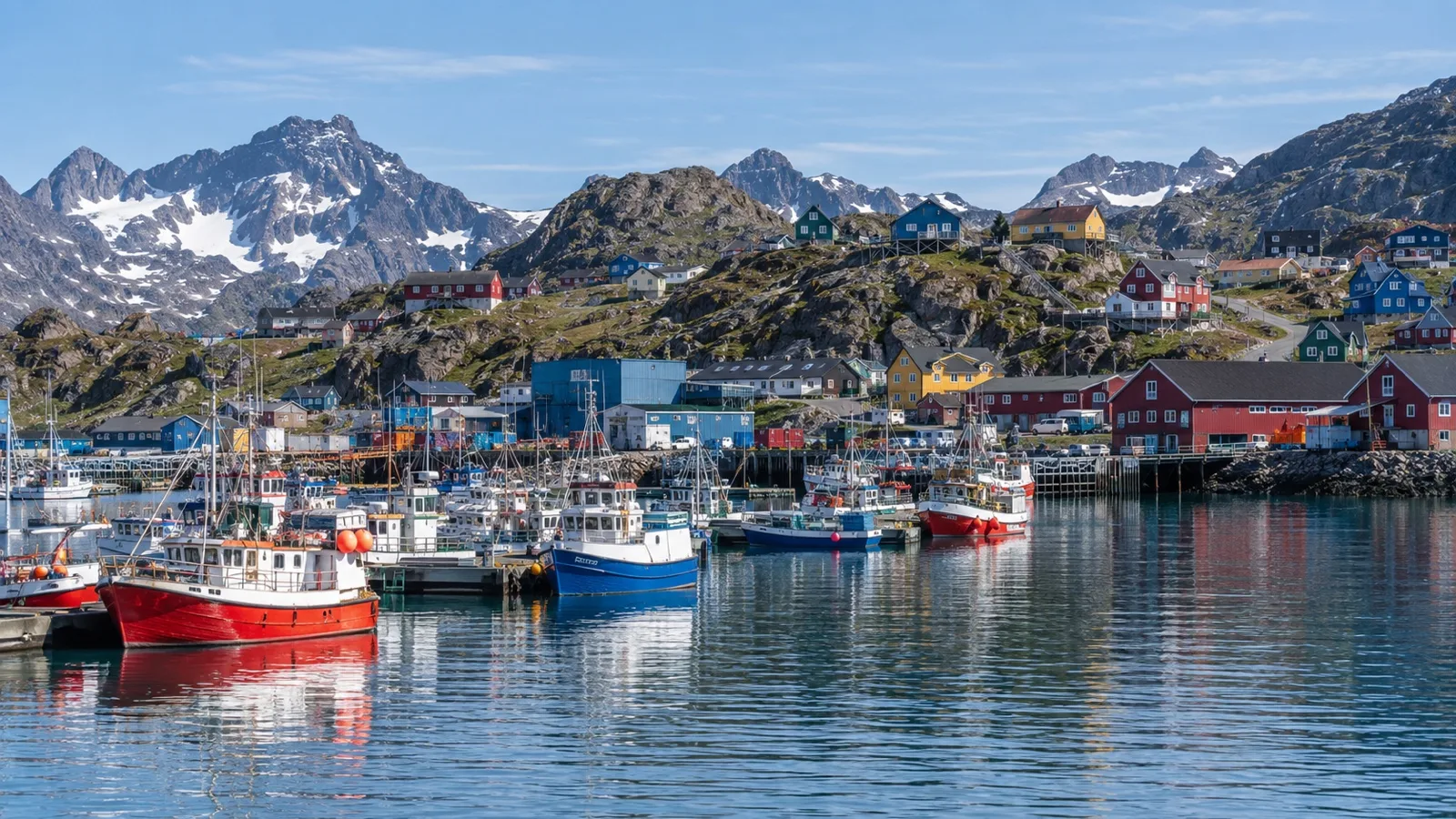
Sisimiut is the second largest town and sits just north of the Arctic Circle, and it calls itself Greenland’s adventure hub without much exaggeration. It is the end point of the Arctic Circle Trail, about 100 miles from Kangerlussuaq, which is a fair hint about the terrain.
Boats from the harbor run out to the Aasivissuit-Nipisat World Heritage area, an Inuit hunting landscape running from the coast inland toward the ice cap. Four thousand years of continuous use, and the archaeology backs it.
South Greenland is the green bit, and it surprises people expecting wall-to-wall ice. Qaqortoq has the only fountain in any Greenlandic town square, plus forty stone sculptures carved into rock faces from a Nordic art project in the mid-1990s.
The real draw down there is Kujataa, inscribed by UNESCO in 2017 across roughly 135 square miles near Qaqortoq and Narsaq. It preserves both Norse farming remains from the 10th to 15th centuries and Inuit farms from the 18th century onward, including the standing walls of Hvalsey church.
Uummannaq, farther north, is mostly about its heart-shaped mountain, about 3,855 feet high. Fjord boats visit Qilakitsoq, where Greenland’s oldest mummies were found.
Scoresby Sund on the east coast is the most ambitious call of the lot, the largest fjord system in the world, fronted by the settlement of Ittoqqortoormiit. Getting there depends on sea ice clearing, which it does late and unpredictably, so treat an east coast itinerary as a genuine gamble rather than a schedule.
The stops I would actually spend time on
Greenland offers fewer choices than a European port day, which is a mercy. This is the list I would build an itinerary around.
- The icefjord boardwalk, Ilulissat: the walk out through Sermermiut to the fjord edge, level and well built. If you do one thing in Greenland, do this one, and do it in the evening light.
- An icefjord boat, Ilulissat: a couple of hours among bergs the size of office blocks. It is also the trip most likely to be canceled.
- Nuuk’s Colonial Harbour: Hans Egede’s house, the National Museum, and the wooden waterfront that predates everything else. The museum holds the Qilakitsoq mummies, which are quietly extraordinary and not remotely gruesome.
- Hvalsey church, near Qaqortoq: the best preserved Norse ruin in Greenland, reached by boat. The last recorded event in Norse Greenland was a wedding here in 1408, and then the written record simply stops.
- Uunartoq hot springs: a natural warm pool with icebergs floating past, by boat from Qaqortoq or Nanortalik. Silly, memorable, and the only warm water you will meet all week.
- Point 660, Kangerlussuaq: a roughly 16-mile gravel road that ends at the edge of the inland ice. Volkswagen built it to test cars in the cold, which is a very odd origin story for an ice cap access route.
- A settlement visit: Zodiac into a village of a few hundred people, sled dogs staked on the rocks, drying fish. Ask before photographing anyone, and buy something from the craft table.
Fun fact: the Kujataa World Heritage area listed by UNESCO exists because Norse settlers introduced farming to the Arctic more than a thousand years ago, and Inuit farmers took the same fields up again in the 18th century. Sheep still graze there, in Greenland, within sight of the ice cap.
How I would plan the day
Greenland days do not run to a printed program, and the ships that pretend otherwise are lying to you. The expedition leader looks at the ice and the wind at 06:00 and decides, and the plan you were given yesterday may not survive breakfast.
My rule is to be dressed and ready an hour before the first Zodiac, every single day. The best conditions are often early, and lines routinely bring landings forward when a window opens.
In town calls I skip the ship’s orientation walk, because these towns are small enough to cover on foot. Nuuk is the exception, where a taxi is justified.
The thing I would not do is book independent excursions with fixed start times. If the ship is late off the anchor, the operator ashore keeps your money and you keep the disappointment.
A realistic word on accessibility
This is the honest part, and it is not encouraging. Zodiac boarding involves a moving platform, a hand-over-hand sailor’s grip, and a step down into a bouncing rubber boat.
Most expedition lines will not carry a passenger who cannot do that unaided, and some require a written mobility declaration. A walking stick is usually fine; a wheelchair or scooter is not, on the landings.
Ashore, the towns are built on rock and they are steep. Nuuk and Ilulissat have sidewalks, but the gradients are real and the shortcuts are all stairs.
The exceptions worth knowing are the Icefjord Centre boardwalk at Ilulissat, which is level timber, and the museums in Nuuk. If your mobility is limited, I would choose a ship with big windows, a good bridge policy and a lecture program, and treat the landings as a bonus rather than the point.
When to go, and the weather
The season is short and runs roughly from June to early September on the west coast, and later still on the east. Sea ice, not temperature, sets the calendar.
Do not come expecting warmth. Visit Greenland’s own climate figures put Nuuk’s July average around 45 Fahrenheit, Ilulissat’s July peak roughly 47 Fahrenheit, and Qaqortoq in the south around 46 Fahrenheit.
Those are averages, and a Zodiac cruise into wind feels far colder than the thermometer says. Layers, a windproof shell and gloves, in July, are not optional.
Winter explains why nobody cruises then, with Nuuk averaging about 17 Fahrenheit in February and Ilulissat roughly 5 Fahrenheit. If northern lights are the goal, that is a land trip to Kangerlussuaq, which gets over 300 clear nights a year.
Airports, entry rules, and the connection buffer
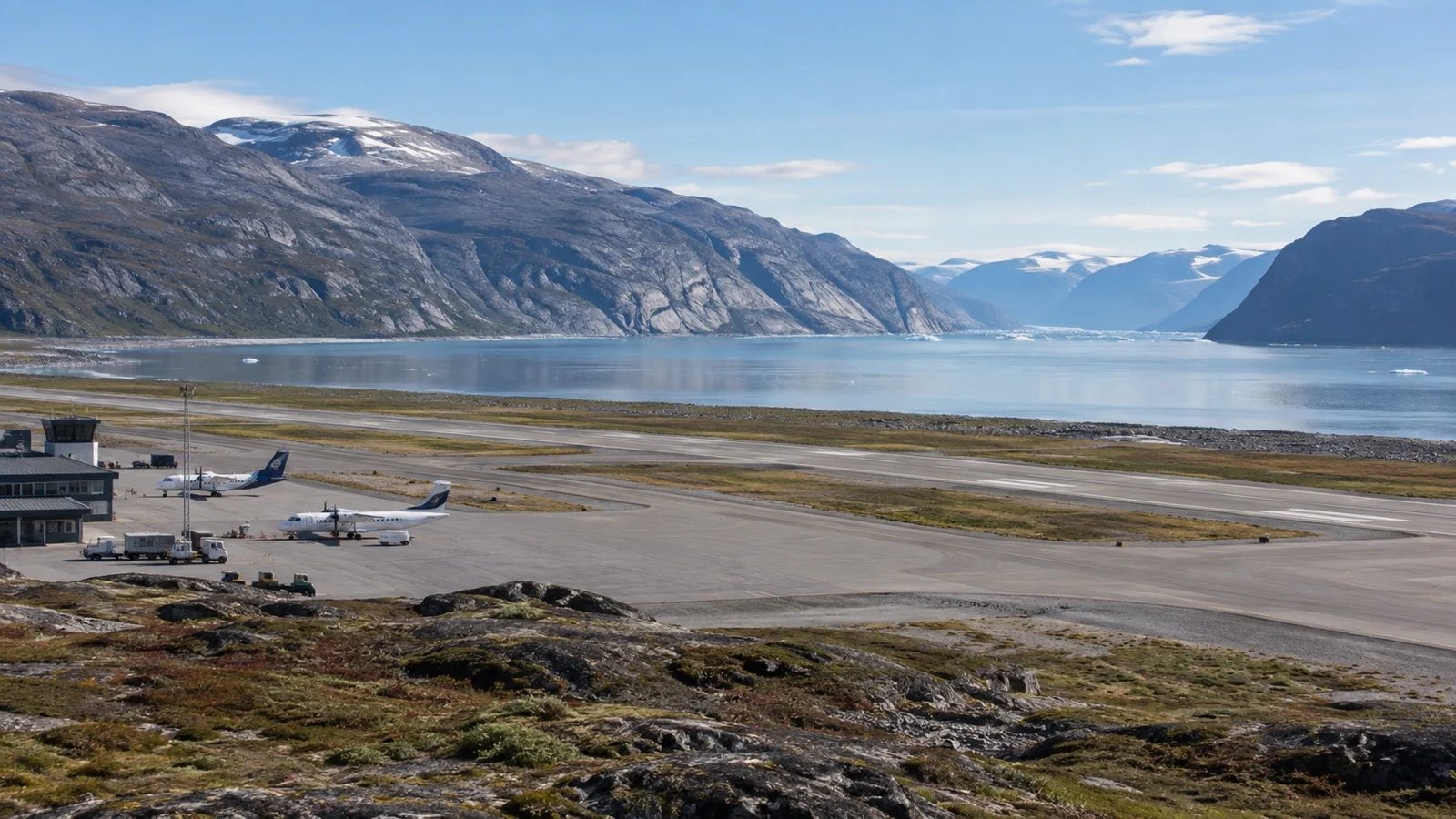
Nuuk’s new international airport is operating, Qaqortoq Airport opened in 2026, and Ilulissat’s replacement airport was still a future opening at this review date. Do not book an itinerary on the assumption that a not-yet-open terminal will handle your flight; use the airport and connection printed by the cruise operator.
Kangerlussuaq remains operational, but direct Copenhagen service is no longer the dependable default it once was. Seasonal and charter patterns change, so price the complete air package and verify who carries the risk when a domestic or international connection is disrupted.
Greenland is outside the EU and Schengen Area for immigration purposes, and a Schengen visa alone is not automatically permission to enter Greenland. Check the Danish Immigration Service rule for your nationality and remember that a connection through Denmark or Iceland may create a separate Schengen requirement.
There are no roads between towns, while boat, helicopter, and flight schedules are weather-dependent and do not guarantee recovery from a missed sailing. I would arrive at least two nights before embarkation, keep one or two nights after it, and have the line confirm the actual berth, tender, baggage, and mobility sequence.
Quick answers
Does my ship dock in Nuuk or do I tender?
Assume a Zodiac or tender unless your line tells you otherwise in writing.
Nuuk has commercial quays and smaller ships do sometimes come alongside, but cargo has priority and the allocation is made locally.
Which airport should I fly into for a Greenland cruise?
Use the airport specified for your sailing: Nuuk is the established international southwest gateway, while Ilulissat’s replacement airport was not yet open at this review date.
Icelandair and Air Greenland serve the new gateways, with a United route from Newark to Nuuk.
Can I get between Greenlandic towns on my own?
Only by plane, helicopter or boat, because there is no road network between towns.
Building your own multi-town trip around a cruise is possible but expensive and weather-dependent.
How likely is a canceled landing?
Greenland landings are more variable than a routine dock call, and Ilulissat boat access can be canceled when ice fills the bay.
No official systemwide cancellation rate is published, so build slack into the itinerary and treat a change as normal expedition cruising.
Do I need a separate visa for Greenland?
Greenland is outside the EU and outside Schengen, so a Schengen visa is not valid there.
Most Western passport holders are visa free, but nationals who need a visa must apply for Greenland specifically.
The last word
Greenland is the best expedition destination in the northern hemisphere and the one most often oversold as a comfortable coastal cruise. The gap between those is where disappointment lives.
Go small, go with a line that has a real expedition team, and accept that the ice writes the itinerary. If you have never done this style of cruising, my explainer on how Zodiac landings actually work is the thing to read before you book, and it pairs with the wider picture in my roundup of Greenland’s cruise ports.
For the two calls most people build the trip around, I have separate write-ups on Ilulissat and on Sisimiut. Between them they cover most of what a west coast itinerary shows you.
And if the tendering question is what is bothering you, the general principles in how tendering eats your day ashore apply here in triplicate. The difference is that in Greenland, the tender is an inflatable and the line is worth it.
How this guide was researched: Unless a first-hand visit is explicitly identified above, this guide is based on independent research using official port, tourism, transit, government, and attraction sources where available. Airport opening dates were checked against Greenland Airports’ own announcements, transport, climate and entry rules against Visit Greenland, and heritage details against the UNESCO World Heritage listings for Ilulissat Icefjord and Kujataa.
Logistics and time-sensitive details were reviewed September 12, 2026. See our Editorial Policy.