North Seymour Island Cruise Port: Frigatebirds, Landing, and Trail Guide
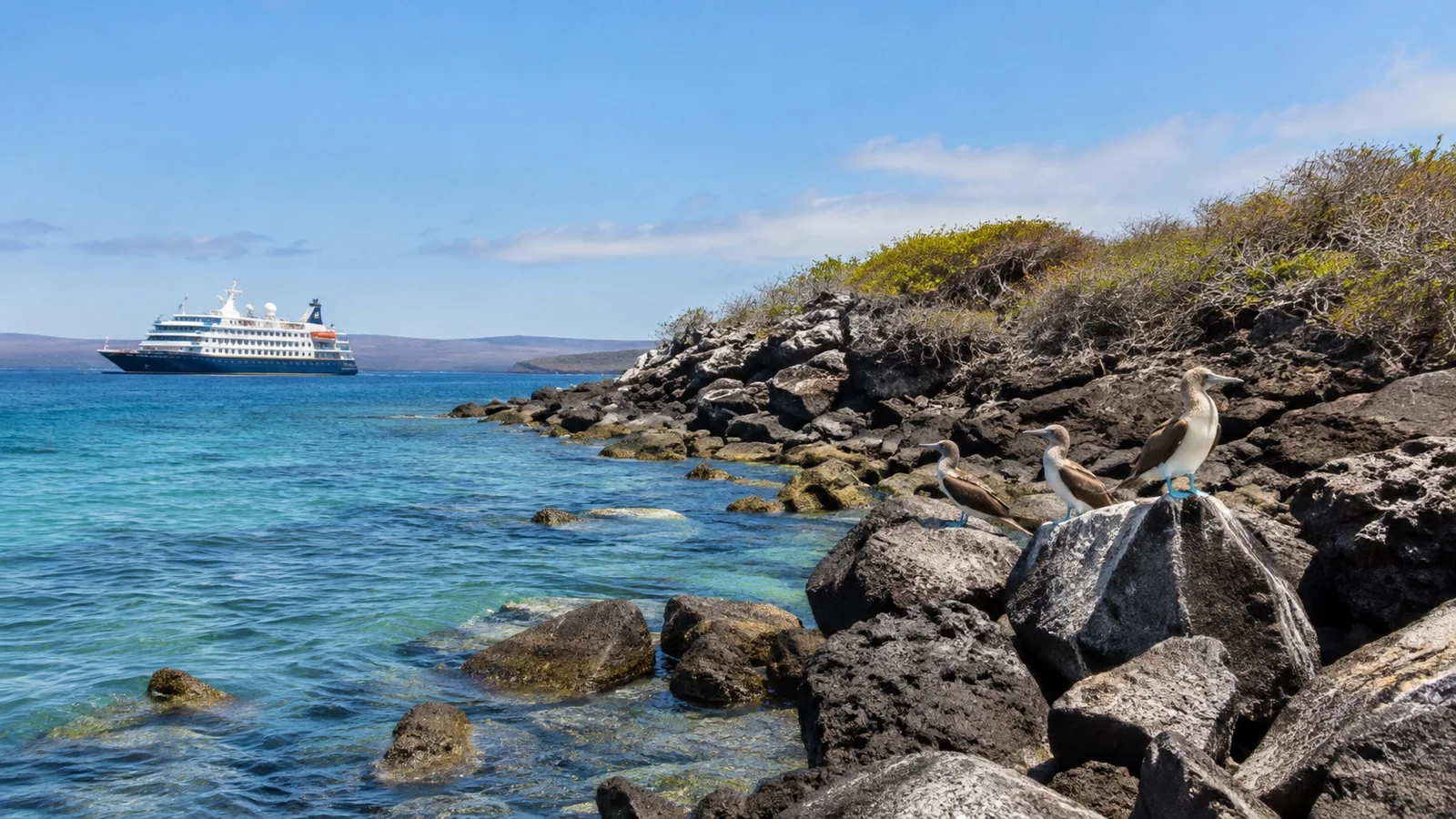
North Seymour Island is the sort of Galápagos landing that makes a small patch of dry ground feel like an entire nature documentary. Frigatebirds display above the scrub, blue-footed boobies occupy the open terrain, and land iguanas can appear beside the trail with almost comic confidence.
It is also a tightly managed protected site rather than a port in the usual sense. Your experience depends on the approved vessel itinerary, your naturalist guide, the day’s sea conditions, and the wildlife itself.
My quick take
North Seymour is one of the strongest Galápagos choices for travelers who want concentrated birdlife and can manage a hot, exposed walk over uneven volcanic ground. The island is compact, but the visit deserves your full attention because animals can be close to the path and footing can change from step to step.
Do not plan an independent arrival or imagine a town beyond the landing. This is a guided nature visit from beginning to end, and the best preparation is to understand the transfer, trail, rules, and realistic limits before you leave the ship.
Quick Facts
- Visit type: North Seymour is a protected Galápagos visitor site reached by authorized vessel and explored with a licensed naturalist guide.
- Landing: The Galápagos National Park Directorate inaugurated a new visitor pier in March 2025, but transfer and access procedures still depend on the vessel, sea state, and park instructions.
- Main wildlife: Frigatebirds, blue-footed boobies, land iguanas, marine iguanas, swallow-tailed gulls, and sea lions may be seen, with no species or behavior guaranteed.
- Facilities: Expect no town, shops, cafes, or conventional visitor center on this uninhabited island.
- Terrain: The fixed trail crosses exposed, rocky ground with limited shade and wildlife close to the route.
- Essential gear: Bring sun protection, water, secure footwear, and only the equipment your guide permits ashore.
- Core rule: Stay on the marked route, keep at least two meters from wildlife, and never touch, feed, or block an animal.
Is North Seymour a cruise port?
North Seymour has no cruise terminal, streets, taxis, or local businesses. It is an uninhabited visitor site within Galápagos National Park, accessed through an authorized itinerary rather than an open-ended port call.
Expedition vessels and day-tour boats approach offshore, then follow the landing procedure assigned for the visit. The Galápagos National Park Directorate opened a new pier at the site on March 7, 2025, so older guides that describe only a wet or rocky landing may be out of date.
The pier does not turn the arrival into a conventional walk-off call. You may still transfer by panga or another small craft from your vessel, and the crew can change or cancel operations when wind, swell, wildlife, or park instructions require it.
What the landing involves
Listen to the full briefing before boarding the tender or panga. Crew members will explain where to sit, how to secure cameras, when to stand, and whether bags must be passed separately.
Keep both hands available for boarding whenever possible. A camera should be zipped into a compact bag during the transfer, not swinging from your neck while you step between moving surfaces.
At the island, wait for the guide or crew to direct each person ashore. Even with improved infrastructure, surfaces can be wet, the boat can move, and the safest handhold may not be obvious from your seat.
Ask in advance whether you must step up, step down, cross a gap, or climb any steps. Travelers with balance concerns should also ask if crew can provide a steadying hand and whether remaining aboard is possible if conditions deteriorate.
The trail and physical demands
North Seymour is often described as flat, but flat does not mean smooth. The route crosses rough volcanic material, loose stones, natural ledges, and exposed sections where you need to watch both wildlife and your feet.
There is little dependable shade, and the equatorial sun can feel intense even when the air is breezy. Heat, glare, and concentration on uneven ground make the walk more tiring than its distance might suggest.
The group moves at the guide’s pace and must remain on the marked route. You cannot shortcut around a slow section, approach a nest for a better photograph, or wait alone while the rest of the group continues.
Use supportive closed-toe shoes with reliable grip unless your operator gives different instructions. Trekking poles can be helpful for some travelers, but confirm that they are permitted and that their tips will not damage the trail.
Frigatebirds: what you may see
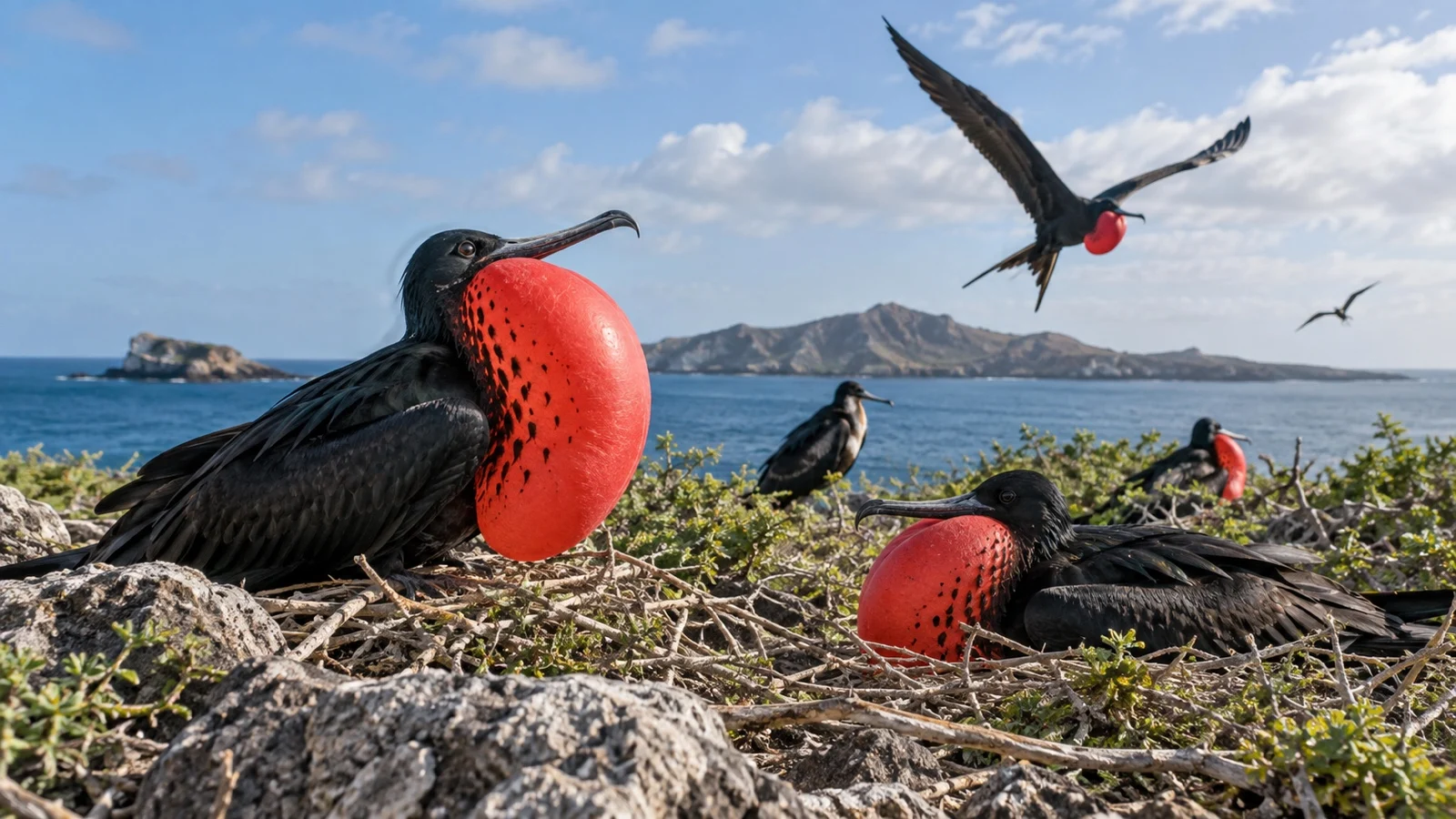
North Seymour is celebrated for frigatebirds, including great and magnificent frigatebirds. Their long wings, forked tails, and effortless soaring make them striking even before you notice the nesting activity.
Adult males are famous for the red throat pouch used in courtship displays, but an inflated pouch is not guaranteed on every visit. Timing, individual behavior, nesting stage, weather, and where the group can safely pause all affect what you see.
Females, juveniles, nests, and birds in flight are just as rewarding when a full display is absent. A naturalist guide can help distinguish species and ages without relying on one dramatic field mark.
Watch the sky as well as the shrubs. Frigatebirds may cruise overhead, interact around nesting areas, or attempt to steal food from other seabirds, behavior known as kleptoparasitism.
Blue-footed boobies and other seabirds
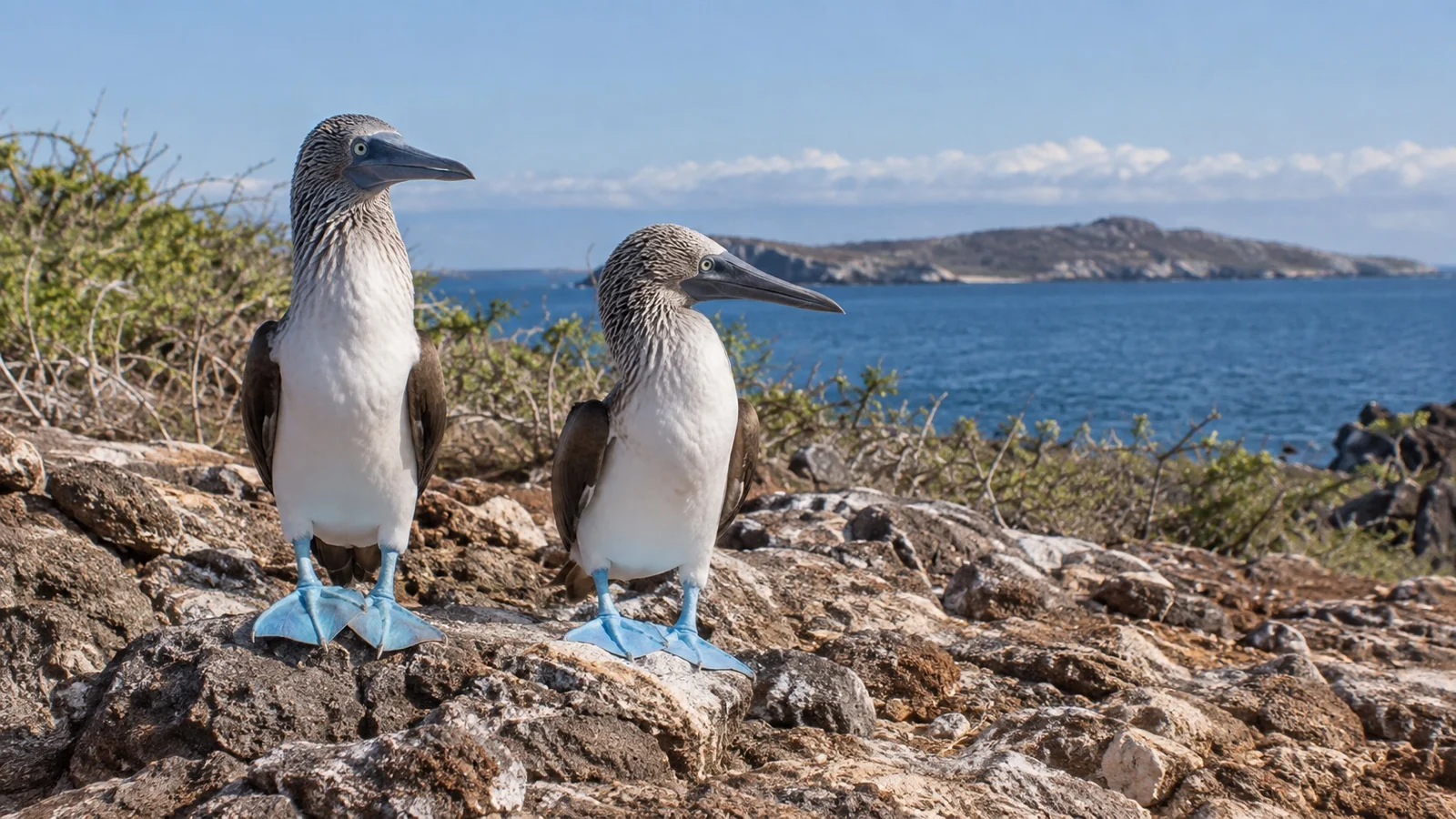
Blue-footed boobies are another major reason to visit. Their deliberate steps, pointed bills, plunge-diving adaptations, and vivid feet are memorable, although foot color can look different with age, light, distance, and camera settings.
Courtship displays, eggs, chicks, or active feeding are never promised. Stay open to the behavior unfolding in front of you rather than measuring the visit against one photograph from a brochure.
Swallow-tailed gulls may also appear, and their large eyes reflect an unusual adaptation for nocturnal feeding. Other coastal and migrant birds can pass through, so let the guide identify uncertain sightings instead of crowding a nest while checking an app.
The island’s birdlife can occupy both sides of a narrow trail. Move slowly, keep voices low, and avoid sudden gestures that disturb an animal or cause another visitor to step off the route.
Land iguanas and marine iguanas
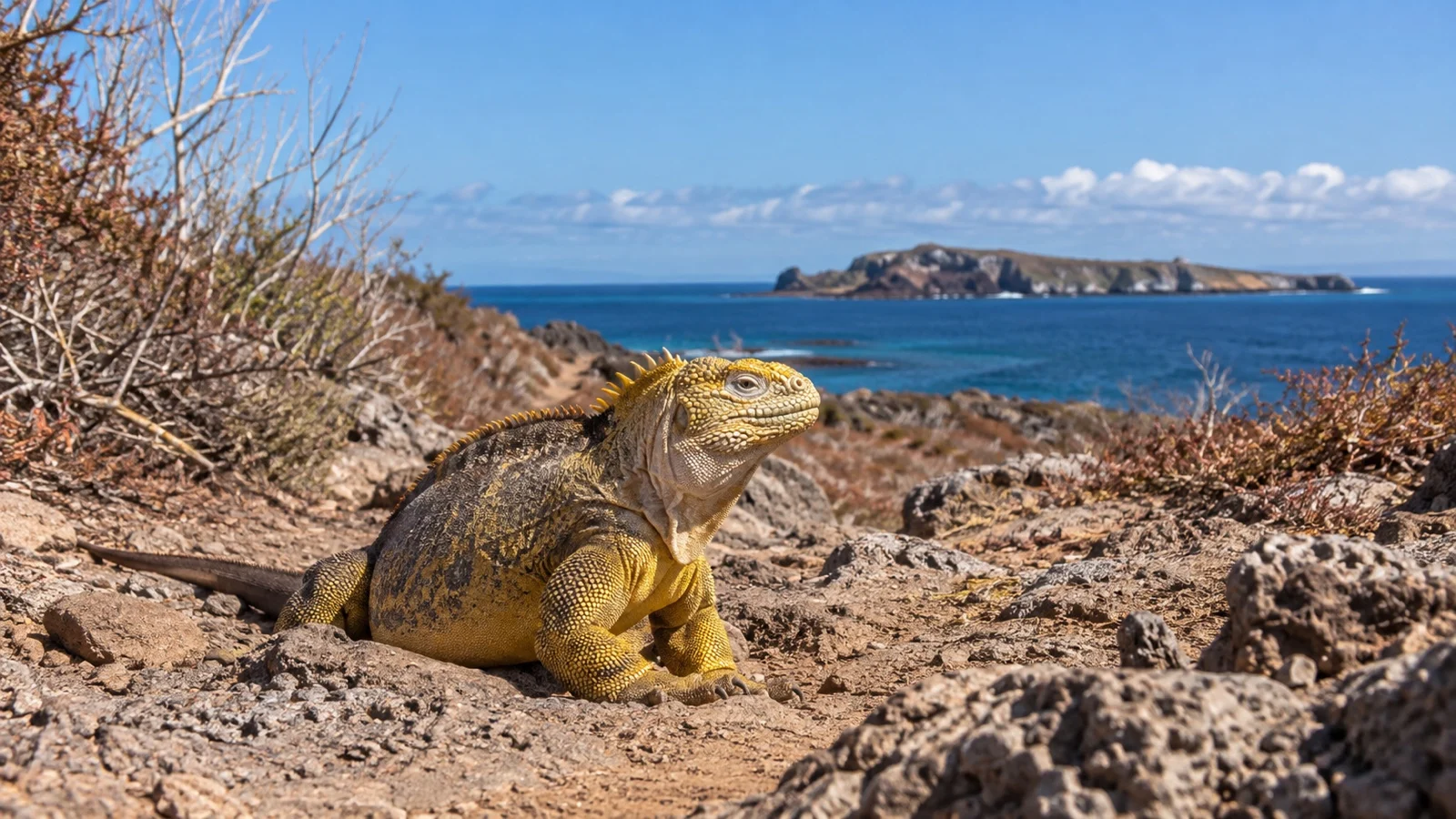
North Seymour’s land iguanas are an important part of the island’s conservation story. Their presence is linked to historic management efforts, and they now use the dry habitat among cactus, scrub, and open ground.
Land iguanas can blend into ochre rocks surprisingly well. Scan ahead before placing a foot near the trail edge, especially when the guide signals that an animal is resting nearby.
Marine iguanas may be seen closer to the coast, where their darker coloring suits the lava. They are distinct from land iguanas in habitat and feeding behavior, even when both appear during the same visit.
Never angle yourself between an animal and its clear route away. The park’s distance rule is a minimum, not permission to surround wildlife when several people want the same photograph.
Sea lions and the shoreline
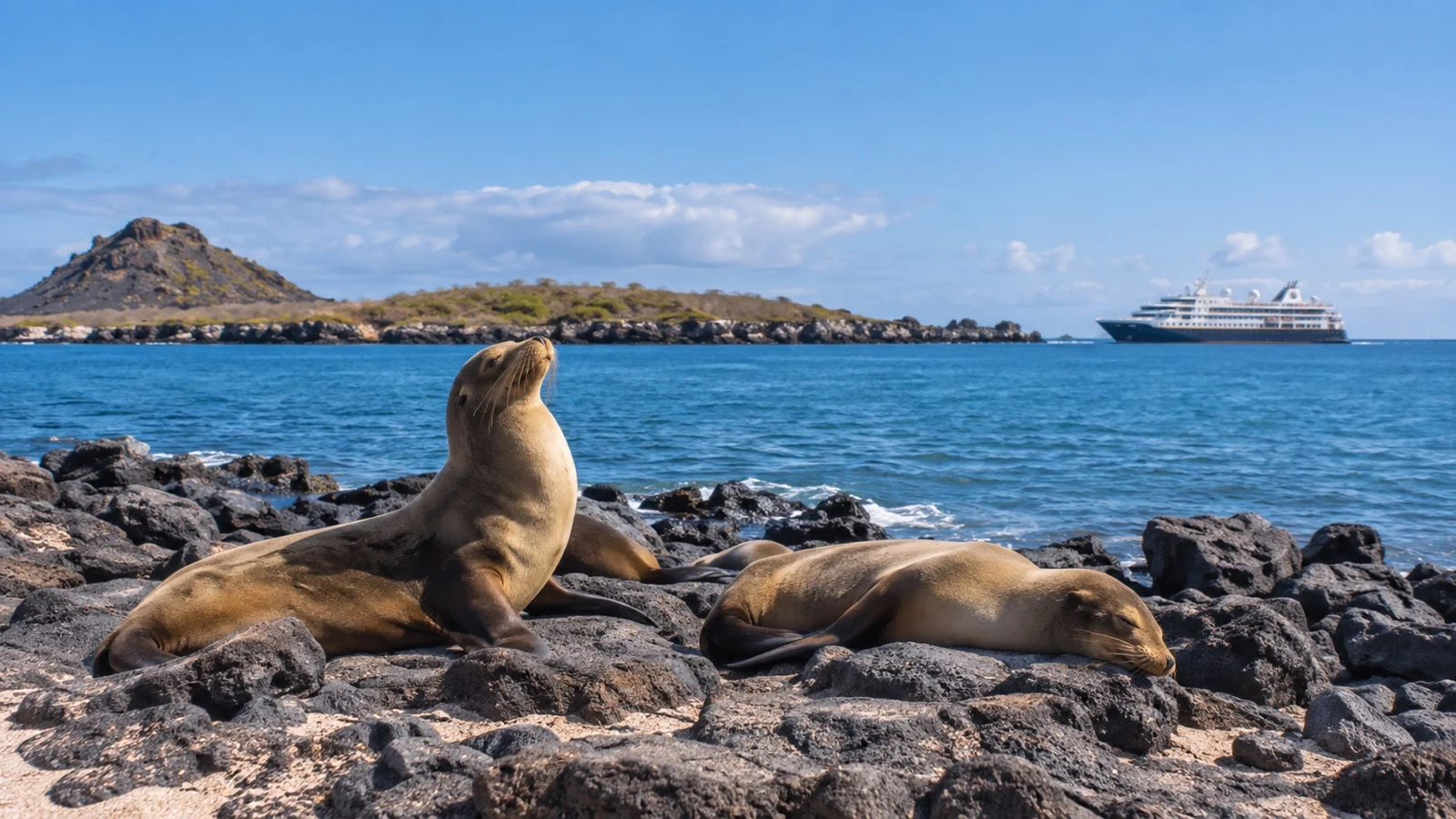
Galápagos sea lions may rest near the coast or appear in the water around the landing. Their relaxed posture can be misleading because they are wild, powerful animals that need room to move.
Give extra space when a sea lion lies near a path, and let the guide decide whether the group waits or passes. Never step over an animal, touch it, or position yourself between a mother and pup.
A sea lion sighting is possible rather than guaranteed, and the exact shoreline scene varies. North Seymour is primarily a rocky, arid island, so a photograph of a broad sandy beach should not define your expectations for this landing.
Wildlife etiquette that protects the island
The Galápagos National Park Directorate’s visitor rules require at least two meters of distance from wildlife, including when using a camera. If an animal approaches you, stay still when safe and follow the guide’s direction rather than moving closer.
Do not touch or feed animals, remove stones or sand, pick plants, or leave any waste. Return every item to the vessel, including tissues, food wrappers, and small pieces of equipment.
Flash, playback, drones, and specialized gear may be restricted. Ask your operator before the visit instead of assuming that equipment permitted elsewhere can be used at a protected nesting site.
Biosecurity matters because introduced organisms can damage island ecosystems. Clean soil, seeds, and plant material from footwear, hook-and-loop fasteners, tripod feet, and bags before the landing, then follow any inspection or disinfection procedure your vessel requires.
The park’s rodent eradication program declared North Seymour and nearby Mosquera free of invasive rodents after two years of work. Visitor care helps protect those conservation gains and reduce the risk of reintroduction.
Photography without causing pressure
A moderate telephoto lens is more useful than trying to get physically close. Set your camera before the walk, use a fast enough shutter speed for birds, and keep the strap controlled so it cannot snag vegetation or another traveler.
Photograph from the marked trail and avoid blocking the group. If a bird faces away or vegetation obscures the view, accept the scene rather than leaning into protected space.
Phones work well for wider images that show animals in their habitat. Turn off artificial sounds, lower screen brightness, and never hold a device over another person’s head where it might fall near a nest.
The strongest photographs often include context such as dry scrub, lava, sky, and the spacing of a colony. A tight portrait is appealing, but the landscape explains why North Seymour feels different from a zoo or rehabilitation center.
Weather and seasonal expectations
Galápagos conditions shift through the year, with a generally warmer, wetter period and a cooler, drier period influenced by ocean currents. Daily weather can still differ from broad seasonal patterns, and wind or swell may affect the transfer even on a bright day.
Cloud does not eliminate ultraviolet exposure near the equator. Apply reef-conscious sunscreen before leaving the vessel, wear a secure brimmed hat, and bring sunglasses with good protection.
Carry water in a reusable bottle if permitted, but do not eat on the trail unless your operator and guide explicitly allow it. Food can attract animals and create waste in a place without visitor services.
A light rain shell can protect against spray or a passing shower, while loose ponchos may flap in wind. Choose compact clothing that leaves your hands free and does not drag against plants.
Accessibility and who should reconsider
This visit may be challenging for travelers who cannot transfer into a small craft, stand on moving surfaces, or walk over uneven rock without continuous support. The lack of shade, seating, restrooms, and a quick independent exit adds to the difficulty.
Ask the expedition team for the actual conditions expected on your date. Useful questions cover the panga step, pier height, handrails, number of steps, trail surface, walking time, rest opportunities, pace, and whether a guide can accompany a shorter route.
A wheelchair user should not rely on the word pier as proof of step-free access. The transfer craft, shore connection, natural trail, and operating rules all have to work together, and the answer can change with sea conditions.
If the landing is not suitable, ask what wildlife viewing is possible from the vessel or panga. Choosing a safer alternative is not a failure because the surrounding water and coastline can still produce excellent observations.
Facilities and what to bring
There are no normal port facilities on North Seymour. Use the restroom before boarding the landing craft, and assume you cannot buy water, snacks, batteries, or sun protection ashore.
Bring only what you can manage safely: water, hat, sunscreen, sunglasses, camera, spare battery, and any essential medication. A small dry bag or securely closed daypack is better than an open tote.
Keep medications with you rather than in a cabin drawer if a delay would matter. Motion-sensitive travelers may want to discuss preventive options with a medical professional before the trip, because remedies often work best before boarding a small craft.
Leave unnecessary valuables aboard. Salt spray, dust, sudden rain, and a wet landing transition can be hard on electronics even when the walk itself stays dry.
How the visit usually flows
Your naturalist or expedition leader normally gives a briefing aboard, followed by a small-craft transfer and controlled landing. The group then follows the authorized loop or route, stopping when wildlife and safe trail spacing allow.
The return time is set by the vessel and the park schedule, not by individual preference. When the guide calls the group forward, finish the photograph and move promptly so later groups and wildlife are not pressured.
A visit can feel busy when several animals appear at once. Pick one behavior to watch, listen to the guide, and let the scene develop rather than rushing between every possible subject.
Combining North Seymour with other Galápagos stops
North Seymour is often part of a wider expedition itinerary or a day tour from the central islands. The combination depends on permits, vessel class, operating schedule, and park management rather than a fixed menu that every traveler can book.
Do not compare two itineraries only by the number of island names. Time ashore, guide quality, group size, transfer conditions, and the balance between wildlife, geology, and snorkeling matter more than a rapid sequence of landings.
If your itinerary also includes nearby Baltra, remember that Baltra’s airport and transport role is separate from the protected visitor experience on North Seymour. You cannot simply leave the airport area and visit North Seymour on foot.
Conservation context
The Galápagos are globally important because volcanic processes, isolation, and living ecological change are visible across the archipelago. North Seymour’s dense wildlife encounters are possible only because access is limited and conservation rules shape every visit.
The park authority monitors visitor sites for infrastructure, safety, wildlife observations, physical condition, and group management. Its pier announcement says North Seymour receives about 120 visitors a day, and the new structure remains part of a managed system rather than an invitation for unrestricted access.
North Seymour and Mosquera were declared free of invasive rodents after a multi-year eradication and monitoring project. That work protects nesting birds, reptiles, plants, and the ecological relationships visitors come to see.
For current operational news, consult the Galápagos National Park Directorate’s North Seymour pier update. The directorate’s visitor rules reminder explains the two-meter distance, no-feeding rule, marked-trail requirement, and use of authorized tourism services.
Common planning mistakes
The first mistake is treating North Seymour like a town port where you can arrange plans after arrival. Every landing is part of an authorized operation, and there is nowhere ashore to hire transport or change tours.
The second mistake is assuming that famous courtship behavior will happen on cue. Wildlife is seasonal and independent, so a visit rich in birds can still look different from promotional images.
The third mistake is focusing on camera gear while underestimating heat and footing. Water, sun protection, stable shoes, and free hands contribute more to a safe experience than an extra lens.
The final mistake is using old landing descriptions as a guarantee. Infrastructure has changed, and the exact small-craft procedure can still change with the sea and park direction.
Quick answers
Can I explore North Seymour independently?
No. Visit through an authorized vessel and remain with the licensed naturalist guide on the designated route.
Is the landing wet or dry?
The park inaugurated a new visitor pier in 2025, but your vessel may still use a small-craft transfer and operating procedures can vary. Ask the expedition team for the current landing description rather than relying on an old itinerary.
Will I definitely see a male frigatebird with an inflated red pouch?
No wildlife behavior is guaranteed. You may see displaying males, nesting birds, juveniles, or frigatebirds soaring overhead, depending on conditions and timing.
Are there restrooms or shops?
No conventional visitor facilities should be expected on the island. Use the restroom before departure and carry approved essentials from the vessel.
Is North Seymour suitable for limited mobility?
It depends on the small-craft transfer, pier connection, trail, weather, and the traveler’s balance and endurance. Ask for a condition-specific assessment from the expedition team before choosing the landing.
Do Galápagos entrance fees cover this visit?
Archipelago fees and individual tour inclusions are separate planning questions. Confirm all government fees, guide services, vessel transfers, and excursion charges with your operator because rules and prices can change.
Final word
North Seymour delivers an extraordinary concentration of Galápagos wildlife without needing dramatic mountains or lush vegetation. Its power comes from watching birds and reptiles live their ordinary lives at close range while your group carefully respects the boundaries that protect them.
Prepare for the transfer, bring less gear than you think you need, and follow your guide without exception. The result is a safer landing, better wildlife watching, and a visit that leaves the island as you found it.
Research note
This guide was checked against current information from the Galápagos National Park Directorate, including its March 2025 North Seymour pier announcement, visitor conduct guidance, site monitoring reports, and rodent eradication updates. Landing methods, trail access, wildlife activity, weather, fees, and expedition schedules can change, so reconfirm the details with your operator before travel.
More on this topic: browse every guide on expedition and alternative cruises.