Alaska Ferry vs Cruise: The Alaska Marine Highway as a Cruise Alternative
The Alaska ferry is not a cheap cruise, and the sooner you accept that the happier you will be. It is a state highway that happens to float, run by a transport department for people who need to get to work, to hospital, or home with a truck full of groceries.
That single fact settles most of the alaska ferry vs cruise argument before it starts. One product is designed to entertain you, the other is designed to move you, and they price and behave accordingly.
My quick take
I love the Alaska Marine Highway and I would not recommend it to most people who are shopping for a cruise. It is the best way I know to see Southeast Alaska at the pace the place actually runs at, and it asks a lot of you in return.
You carry your own bags, you find your own dinner, and nobody announces anything cheerful over the PA system. If that sounds like a relief rather than a downgrade, you are the right customer.
My default plan would be Bellingham to Ketchikan, then a slow hop north with two or three nights ashore in the smaller towns, finishing at Haines or Skagway. That is a two-week trip, not a one-week trip, and it only works if you are comfortable building your own itinerary around a published sailing grid.
The thing I would not do is treat the ferry as a budget substitute for a seven night Inside Passage cruise. Once you add hotels, meals ashore, and the days the schedule quietly eats, the saving is smaller than the internet promises.
The quick facts
- The scale: Alaska DOT describes a network covering 3,500 miles of coastline, serving over 30 communities from Bellingham to Dutch Harbor. The published fleet list currently runs to nine vessels, four mainliners and five day boats or shuttles.
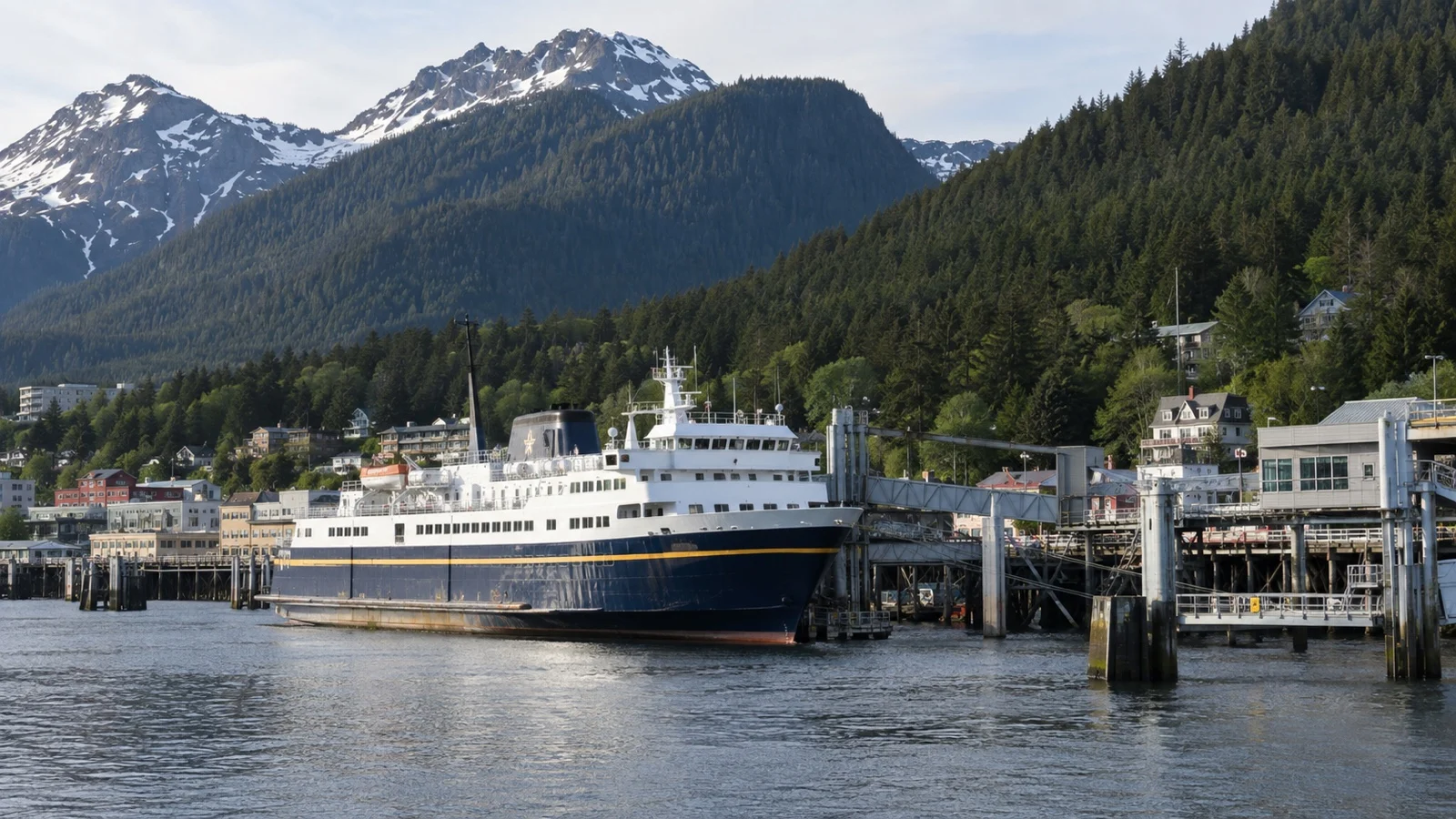
- The southern gateway: Bellingham, Washington, at 355 Harris Avenue in the Fairhaven district, about 3 miles from the town center. AMHS calls it the southernmost terminus, 595 nautical miles south of Ketchikan.
- Where you land: ferry terminals sit well outside town, unlike cruise berths. AMHS gives Juneau’s Auke Bay terminal as roughly 13 miles from downtown, Sitka’s as 7 miles, and Ketchikan’s as 2 miles.
- Sleeping: cabins are basic, most with a private bathroom, and AMHS sells them per trip rather than per person or per night. The two day boats, Hubbard and Tazlina, have no cabins at all.
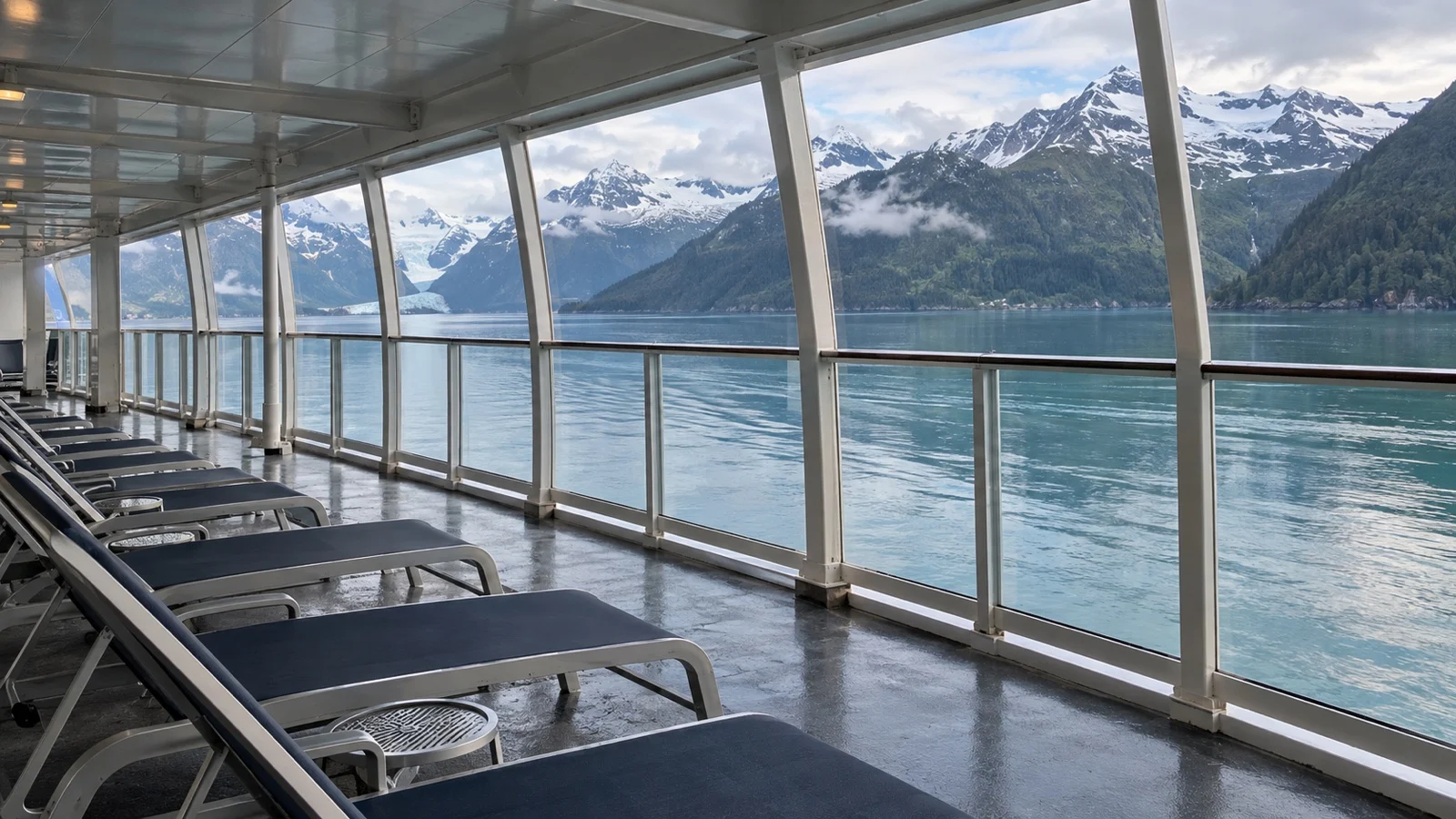
- The alternative to a cabin: heated covered solariums on the upper decks are popular sleeping spots, recliner lounges take a sleeping bag, and small tents are allowed on the upper decks. This is normal here, not a stunt.
- Check-in: online reservations close 4 hours before sailing. Walk-on passengers check in 2 hours ahead at Bellingham and Juneau and 1 hour elsewhere, vehicles need 3 hours at Bellingham and Juneau, and everyone must be aboard 15 minutes before departure.
What the Southeast run actually looks like
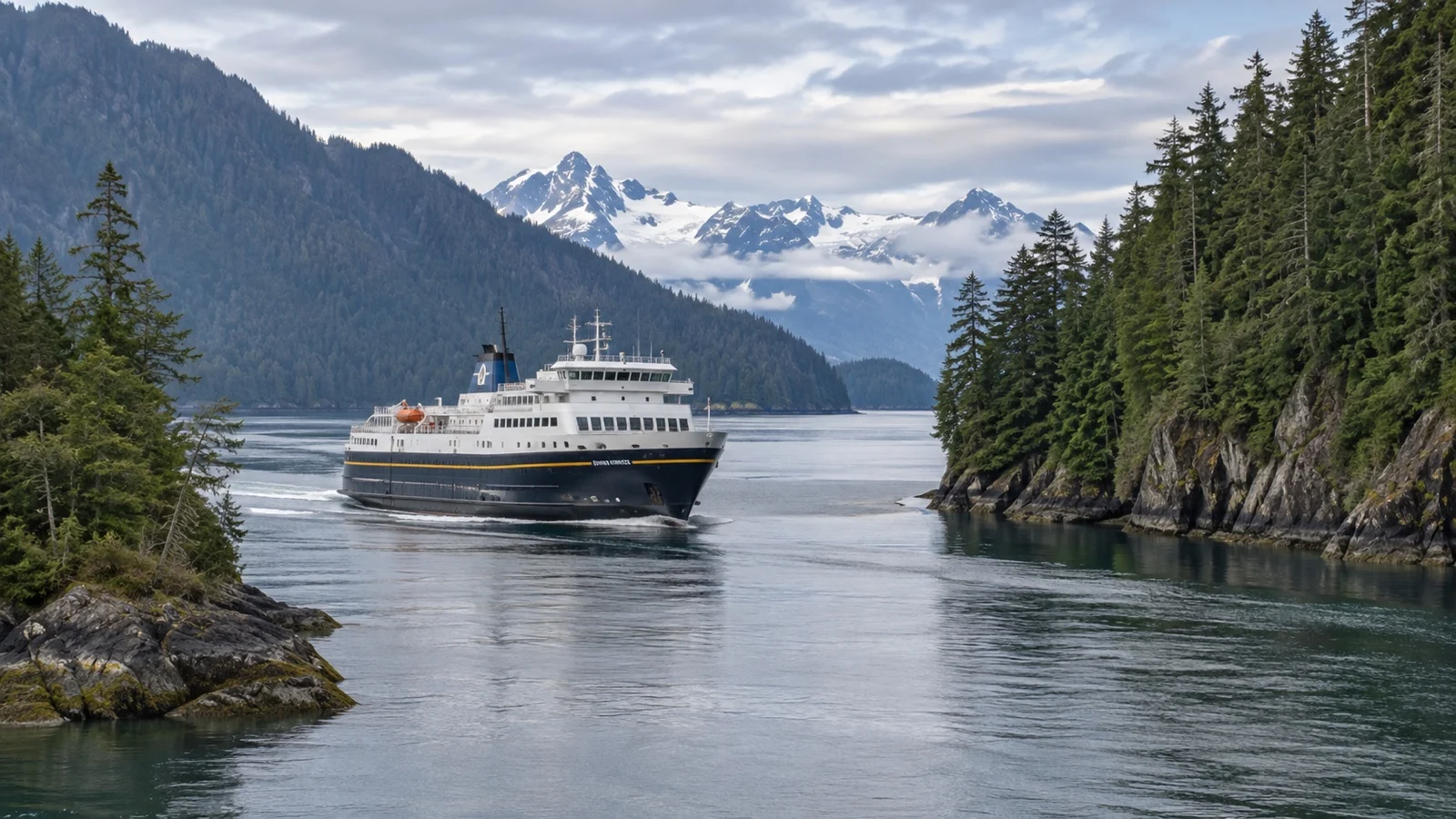
The classic trip starts at Bellingham because the domestic Bellingham-to-Alaska route does not call in Canada, though AMHS still requires photo ID. The Port of Bellingham runs the terminal alongside Amtrak, buses and the San Juan Islands ferries, which makes it an unusually easy place to arrive without a car.
From there it is roughly 38 hours at sea to Ketchikan, with no land in sight for long stretches of it. That leg is the part people either love or quietly regret booking.
North of Ketchikan the route threads Wrangell, Petersburg, Sitka, Juneau, Haines and Skagway, with smaller day boats reaching places no cruise ship calls at. Angoon, Kake, Hoonah, Pelican, Tenakee and Gustavus are all on the AMHS community list.
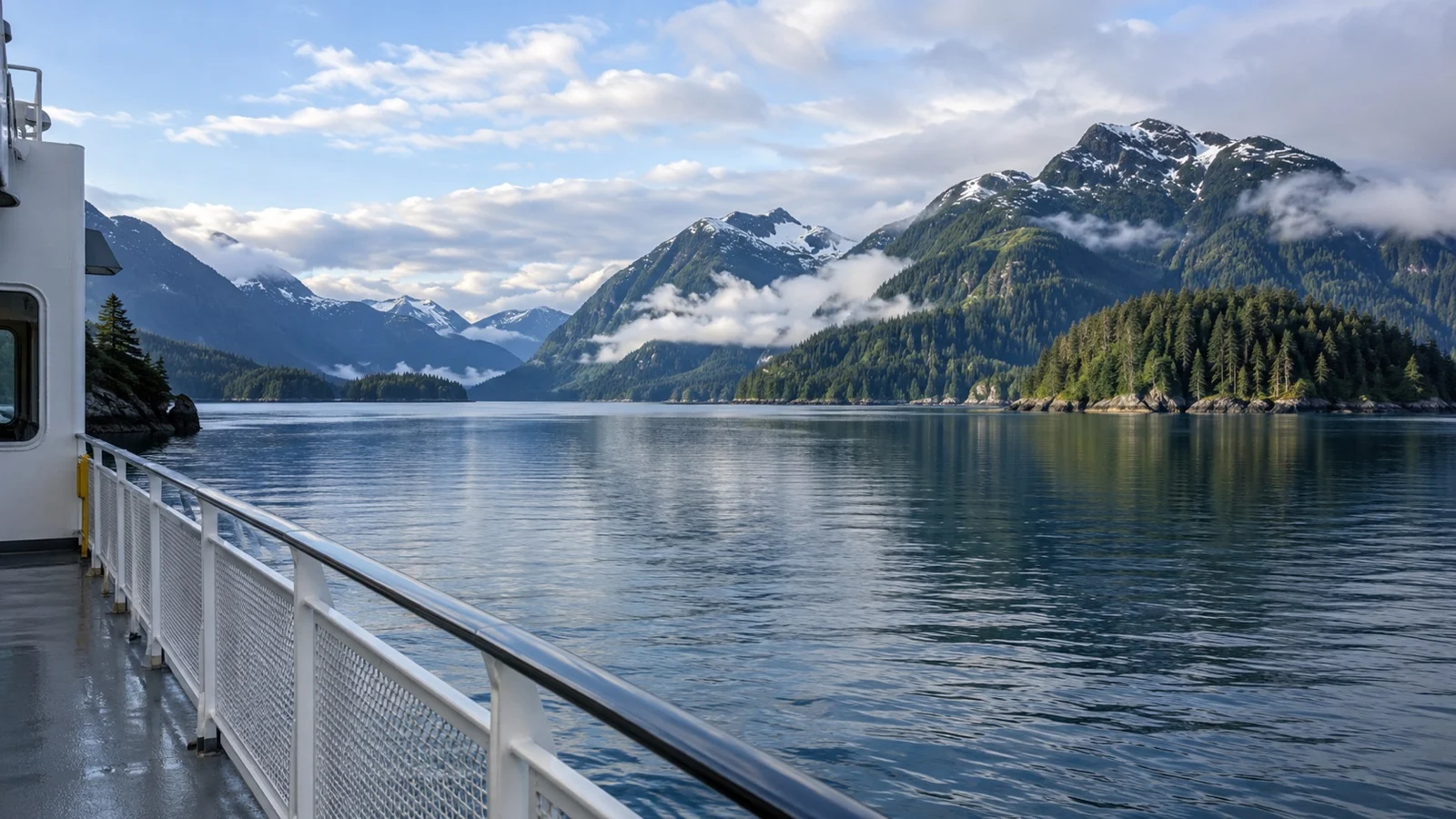
Wrangell Narrows, the shallow twisting channel into Petersburg, is the single best piece of navigation in the system. Ferries take it at slow speed with the buoys close enough to read, which is why Petersburg feels earned in a way that a big-ship port day never does.
What you do not get is Glacier Bay. The National Park Service manages entry under a permit system, with typically two cruise ships a day going up the West Arm, and the state ferry serves Gustavus rather than sailing the bay itself.
Cabins, the solarium, and the tent people
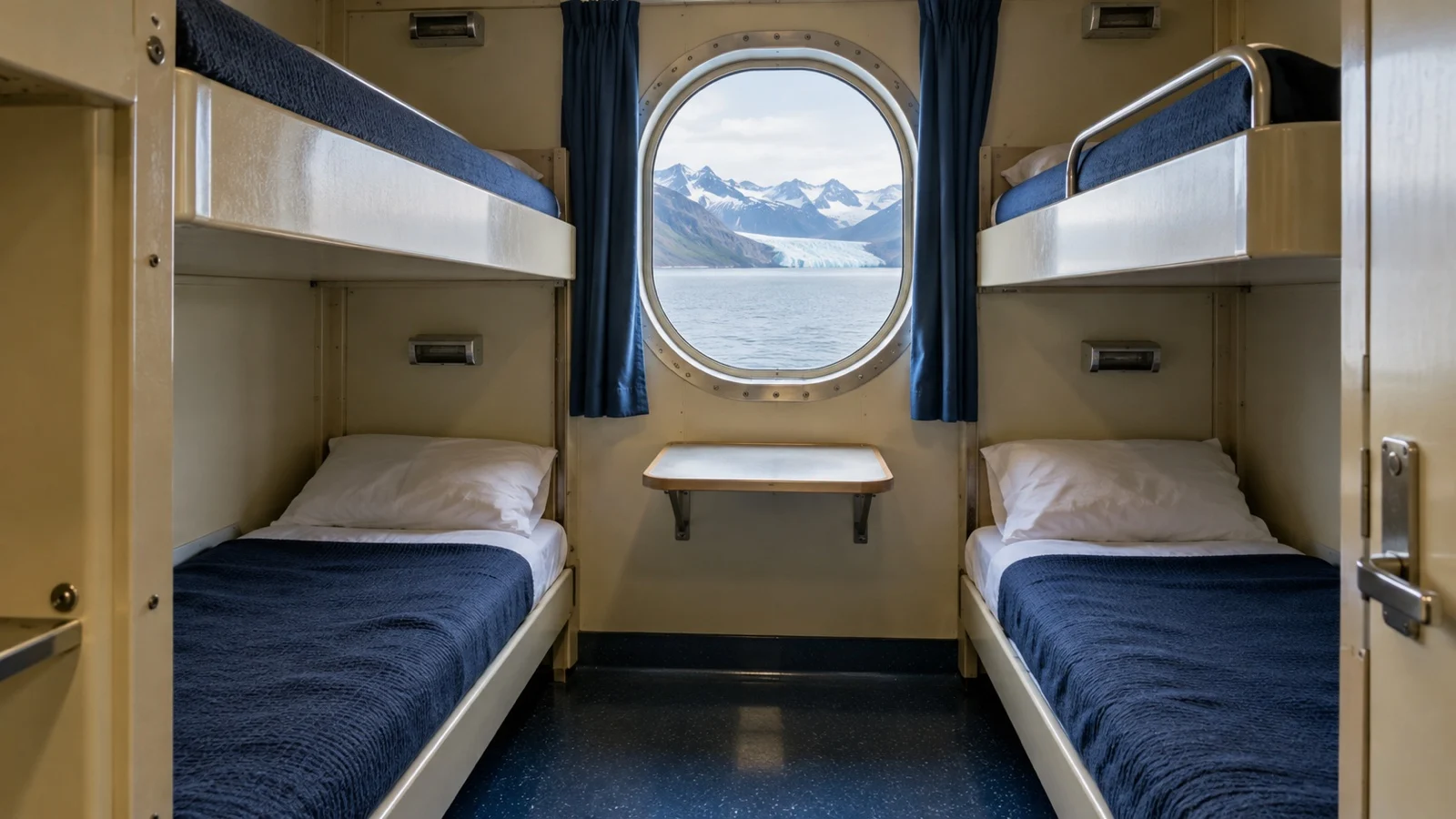
A mainline cabin is a small functional box with bunks, a private bathroom on most of them, and a window if you are lucky. Alaska DOT lists the 418 foot Columbia, the largest and fastest vessel in the fleet, with 45 four-berth cabins, 56 two-berth cabins and three wheelchair accessible ones for up to 499 passengers.
The solarium is a covered, heated deck at the stern where people claim a lounger, tape a tarp against the wind, and sleep there for two nights. Fresh linens and blankets are available for a small fee, and public showers are on every vessel except the little Lituya.
Tents on the open deck are the other half of the tradition, pitched and taped down because you cannot hammer a peg into steel. It is sociable, slightly ridiculous, and much cheaper than a cabin.
My honest view is that the solarium is a young person’s game in July and a mistake in October. If you are over sixty or traveling with anyone who sleeps badly, book the cabin and stop pretending.
Food is a cafeteria, not a buffet, and you pay for what you take. AMHS says all vessels except the Lituya offer food service, and only the Columbia and the Tustumena have a proper dining room.
What it costs, and what it does not include
AMHS does not publish a simple fare table, and I am not going to invent one. Fares come out of the Sailing Search tool on the booking site, priced per leg by passenger, by cabin, and by vehicle length measured from its furthest extensions.
That structure is the real story. A cruise fare bundles your bed, your food, your entertainment and your transport into one number, while the ferry unbundles all of it and charges you only for the bits you use.
So a solo walk-on with a sleeping bag pays a fraction of what a cruise costs, and a couple with a cabin, three meals a day and a vehicle can end up paying more than a shoulder season inside cabin on a big ship. Vehicle fares do not include the driver, which catches people out constantly.
Book as early as you can stand, because cabins and vehicle space on the Bellingham mainliners go first and the summer grid is finite. If the sailing you want is full, ask about the waitlist rather than assuming it is closed.
The legs I would actually choose
- Bellingham to Ketchikan: around 38 hours and 595 nautical miles, the leg that turns a ferry ride into a voyage. Take a cabin for this one or you will start the trip already tired.
- Wrangell to Petersburg: the Narrows leg, and the one I would prioritize above all others. Stand outside on the forward deck and watch the crew work the buoys.
- Petersburg to Juneau: a long day with real chances of whales and a Norwegian-flavored town at one end. The Auke Bay terminal is 13 miles out, so plan the taxi before you dock.
- Juneau to Sitka: the awkward one, because Sitka sits on the outer coast and the schedule is thin. It is also the most beautiful town in Southeast, so I would take the inconvenience.
- Juneau to Haines: a few hours up the Lynn Canal with mountains on both sides. Haines is the quiet alternative to Skagway and has better hiking within walking distance.
- The day boats: Angoon, Kake, Tenakee, Pelican and Hoonah are reachable on shuttle runs and see almost no visitors. Check the return sailing carefully, because some of these are once or twice a week.
Fun fact: the Port of Bellingham terminal sits in a historic district next to an Amtrak platform and a bus stop, 595 nautical miles south of Ketchikan. You can therefore travel from Seattle to Alaska without ever getting into a car or an airplane.
How I would actually decide
Ask one question first: do you want Alaska delivered to you, or do you want to go and get it. Cruise passengers get the logistics solved for them; ferry passengers solve them.
If you have under ten days, take the cruise. The ferry schedule is too sparse to build a satisfying trip in a week, and you will spend the difference on hotels anyway.
If you want to bring a vehicle, a kayak, a bicycle or a dog, the ferry is the only option and the question answers itself. Pets ride on the car deck in a carrier or in your vehicle, with roughly 15 minute pet calls about every eight hours on long sailings.
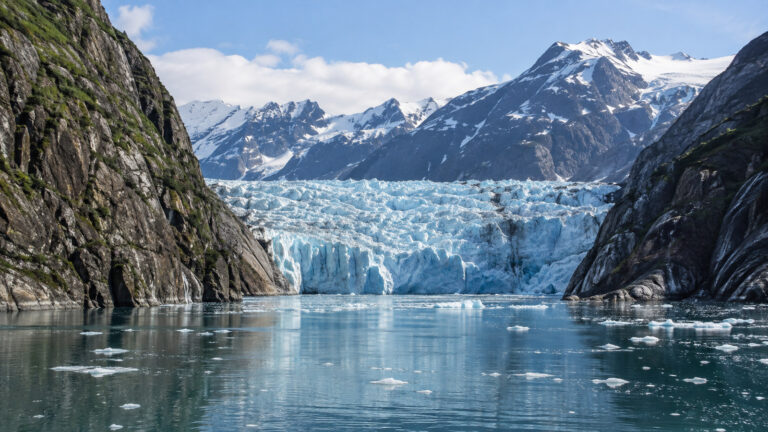
If your priority is glaciers and scenery from the ship, take the cruise and do not argue with me. Glacier Bay, Tracy Arm and Hubbard are permit-and-itinerary things that the state ferry simply does not do.
A realistic word on accessibility
The vessels are better than their reputation. AMHS states that all its vessels have elevator access and that every vessel with cabins provides at least one wheelchair accessible cabin, though on the Matanuska that means exactly one.
The hard part is not the ship, it is everything around it. Terminals are out of town, taxis are limited, and the 100 pound hand-carried baggage rule assumes you can move your own luggage up a car deck ramp.
There is no gangway porter service and no medical center in the cruise ship sense. Each vessel can provide basic emergency care with staff trained to Emergency Trauma Technician level, and that is the ceiling.
If access matters, ring reservations rather than booking online, and say exactly what you need. The accessible cabins are few and they go early, and a cruise ship remains the easier choice for anyone with significant mobility needs.
When to go, and the weather
Southeast Alaska is a temperate rainforest, and the ferry runs year round through all of it. The summer sailing grid is much denser than the winter one, so June to August is when the trip is genuinely buildable.
Temperatures are cool rather than cold. The National Park Service gives summer highs at Glacier Bay of 50 to 60 Fahrenheit and describes good rain gear as essential.
Rain is the constant, not the exception. The Park Service puts average annual precipitation at Sitka’s airport around 90 inches, with September to November the wettest stretch and October alone averaging close to 15 inches.
May and early June are the driest window and my pick if I could choose freely. Late September is beautiful, emptier and considerably wetter, and a solarium in that weather is character-building rather than pleasant.
How I would build an Alaska ferry itinerary
The Alaska Marine Highway is a public transportation network with more than 3,500 route miles and over 30 communities, not a continuous cruise itinerary. Build each leg in the official sailing search, reserve every segment and cabin, and check the vessel because amenities differ sharply between mainliners and day boats.
AMHS requires photo identification and publishes longer check-in times at Bellingham and Juneau than at most other terminals. Walk-on passengers should currently plan on two hours at Bellingham or Juneau and one hour elsewhere, then recheck the ticket and service notices close to travel.
A domestic Bellingham-to-Alaska itinerary does not call in Canada, but that does not remove the ID requirement or settle documents for any separate Canadian travel. If you take a vehicle, enter its full dimensions accurately; if you take a pet, read the current car-deck and captain-controlled pet-call rules rather than planning around a fixed interval.
Connections are not protected like one airline ticket, and ferry terminals can be far from lodging and town sights. Put an overnight between a critical sailing and the next nonrefundable booking, then confirm the exact reboarding deadline whenever you leave the vessel during a community stop.
Quick answers
Is the Alaska ferry cheaper than a cruise?
Per mile, yes, and per trip it depends entirely on how you sleep and eat.
A walk-on in the solarium saves a fortune, while a couple with a cabin, a car and restaurant meals often does not.
Can you really sleep in a tent on the deck?
Yes, AMHS explicitly allows small tents on the upper decks, and the heated solarium is a popular sleeping area too.
Bring tape rather than pegs, because you are pitching on steel.
Does the Alaska ferry go to Glacier Bay?
No.
It serves Gustavus, the gateway community, but entry into the bay itself is permit-controlled and handled by tour vessels and cruise ships.
How far in advance should I book?
As soon as the season you want is loaded into the booking system, particularly for cabins and vehicles out of Bellingham.
Online reservations close 4 hours before each sailing, but the popular summer legs sell out months earlier.
Is there entertainment on board?
Not in the cruise sense, and that is the point.
Some vessels list a movie lounge, there are observation lounges and showers, and the rest of the program is the window.
The last word
The ferry is the honest version of Southeast Alaska and the cruise is the comfortable one, and there is no shame in wanting comfortable. What there is shame in is booking the ferry expecting the cruise, then writing a furious review because nobody carried your suitcase.
If you are still weighing the two formats, my longer piece on taking the Inside Passage by ferry rather than by cruise ship goes deeper on the route itself. Read it alongside the Alaska cruise ports overview and the shape of the decision becomes obvious quickly.
The strongest argument for the ferry is towns like Petersburg, which the big ships cannot reach. The strongest argument against it is a day of scenic cruising in Glacier Bay, which no state ferry will sell you.
One practical action for today: open the AMHS Sailing Search, price the exact legs you want with and without a cabin, and compare that against a real cruise quote for the same two weeks. Then look at the Juneau map and notice that the ferry terminal is 13 miles from everything you came to see.
How this guide was researched: Unless a first-hand visit is explicitly identified above, this guide is based on independent research using official port, tourism, transit, government, and attraction sources where available. Routes, vessel specifications, baggage, cabin, pet and check-in policies were checked against the Alaska Department of Transportation’s own Alaska Marine Highway pages, terminal details against the Port of Bellingham, and climate figures against the National Park Service.
Logistics and time-sensitive details were reviewed September 10, 2026. See our Editorial Policy.
More on this topic: browse every guide on expedition and alternative cruises.