Nordfjordeid Cruise Port: SeaWalk, Vikings & Fjord Trips
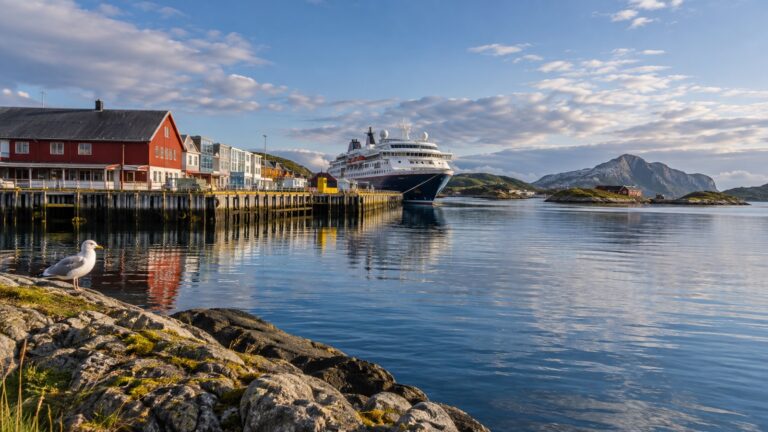
Nordfjordeid is the rare Norwegian fjord call where the most interesting local story begins almost as soon as you step ashore. A floating SeaWalk can connect the ship directly with the village, Sagastad puts an extraordinary Viking ship reconstruction within an easy walk, and longer excursions reach mountain, glacier, and coastal landscapes.
The temptation is to plan too much because the map looks compact. I would first confirm whether your sailing uses the SeaWalk or tenders, then choose either a relaxed village day or one major regional outing with a generous return margin.
Quick Facts
- Port: Port of Nordfjordeid at the head of Eidsfjorden
- Typical arrival: Floating SeaWalk or tender, depending on the ship and operating conditions
- Village access: Both arrival points place passengers close to the compact center
- Main local sight: Sagastad Viking Center and the full-size Myklebust Ship reconstruction
- Sagastad walk: About 10 to 15 minutes from the pier by the official town route
- Loen Skylift: A major regional excursion, officially described by the port as roughly a four-hour round trip
- Briksdal: A longer excursion with a substantial drive and a walk or optional local transport
- Currency: Norwegian krone
- Language: Norwegian, with English widely used in visitor settings
- Weather: Changeable, wet, and often much colder at altitude
- Best low-risk plan: Sagastad, Eidsgata, Saga Park, and one or two nearby landmarks
- Return rule: Use the ship’s all-aboard time and final SeaWalk or tender instructions as hard deadlines
SeaWalk and tender are two different arrivals
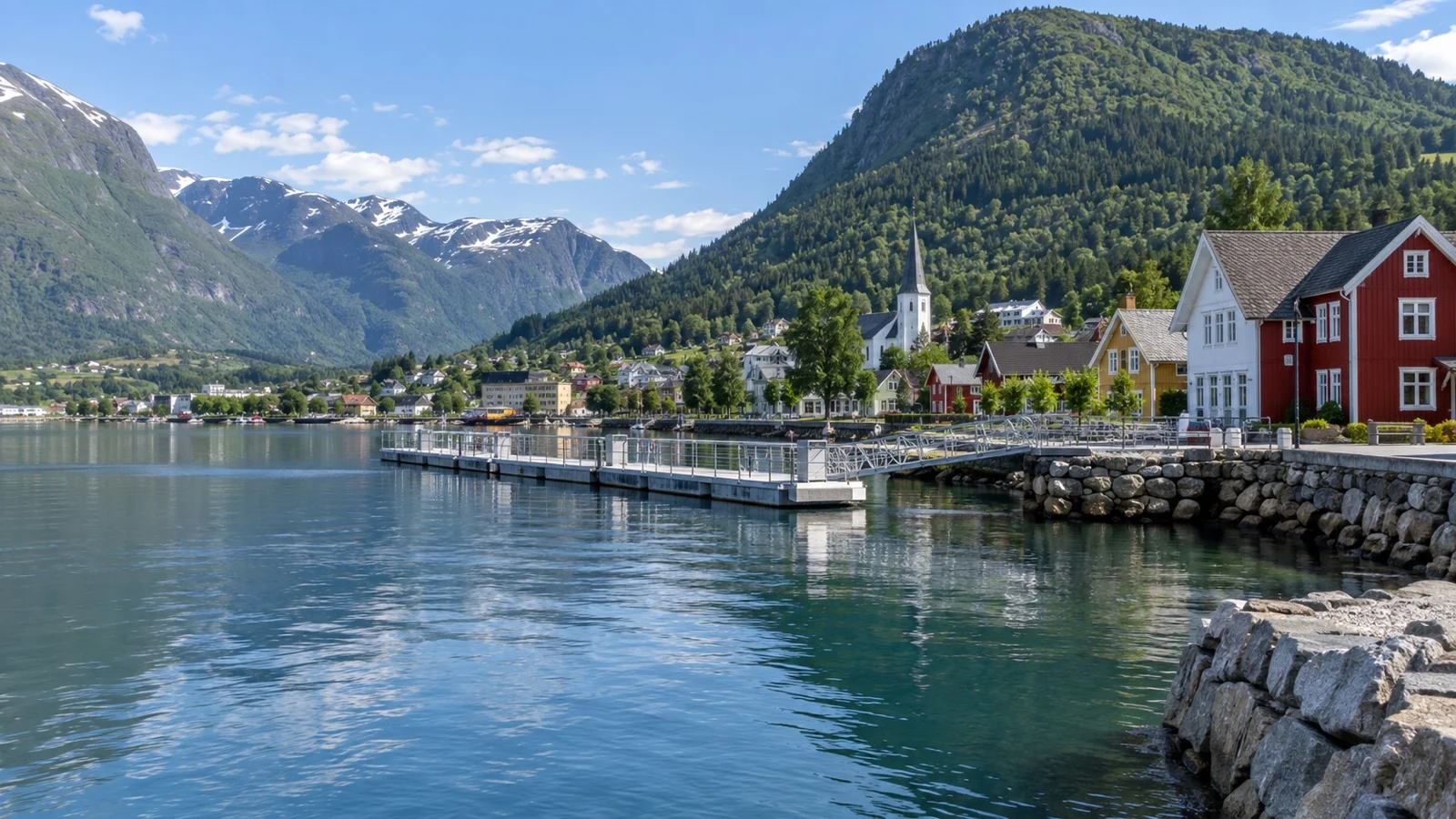
Nordfjordeid’s signature infrastructure is the SeaWalk, a movable floating walkway extended between a moored ship and shore. When it operates, you walk ashore without boarding a tender, but the surface can still move and may include ramps whose slope changes with the water level.
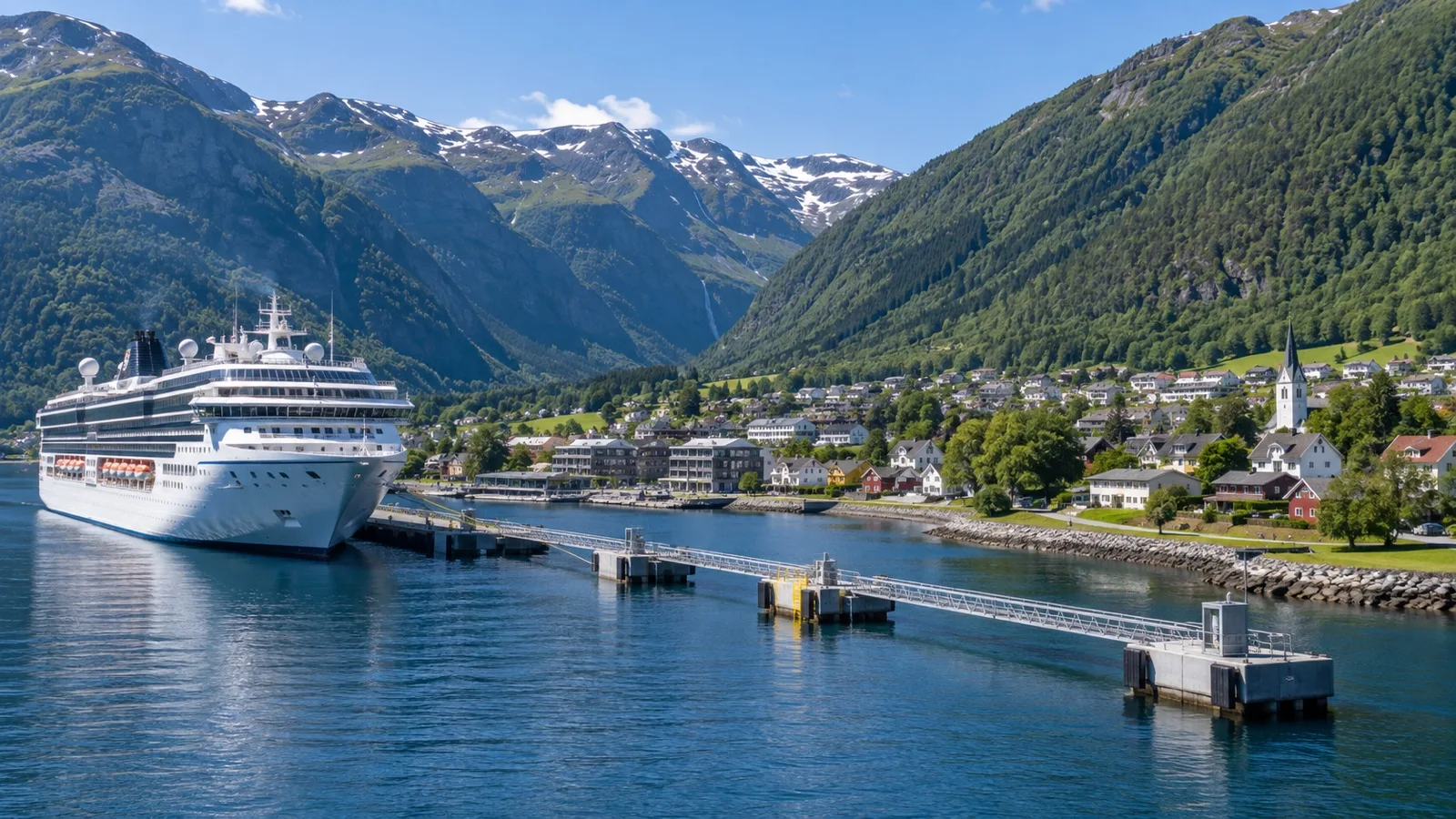
A SeaWalk call is not guaranteed merely because the port has the equipment. The ship, port, weather, wind, sea state, and operational plan determine how passengers go ashore on your day.
Some calls use tenders instead. Tendering adds loading, queuing, boat travel, and possible priority groups, so it can reduce the time available for an independent excursion even when the tender landing is conveniently placed.
Read the daily program for the final gangway or tender location, mobility rules, last shore departure, and all-aboard time. If the operation changes after arrival, recalculate the whole day instead of trying to preserve the original plan.
What the arrival feels like
Both the SeaWalk and tender landing bring you close to a small, walkable village rather than an industrial port district. The official Port of Nordfjordeid and Sagastad visitor information describe the center, cafés, shops, parks, and main attractions as reachable on foot.
That compactness is a major advantage for passengers who prefer not to take a long coach ride. You can create a satisfying day around history, local streets, the fjord edge, and a warm indoor stop while keeping the ship visible or nearby for much of the visit.
Do not confuse a short village walk with a completely step-free route. Floating ramps, curbs, wet paving, gravel, and building thresholds can still matter, so ask the cruise line about the actual gangway arrangement if mobility is limited.
Sagastad is the essential local visit
Sagastad Viking Center is the port’s strongest independent attraction and much more than a rainy-day backup. Its centerpiece is the full-size reconstruction of the Myklebust Ship, based on remains from a major Viking Age ship burial discovered at Nordfjordeid.
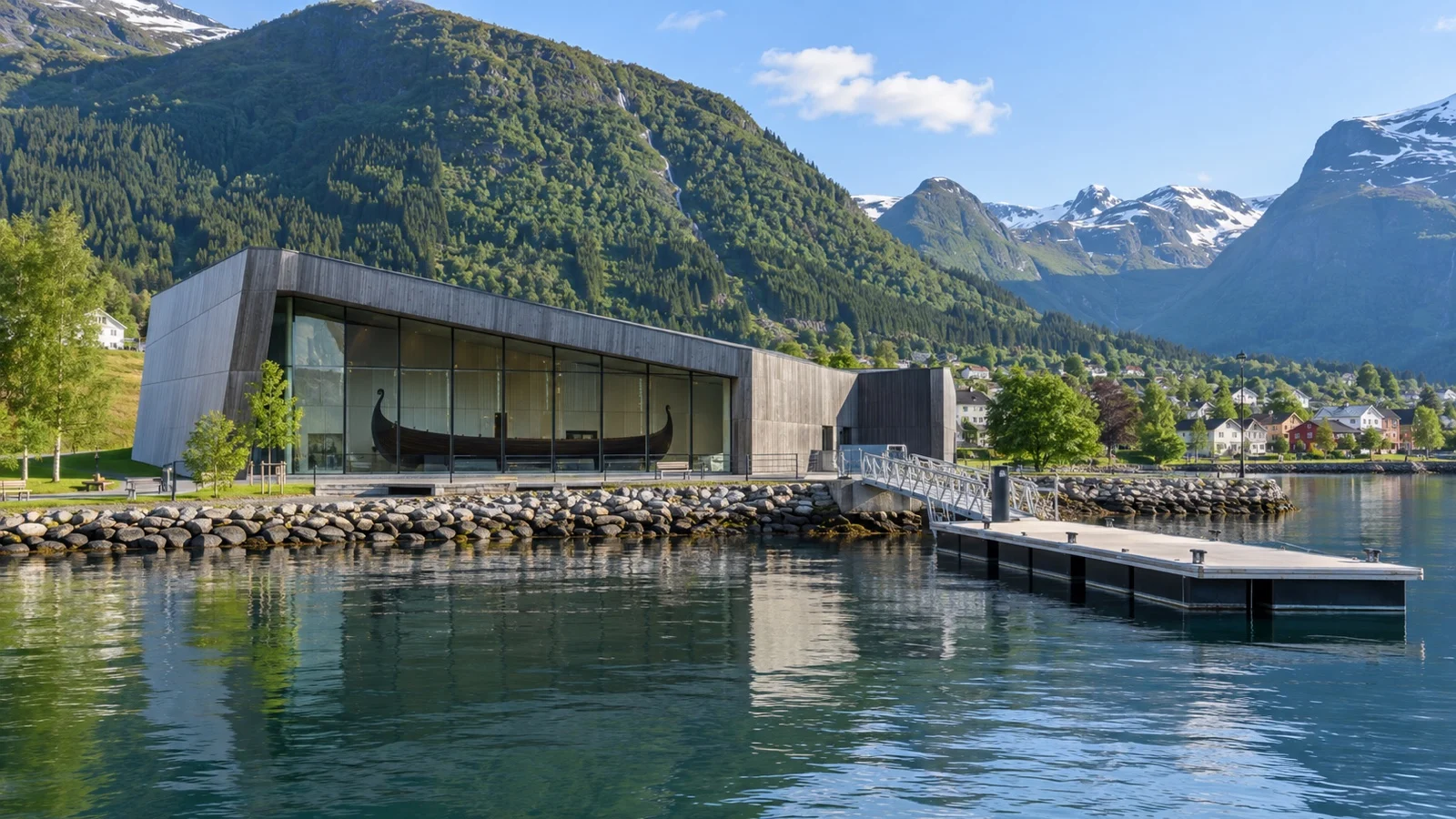
The official port describes the ship as 30 meters long, 6.5 meters wide, and roughly 40 tons. At Sagastad you can step aboard the reconstruction and use the exhibition to understand the burial, local power, shipbuilding, travel, belief, and daily life in the region.
Sagastad says the walk from the pier takes about 10 to 15 minutes and recommends going through old Eidsgata. That route adds historic wooden architecture, small shops, and a connection to the burial landscape rather than making the museum an isolated stop.
Cruise-day hours are adjusted to the call. Sagastad states that it opens on cruise days even when normal seasonal hours would otherwise leave it closed, usually beginning around 30 minutes after the scheduled ship arrival and remaining open for at least several hours.
Check the exact date and opening notice before leaving the ship because general seasonal schedules can differ from call-day arrangements. Advance tickets can be useful on a busy ship day, but avoid relying on an old price copied into a blog post.
How long to allow inside
Sagastad recommends at least 1.5 hours for the visit, including the exhibition and film. I would add walking time in both directions plus a little flexibility if your ship is large or several tours reach the museum at once.
The exhibition uses Norwegian, English, and German, while the free digital audio guide adds Spanish, French, Mandarin, English, and German. Bring your own smartphone and headphones, and use the center’s free Wi-Fi if you do not want to spend mobile data.
Accessibility at Sagastad
Most of Sagastad’s exhibition is on the ground floor, and the center lists an accessible restroom. Access to the raised platform for boarding the Myklebust Ship involves stairs and a ramp, but Sagastad specifically says it does not recommend using that ramp in a wheelchair because it is too steep.
That distinction is important because an accessible museum does not mean every element is accessible. Ask staff what you can see from the main floor and whether current assistance or alternative interpretation is available.
Build a rewarding village day
Nordfjordeid gives independent travelers more than enough for several unhurried hours. The smartest route links Sagastad with Eidsgata, the Viking burial context, Saga Park, and one additional stop that matches your energy and the weather.
Eidsgata and the old center
Eidsgata is the village’s historic street, lined with traditional wooden buildings adapted as cafés, bakeries, studios, and small shops. It is a pleasant route rather than a monumental attraction, which is exactly why it works well between scheduled visits.
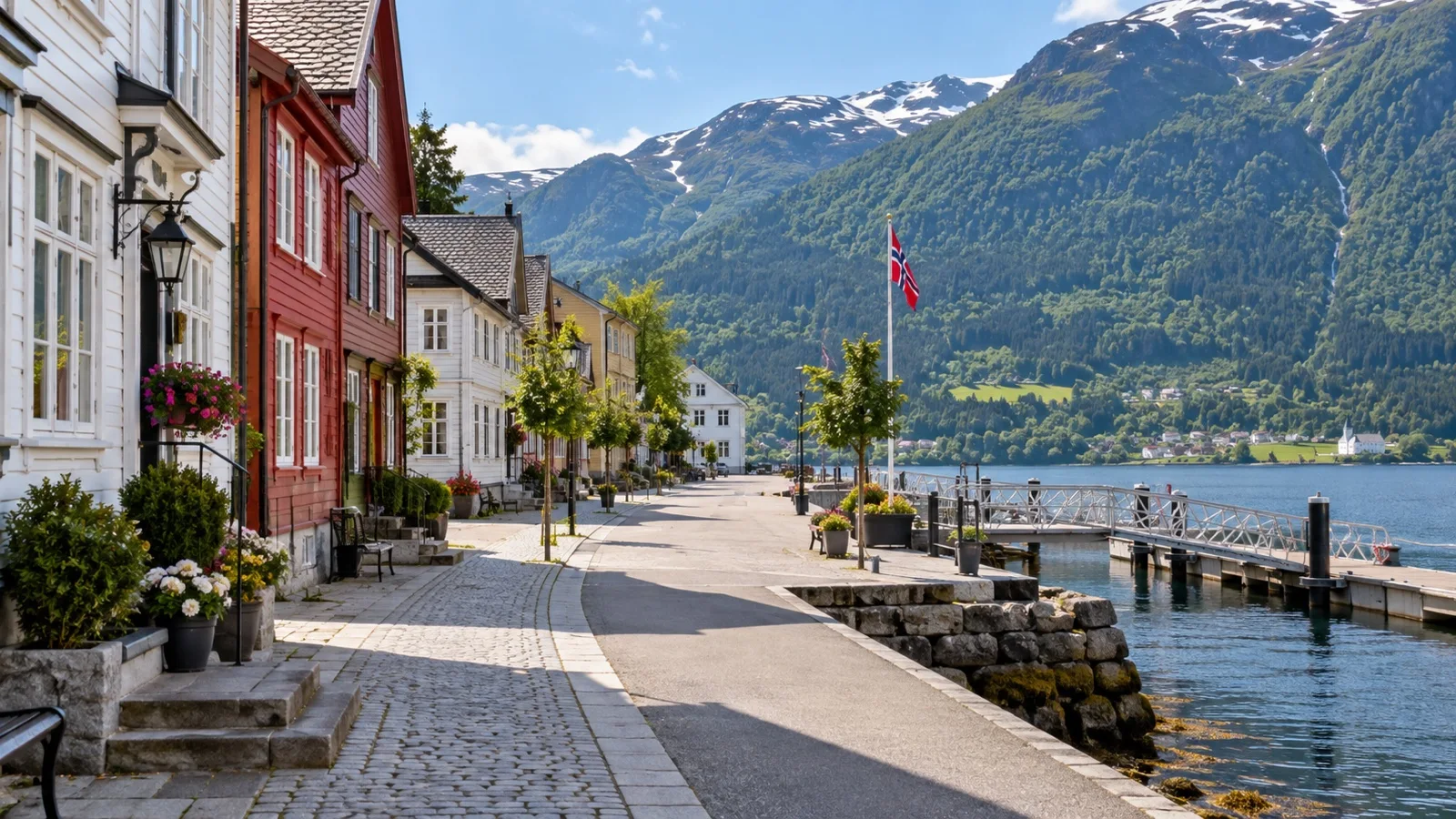
Buy locally if something genuinely appeals to you, and remember that Sunday or seasonal opening can be limited. A cruise-day program may bring extra activity, but individual businesses still set their own hours.
Saga Park and the fjord edge
Saga Park sits beside Sagastad and gives you an open view back toward the water and ship. The official port promotes its small beach, but cold water, weather, depth, and local safety conditions deserve more respect than an inviting summer photograph suggests.
Even without swimming, the park is useful for a short rest or a quiet view. Keep to signed paths and leave enough time to return without rushing over a wet floating walkway.
Eid Church and Malakoff
The official port dates Eid Church to 1849 and highlights its carvings and painted interior. Opening can depend on worship, events, staffing, and the call-day program, so treat interior access as a bonus unless it is confirmed.
Malakoff’s historic drill square adds a different layer of local history, including military training and remembrance. It fits best as part of a walk rather than a reason to cross the village in a hurry.
The Norwegian Fjord Horse Centre
Nordfjordeid is closely associated with the Norwegian Fjord horse, and the national center is around a 20-minute walk from the pier according to the port. Meeting horses or riding requires a confirmed visitor program, not simply arriving at the stable gate.
Horse activities have age, ability, clothing, and group-size requirements. Book through an official operator, follow animal-welfare instructions, and ask how the experience handles rain or a delayed landing.
Loen Skylift is the strongest big-view excursion
Loen Skylift carries visitors from the fjord to Mount Hoven, roughly 1,000 meters above sea level, in about five minutes. The official port describes the excursion from Nordfjordeid as around four hours round trip with about one hour of driving each way.
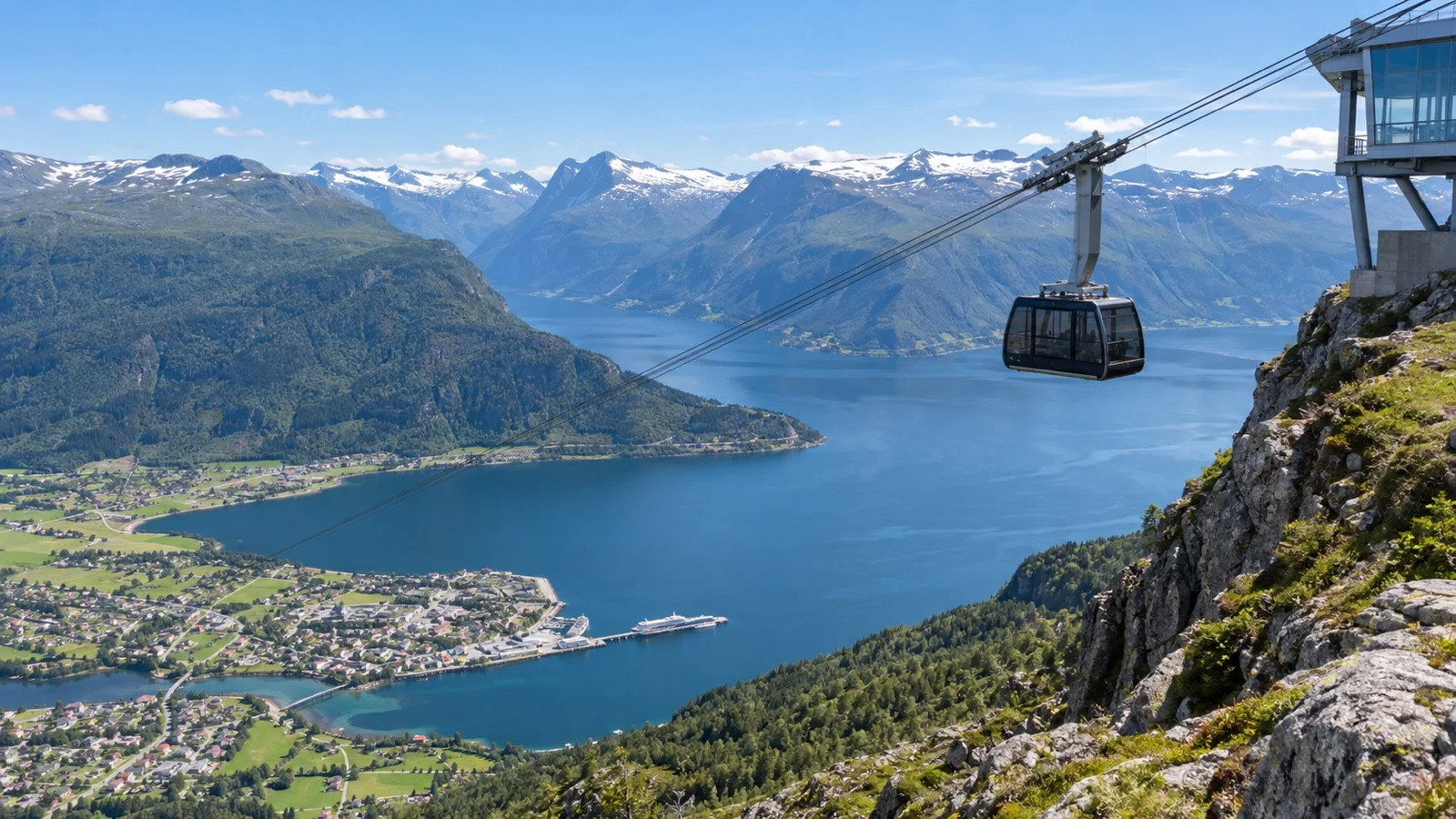
That makes Loen a realistic major outing on many full-length calls, but it is not a casual add-on to a packed village day. Coach loading, road conditions, cable-car queues, summit time, and the return drive all consume the margin.
The view can be magnificent, yet clouds may hide much of it while the village stays bright. Check Loen Skylift’s official live page, webcam, weather station, and operating status before treating the summit panorama as certain.
The cable car normally runs at least on the full and half hour, with continuous service possible when demand is heavy. Tickets are flexible within their stated validity rather than tied to one departure, but cruise passengers still need a fixed personal turnaround time.
Accessibility and conditions at Hoven
Ask the excursion provider about coach steps, lift access, the route through the lower and upper stations, and the distance to viewpoints or the restaurant. A cable car can remove most of the climb without making every mountain surface easy.
The temperature and wind at Hoven can differ sharply from the port. Carry a warm waterproof layer even when Nordfjordeid feels mild, and wear shoes that cope with wet or loose surfaces.
Do not turn a cruise-day cable-car visit into an unplanned long hike downhill. Loen Skylift’s own information describes a lengthy route involving gravel road, major elevation change, additional road distance, and separate return transport.
Briksdal requires more time and stamina
Briksdal Glacier is part of the Jostedalsbreen landscape and is one of the port’s headline regional excursions. The official port estimates a five to six-hour round trip, with roughly two hours of driving each way and about three kilometers of walking from the arrival area toward the glacier viewpoint.
Optional local transport may reduce part of the walk, but it does not remove every slope, weather exposure, or distance. Confirm exactly where the vehicle stops, how far the remaining walk is, and whether a seat is guaranteed.
Glaciers change, and the view on the day may not resemble an older promotional image. Follow barriers and local instructions because meltwater, rockfall, unstable ice, and changing trail conditions are not suitable for shortcuts.
Briksdal is a high-commitment choice for a cruise call. I would favor the ship’s excursion or an operator with a clear port return plan, especially when the call is short or tendering is involved.
Geiranger and the coast need disciplined expectations
The port also lists Geiranger and westward coastal excursions among its possibilities. These routes can be beautiful, but a destination appearing on a port excursion page does not mean it fits every ship schedule or every weather day.
The official port describes Geiranger trips as roughly five to eight hours and about two hours of driving from Nordfjordeid. That is a full-day commitment whose value depends on the specific route, season, ferry or road operations, and the ship’s time in port.
West Cape, Selje, and the outer coast move you in the opposite direction toward a more exposed maritime landscape. Choose one regional direction and let it be the day instead of combining remote attractions that leave no recovery time.
Active options on the fjord and hills
Kayaking, RIB rides, fishing, efoiling, horseback riding, and guided hikes may operate on cruise days. Each requires an official booking, an honest assessment of physical ability, and a clear cancellation policy for wind, rain, or sea conditions.
A RIB tour should include a safety briefing and suitable flotation or exposure gear. Tell the operator about back, neck, pregnancy, mobility, or medical concerns before paying because high-speed craft can involve repeated impact.
For hiking, ask for distance, elevation gain, surface, exposure, and the slowest expected pace. Norway’s mountain weather can change faster than a port promenade plan, and phone coverage should never substitute for an appropriate guide or equipment.
Weather determines more than the view
Nordfjord weather can move from calm sun to cold rain and low cloud within the same call. Bring a waterproof outer layer, a warm midlayer, and shoes with dependable grip even if the morning begins gently.
Wind and sea state can influence the SeaWalk or tender operation, while mountain conditions affect Loen and hiking. Check the ship’s announcements, the port’s current call information, and each attraction’s live status before leaving.
In shoulder seasons, snow or ice can remain at altitude after spring has reached the village. Do not infer summit conditions from the temperature beside the ship.
Money, connectivity, and practical comfort
Norway uses the Norwegian krone, and cards are widely accepted in visitor businesses. Carrying a small backup payment method still helps if a terminal, network, or individual vendor has a problem.
Public Wi-Fi may be available at major attractions, including Sagastad, but download maps, tickets, and the ship’s contact information before going ashore. A screenshot of the all-aboard time is far more useful than trying to remember it during a weather change.
English is commonly used in tourism, yet a place name saved in Norwegian can help with a driver or local bus. Restrooms are easiest to plan around attractions, cafés, and shopping facilities rather than assuming they exist along a rural road.
Accessibility starts with the arrival method
Ask the cruise line whether your call is scheduled for SeaWalk or tender and whether your mobility device can be accommodated. Tender policies often depend on transfer steps, crew assistance limits, chair type, and sea conditions.
On the SeaWalk, the slope and movement may matter more than the distance. Request current information for your ship rather than relying on a photograph from a different tide or vessel.
A village plan can be adapted with rest stops and indoor time, but cobbles, curbs, wet surfaces, and the ship’s ramp remain relevant. For regional coach tours, ask about vehicle steps, restroom timing, walking surfaces, and whether mobility equipment fits in the luggage compartment.
Return timing without drama
The all-aboard time is the deadline, not the published sailing time. I plan to be back at the pier earlier than required, with a larger cushion for Loen, Briksdal, Geiranger, or the outer coast than for Sagastad.
If tenders are operating, learn when the final tender leaves shore and whether independent guests should expect a queue. A five-minute map distance does not protect you from a closed boarding line.
For independent regional travel, agree on the return time before departure and keep the driver’s contact details offline. Turn around when the buffer begins to shrink, even if that means skipping the final viewpoint.
Three plans that actually fit the port
The low-stress Viking day
Walk through Eidsgata to Sagastad, allow the recommended 1.5 hours inside, then continue to Saga Park and one nearby landmark. Finish with a café stop close to the pier and return well before the final boarding window.
The big-view day
Take a reserved excursion to Loen Skylift, check the live summit status, and let Hoven be the day’s main event. Add only a brief village walk if the return timing genuinely permits it.
The long scenic day
Choose Briksdal, Geiranger, or the outer coast through a ship excursion or accountable local operator. Verify the walking demands and return commitment, then avoid adding independent stops after the coach returns.
Common Nordfjordeid cruise questions
Will my ship definitely use the SeaWalk?
No, the port also handles tender arrivals and operating conditions can change the plan. Use the ship’s final announcement for the arrival method and boarding instructions.
Can I walk to Sagastad?
Yes, Sagastad and the port describe it as about a 10 to 15-minute walk from the pier. The route through Eidsgata adds historic streets and the Viking burial context.
Is Sagastad open on cruise days?
Sagastad says it opens for cruise calls even outside its normal seasonal schedule. Exact hours are adjusted to each ship, so check the center’s call-specific notice.
Can a wheelchair user board the Myklebust Ship?
Most of the exhibition is on the ground floor, but Sagastad says the ramp to the ship platform is too steep for it to recommend wheelchair use. Contact the center for the current access arrangement and available alternatives.
Can I do Loen Skylift independently?
It may be possible with prearranged transport and a long enough call, but the return drive and live operating status need careful control. A coordinated excursion is the simpler risk choice for most cruise passengers.
Is Briksdal better than Loen?
Briksdal emphasizes valley and glacier scenery with more road time and walking, while Loen offers rapid access to a high mountain viewpoint. The better choice depends on weather, mobility, call length, and what you most want to experience.
My bottom line for Nordfjordeid
Nordfjordeid is unusually good at giving cruise passengers a meaningful day without demanding a coach. Sagastad, Eidsgata, Saga Park, local history, and the fjord edge create a complete itinerary within walking distance of the landing.
Choose Loen, Briksdal, Geiranger, or the coast when one major landscape is your clear priority and the ship’s schedule supports it. Confirm SeaWalk versus tender, live weather, attraction status, walking demands, and the return plan before you commit.
For a wider regional view, continue with our Norway cruise ports guide and our Geiranger cruise port guide. Our excursion versus DIY guide helps compare the return-risk tradeoffs.
How this guide was researched: This guide was independently checked on September 11, 2026, against the Port of Nordfjordeid, Sagastad Viking Center, Loen Skylift, and current official attraction and cruise-line instructions. Reconfirm the arrival method, all-aboard time, attraction status, transport, accessibility, and weather before sailing because live conditions can change.