Akpatok Island Cruise Port: A Cruiser’s Guide to Ungava Bay’s Seabird Cliffs
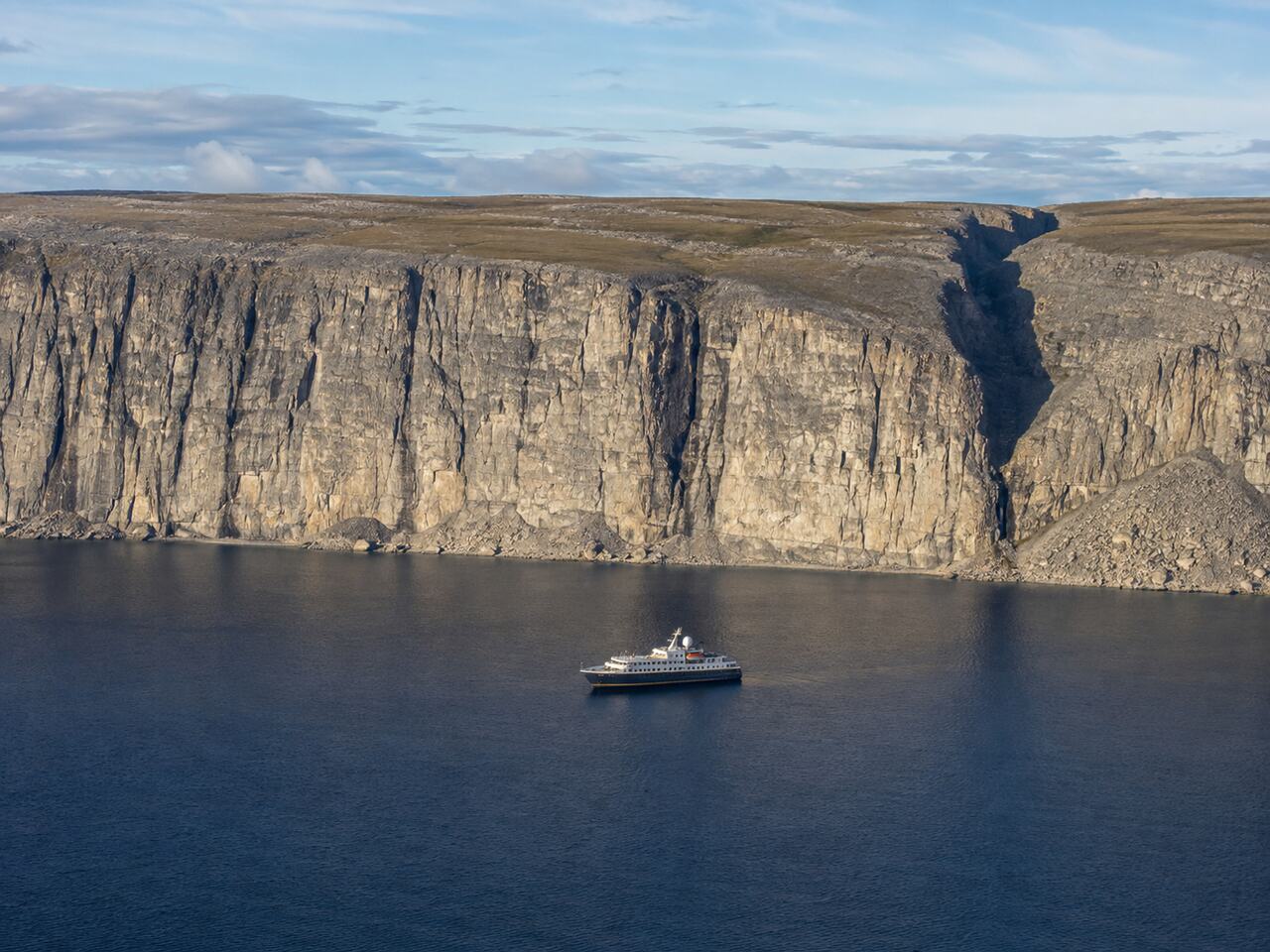
Akpatok Island is not a cruise port in any ordinary sense. There is no pier, town, road, shop, or independent shore day, and an expedition visit normally means watching immense seabird cliffs from the ship or from a Zodiac when conditions and permissions allow.
That absence of infrastructure is precisely the appeal. Akpatok rises from Ungava Bay as a broad limestone table, with narrow shores beneath high cliffs, streams of thick-billed murres overhead, and the possibility of polar bears, walruses, or seals in a landscape that remains firmly in charge.
My quick take
Come for scale rather than a checklist. The most memorable version of Akpatok may be the sound of murres rolling across the water, a patient shipboard scan of the cliffs, or twenty quiet minutes in a Zodiac with no mammal in sight.
A landing should never be the measure of success here. Wildlife, nesting birds, sea state, ice, fog, legal access, and community interests all carry more weight than a printed itinerary.
I would attend every briefing, dress before the operation is called, and keep binoculars within reach all day. Expedition travel rewards readiness, but it also asks you to accept “not today” without treating responsible judgment as a failure.
Quick Facts
- What Akpatok is: A large, uninhabited island in Ungava Bay, officially recorded within Nunavut.
- Where ships dock: Nowhere, because the island has no cruise berth or passenger terminal.
- Normal visit: Scenic ship cruising or a guided Zodiac operation if the expedition team authorizes it.
- Landing: Never assume one, and do not attempt independent access.
- Main wildlife: Thick-billed murres, with polar bears, walruses, seals, and other birds possible but never guaranteed.
- Facilities ashore: None for cruise visitors, including no restrooms, shelter, transport, food, or medical support.
- Essential gear: The operator’s required flotation equipment, waterproof layers, warm insulation, gloves, hat, and secured optics.
- Best mindset: Let safety, wildlife distance, Inuit context, and current conditions determine the day.
First, correct the word “port”
Your itinerary may label Akpatok Island as a port of call because cruise booking systems need a destination name. In practice, the bridge positions the ship offshore and the expedition leader decides whether a small-boat operation is safe, appropriate, and authorized.
There is no gangway leading to a visitor center. There are also no local taxis, cafés, guides waiting ashore, or independent tours to arrange after arrival.
A ship may make a scenic pass along part of the coast, hold position for wildlife observation, launch Zodiacs, change the operating area, or move on. The decision can change after breakfast or even after the first boats launch because fog, wind, swell, ice, or animals have changed the risk.
If you are new to small-boat calls, my guide to tender ports explains the basic idea of leaving a ship by boat. Akpatok is more demanding than a routine tender because expedition Zodiacs, remote operations, and wildlife protocols create a different set of limits.
Where Akpatok Island is
Natural Resources Canada’s official geographical names record places Akpatok Island in Nunavut near the center of Ungava Bay. The island sits far from a road-connected settlement and is separated from northern Quebec’s mainland coast by open water.
This geography can confuse travelers because Akpatok is deeply connected to Nunavik Inuit history and present-day use. The Canadian Coast Guard describes it as an important Ungava Bay landmark used by Inuit of Nunavik for centuries.
The Nunavik Inuit Land Claims Agreement sets out Nunavik Inuit lands and exclusions on Akpatok and addresses the surrounding Nunavik Marine Region. That legal context is a good reminder that “uninhabited” does not mean unused, ownerless, or culturally empty.
You are visiting an Inuit homeland, even when no houses appear below the cliffs. Listen when Inuit expedition staff and regional experts explain place names, harvesting, travel, and relationships with wildlife.
Why the cliffs look the way they do
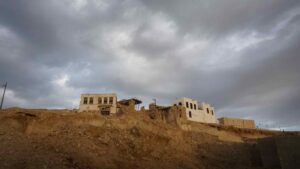
Akpatok is a huge, mostly flat-topped mass of limestone whose edges rise sharply from the bay. Much of the visual drama comes from that simple geometry, a pale wall above a narrow shore with dark water at its foot.
Weathering, freeze and thaw, falling rock, snowmelt, and runoff continually work on the cliff face. After rain or melt, thin waterfalls may appear, while ledges and fissures create nesting space for seabirds.
The plateau is not a public hiking destination and the cliffs are not a backdrop for an improvised landing. Loose rock, surf, wildlife, and the sensitivity of breeding colonies all argue for distance and professional control.
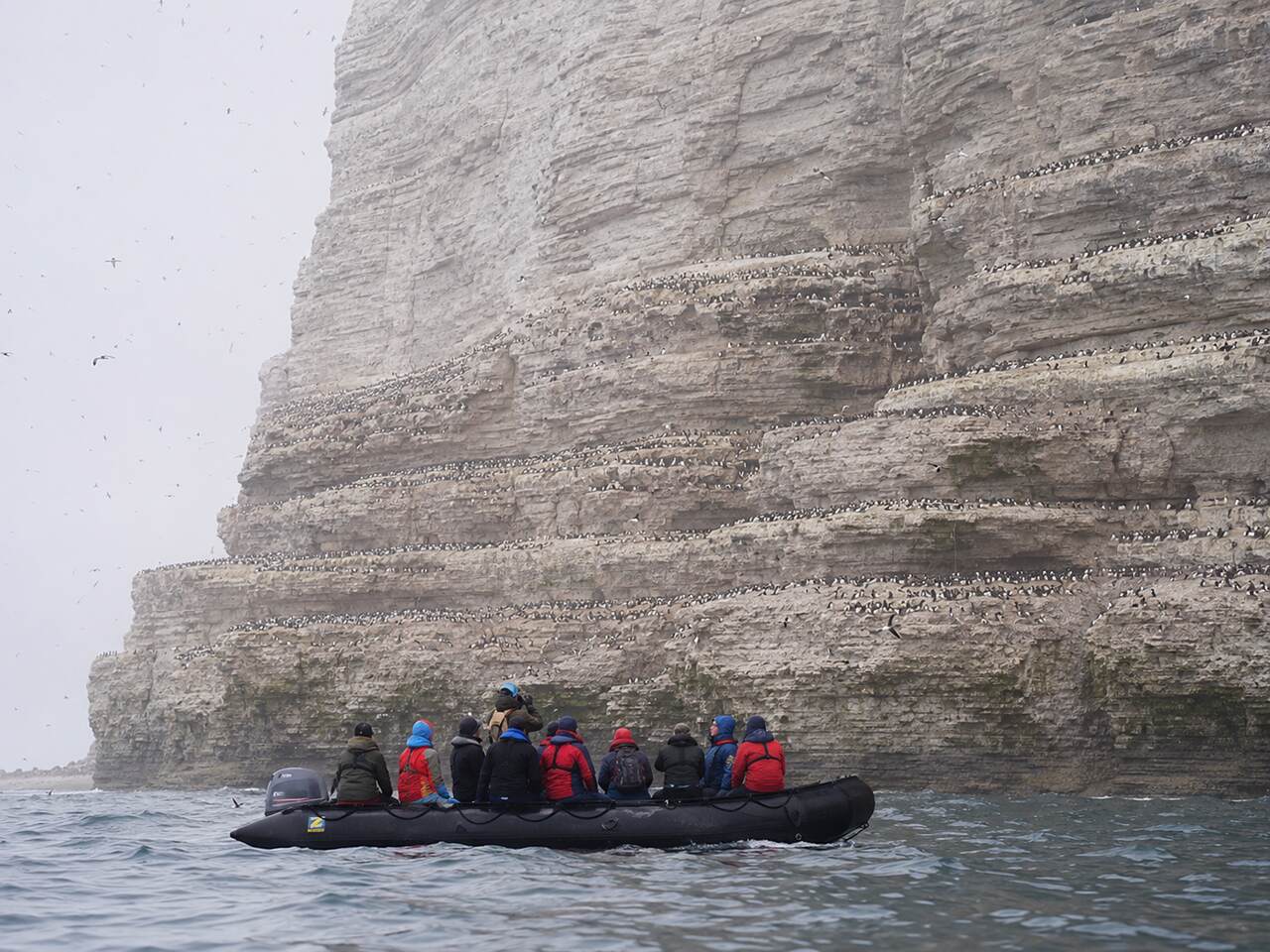
The thick-billed murres are the headline
Akpatok takes its name from akpa, an Inuit word associated with the thick-billed murre. A historic Canadian Wildlife Service report notes that the island’s great murre colonies had been known to local Inuit for centuries before formal scientific census work.
The island has major nesting areas on different stretches of coast, and the Important Bird Area profile identifies Akpatok for its globally significant numbers of thick-billed murres. Historic estimates depend on survey year and method, so I would not turn one old figure into a promise about what exists today.
Murres gather on narrow ledges and commute between cliffs and feeding water. From a respectful distance, watch for their dark backs, pale undersides, compact shape, fast wingbeats, and purposeful lines of birds crossing the sea.
The colony is not only a visual spectacle. When wind and distance cooperate, the layered calls from the cliff can create a wall of sound that explains the island more powerfully than a wildlife tally.
Binoculars are more useful than extreme digital zoom. A moderate telephoto lens can record behavior, but no photograph justifies asking a driver to move closer than the expedition team’s wildlife limits.
How to watch a colony well
Start wide and let your eyes adjust to the apparent chaos. Soon you will see flight lanes, crowded ledges, birds arriving from the water, and predators or scavengers working the margins.
Keep conversation low during quiet viewing periods and avoid sudden movement in a small boat. The goal is to observe natural behavior, not to make the colony react to you.
Never use recorded calls, food, flash, or other tricks to attract birds. Follow the staff’s instructions even when another boat appears closer, because you may not know its task, permit, or operating constraint.
Polar bears: possibility, not promise
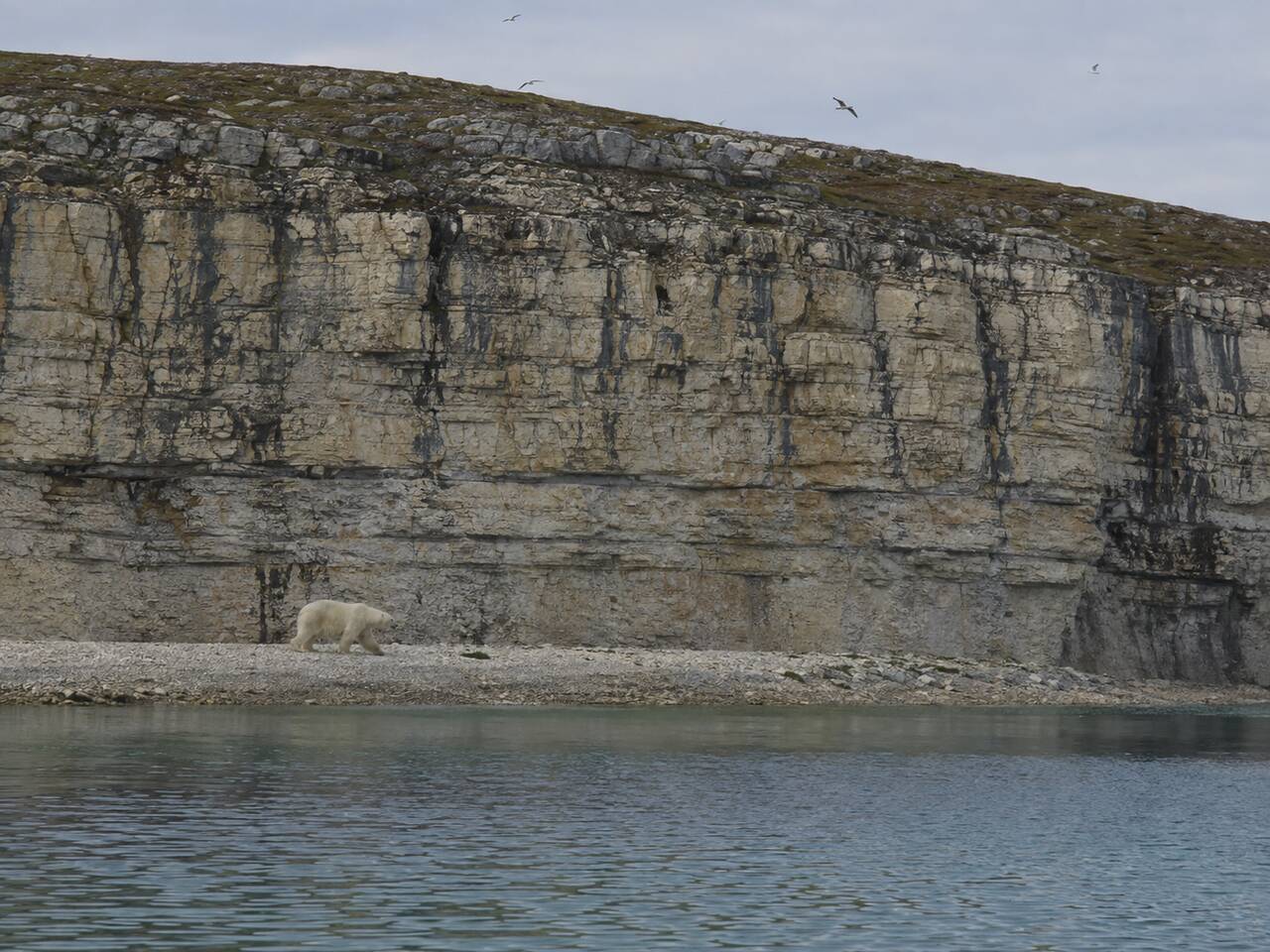
Polar bears use the island and surrounding region, and an expedition team may scan shorelines, cliff bases, and patches of remaining snow for them. A pale rock, a distant bird stain, and a bear can look frustratingly similar until trained eyes and good optics settle the question.
A sighting can transform the day’s plan. Staff may increase distance, stop an engine, restrict movement, cancel a landing, or end an operation to protect passengers and prevent disturbance.
That is responsible expedition work, not lost value. A bear does not owe the ship a prolonged encounter, and passengers should never pressure a driver to surround, follow, or block an animal.
Keep your expectations honest. Even on an itinerary marketed around Arctic wildlife, a polar bear remains a wild possibility rather than an included attraction.
Walruses, seals, and the wider marine picture
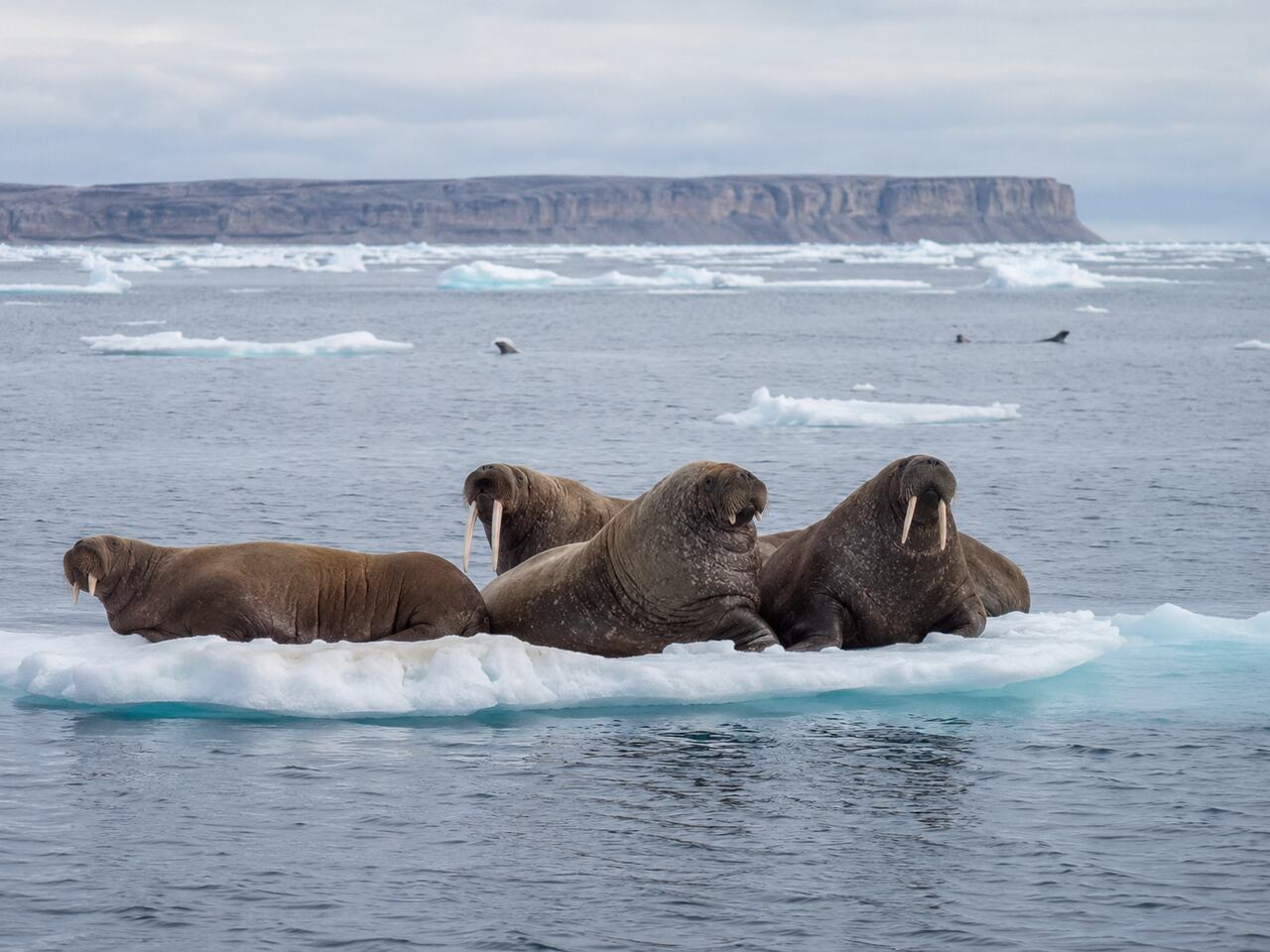
Atlantic walruses have a long history around Akpatok and remain important in Inuit harvesting and knowledge. The Government of Canada’s Atlantic walrus assessment describes seasonal movement through Ungava Bay while emphasizing uncertainty in population information.
That uncertainty matters for visitors. Historic counts or harvest records are not forecasts for your sailing, and a responsible guide will distinguish what has occurred in the region from what is likely on this particular morning.
Walruses may be seen in the water, on a shore, or associated with ice, while seals can surface briefly and disappear. Give hauled-out animals ample space because a group entering the water in alarm is not a successful encounter.
Other wildlife can include gulls and additional seabirds, with the precise mix shifting through the season. Ice shapes the whole food web and the visual experience even when there are no mammals nearby.
Ask the naturalists what to look for rather than demanding a named species. A good interpreter can make feeding behavior, geology, light, and sea ice fascinating long after the distant shape has been identified as another rock.
What a Zodiac operation feels like
If the bridge and expedition leader authorize a Zodiac cruise, groups are normally called in a controlled sequence. Your exact launch time, route, duration, and wildlife distance belong to that day’s operation, not to a schedule copied from an earlier voyage.
Wear every item required by the operator, including the designated personal flotation equipment. Waterproof outer layers, insulation, warm gloves, a hat, suitable boots, and secured eyewear are practical even when the ship’s sheltered deck feels mild.
Board only when invited and use the grip demonstrated by the crew. Keep both hands available for the transfer, place cameras or bags where instructed, and move directly to the assigned seat.
Once seated, stay low and keep your body inside the boat. Standing for a photograph can destabilize a small craft and block the driver’s sightline at exactly the wrong moment.
Wind and spray make the Zodiac feel colder than the air temperature suggests. Protect electronics in a dry bag or weather cover, and keep spare batteries close to your body.
The driver controls proximity to cliffs, wildlife, ice, other boats, and the ship. Patient positioning often produces better observation than chasing movement along the shore.
A ride can be shortened after it begins. Fog can thicken, swell can build, ice can shift, or an animal can enter the operating area, and an immediate return shows that the team is still managing risk.
Getting in and out of the boat
Transfers may involve a moving platform, steps, the inflated tube, crew assistance, and the motion of both ship and Zodiac. Completing a similar transfer yesterday does not guarantee that today’s sea conditions are suitable for you.
Tell the expedition team about mobility, balance, vision, hearing, or grip concerns before group calls begin. They need time to make a safe decision, and they may recommend shipboard viewing instead.
Why the ship may be the best viewing platform
The expedition ship offers height, stability, heated indoor space, restrooms, and room for spotting scopes. A high deck can reveal the colony’s full scale and the movement of animals along a shoreline more clearly than a low boat.
Listen for announcements about which side faces the cliffs and whether the naturalists are using clock positions from the bow. Learning that convention early saves a deck full of people from spinning in different directions.
Rotate through rail space rather than holding one position all day. Leave accessible windows and low rail sections available for guests who cannot move easily between decks.
When fog closes the view, no lens can manufacture visibility. Use the pause for a lecture on birds, geology, Inuit culture, ice, or photography, then return to deck when conditions improve.
For travelers unable to use a Zodiac, shipboard observation is not automatically second rate. It is the primary experience whenever conditions make small-boat work unsafe or disruptive.
There is no honest hour-by-hour itinerary
Akpatok days are built around windows, not appointments. The team may plan a coastal pass, several boat groups, a lecture program, or a second look later, but every element remains conditional.
Prepare clothing, binoculars, medication, memory cards, and batteries before the morning announcement. Eat and use the restroom when the program allows, because your group may be called as soon as a safe window opens.
If the first rotation launches, do not assume the next one will. Weather and wildlife can change faster than a ship can cycle every passenger through a landing platform.
Do not demand an alternative landing when Akpatok closes. A good expedition itinerary offers skilled decision-making and backup interpretation, not control over a remote environment.
My wider Northwest Passage cruise ports guide explains how the same flexibility shapes other Arctic calls. Akpatok is especially pure because there is no town excursion waiting behind the wildlife plan.
Access, permission, and respectful behavior
Passengers cannot treat the lack of fences or signs as permission to go ashore. The operator is responsible for resolving applicable Canadian, territorial, Inuit land, wildlife, and marine requirements before any activity.
Follow biosecurity instructions for boots, clothing, bags, and equipment. Cleaning removes soil, seeds, and organisms that should not travel between remote places.
Nothing should be left on the island or taken from it. Stones, feathers, bones, plants, and cultural material stay where they are, and any dropped plastic or equipment should be reported immediately.
A drone is not a private workaround for distance. Aircraft can disturb birds and wildlife, and their use is controlled by law, ship policy, permits, and local considerations.
Do not describe Akpatok as untouched simply because it lacks a permanent settlement. Inuit have known, used, named, and traveled through this region across generations.
Accessibility and medical reality
Ask the cruise line for its expedition-boat participation criteria before booking. You need concrete information about steps, weight-bearing ability, transfer technique, seating, assistance limits, and whether mobility equipment can be accommodated.
The ship should be the main accessible wildlife platform, though thresholds, exterior doors, deck surfaces, elevators, and observation windows vary. Request the vessel’s actual access plan rather than relying on a generic claim that assistance is available.
Cold can worsen circulation, breathing, balance, pain, and hand dexterity. Carry essential medication on your person, tell the medical team about relevant conditions, and do not let excitement push you past a limit discussed in advance.
There are no visitor restrooms, warm shelters, pharmacies, or emergency services on Akpatok. Anyone boarding a Zodiac needs to tolerate the full operation and a possible delay without shore facilities.
Seasickness can occur at anchor and in a small boat. Discuss medication with a clinician before travel so your first dose is not an experiment conducted beside the boarding platform.
Photography without losing the experience
Use a fast shutter for flying murres and a wider frame for the colony itself. The cliffs tell a story of scale that disappears when every photograph is cropped to a single bird.
Cold drains batteries and warm interiors create condensation. Keep spares insulated, seal cold equipment before returning inside, and let it warm gradually.
Secure straps so they cannot trail outside the Zodiac or catch during boarding. If the driver asks everyone to put cameras down, do it immediately.
Take a few photographs, then lower the camera and listen. Akpatok’s sound, cold air, and sense of distance are usually the parts a file cannot preserve.
Weather, sea ice, and what can cancel the plan
Fog, wind, swell, cold rain, low cloud, and shifting visibility are ordinary possibilities in Ungava Bay. Even a calm view from one side of the ship may hide rougher water near the cliff or landing platform.
Sea ice varies by year, season, location, and wind. The Canadian Ice Service publishes official ice information, while the ship’s master and expedition team make the decisions that govern your call.
Long summer light creates more opportunity to observe, but it guarantees nothing. A late or early wildlife announcement can be wonderful if you have protected some sleep and kept warm clothes ready.
The best mental hierarchy is simple: safe observation first, an appropriate Zodiac cruise second, and a landing only if the operator explicitly authorizes one. That order turns change into expedition reality rather than personal disappointment.
What to pack for the day
Pack in layers that can be changed without exposing yourself to wind. A moisture-managing base, insulating middle layer, and genuinely waterproof outer shell are more useful than one bulky coat.
Bring warm gloves that still let you handle binoculars, plus a backup pair if the first gets wet. A close-fitting hat and neck layer prevent wind from finding the gaps.
Binoculars are essential, and a small lens cloth earns its place quickly. Add a dry bag, spare battery, empty memory card, and any medication you may need before returning to the cabin.
Use the boots and flotation gear specified by your operator. Expedition companies standardize equipment because small differences in soles, straps, and fit matter during repeated transfers.
Frequently asked questions
Does Akpatok Island have a cruise terminal?
No. Ships operate offshore, and there is no terminal, dock, visitor center, or independent transportation.
Will we land on the island?
Do not expect a landing. Any approach depends on authorization, wildlife, birds, shore conditions, surf, ice, and the expedition team’s safety assessment.
Will I see a polar bear?
Perhaps, but there is no honest guarantee. Treat a bear as a possibility and the murre cliffs as the dependable reason for the call.
Can I see wildlife from the ship?
Yes, when distance and visibility cooperate, and the ship’s higher viewpoint can be excellent for understanding scale. Bring binoculars and follow the naturalists’ directions to the active side.
Can wheelchair users join the Zodiac cruise?
Eligibility depends on the vessel, boarding system, equipment, sea state, and the cruise line’s participation rules. Ask for a specific assessment before booking and plan on the ship as the reliable viewing platform.
Can I buy anything ashore?
No, because there are no visitor services. Carry what the operator permits and return with everything you brought.
What happens if the call is canceled?
The expedition leader may substitute shipboard viewing, lectures, another operating area, or a revised route. The correct response depends on the reason and the options safely available that day.
The bottom line
Akpatok is a wildlife encounter, not a destination to conquer. Let murres, limestone, Inuit context, ice, and changing water set the pace, and the day can be extraordinary even when nobody steps ashore.
How this guide was researched: Canadian geographical, land-claim, wildlife, ice, and seabird sources were checked alongside current expedition information on September 11, 2026. Conditions and permissions remain call-specific, so follow your operator’s live guidance and see our Editorial Policy.