Port Taxis: Meters, Flat Rates and the Setups That Overcharge You
You step off the gangway, a driver says forty dollars to the beach, and you say yes. At the beach you find out that forty dollars meant each of you, one way, and nobody actually lied.
My quick take
I am not cynical about port taxi drivers. Most of them are running a legitimate business around a ship schedule they do not control, and some of the best hours I have spent ashore were in the front seat of a cab with a driver who decided I should see one more thing.
What goes wrong is almost always a terms problem, not a character problem. I say the number, the currency, the passenger count and the direction out loud before I close the door, and no driver has ever been offended by it.

The quick facts
- Pricing model: Most Caribbean ports use published fixed rates by zone rather than meters.
- Per person: Plenty of island rate sheets quote a fare for one or two people and charge separately above that.
- Rate board: The official chart is usually posted at the dispatch stand inside the port gate.
- Currency: Say the number and the currency in the same breath, every time.
- Return trip: Settle the ride back before you get out of the car, not after you are on the sand.
What a port taxi is actually pricing
Port taxis mostly price by zone, not by distance. The island or the city gets carved into named areas, each pair of areas has a number attached, and that number is what the driver is working from.
That number is built on three things: a route, a vehicle and a passenger count. Change any one of them and the price legitimately changes, which is where nearly all of the confusion starts.
A flat rate is not a lesser version of a meter. In a lot of the ports cruise ships visit, the fixed published fare is the regulated system, and the meter is the unusual thing.
The price that is per person and not per car
This is the single most common misunderstanding in the Caribbean and it is the one that costs real money. You hear a number, you assume it is for the car, and the driver assumed you understood it was for a head.
On several islands the published fare covers one or two passengers and everyone after that is priced on top. There are zone rate sheets written for one to two people with separate pricing tiers once the group grows, and both readings of a quote are honest.
So do not ask what it costs, ask for the total. The question that ends the argument before it starts is “sixty dollars for all four of us, is that the whole car?”
Where the rate board actually lives
Almost every port with regulated fares posts the chart somewhere, and it is rarely where you would think to look. Check inside the terminal building, at the dispatch booth, taped to a pole at the head of the taxi line, or laminated and stuffed in the driver’s door pocket.
Some destinations publish the whole thing online, which is the version I actually use. Sitting at home with a route by route fare chart a month before I sail is worth more than squinting at a sign while a line builds behind me.
Screenshot it before you go. A phone with the official chart on it settles a disagreement in about four seconds, and it does it politely.
The currency you agreed in
Twenty is a number, not a price. In any port that runs on both US dollars and a local currency, “twenty” can mean two very different amounts, and the gap does not usually land in your favor.
Name the currency out loud, then decide how you are paying. The exchange rate a driver uses to break a large foreign bill is its own quiet fee, which is part of why my guide to carrying cash and cards in port keeps banging on about small bills.
Carry the fare in the right denominations if you can. A driver with no change is not necessarily working an angle, but you are the one who ends up rounding up.
Meters, and where I actually trust them
Meters are genuinely reliable in cities with real enforcement behind them. Big North American, Western European, Japanese and Australian port cities are the easy cases, and the fare structure is normally published down to the surcharge.
The thing that makes a meter trustworthy is not the device, it is the paperwork around it. Where a city publishes the exact per mile rate and every surcharge and backs it with licensing, the meter is the cheapest way to travel and you should just use it.
The same goes for cities that pair a metered fare with a published complaints process and a minimum charge from the cruise terminal. A broken meter, meanwhile, is not a crisis and not necessarily a con, it is just a switch to a different pricing model.
If the meter is out, agree a flat number before the car moves. If that number sounds wrong, the next car is thirty seconds away.
The dispatch stand versus the guy at the gate

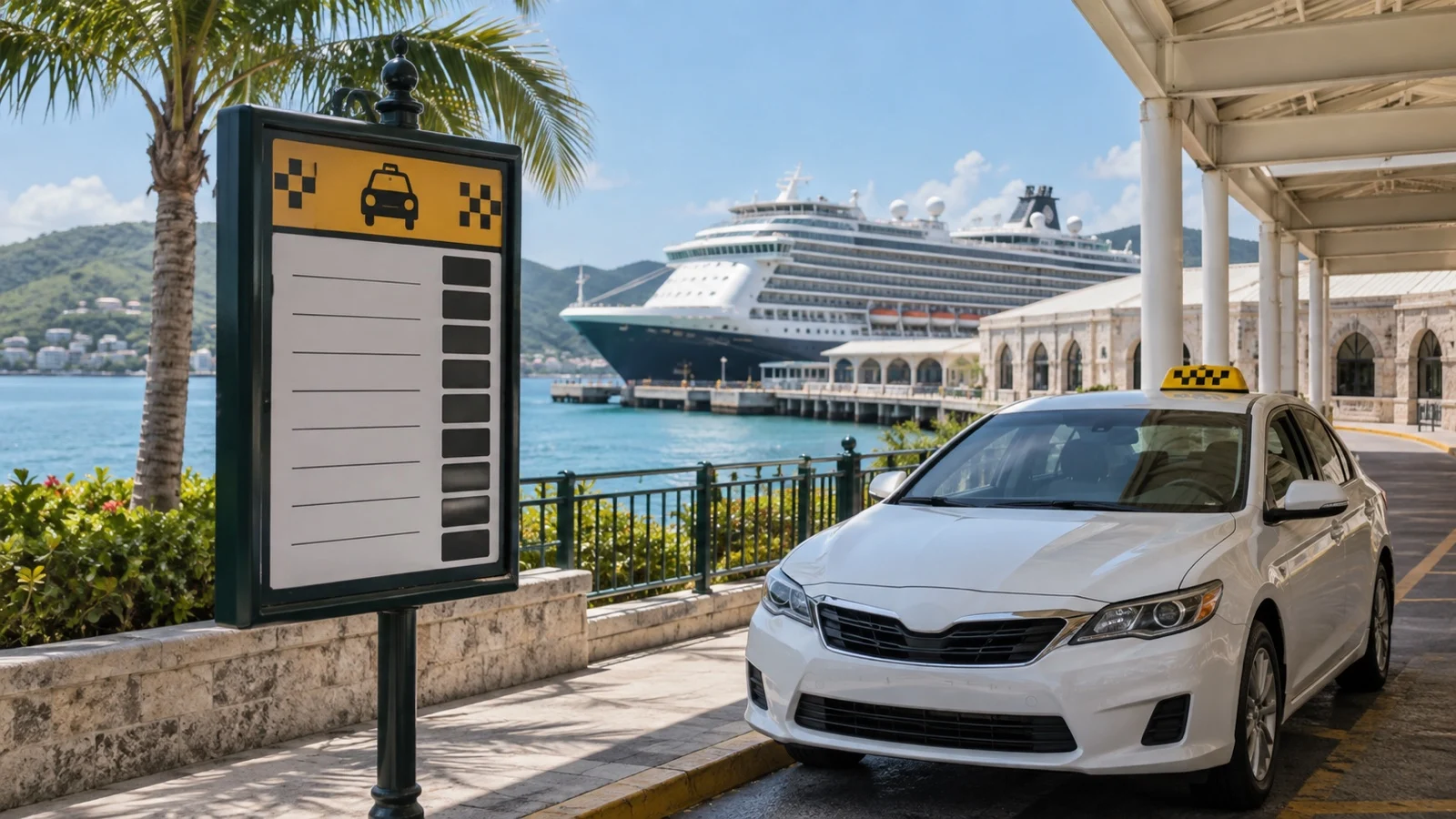
Most cruise ports run some form of dispatch. It might be a booth, a starter in a vest, or one person with a clipboard sending you to the next car in the line, and it exists because the port has a direct interest in you not having a bad morning.
A dispatch stand gives you three things nothing else does. You get a licensed car from a regulated line, a fare taken from the official chart, and a named human being to go back to if something goes sideways.
The person who intercepts you before the stand is not automatically a problem, and sometimes they are cheaper. They are simply outside the system that would help you, and on a day where your ship leaves at five, that is the entire difference.
The gate is a real line even when it does not look like one
In a lot of ports the rules change at the port gate. Inside, cars are licensed, dispatched and priced from the board, and outside it is simply a street.
Walking out can genuinely be cheaper, and in some big cities it is the obvious move. It also means whatever you agree is strictly between you and that driver, with nobody standing behind it.
Check the layout before you sail rather than at the bottom of the gangway. Some ports are working cargo terminals where you cannot walk out at all, and the ports where the shuttle is not optional are worth knowing by name.
The tour you did not ask for
The upsell is the friendliest overcharge there is. You asked for a ride to a beach, and somewhere along the way it becomes a viewpoint, a spice stall, a rum stop and a photo of a fort.
Sometimes that turns into the best day of the whole cruise. It is also a different product at a different price, and the price tends to show up at the end rather than the beginning.
If the route changes then the number changes, so say so while it is still changing. Asking what the new total will be is not rude, any more than it would be rude with a plumber at home.
The return leg is what you are really betting on

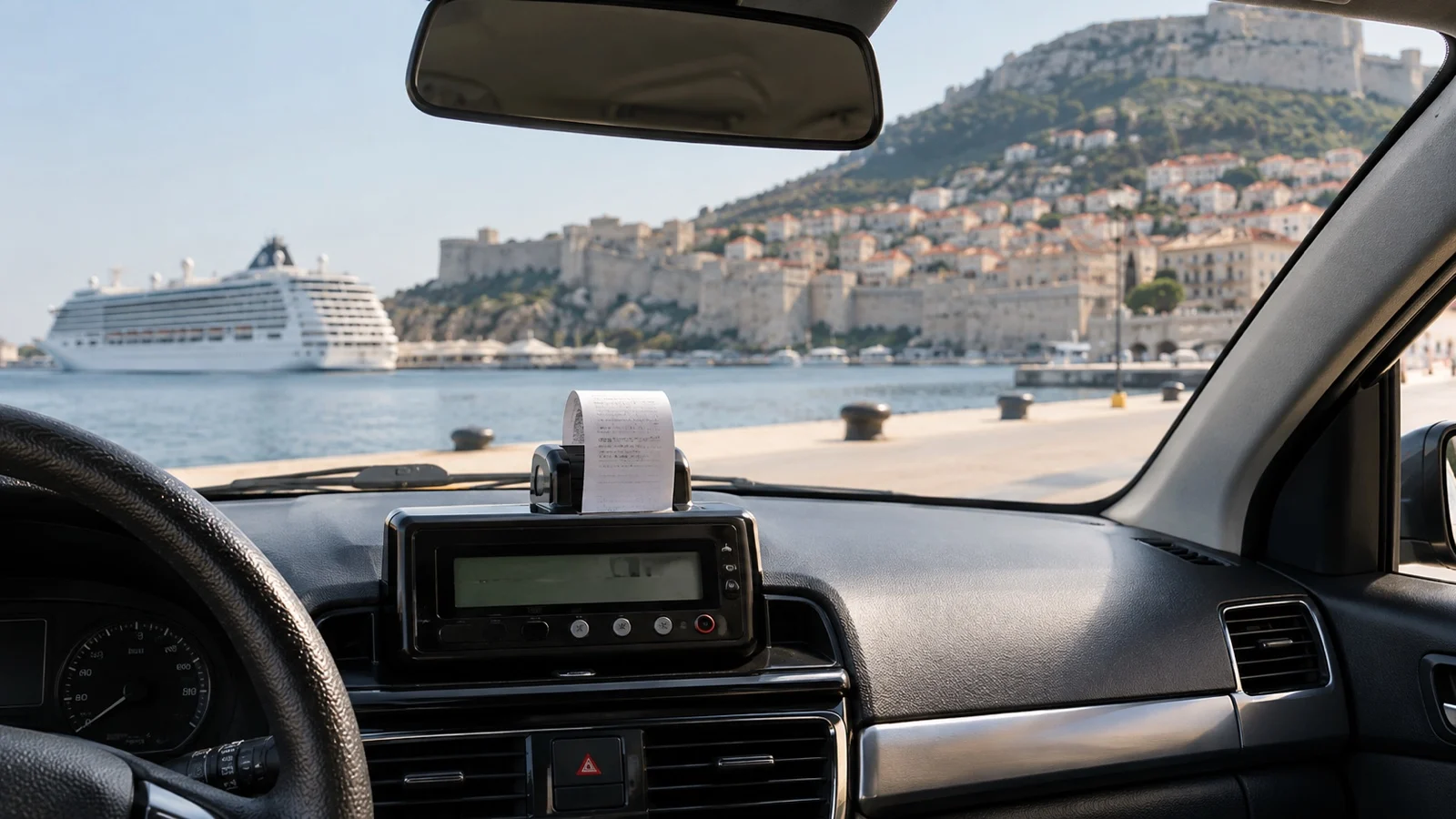
Getting from the pier to a beach is the easy half of the day. Getting back at three in the afternoon, from a beach holding four hundred other cruise passengers and served by about six cars, is the half that costs money.
Agree the round trip up front, out loud, with a pickup time and a spot you can describe. Then write down what you agreed, because a beach bar at two in the afternoon is not a great place to reconstruct a conversation.
- Total price: For the whole car, both directions, everyone in your group.
- Currency: Named explicitly, not implied.
- Pickup time: Plus a landmark you will still recognize with sand on your feet.
- Contact: The driver’s name and a phone number that works locally.
- Backup: What you will do if nobody shows, decided while you are still calm.
Build in a buffer against all-aboard time that you would be embarrassed to admit to. An hour of sitting by the ship beats twenty minutes of sprinting toward it.
Vans, big groups and when the math flips
Six people is a different vehicle and usually a different rate. A van or a small taxi bus is often cheaper per head than two sedans, but it is not always sitting at the pier waiting for you.
Where fares are set per car, a full car is the best value on the island. Some places price the vehicle for up to four people and add a modest charge for each extra passenger, plus surcharges at night and on public holidays.
Where fares are set per head, group size barely helps and the van is about comfort instead. Either way, ask for the vehicle and the total in one sentence: “one van, six of us, round trip, what is the number?”
Paying at the end, and what a deposit really buys
I pay at the end wherever I am allowed to. Money still in my pocket is the most reliable reason for a car to be at the beach entrance at the time we agreed.
Some drivers reasonably want something up front, especially if they are turning down other fares to wait around for you. Half now and half later is a fair answer, and so is covering their lunch while they wait.
What I avoid is handing over the full round trip before we have gone anywhere. That is not a deal, it is a prepayment with no leverage attached, and tipping customs vary enough by country that you should check yours rather than guess from home.
Turnaround day taxis are a different transaction
Embarkation and disembarkation rides are not port day rides. They are airport work, they are time critical, and they often run on a completely separate set of rules from the taxi that takes you to a beach.
Some cities set a flat airport fare in each direction, which is the easiest version of this to plan around. Others meter it with an airport surcharge, and a few apply a minimum fare to anything starting at the cruise terminal.
The thing worth checking is capacity, not price. Four adults with four large suitcases do not fit in a standard sedan, and discovering that with a flight to catch is a genuinely bad start to a vacation.
When the taxi is simply the right answer
For all of the above, the taxi is still what I default to in most ports. The line of cars outside the terminal is the one piece of transport that is always there, and on a day with a departure time attached, always there is worth paying for.
Ride hailing is excellent where it works and useless where it does not, and the pier is a terrible place to find out which one you got. My guide to where ride-hailing works at cruise ports is the check I run before I sail, not on the day.
Renting a car beats a taxi in a short list of ports and is an expensive mistake in plenty of others, which is the whole point of my guide to renting a car on a port day. Compare it against the round trip taxi number before you book anything.
In a fair number of stops you do not need wheels at all. The Caribbean ports that are easy without an excursion mostly put you within a short walk of something good, which is the cheapest taxi negotiation of all.
Quick answers
Are cruise port taxi rates per person or per car?
It depends entirely on the destination, and both systems are common in the Caribbean. Ask for the total for your whole group in one direction, then confirm it covers the car rather than each seat.
How much is a taxi from the cruise port to the beach?
Short beach runs in the Caribbean are usually modest for a car and add up quickly once a fare is charged per head. Look up the posted zone rates for your specific port before you sail, since they get revised regularly.
Should I pay a port taxi before or after the trip?
Pay at the end when you can, especially on a round trip where the driver is waiting for you. A partial deposit is reasonable, but full prepayment leaves you with nothing to negotiate with.
Is it cheaper to get a taxi outside the cruise port gate?
Sometimes, in cities where street taxis are metered and regulated the same way as the ones inside. In smaller ports the car inside the gate comes with a posted rate and a dispatcher, which is usually worth the difference.
Do cruise port taxis take credit cards?
Assume no unless you have confirmed otherwise for that specific port. Carry enough local or US cash in small bills to cover the round trip plus a tip.
Final word
Almost none of this is about dishonest drivers. It is about two people using the same word to mean different amounts of money, in a hurry, in a language that is native to only one of them.
Say the total, the currency, the headcount and the return time before you sit down, and the overwhelming majority of port taxi problems never happen. Then enjoy the ride, because the driver usually knows the island better than the excursion desk does.
How this guide was researched: Published taxi tariffs, zone rate sheets and regulated meter rates for several major cruise destinations were checked in September 2026, along with the surcharge and luggage rules attached to them. Fares, surcharges and passenger thresholds are revised often, so confirm the current posted rates for your own port before you sail. See our Editorial Policy.
More on this topic: browse every guide on port logistics and timing.