St. Louis River Cruise Port: Downtown Levee, Gateway Arch and Alton Guide
St. Louis can mean a city visit near the Gateway Arch or an Alton, Illinois, transfer tied to the same advertised destination. Confirm the actual address first, then build the day around Arch security and tram limits, metropolitan transfer time, and a comfortable return margin.
Quick take
St. Louis is an active 2026 Mississippi cruise destination and gateway city, but it is not one universal berth. Current American Cruise Lines and Viking itineraries use a St. Louis and Alton framework, so do not assume an overnight ship will use the downtown sightseeing-boat levee.
For a daytime call, prioritize Gateway Arch National Park, the free Museum under the Gateway Arch, and the newly reopened Old Courthouse. Reserve the Tram Ride to the Top in advance if it matters, because timed tickets can sell out and the experience has important mobility restrictions.
For embarkation, follow the cruise line’s address rather than the largest landmark on the brochure. The Arch is magnificent, but it is a poor substitute for finding your ship.
Quick facts
- Into Town: Current overnight itineraries may use Alton, Illinois, with a cruise-line transfer; the downtown levee below the Gateway Arch serves local sightseeing boats but does not prove your ship’s berth.
- Currency and Language: US dollar and English. Cards are widely accepted, but small cash helps for tips and small purchases.
- Time Zone: Central Time, UTC-6 standard and UTC-5 daylight time, observed from March to November.
- Operational note: High or low water, levee access, river traffic, weather, or itinerary changes can move, shorten, or replace the call. No audited local missed-call rate is published.
A switch between downtown and Alton, a changed transfer plan, or reduced time does not necessarily remove the St. Louis destination. Follow the operator’s final documents and daily instructions.
Is St. Louis an active river cruise port in 2026?
Yes. American Cruise Lines’ current Upper Mississippi itinerary sells 2026 voyages beginning or ending at “St. Louis, MO / Alton, IL,” and notes that fluctuating river conditions can affect the route.
Viking’s 2026 Big Easy to the Gateway City voyage likewise ends at “St. Louis (Alton).” Those parentheses carry real logistical weight because Alton is a separate Illinois river city north of downtown St. Louis.
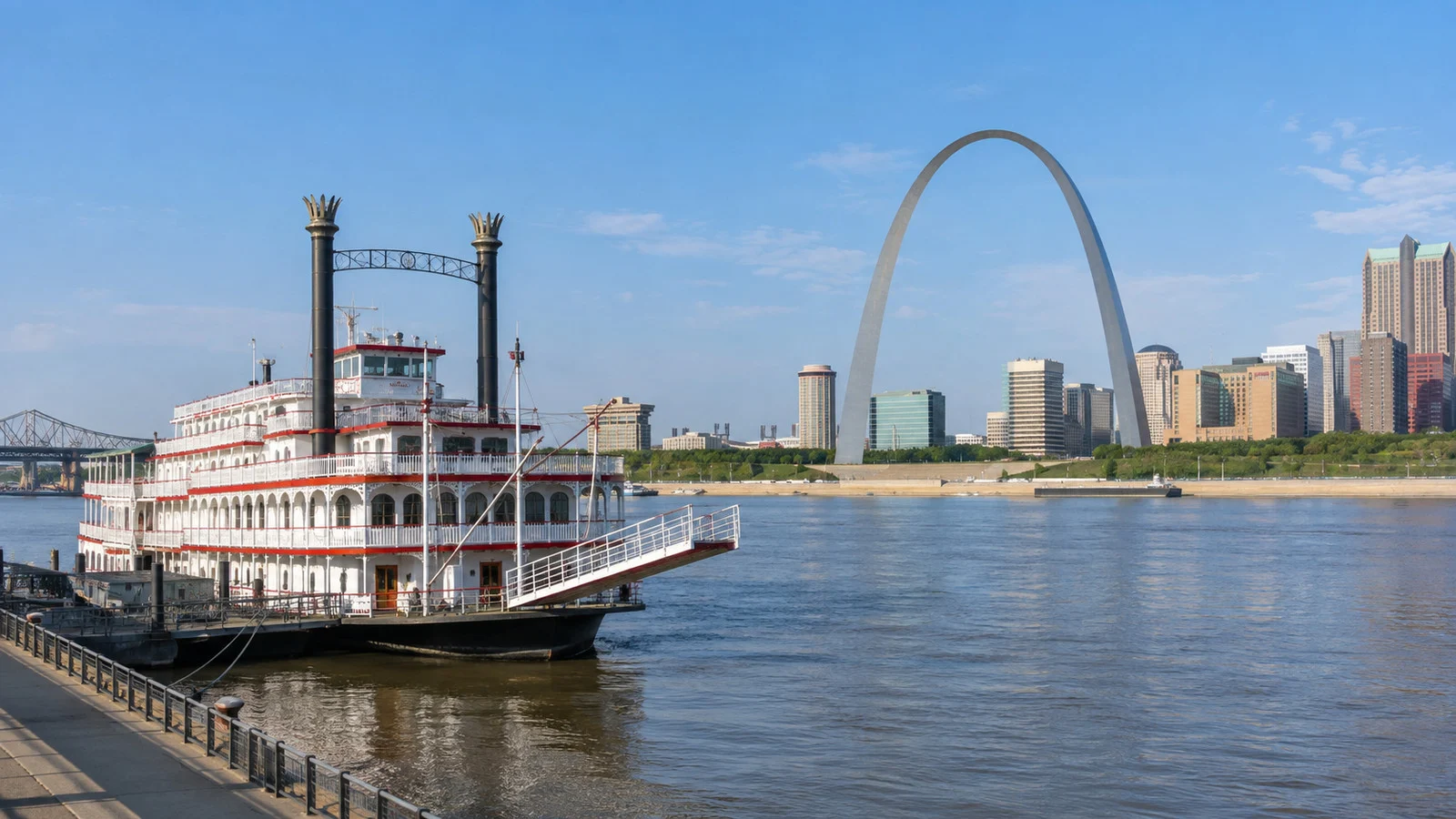
Local excursion boats also operate from the Arch levee in 2026, confirming an active downtown passenger waterfront. The Gateway Arch’s official 2026 season announcement lists daily sightseeing cruises beginning March 5, although those local boats do not determine where an overnight cruise ship will berth.
Use the Mississippi River cruise ports guide to compare St. Louis with neighboring Upper and Lower Mississippi calls. The city often functions as the handoff between those two styles of itinerary.
What does the downtown levee prove?
The Riverboats at the Gateway Arch publish 50 South Leonor K. Sullivan Boulevard as their local sightseeing-boat boarding address. The sloped historic levee below Gateway Arch National Park is paved in cobblestones, with floating docks or landing structures connecting boats to shore.
That address proves the location of the local sightseeing dock, not a guaranteed overnight-vessel berth for any cruise operator. Current overnight itineraries can instead use Alton and a motorcoach transfer.
A larger cruise ship may use another assigned position along the city front, or the itinerary may use Alton instead. River stage, vessel dimensions, tow traffic, dock availability, maintenance, security, and the cruise line’s hotel program all influence the decision.
Read the final travel documents, luggage tags, and same-day instructions. “St. Louis” on the itinerary identifies the destination region, not permission to ask a rideshare driver to improvise along several miles of river.
Downtown levee to the Gateway Arch
From a landing near the Arch, the park grounds can be only a few minutes away. The direct route rises from the levee by the Grand Staircase or long ramps, then crosses the landscaped grounds toward the visitor entrance on the west side of the Arch.
Allow an estimated 10 to 20 minutes from a nearby gangway to the Arch entrance, excluding security. This is an editorial range because berth position, water level, ramp route, and personal pace can change the walk considerably.
The staircase is the shortest-looking option, but the ramps are kinder to knees, wheelchairs, scooters, and rolling luggage. At low water, more of the steep cobblestone slope may be exposed between the dock and park.
The Gateway Arch’s accessibility guidance says newer sloping paths connect the riverfront and park, yet it also warns that cobblestones are difficult and the paved paths across the levee are not ADA compliant. That is unusually candid guidance, and cruise guests should take it seriously.
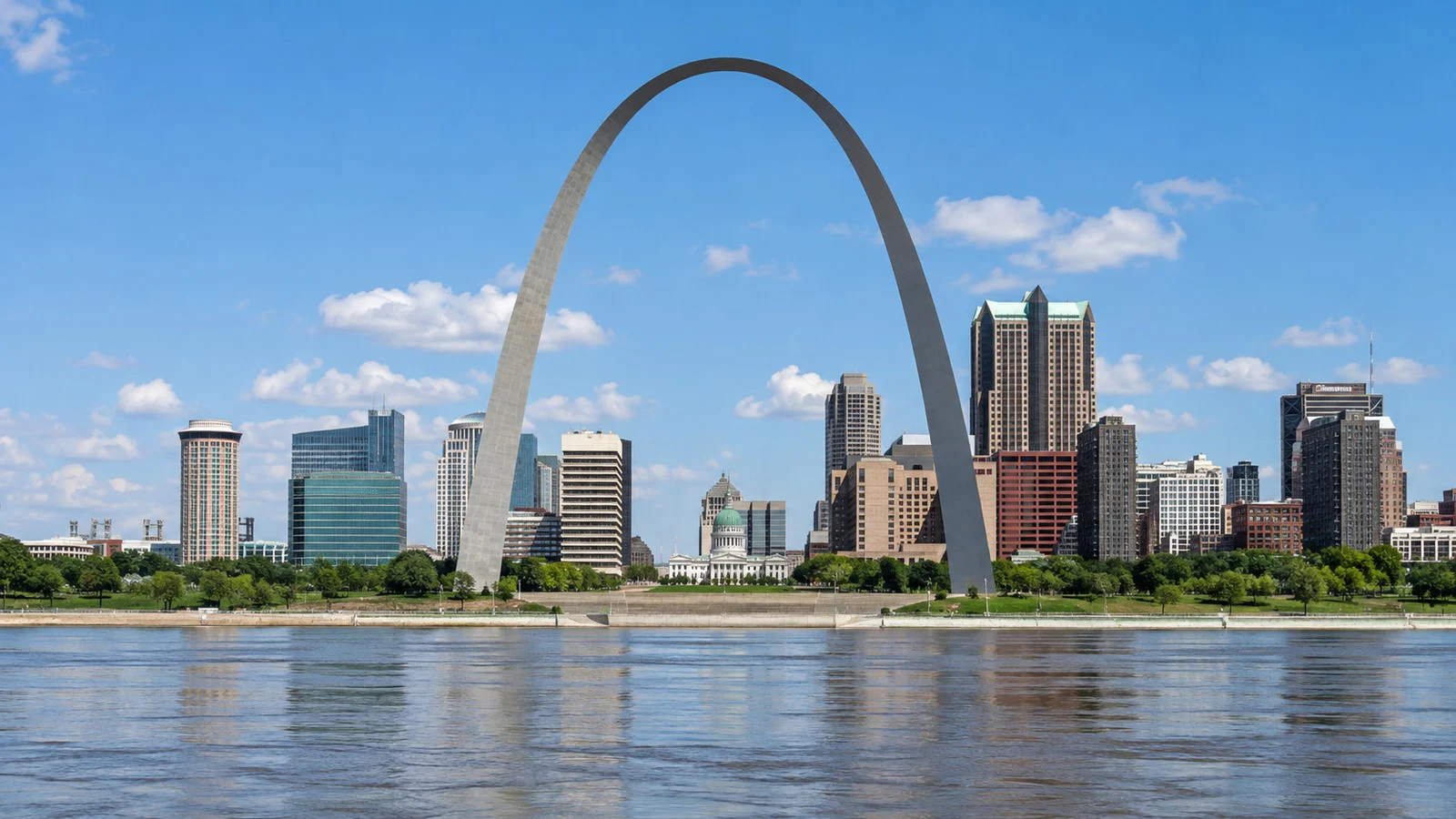
Gateway Arch National Park
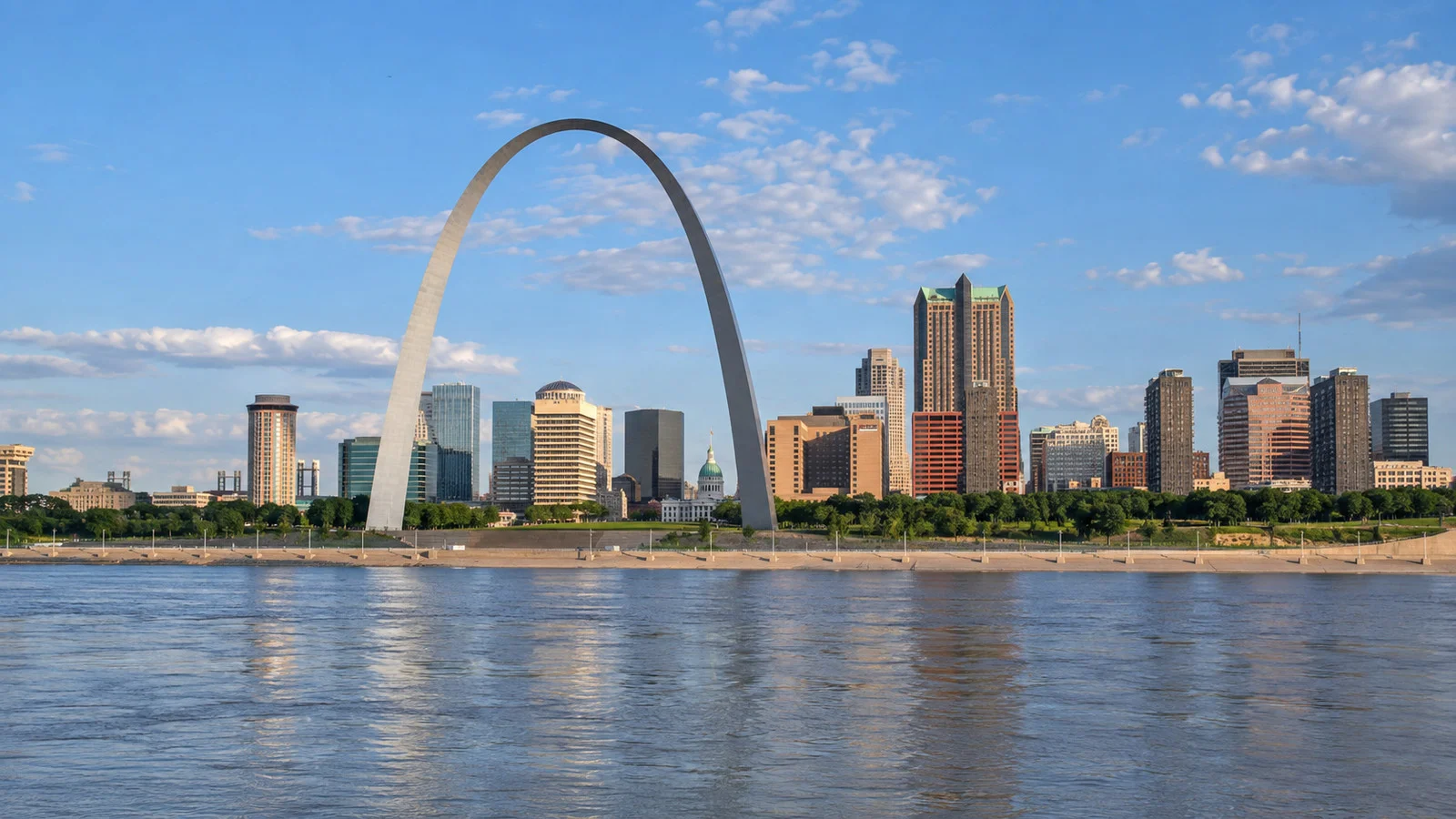
The Arch, museum, grounds, and Old Courthouse form a compact national park in central St. Louis. Eero Saarinen’s stainless-steel monument commemorates the city’s role in United States expansion, but the museum adds the people, conflicts, and consequences that a triumphant skyline silhouette cannot explain alone.
Enter through the visitor center facing Fourth Street and the Old Courthouse, not through an Arch leg. Every visitor entering the underground museum and tram area passes airport-style security, so keep bags simple and prohibited items aboard the ship.
The official Gateway Arch visitor guidance says to allow at least 15 minutes for screening, while some 2026 notices recommend arriving 30 minutes before a reserved tram time. On a cruise schedule, use the more generous buffer.
The Museum under the Gateway Arch
The museum is free, indoors, and far more than a waiting room for the tram. Six galleries interpret Indigenous homelands, colonial St. Louis, river commerce, westward migration, national expansion, and the building of the Arch.
Give it at least 45 to 75 minutes if you want more than air conditioning and a quick photograph. That timing is an editorial planning estimate, and curious readers could easily stay longer.
Approach “westward expansion” critically. Settlement, trade, and migration were intertwined with Indigenous dispossession, slavery, warfare, federal policy, and environmental transformation, all of which deserve more attention than a cheery wagon graphic.
The Tram Ride to the Top
The tram is ticketed, timed, and popular enough to sell out. Buy through the official site in advance only if the ship’s schedule gives you a comfortable margin for security, boarding, the ride, and the return to the levee.
The top is not wheelchair accessible. Official guidance says passengers must manage at least 96 steps in six flights, may need to stand for 30 to 60 minutes or longer, and cannot take wheelchairs, walkers, scooters, or strollers into the tram cars or observation deck.
The compact tram capsules can also feel tight for guests who dislike enclosed spaces. A full-scale keystone exhibit with live camera views offers an accessible alternative without asking your knees to negotiate with modernist architecture.
The Old Courthouse
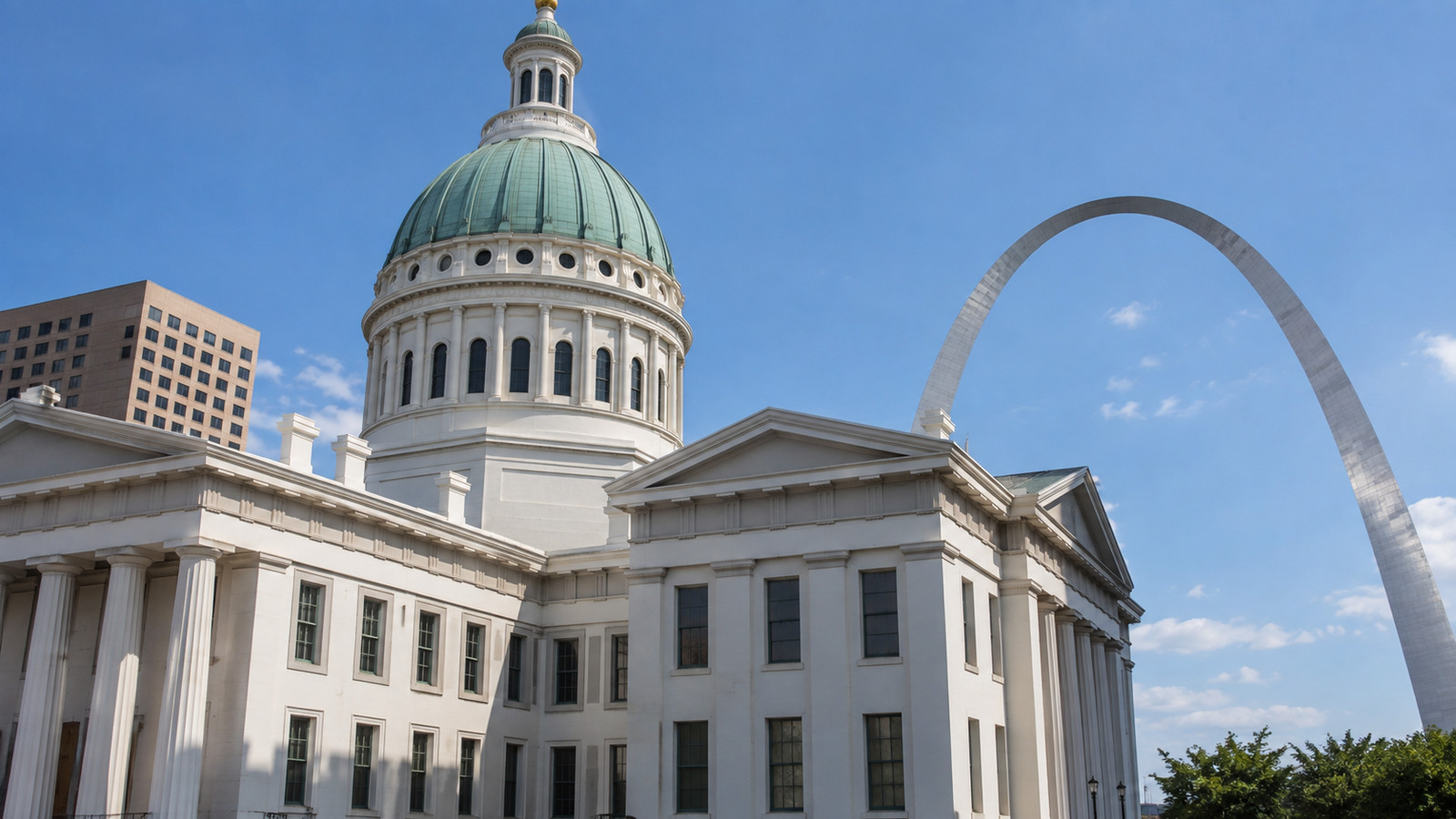
The Old Courthouse stands west of the Arch grounds and reopened with updated exhibits and accessibility improvements. Its free museum addresses the Dred and Harriet Scott freedom suits, American courts, and African American life in St. Louis.
This stop makes the park’s story more honest. The United States expanded west from a city where enslaved people pursued freedom through the courts, only to see the Supreme Court’s 1857 Dred Scott decision deny citizenship and federal power to restrict slavery in the territories.
The building now has ramps, an elevator, added restrooms, and accessible exhibits. Unlike the Arch interior, it does not use the same security screening process, although weapons and other listed items remain prohibited.
What else can you reach from the riverfront?
Laclede’s Landing
North of the Arch, Laclede’s Landing preserves warehouse buildings and some of downtown’s oldest street fabric. It is close enough for a short walk, but brick and cobblestone surfaces can be uneven.
The MetroLink station here connects the riverfront with other city districts. Check elevator status before relying on it, because Metro Transit publishes alternate routes when an elevator is unavailable.
Citygarden and downtown
Citygarden places contemporary sculpture, lawns, water features, and shade along Market Street. From the Arch visitor entrance, allow roughly 15 to 20 minutes on foot, an editorial estimate for a mostly urban route.
Busch Stadium is also nearby, although a baseball game requires enough port time and a ticket secured independently. Do not let the seventh inning stretch become an unplanned overnight in Missouri.
Missouri History Museum and Forest Park
The Missouri History Museum is in Forest Park, not beside the Arch. MetroLink or a taxi can make it realistic on a long independent day, but it should not be squeezed between a timed tram and early all-aboard.
Forest Park also contains the Saint Louis Art Museum, Saint Louis Zoo, and Missouri Botanical attractions nearby or elsewhere in the city, each substantial enough to dominate a visit. Pick one rather than trying to turn public transit into a scavenger hunt.
Accessibility from gangway to city
A modern ship may provide accessible public rooms and elevators, yet the shore connection remains a separate chain. Ask about gangway width and slope, the surface between ship and motorcoach, lift-equipped transfers, restroom access, and whether the day uses downtown or Alton.
At the downtown levee, high water can limit access from the road to the dock ramps. Low water exposes more sloped cobblestone, while rain makes an already irregular surface less forgiving.
Gateway Arch National Park itself has paved accessible paths, a highly accessible museum, and an accessible Old Courthouse. The tram to the top is the major exception, and the riverfront transition below the park remains the awkward link.
The river cruise accessibility guide has questions worth sending to the line before final payment. “Wheelchair friendly” is not specific enough for a steep levee or a transfer between two states.
High water, low water, and the working harbor
St. Louis sits just below the Missouri River confluence in a busy commercial corridor. Barges and towboats are not background decoration, and their movements can affect when a passenger vessel approaches or leaves a landing.
High water can cover lower parts of the levee, remove parking, alter pedestrian access, increase current, and trigger navigation precautions. The official Arch parking page says levee parking may close and directs visitors to an inland garage when river conditions make the waterfront unavailable.
Low water can steepen the route down to a floating dock and constrain usable landing geometry. It may also slow sailing or alter calls elsewhere on the itinerary even when St. Louis itself remains reachable.
Fog, thunderstorms, extreme heat, bridge traffic, maintenance, and berth conflicts add ordinary operational uncertainty. Our river cruise low-water guide explains why operators sometimes change a landing or motorcoach transfer to preserve the itinerary.
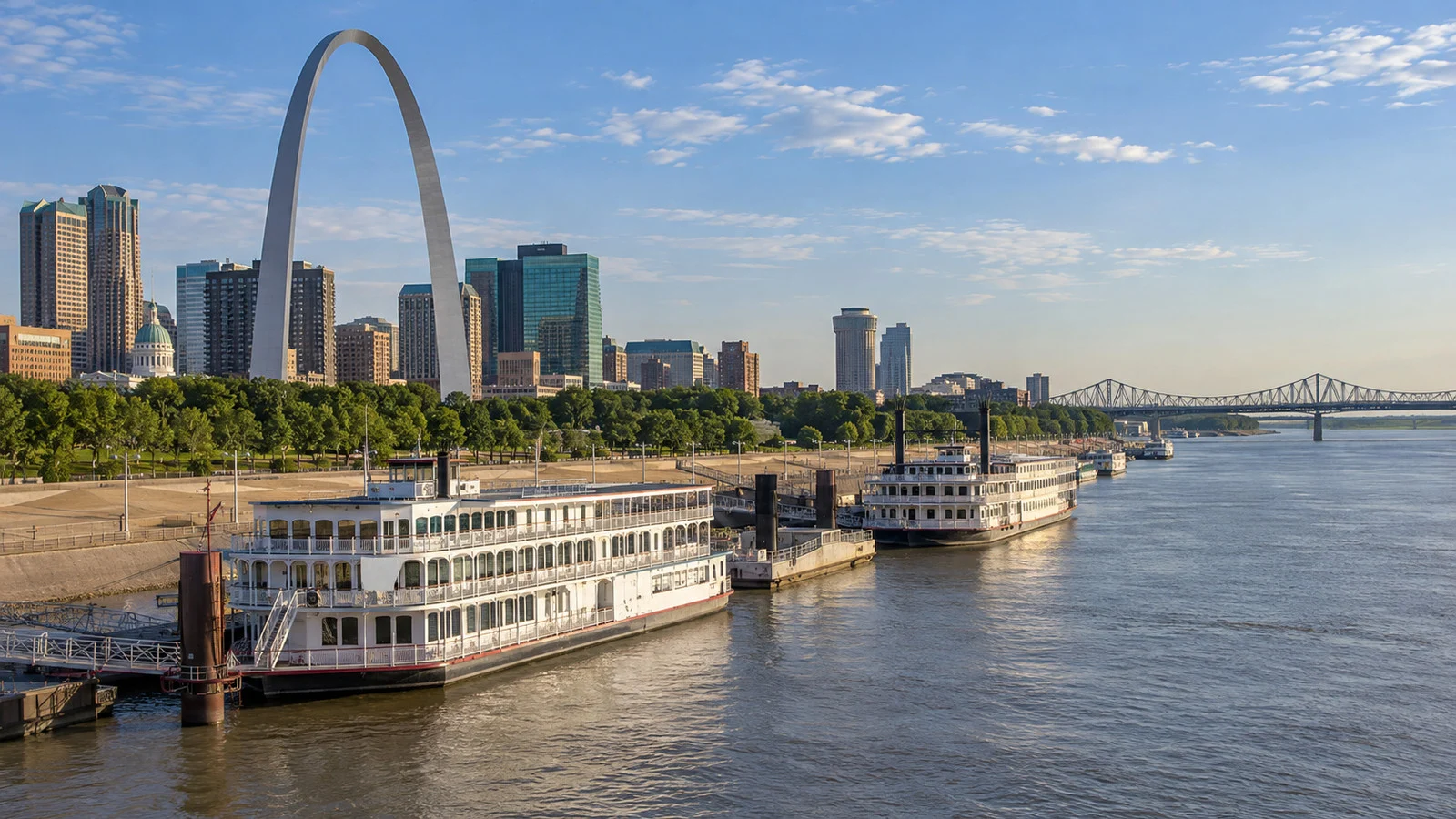
Embarking or disembarking in St. Louis
Do not assume the ship spends embarkation day under the Arch. Current American Cruise Lines and Viking itineraries explicitly pair St. Louis with Alton, so the line may use a St. Louis hotel, move guests by motorcoach, and board the vessel in Illinois.
The final cruise documents outrank every blog, map pin, and friendly hotel clerk. Confirm the hospitality desk, baggage deadline, motorcoach departure time, ship location, and whether independent arrivals may go directly to the vessel.
If flying, build in a full day before embarkation when possible. A same-day delay becomes particularly unpleasant when your hotel, luggage, transfer motorcoach, and riverboat are all moving through different parts of the metropolitan area.
At disembarkation, identify whether the advertised St. Louis arrival means downtown, Alton, or a motorcoach terminating at a hotel or airport. Schedule flights with the cruise line’s stated earliest-departure guidance, not the optimistic drive time shown at 2:00 in the morning.
The Arch and Alton plan to confirm
Use the cruise documents for the exact downtown or Alton address, pickup point, and luggage instructions. If this is embarkation, arrive in the metropolitan area at least one night early when practical, because a same-day delay can separate you from both the hotel transfer and the ship.
Gateway Arch museum entry is free, but the tram requires a paid timed ticket and security screening. The tram and observation deck are not wheelchair accessible, so use the museum, grounds, Old Courthouse, and live-view alternative when stairs, enclosed capsules, or prolonged standing are unsuitable.
Gateway Arch is a national park, so follow current screening, prohibited-item, monument, and park rules. Do not climb structures, cross barriers, or treat a riverfront drone launch as harmless simply because the grounds feel like an urban lawn.
From downtown, follow the ship’s stated return margin and allow more time after an independent vehicle trip. From Alton, use the operator transfer unless a private ride has a written meeting point, traffic allowance, and return that protects all aboard.
Foreign passengers remain subject to current United States entry rules. An accessible park does not make the cobbled levee, variable gangway, Alton motorcoach, or tram accessible, so confirm each link separately.
Three realistic plans
Classic first visit
Walk or ride from the levee to Gateway Arch National Park, visit the free museum, and use a prebooked tram ticket if mobility and time allow. Add the Old Courthouse before returning to the ship.
History without the tram
Spend longer in the Arch museum, continue to the Old Courthouse, then walk toward Citygarden or Laclede’s Landing. This plan has more interpretation, fewer lines, and absolutely no requirement to sit inside a tiny metal capsule.
Mobility-conscious visit
Use the operator shuttle or accessible drop-off at the park’s west side, then enjoy the museum, grounds, and Old Courthouse. Confirm the levee-to-motorcoach route in advance and use the Arch’s live-view exhibit instead of the inaccessible tram.
Quick answers
Do river cruise ships dock beneath the Gateway Arch?
Some calls use the downtown riverfront near the Arch, but no single berth is guaranteed. Other St. Louis itineraries embark or disembark in Alton, Illinois, with a motorcoach transfer.
Can I walk from the ship to the Arch?
From a nearby downtown landing, yes. Expect a steep cobblestone levee plus stairs or long ramps, and allow an estimated 10 to 20 minutes before security.
Is the Gateway Arch museum free?
Yes, entry to the Museum under the Gateway Arch is free, although security screening is required. The tram, documentary film, virtual reality experience, and riverboat rides have separate tickets.
Can wheelchair users ride to the top?
No. The observation deck requires at least 96 steps, and wheelchairs, scooters, walkers, and strollers are not permitted in the tram cars or at the top.
Will flooding cancel St. Louis?
Not necessarily. High water can close levee access or move a landing, while operators may use a different dock, transfer route, schedule, or Alton before canceling the destination.
The last word
St. Louis can deliver the rare river cruise moment when the signature landmark is visible before breakfast and walkable after it. The Arch is the easy part; understanding which waterfront, transfer, and level of the levee you are using takes the real planning.
Follow the final berth instructions, reserve the tram only with a comfortable buffer, and give the museums time to complicate the postcard. This city is more rewarding when the Gateway to the West opens onto the full story rather than a souvenir shop.
How this guide was researched: No firsthand visit is claimed; current itinerary, transfer, riverboat, park, security, and accessibility details were checked against American Cruise Lines, Viking, Gateway Arch National Park, and Riverboats at the Gateway Arch.
Logistics and time-sensitive details were reviewed September 12, 2026. See our Editorial Policy.