Service Dogs on a Cruise: Which Countries Let Them Ashore?
A trained service dog can go ashore only when two separate gates open. The cruise line must accept the dog for the voyage, and each country or territory must authorize entry at that specific port.
Boarding approval is not a passport for every stop, and a country’s general pet rules may not work for a cruise arrival. Think of the ship as the carrier and every port as a new border.
The short answer by destination
There is no worldwide yes list, and this is not a substitute for a permit. These are practical starting points for common cruise regions, based on rules available in September 2026.
- European Union and Ireland: Often possible when the dog meets the EU’s noncommercial animal-entry rules and is cleared at the correct travelers’ point of entry. Microchip, rabies timing, an animal health certificate, and sometimes a rabies titer or tapeworm treatment are part of the file.
- Great Britain: Often possible only on an approved route with a registered carrier, plus the correct pet travel document and any required tapeworm treatment. The exact ship and route matter as much as the cruise brand.
- Canada: Often possible, and a certified guide, hearing, or service dog accompanying its user has a limited exemption from Canada’s rabies-certificate requirement. Carry training or certification evidence and vaccination records anyway because the line and border official still make their own checks.
- Mexico: Potentially possible with inspection and current animal-health documents. Dogs traveling from the United States now need the current New World screwworm inspection document, and cruise lines may impose additional parasite-document rules.
- Bermuda, the Cayman Islands, and the Bahamas: Potentially possible, but each uses advance animal-entry paperwork and none should be treated as a casual walk-off port. The Cayman Islands has especially long lead times, origin restrictions, breed restrictions, and a rabies-titer sequence.
- Jamaica: Plan on no shore visit unless Jamaican Veterinary Services and your cruise line approve the exact cruise port and arrival in writing. Published import routes and cruise-port operations do not always match.
- Iceland: No for a normal cruise call. Iceland’s food and veterinary authority says animals aboard visiting vessels may not leave the carrier, including service animals.
- Norway: Potentially possible with the correct entry document, rabies record, and usually veterinarian-administered tapeworm treatment 24 to 120 hours before entry. The rule set depends on where the dog is arriving from.
- Australia and New Zealand: Narrowly possible in specific domestic or trans-Tasman arrangements, not a general yes for international cruises. Current Australian guidance says New Zealand clearance for an assistance dog arriving by cruise from Australia can be completed only at Auckland.
- United States return: The answer depends on every country visited during the previous six months and the dog’s rabies-vaccination history. Do not assume the outbound paperwork covers reentry.
A port not named here is not automatically allowed or prohibited. Ask the national animal-health authority about arrival by cruise vessel, then get the line’s access desk to confirm the sailing-specific process.
Why ship boarding and going ashore are different
Carnival’s current service-dog policy spells out two document sets: one to board the ship and another for entry at each port. It also says port approval is controlled by local authorities, not guaranteed by the cruise line.
That distinction applies even when another line uses different forms or deadlines. A dog can be accepted onboard for the full cruise and still be required to remain aboard in one or more countries.
This guide covers task-trained service dogs, not pets, emotional support animals, or dogs in training. Each cruise line defines its onboard eligibility, and some lines exclude those other categories entirely.

The document sequence that causes the most trouble

- Confirm the dog is eligible to sail: Contact the line’s access department before paying a nonrefundable deposit. Ask about the ship, itinerary, relief area, tender ports, required forms, and the deadline for submitting copies.
- Map every border: Include embarkation, every port where the dog might leave the ship, and final disembarkation. Reentry to the United States is a separate border step.
- Check the arrival mode: Ask each authority about a dog arriving on a cruise ship for a day visit. Rules written for airports or permanent imports may not authorize the cruise pier.
- Microchip before rabies work: Several countries require the chip to be implanted or read before the qualifying rabies vaccination. Reversing the order can invalidate the vaccination sequence.
- Build backward from timed treatments: Health certificates, parasite treatments, and inspections can have windows measured in days or hours. A titer test can add months, so the hardest port sets the calendar.
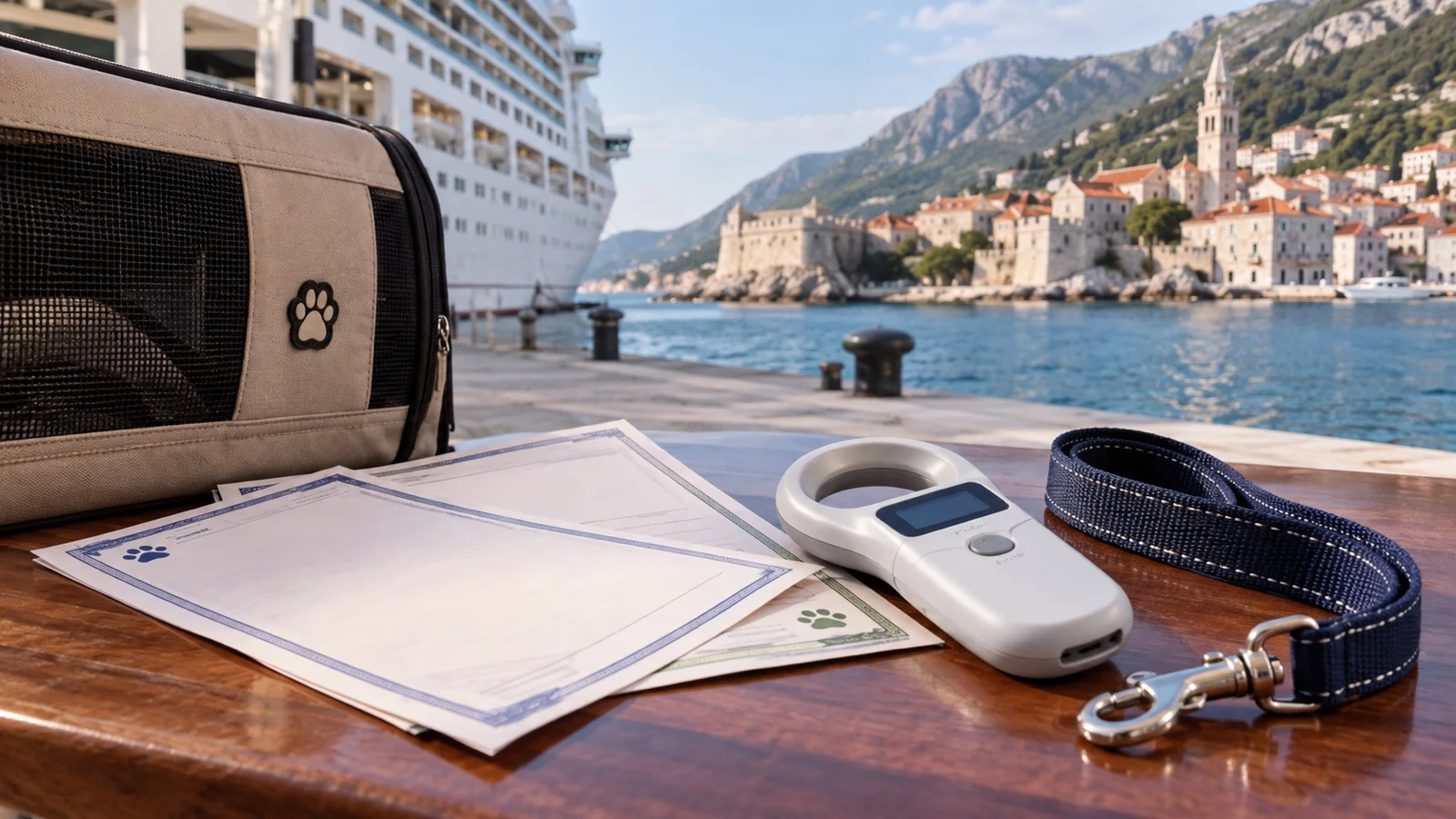
- Carry originals: Keep permits, certificates, vaccination records, microchip details, titer reports, training evidence, and written approvals in hand luggage. Also keep digital copies where they are available offline.
Ask your veterinarian which certificates require government endorsement, because a clinic signature alone is not enough everywhere. For United States-origin dogs, use a USDA-accredited veterinarian when USDA endorsement or an export document is required.
European Union and Ireland
The European Commission’s noncommercial entry rules generally require identification by microchip, valid rabies vaccination, an animal health certificate, and an owner’s declaration. The primary rabies vaccination becomes valid only after at least 21 days, and it cannot predate the chip.
A rabies antibody titer is required for arrivals from some countries but waived for countries on the EU’s current listed-country annexes. Do not rely on an old country list because the governing annexes and certificate models changed in 2026.
The health certificate is generally valid for ten days to the documentary and identity check, with the period extended by the sea journey. After successful entry checks, it can support onward movement within the EU for up to six months or until the rabies vaccination expires, whichever comes first.
Ireland follows EU rules and also requires veterinarian-administered tapeworm treatment 24 to 120 hours before scheduled entry. Your first EU landing must be able to perform the required check, so confirm the actual travelers’ point of entry with the authority and line.

Great Britain
England, Scotland, and Wales apply pet-travel health rules to guide and assistance dogs. A dog normally needs a microchip before rabies vaccination, the correct travel document, and tapeworm treatment 24 hours to five days before arrival when that treatment applies.
The quiet trap is the route. GOV.UK maintains a live list of registered cruise companies, ships, and routes for assistance dogs, and it warns that a dog may still be unable to leave the ship outside the United Kingdom.
Check the specific hull and itinerary rather than spotting the brand name and calling it done. If entry rules fail, Great Britain may quarantine the dog for up to four months or refuse a sea arrival, with costs falling to the handler.
Bermuda, Cayman, Bahamas, and Jamaica
Bermuda
Bermuda’s government requires service animals to meet the same entry conditions as pets. An advance import permit and original veterinary health certificate issued within ten days of arrival are central requirements, and animals without proper documents are returned to origin.
The government specifically addresses arrivals by ship and requires the animal to be restrained and controlled ashore. That makes Bermuda a possible yes with approved paperwork, not a guaranteed yes because the dog is a service animal.
Grand Cayman
The Cayman Islands Department of Agriculture requires an import permit for cruise travelers, and service dogs do not receive a blanket exemption. The dog must come from an eligible origin and meet breed, microchip, rabies, titer, treatment, certificate, and inspection conditions.
The successful FAVN sample must be collected at least 30 days after vaccination and measure at least 0.5 IU/ml. Current guidance makes the dog eligible no sooner than two months and no later than twelve months after that blood draw, with tick and tapeworm treatment plus the health certificate completed within fourteen days of travel.
Even a permit does not guarantee entry, and the Cayman Islands says detention or quarantine is not an option when requirements fail. This is the itinerary item to solve months before sailing, not the week before.
The Bahamas
The USDA destination page for the Bahamas says an import permit is required and recommends applying at least four weeks ahead. Dogs originating in areas affected by New World screwworm must also meet the current screwworm protocol.
For arrivals on or after January 1, 2027, the published rule adds an electronically signed and USDA-endorsed export health certificate for dogs traveling from the United States. Recheck this close to sailing because the implementation details can change.
Jamaica
Jamaica requires formal animal-import documentation and inspection, but the published entry framework does not automatically make every cruise pier an approved animal entry point. Treat Ocho Rios, Falmouth, and Montego Bay as no-landing stops unless Jamaican Veterinary Services grants the necessary approval for that port and your line confirms it.
A general health certificate is not enough to make that promise. The USDA Jamaica page points United States travelers to the official international health certificate and warns cruise travelers to meet every country’s port-entry rules.
Canada, Mexico, and the United States
Canada
For dogs traveling from the United States, USDA APHIS summarizes Canada’s current requirements. Certified guide, hearing, or service dogs accompanying their users are exempt from the rabies-certificate requirement that normally applies to dogs older than three months.
That narrow exemption is not permission to arrive empty-handed. Bring proof that the dog is a qualifying assistance animal, plus the records your cruise line requests, and confirm the port’s inspection plan before sailing.
Mexico
Mexico requires an animal-health inspection by SENASICA at the point of entry. Effective August 3, 2026, a dog traveling from the United States must carry the official New World screwworm inspection certificate signed by a USDA-accredited veterinarian no more than five days before entry.
The USDA Mexico page carries the current form and cautions that requirements can change without notice. Carnival also lists parasite-treatment documentation no more than fifteen days before the Mexican port, so follow both the country and carrier instructions.
Returning to the United States
CDC requirements depend on the dog’s travel history during the prior six months. A dog that has been only in rabies-free or low-risk countries needs a CDC Dog Import Form receipt, must appear healthy, be at least six months old, and have a microchip readable by a universal scanner.
Those low-risk dogs may enter at any United States seaport, and the country of departure on the receipt must match the return trip. Dogs that visited a high-risk country face additional documentation and arrival restrictions, so run the itinerary through CDC guidance rather than reusing a low-risk checklist.
Iceland, Norway, Australia, and New Zealand
Iceland
Iceland is the clearest no in this guide. The Icelandic Food and Veterinary Authority says animals aboard cruise ships may not leave the carrier under any circumstances, and it explicitly includes service animals.
Iceland has a separate, demanding import process for eligible assistance dogs arriving through its approved airport route. That process does not convert a Reykjavík or Akureyri cruise call into a shore visit.
Norway
Norway can be workable, but it follows animal-health rules rather than granting a universal service-dog waiver. The dog generally needs compliant identification, rabies vaccination, the correct travel document, and veterinarian-administered tapeworm treatment 24 to 120 hours before entry.
The Norwegian Food Safety Authority also describes a 28-day treatment option for frequent travel and limited exemptions based on origin. Use its guided checklist for the dog’s actual departure country.
Australia
Australia’s simplified cruise guidance is narrow. It covers assistance dogs that are Australian residents or have already cleared Australian import rules and are sailing between Australian ports on eligible vessels.
The Australian Department of Agriculture says the simplified process does not apply to voyages that call outside Australian waters. An unexpected foreign disembarkation can also cost the dog its Australian health status and complicate reentry.
New Zealand
For an assistance dog traveling directly from Australia by cruise vessel, both Australian export and New Zealand import requirements must be completed before departure. Current official guidance says biosecurity clearance can be completed only at Auckland, and the dog cannot go ashore before that clearance.
Do not assume a later Lyttelton, Wellington, or Bay of Islands call can perform the first clearance. Confirm the port sequence with New Zealand’s Ministry for Primary Industries and the cruise line before booking.
Quarantine, refusal, and ports to skip
The most likely consequence of incomplete shore paperwork is that the dog remains aboard, which usually means the handler does too. Depending on the country, refusal can also bring re-export, inspection fees, quarantine, or other enforcement at the handler’s expense.
The consequences are not identical everywhere. Great Britain warns of quarantine or sea-entry refusal, Bermuda says improperly documented animals are returned to origin, and the Cayman Islands says quarantine is not available when import conditions fail.
A prohibited-breed rule can apply even to a task-trained dog. Check breed and origin restrictions before doing expensive titer tests, especially for Grand Cayman or a Carnival itinerary that includes Grand Turk.
What to get in writing before you book
- The cruise line accepts this dog on this ship and sailing.
- The line’s deadline and exact boarding documents.
- The relief-area material, location, and whether the dog may ever be left in the stateroom.
- Which ports the line expects the dog to be cleared for shore access.
- Which ports require an import permit, inspection appointment, fee, or original certificate.
- Whether any tender transfer or shore excursion can safely take the handler and dog.
- What happens if a country refuses entry or the itinerary changes.
Start with the hardest port, then work backward through the certificate windows. A lovely easy port does not rescue an itinerary if one difficult stop prevents boarding or demands paperwork you cannot complete in time.
Onboard and shore-day practicalities
Ask where the relief box will be, what substrate the line provides, and whether you may bring the dog’s familiar material. Service dogs usually cannot be left unattended, and ship staff do not take over feeding, toileting, or care.
Tender access is a safety decision separate from immigration clearance. Even with perfect papers, the captain can stop a small-boat transfer because of sea conditions, and an excursion operator may not have suitable transport.
Plan shade, water, pavement temperature, and rest stops before leaving the terminal. Our guides to accessible restrooms in cruise ports and planning a port day with limited walking can help with the shore-day side.
Quick answers
Can a service dog get off the ship in every port?
No. The line decides carriage, while the destination’s animal-health and border authorities decide entry at that port.
Does service-dog status waive quarantine or import rules?
Usually not. A few destinations offer narrow exemptions or special processes, but many apply ordinary dog-import rules to service dogs.
How early should the paperwork start?
Start before booking when possible, and allow several months for a titer-based destination such as Grand Cayman. Short certificate and treatment windows come later, after the long-lead steps are complete.
What if the dog will stay on the ship in a difficult port?
Ask the cruise line before booking because some itineraries require destination documents even when the handler does not plan to disembark. The dog also may not be allowed to remain unattended, so the handler may need to stay aboard.
Can an emotional support animal use these rules?
Do not assume so. Several major cruise lines distinguish task-trained service dogs from emotional support animals and do not accept the latter onboard.
What should happen after an itinerary change?
Recheck every new port immediately with the line and national authority. A permit, certificate, or screwworm inspection tied to the original route may not cover the substitute call.
The last word
The friendly answer is that many countries can welcome a service-dog team, but only after the right carrier, route, documents, and timing line up. Iceland is a firm no for cruise disembarkation, while Grand Cayman, Great Britain, Australia, and New Zealand are good examples of “possible” carrying a lot of fine print.
Solve the hardest border first, keep every approval in writing, and reconfirm shortly before sailing. Then you can spend the port day thinking about the place instead of a missing stamp.
How this guide was researched: This guide uses current government animal-health and border sources plus published cruise-line policies. Rules were reviewed in September 2026; requirements can change without notice, so confirm every port in writing with the national authority, your cruise line, and your veterinarian before sailing.
This is travel-planning information, not veterinary or legal advice. See our Editorial Policy.
More on this topic: browse every guide on accessible and family cruise planning.