Qena and Dendera River Cruise Port: Temple and Landing Guide
Qena and Dendera are itinerary labels rather than one permanent walk-off cruise terminal. The operator may use a Qena-area landing and road transfer to Dendera, so verify the quay, escort, temple ticket, heat, accessibility, and onward sailing time before planning independently.
Qena and Dendera River Cruise Port Quick Facts
Into Town: Qena-area landings vary. Dendera Temple is normally reached by included motorcoach; allow about 15 to 30 minutes from a Qena landing.
Currency and Language: Egyptian pound. Arabic is official; English is common with cruise staff and licensed guides but limited in independent transport.
Time Zone: Eastern European Time, UTC+2; daylight saving generally advances Egypt to UTC+3 from late April through late October.
Call Changes: No reliable public cancellation rate is available. Navigation permissions, lock or bridge timing, security, berth availability, or itinerary changes can shift Qena and Dendera arrangements.
A ship may skip or rename the Qena landing while preserving Dendera by motorcoach from another point, so “missed port” does not always mean “missed temple.” No authoritative Qena cancellation series supports assigning a percentage.
Is Qena an Active River Cruise Port?
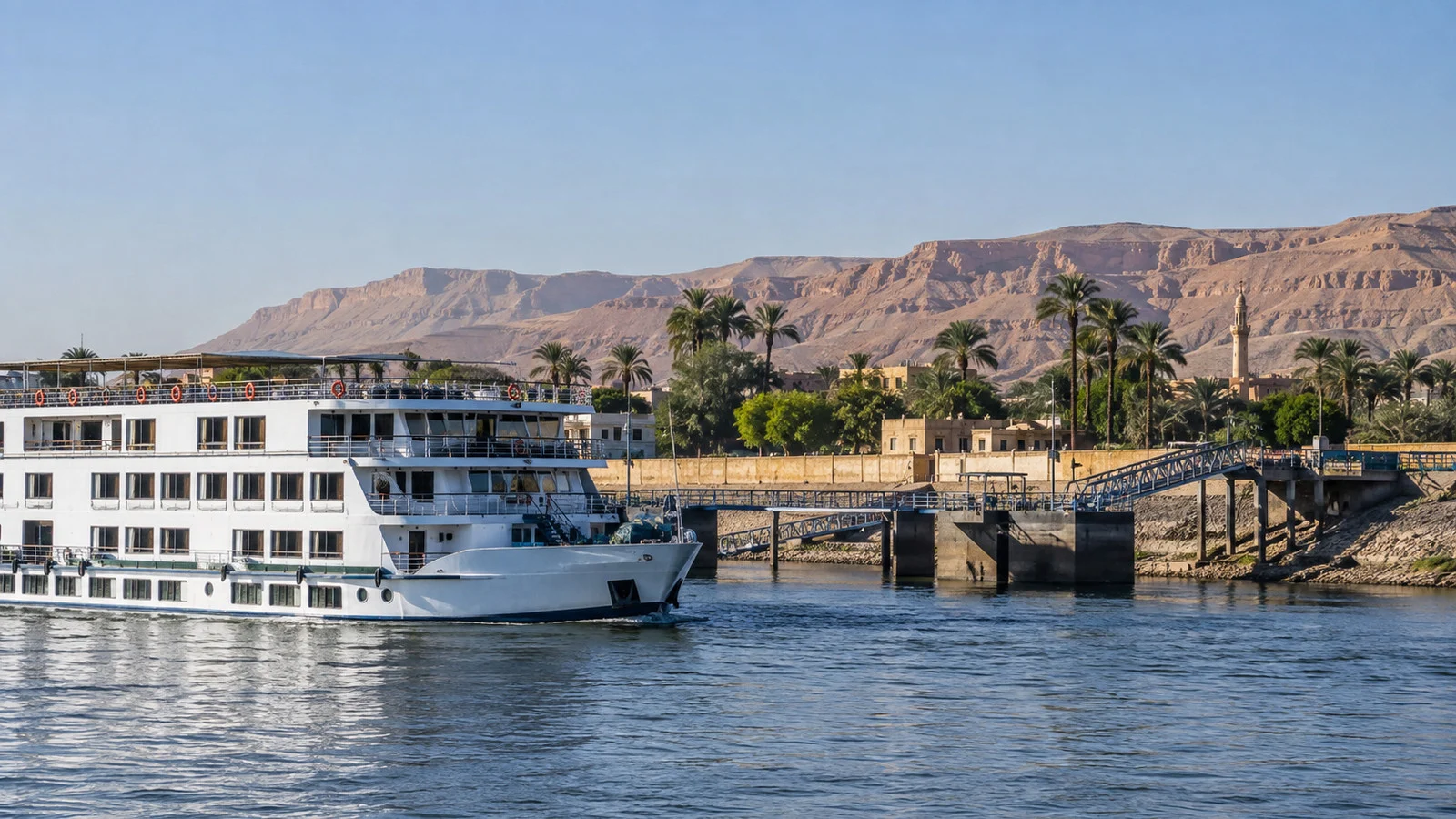
Yes. Viking’s official 2026 itinerary lists Qena and an included Dendera Temple exploration, while AmaWaterways publishes a 2026 Qena call for the Temple of Hathor.
Uniworld’s 2026 program sails from Luxor toward Dendera and visits the Temple of Hathor before returning toward Luxor. That wording matters because some operators sell the destination as Dendera rather than Qena even when the river and road logistics overlap.
Longer Cairo-to-Luxor or Upper Egypt programs can continue north after Qena through the Nag Hammadi navigation system. Egypt’s Tourism Development Authority identifies Nag Hammadi as one of the Nile visitor berths developed for tourist vessels.
Qena is therefore active, but it is not a single standardized cruise terminal with one universal address. It is a working Nile call whose exact landing, rafting setup, motorcoach meeting point, and onward route belong to that day’s operator plan.
For regional context, our Africa cruise ports guide places this inland call alongside Egypt’s Mediterranean, Red Sea, and Nile gateways.
Where Do Nile Cruises Dock for Dendera?
Published itineraries generally describe a Qena or Dendera call without naming a fixed public pier. Ships may use an approved Qena-area landing, a Dendera-side river landing, or an operator-arranged berth that changes with vessel traffic and local instructions.
Multiple Nile ships can occupy the same landing area, which may require walking through another vessel or using a temporary gangway arrangement. Never assume the ship will return to the identical position after an excursion.
Dendera Temple stands on the Nile’s west bank opposite Qena. Egypt’s State Information Service places the temple about 3.1 miles from Qena city, but a road vehicle may need to use the available bridge and approach roads rather than tracing a straight line across the water.
Allow about 15 to 30 minutes between a Qena landing and the temple as an editorial planning range. The actual drive depends on the berth bank, bridge route, traffic, security coordination, motorcoach loading, and the exact site entrance.
This is not a sensible independent walk. The temple, river landing, bridge, and city roads form a transport problem, not a charming waterside promenade with hieroglyphs at the end.
Qena and Nag Hammadi Are Different Stops
Nag Hammadi lies roughly 37 miles northwest of Qena city within Qena Governorate. It is an onward Nile navigation and visitor-berth area, not an alternate spelling for Qena and not the normal name of Dendera Temple’s immediate gateway.
The Egyptian Tourism Development Authority says its Nile berth program developed visitor facilities at Nag Hammadi for tourist vessels. Current long-cruise schedules may visit Dendera from Qena, return guests to the ship, then sail to Nag Hammadi for the night or onward lock passage.
If a day is labeled “Qena, Dendera, Nag Hammadi,” do not assume the ship is stationary while everyone tours. It may be a sequence of morning navigation, motorcoach excursion, reboarding, afternoon sailing, and a later overnight location.
A Nag Hammadi berth would make Dendera a much longer road transfer than a Qena-area berth, so operators normally spell out the touring plan when that is intended. Ask where guests leave the ship, where they reboard, and whether the vessel moves during the visit.
Lock timing, bridge clearance, navigation permission, and traffic can alter this sequence. Those operational changes are routine reasons to listen to the cruise director before building a private plan around yesterday’s map.
Dendera Temple Hours and Tickets
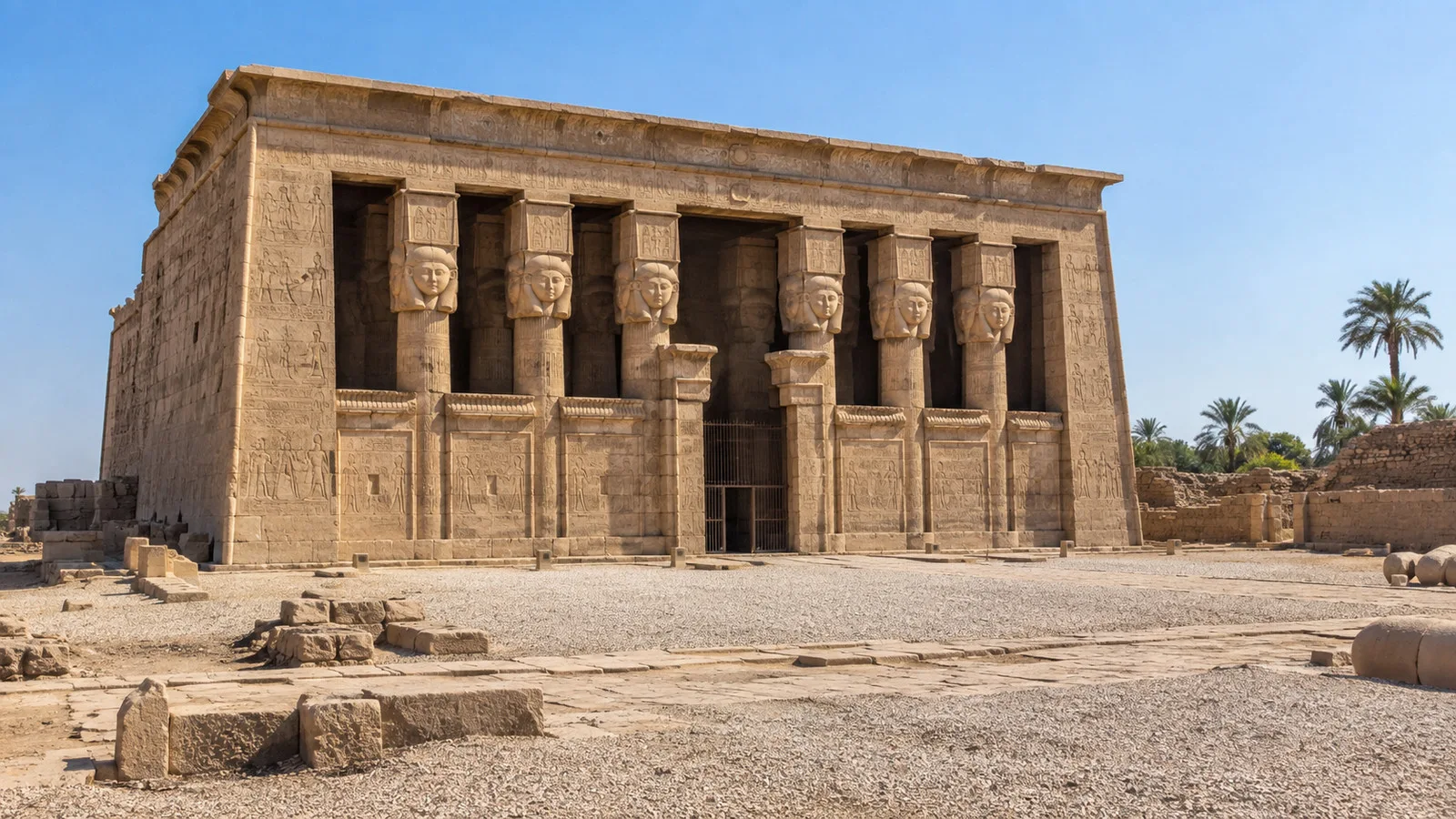
As checked September 12, 2026, the Egyptian Ministry of Tourism and Antiquities lists Dendera Temple open daily from 7 a.m. to 5 p.m. The current foreign visitor price is EGP 300 for adults and EGP 150 for eligible students.
The ministry separately lists the temple panorama at EGP 100 and the serdab, commonly described as the crypt area, at EGP 100 for foreign visitors. These add-ons are controlled access, and a ticket price does not guarantee that either route will be open during maintenance, crowding, or a security restriction.
Organized excursions often include the main admission, guide, and motorcoach, but do not assume the roof panorama or crypt is included. Ask onboard before buying anything twice, and carry a bank card plus enough Egyptian pounds for small official or personal expenses.
Prices and hours can change with little relation to the date a brochure was printed. Check the ministry page close to sailing and treat the onboard Egyptologist’s instructions as the practical rule for the group visit.
What Makes Dendera Special?
Dendera was the principal cult center of Hathor, a goddess associated with music, joy, dance, motherhood, and the sky. The surviving main temple is primarily Ptolemaic and Roman in date, although the ministry notes evidence for much older sacred structures reaching back to King Pepi I.
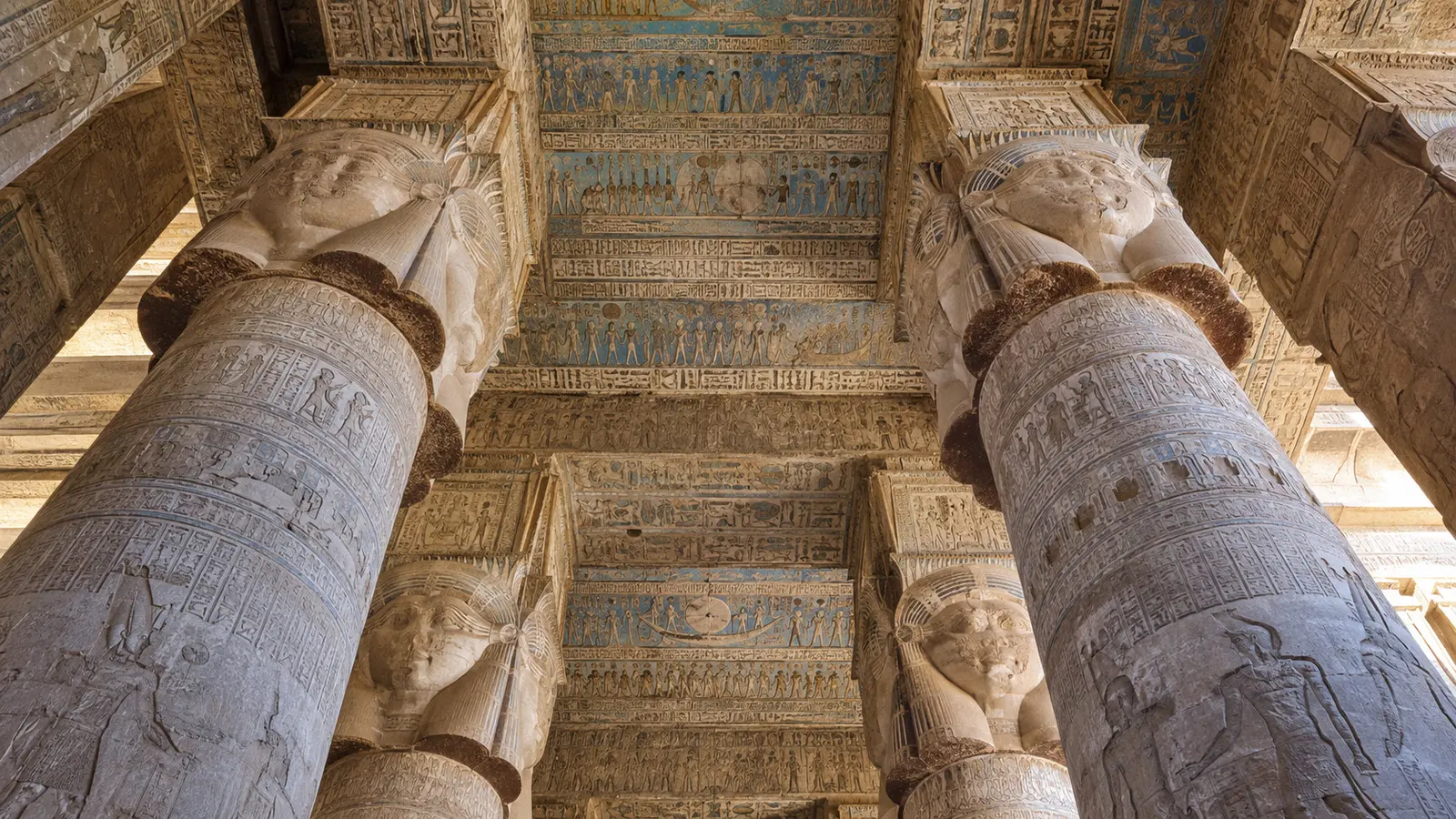
The façade opens into a hypostyle hall supported by six immense columns crowned with Hathor-headed capitals. Inside, restored ceiling sections reveal deep blues, astronomical figures, ritual scenes, and an architectural progression that remains unusually complete.
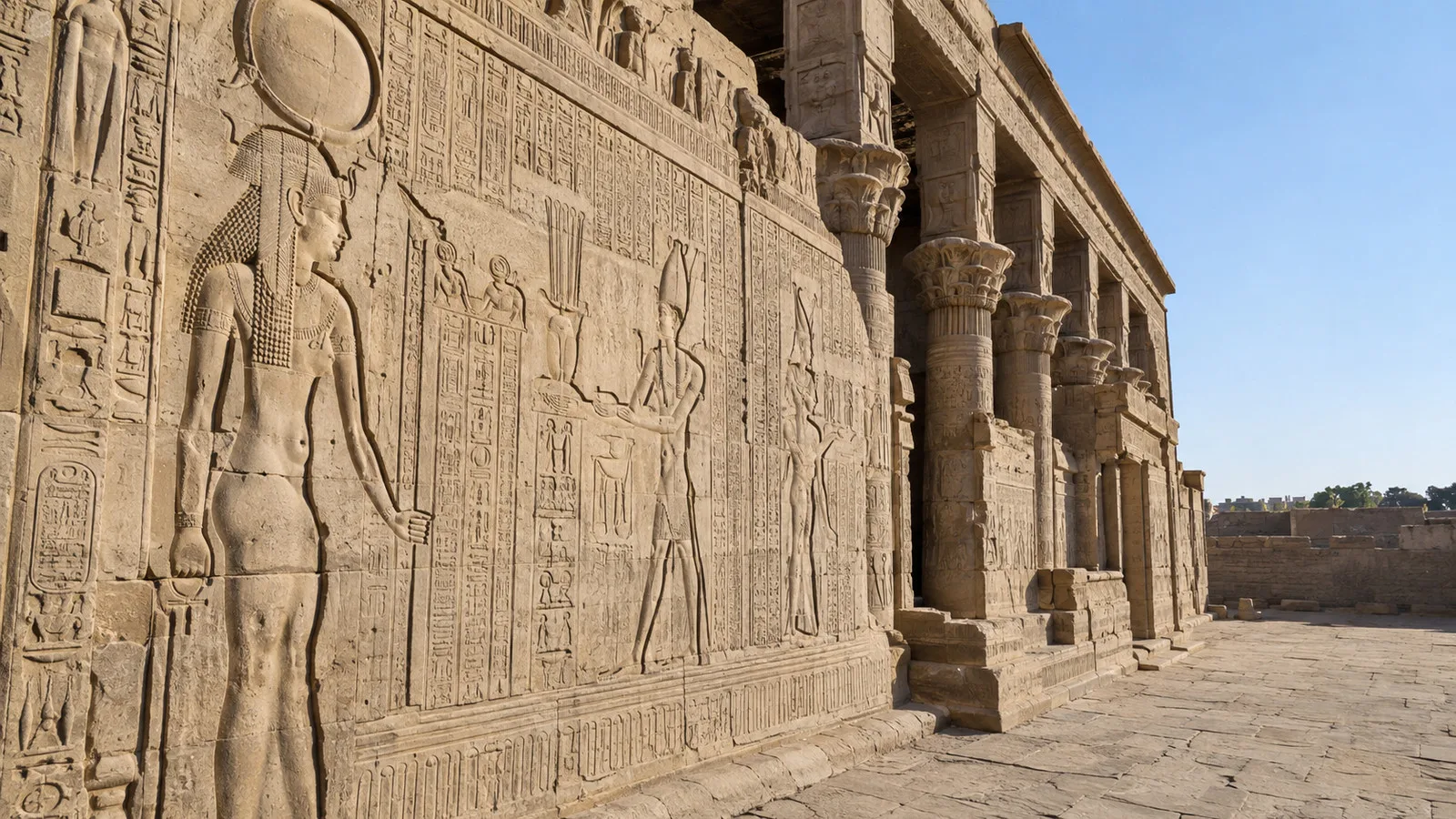
Look for the sanctuary sequence, side chambers, birth house, sacred lake, outer reliefs, and scenes associated with Cleopatra VII and Caesarion. The famous circular Dendera Zodiac on site is a copy because the original is in the Louvre, a detail worth knowing before someone triumphantly announces that they have found the original.
The rooftop panorama and crypts add very different experiences. The roof helps visitors understand the temple’s footprint and surrounding agricultural landscape, while the narrow decorated chambers below reveal ritual spaces that are easy to miss on a fast circuit.
Allow 90 minutes to two hours inside the complex as an editorial planning range for the main temple, major exterior features, and a guided explanation. Add time if the roof or crypt is genuinely included and suitable for your mobility.
Accessibility at Dendera and the Landing
Accessibility begins at the ship, where gangway slope, bank height, rafting, steps, and crew policy can vary by landing. A vessel with comfortable public rooms can still arrive at a shore connection that does not work for a wheelchair or walker.
The temple approach includes open ground and historic surfaces, while interior routes can involve thresholds, uneven stone, dim chambers, and crowded turns. The roof and crypt options require more demanding access and should not be treated as part of a step-free main visit.
The ministry’s public listing does not provide a full route audit covering gradients, ramps, accessible restrooms, and every chamber. Ask the cruise line specifically about the Qena landing, motorcoach steps or lift, distance from parking, rest stops, and which Dendera sections the group will enter.
Our river-cruise accessibility guide explains why ship, gangway, vehicle, and attraction must be checked separately. Uniworld’s Egypt cruise companion also warns that embarkation facilities, uneven ground, steps, and site access can restrict travelers with mobility devices.
A traveler who skips the roof and crypt can still see the grand hall and many defining features if the main route is workable. There is no prize for reaching a panorama by exhausting the knees needed to return to the ship.
Can You Explore Qena Independently?
Most cruise passengers go directly between the landing and Dendera with an Egyptologist. Qena is a substantial provincial city rather than a purpose-built tourist port district, and the berth may not be near the center or independent transportation.
The city is known for the Sheikh Abdel Rehim el-Qenawi Mosque and for its historic role on routes between the Nile Valley and Red Sea. A mosque visit requires modest dress, respect for prayer times, and permission for any non-Muslim tourist access.
Do not add the mosque or market to a Dendera morning unless the operator explicitly provides time and transport. Traffic, security checks, an unfamiliar landing, and a ship that may sail north make a casual detour riskier than the map suggests.
If a private tour is permitted, use a licensed guide and prearranged vehicle familiar with cruise movements. Confirm the pickup landmark, driver’s phone number, temple timing, and the exact place where the ship expects you back.
Navigation and Itinerary Changes
The Nile is regulated by dams and barrages, so Qena does not behave like a free-flowing European river with the same low-water pattern. That does not make navigation immune to change.
Lock schedules, bridge clearance, local traffic, berth assignment, vessel permissions, wind, visibility, maintenance, and security coordination can all alter timing. A longer program north of Qena has more moving parts than a short Luxor-to-Dendera out-and-back sailing.
Operators may preserve the temple visit by motorcoach from Luxor or another approved landing even when the vessel cannot use the planned Qena berth. They may also reverse the order, shorten independent time, or continue to Nag Hammadi sooner than printed.
Viking explicitly states that shore excursions vary by itinerary and are subject to change. Read the daily program after dinner, then read it again after breakfast because the Nile occasionally edits for clarity.
Embarkation, Airports, and Longer Transfers
Qena is normally a call, not the advertised embarkation point for mainstream Dendera itineraries. Most passengers join in Luxor or begin a longer package in Cairo before flying to Luxor.
Do not arrange an independent taxi to “Qena cruise port” without an exact berth contact. The name may refer to a changing riverside landing, and a driver who finds the river has not necessarily found the ship.
Luxor is the practical aviation and cruise hub for many programs, with the road transfer to the Qena region commonly taking about 75 to 120 minutes. That is an editorial estimate dependent on the actual origin, checkpoints, traffic, and chosen road.
If illness, delay, or a missed flight requires joining late, contact the cruise operator rather than chasing the itinerary by road. A vessel moving between Qena and Nag Hammadi can make yesterday’s address useless surprisingly quickly.
Our Aswan cruise port guide covers the other major embarkation hub for Nile programs and helps explain how Qena differs from a city with a larger concentration of regular cruise moorings.
Heat, Clothing, and Visitor Comfort
Upper Egypt can be extremely hot, particularly from late spring through early fall. Dendera’s interior offers shade, but the approach, sacred lake area, outer walls, and rooftop are exposed.
Carry water supplied by the ship or tour, wear a hat and breathable clothing, and use sun protection before leaving the motorcoach. Loose clothing that covers shoulders and knees also suits local norms and protects better than a determined layer of vacation optimism.
Start hydrating before thirst arrives and pace stair choices carefully. Anyone with heart, kidney, respiratory, mobility, or heat-sensitivity concerns should discuss the excursion with a clinician and the operator before travel.
Winter mornings can feel cool on deck even when the temple grounds warm quickly. A light layer helps with early sailing, air-conditioned motorcoaches, and shaded stone interiors.
Safety and Practical Conduct
Use the cruise-arranged motorcoach or a vetted licensed guide, stay with the designated route, and follow tourist-police and site instructions. Security measures can add checkpoints or change movements without advance public detail.
Ask permission before photographing people, and never photograph police, military, checkpoints, bridges, locks, or other sensitive infrastructure. At the temple, obey current signs for flash, tripods, restricted rooms, and professional equipment.
Keep small valuables controlled in crowds, use bottled water, and do not wander along an unfamiliar riverbank looking for a better photograph. Agricultural edges, traffic, uneven ground, and water access create more realistic risks than cinematic tomb curses.
Egypt’s official tourism portal lists Tourist Police at 126, ambulance at 123, and fire service at 180. Save the ship’s local number too, because a changed motorcoach or missed reboarding point should first reach the operator.
A Sensible Qena and Dendera Plan
Take the included Dendera excursion unless the cruise line confirms a reliable independent alternative. Before leaving, note whether the ship remains at Qena, moves toward Nag Hammadi, or expects guests at another landing.
At the site, prioritize the Hathor-columned hall, decorated ceilings, inner sanctuary sequence, and major exterior reliefs. Add the roof or crypt only when admission, time, heat, crowding, and mobility all agree.
Return with the group and keep the driver’s or guide’s contact handy. A precise all-aboard time is important, but the precise all-aboard place matters even more on a moving Nile itinerary.
Final Verdict
Qena is a genuine active river-cruise call and the best-known Nile gateway to Dendera’s Temple of Hathor. The temple is richly preserved, historically important, and rewarding enough to justify the navigation beyond the standard Luxor-to-Aswan corridor.
The smart visitor treats Qena, Dendera, and Nag Hammadi as related but separate labels. Confirm the landing, motorcoach, temple add-ons, accessibility, heat plan, and reboarding location, then give those extraordinary blue ceilings the unhurried attention they deserve.
How I would plan Dendera from the current landing
Egypt’s Tourism Development Authority provides berth context, but the operator chooses the passenger landing and road transfer. Qena, Dendera, and Nag Hammadi should not be treated as interchangeable pins.
Confirm Dendera’s official hours and ticket, start early, and avoid adding a separate Qena loop unless the call is long. Plan to be back with the group at least 45 minutes before sailing because the ship may move or join a convoy.
Use official Egyptian entry guidance and the cruise line for visa rules. The vehicle, temple approach, crypts, rooftop, toilets, heat, and gangway have different access limits, so ask which parts work for the traveler before paying.
Research note
This guide was checked on September 12, 2026 against Egypt’s Ministry of Tourism and Antiquities, Tourism Development Authority, State Information Service, official national tourism portal, and current 2026 Viking, AmaWaterways, and Uniworld itineraries. Transfer times and visit durations are labeled CruisePorts.co editorial estimates; no authoritative Qena berth schedule or cancellation series supports a numerical missed-call rate.
No firsthand visit is claimed. CruisePorts.co applies the sourcing and correction standards in our Editorial Policy, but berth assignment, rafting, gangways, navigation permission, security procedures, temple access, tickets, and hours can change after publication.
How this guide was researched: Unless a first-hand visit is explicitly identified above, this guide is based on independent research using official port, tourism, transit, government, and attraction sources where available. Details were checked against Viking River Cruises, Egyptian Tourism Development Authority and Egypt’s official tourism portal.
Logistics and time-sensitive details were reviewed September 12, 2026. See our Editorial Policy.