Nafplio Cruise Port: Tender, Old Town, Palamidi and Mycenae
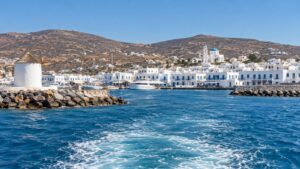
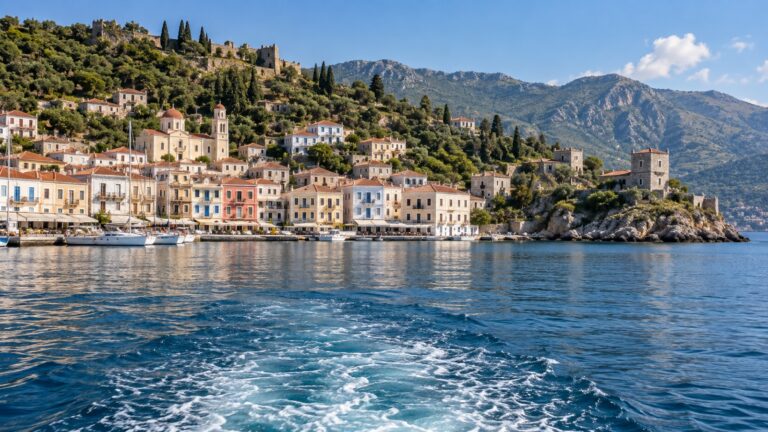
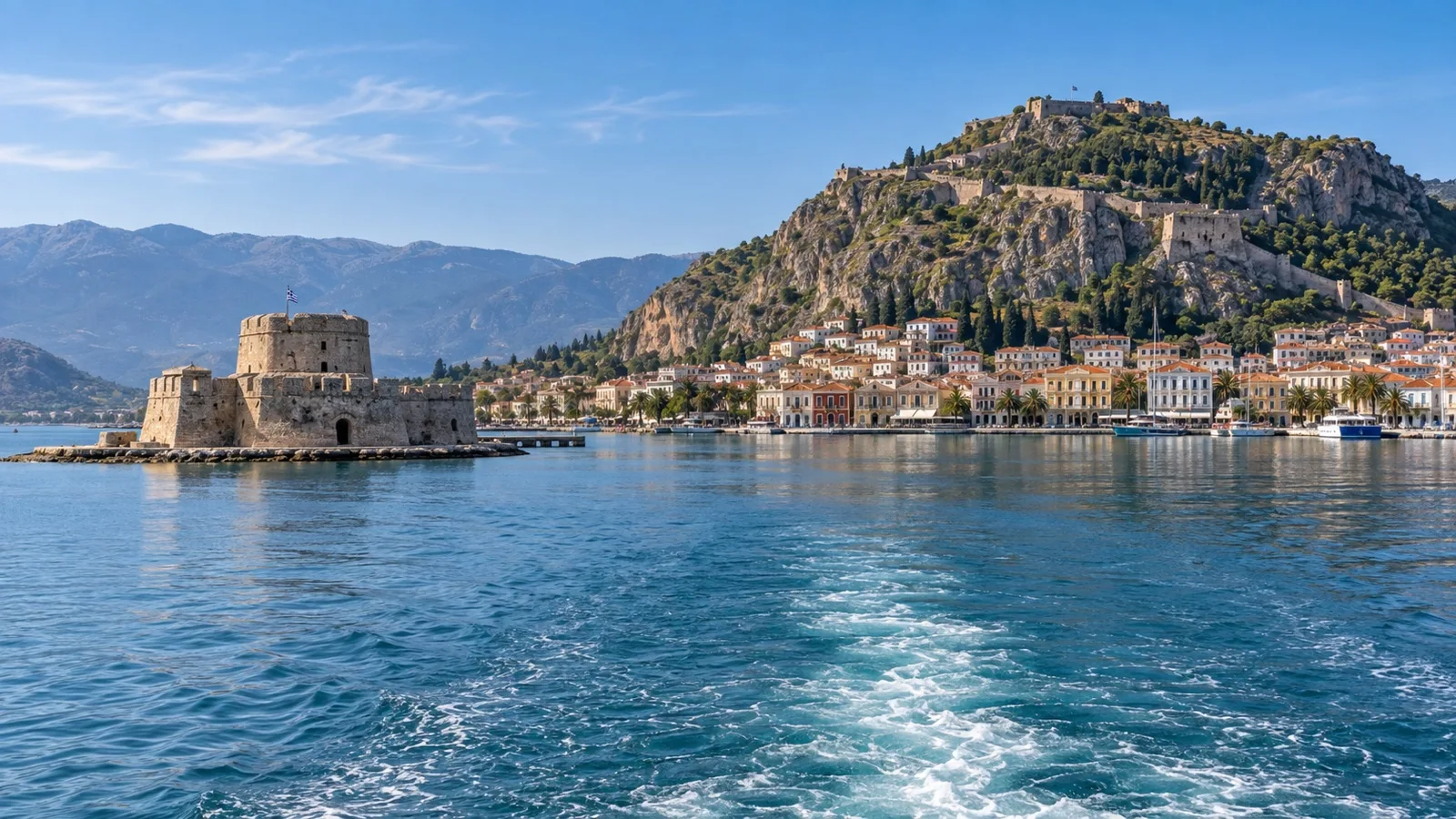
Nafplio is the Greek cruise call that invites you to forget the clock. The tender glides toward a waterfront framed by Venetian fortifications, neoclassical streets, palm-lined promenades, and mountains that make the old town feel like a stage set.
The danger is not distance inside Nafplio, but ambition beyond it. Palamidi, Mycenae, Tiryns, and Epidaurus each deserve time, so confirm the tender process first and choose one major direction with a protected return margin.
Quick Facts
- Port: Nafplio on the Argolic Gulf in the Peloponnese
- Typical cruise arrival: Anchorage with tender service into the central harbor
- Tender landing: Usually beside the waterfront and walkable old town, subject to the ship’s final plan
- Best easy day: Old Town, Syntagma Square, waterfront, and a museum or Akronafplia viewpoint
- Palamidi: Hilltop fortress reached by taxi or a long, steep stairway
- Bourtzi: Harbor fortress reached only when local boat and site access are operating
- Mycenae: UNESCO-listed Bronze Age citadel best handled with reserved transport
- Epidaurus: UNESCO-listed sanctuary and theater requiring a separate regional excursion
- Currency: Euro
- Language: Greek, with English widely used in tourism
- Weather: Hot and exposed in summer, with wind able to affect tendering
- Return rule: Join the tender line well before the final boat, especially after a regional excursion
Tendering defines the call
Most cruise ships anchor in the bay and use tenders because Nafplio’s compact harbor is not a standard deep-water cruise berth. Your ship’s size, the day’s marine conditions, and local operations determine the exact landing and schedule.
Tendering reduces usable time through loading, priority groups, boat travel, and queues in both directions. Do not build an independent Mycenae or Epidaurus plan around the ship’s scheduled arrival before you know when general tender tickets begin.
The landing usually places you close to the central waterfront, which is one of Nafplio’s great advantages. Save the exact return point on your phone because several boats and quays may look similar after a long excursion.
The final tender departure is the real deadline, not the ship’s published sailing time. I aim for an earlier boat and leave space for a queue, a delayed taxi, or a slower transfer from the old town.
Begin with the old town on foot
Nafplio’s old town is compact, atmospheric, and rich enough to fill a full call without a coach. Neoclassical façades, balconies, small churches, lanes, cafés, and squares reveal the city’s Venetian, Ottoman, and modern Greek layers.
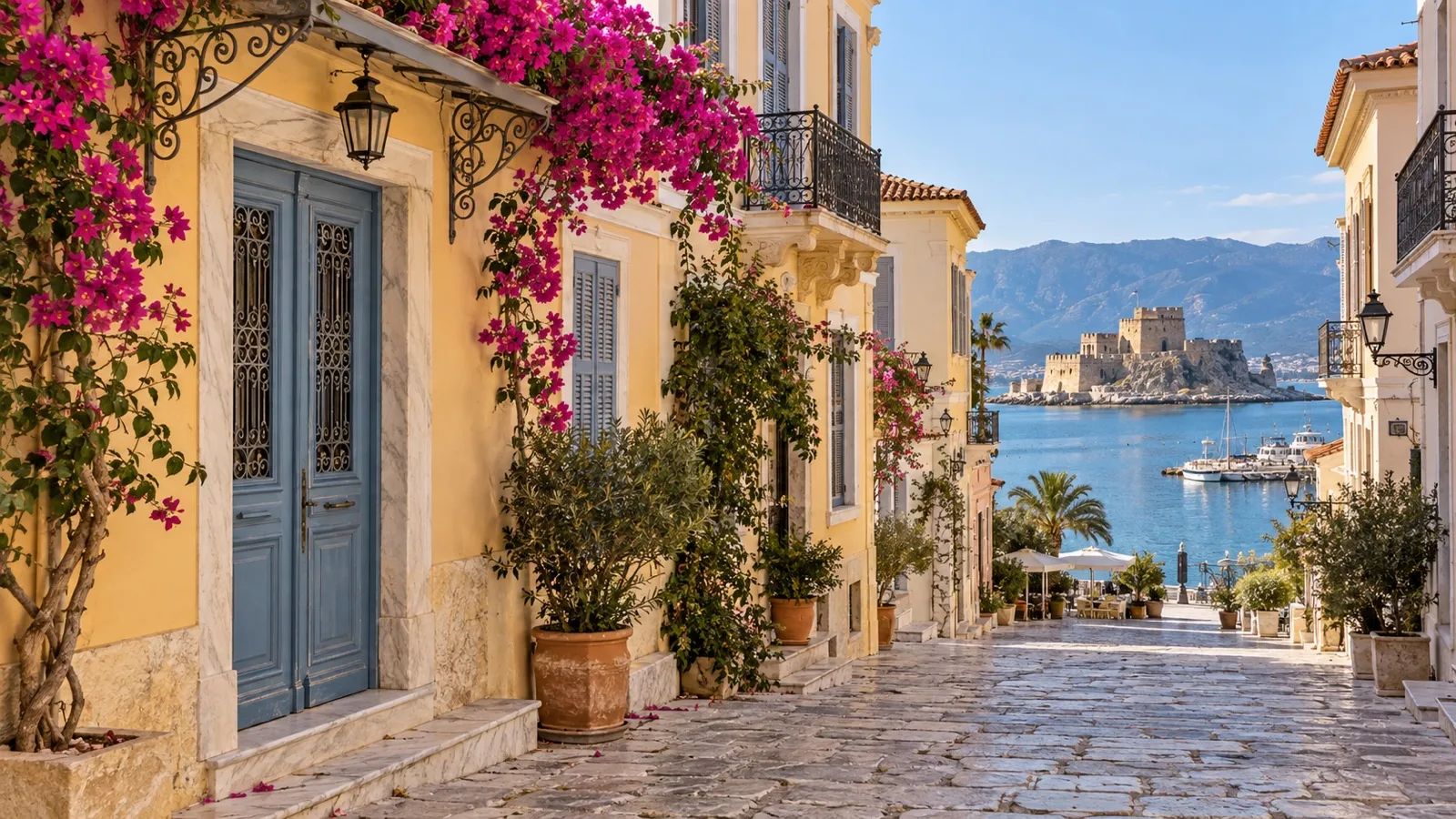
Syntagma Square is the natural center of the walk. The Archaeological Museum of Nafplio occupies a prominent historic building here and adds the deeper regional story, including material from prehistoric and ancient Argolis.
Check the museum’s official Hellenic Ministry of Culture information for opening days and current access. Greek state sites can change hours by season, and a Monday assumption from another country may be wrong.
The Church of Saint Spyridon, old mosques adapted to later civic uses, and the first-parliament associations around Vouleftiko help explain Nafplio’s place in the creation of the modern Greek state. Dress and behave respectfully when entering an active church.
Walk the waterfront and Akronafplia
The harbor promenade gives you changing views of Bourtzi, anchored ships, fishing craft, and Palamidi high above the town. It is the easiest place to slow down, find a café, and keep the tender landing within sight.
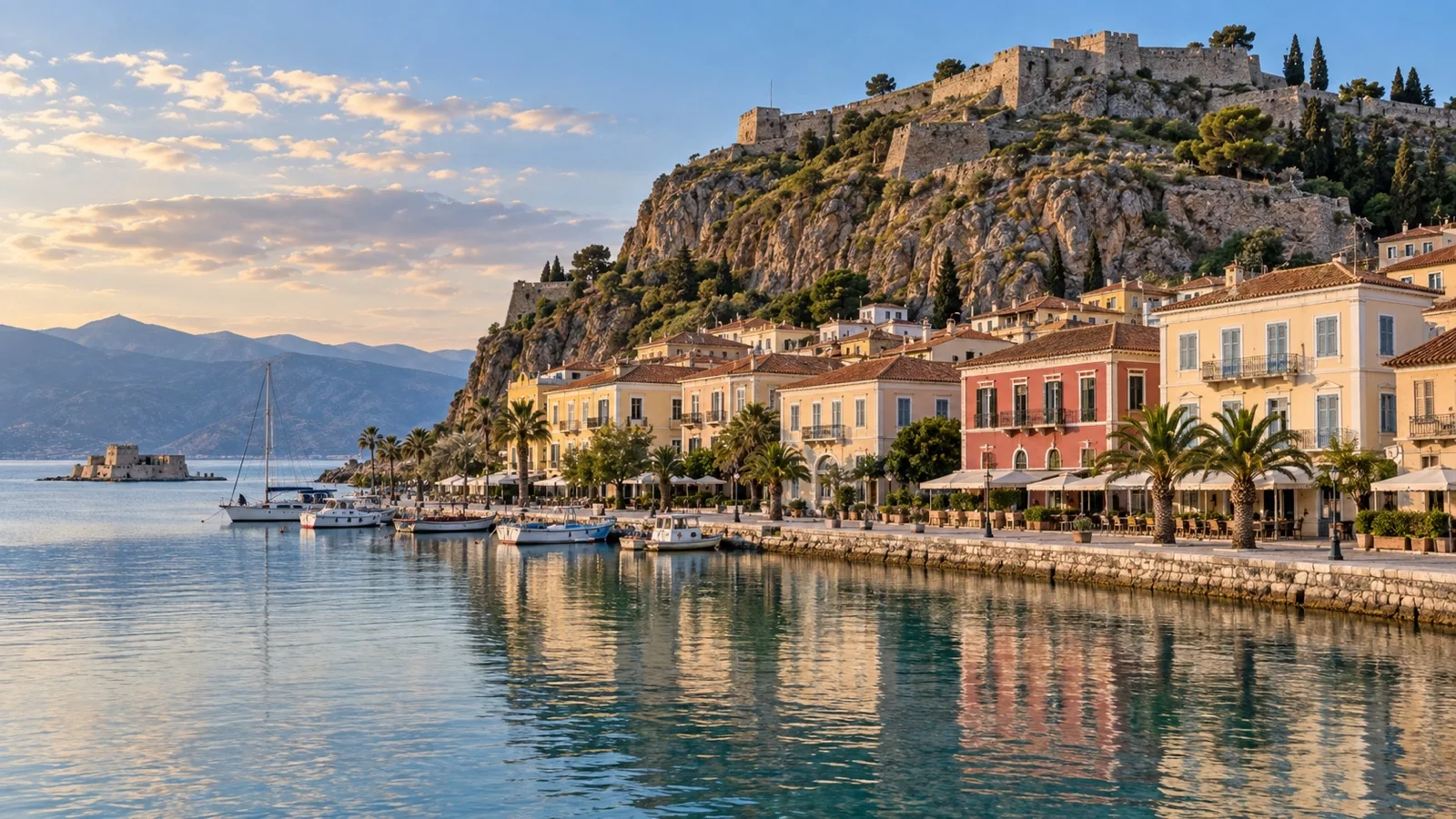
Akronafplia is the lower fortified height immediately above the old town. Routes climb through streets, paths, and slopes to viewpoints, but access, surfaces, and any restricted sections should be checked locally.
This is a better moderate climb than Palamidi for many visitors, yet heat can still make it demanding. Carry water, use shoes with grip, and descend before fatigue starts to control the return pace.
Arvanitia promenade and nearby coastal paths can add a sea-level walk, but weather, maintenance, rockfall precautions, and closures matter. Do not step around a barrier because an older map shows the path as continuous.
Palamidi is the commanding fortress
Palamidi sits high above Nafplio and is one of the city’s defining sights. The Venetian fortress is organized across multiple bastions, with broad views over the old town, Argolic Gulf, Akronafplia, and surrounding plain.
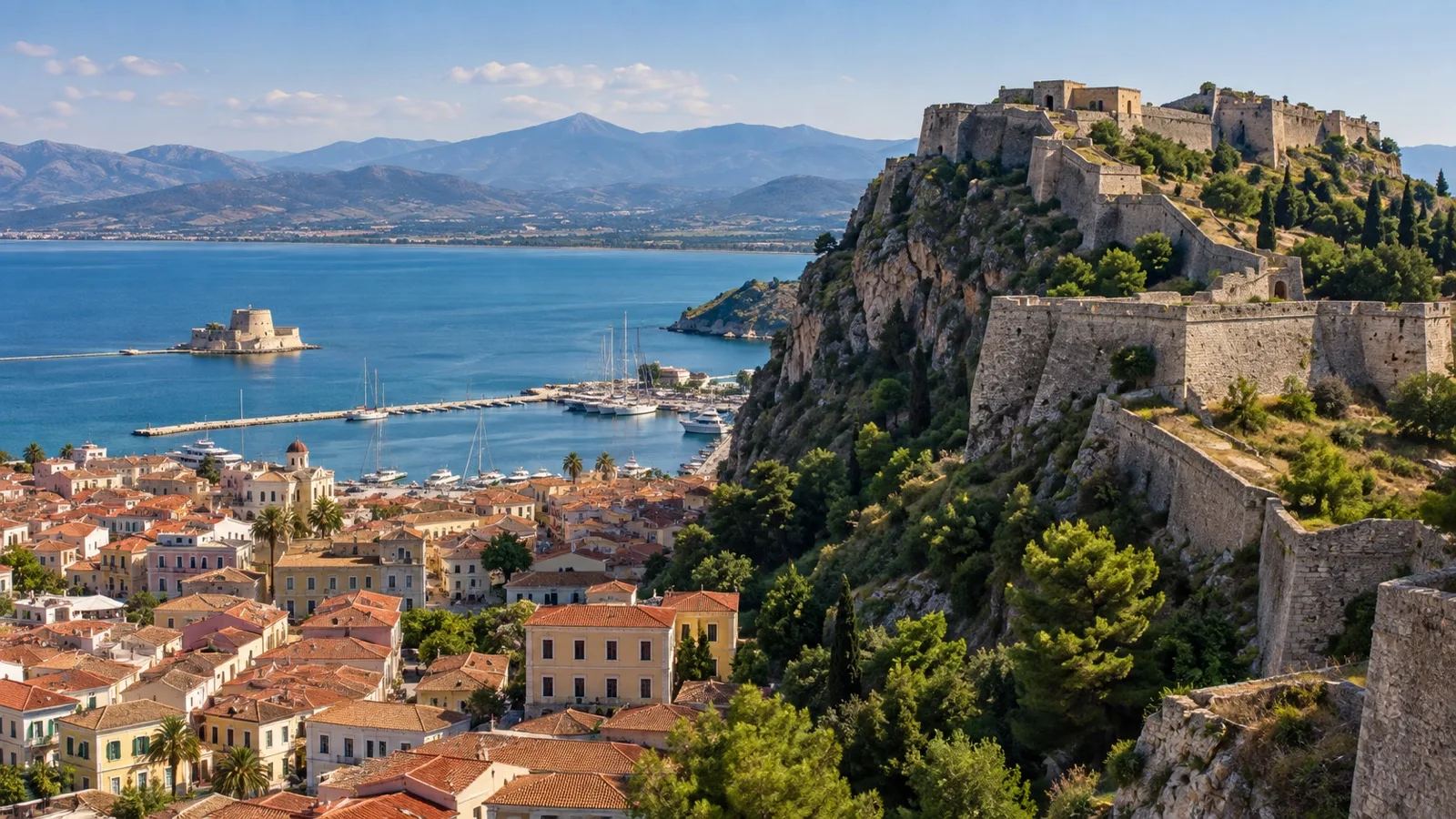
The famous stairway from town is long, steep, and exposed. The exact count is less important than the sustained climb, uneven stone, limited shade, and the need to descend safely.
A taxi to the road entrance is the practical choice for many cruise passengers. Agree on whether the driver waits, save a pickup point, and allow time for the walk between the entrance and the viewpoints you want.
Opening hours and ticketing should be checked through the Hellenic Ministry of Culture or the local archaeological authority. Events, heat precautions, maintenance, or emergency conditions can alter access without changing every third-party listing.
Who should skip the stair climb
Travelers with knee, balance, cardiac, respiratory, or heat-sensitivity concerns should not treat the stairway as a casual shortcut. A vehicle ride can preserve energy for the fortress while avoiding the hardest ascent.
Even after arriving by road, the historic site contains stone surfaces, slopes, steps, and limited shade. Ask what areas are reachable with your mobility needs rather than assuming the upper entrance solves every barrier.
Bourtzi depends on boat and site operations
Bourtzi is the small fortified island in Nafplio’s harbor and the landmark you will see repeatedly from the waterfront. Reaching it requires a local boat service and current permission to enter, which can vary with weather, season, restoration, and operating arrangements.
Do not assume every harbor boat includes landing or interior access. Ask what the ticket covers, how long the visit lasts, which quay is used, and whether the schedule returns in time for the ship’s tender.
Small-boat boarding may involve steps, movement, and uneven gangways. Travelers with limited mobility should confirm assistance limits and the island’s accessible areas before buying.
The best Bourtzi view may simply be from shore if time is short. A waterfront pause with the fortress, bay, and anchored ship can be more satisfying than adding another boat deadline to a tender port.
Mycenae is the strongest regional history trip
Mycenae is the obvious choice when Bronze Age Greece is your priority. UNESCO describes Mycenae and Tiryns as the two great cities of Mycenaean civilization, which shaped the eastern Mediterranean and later Greek culture.
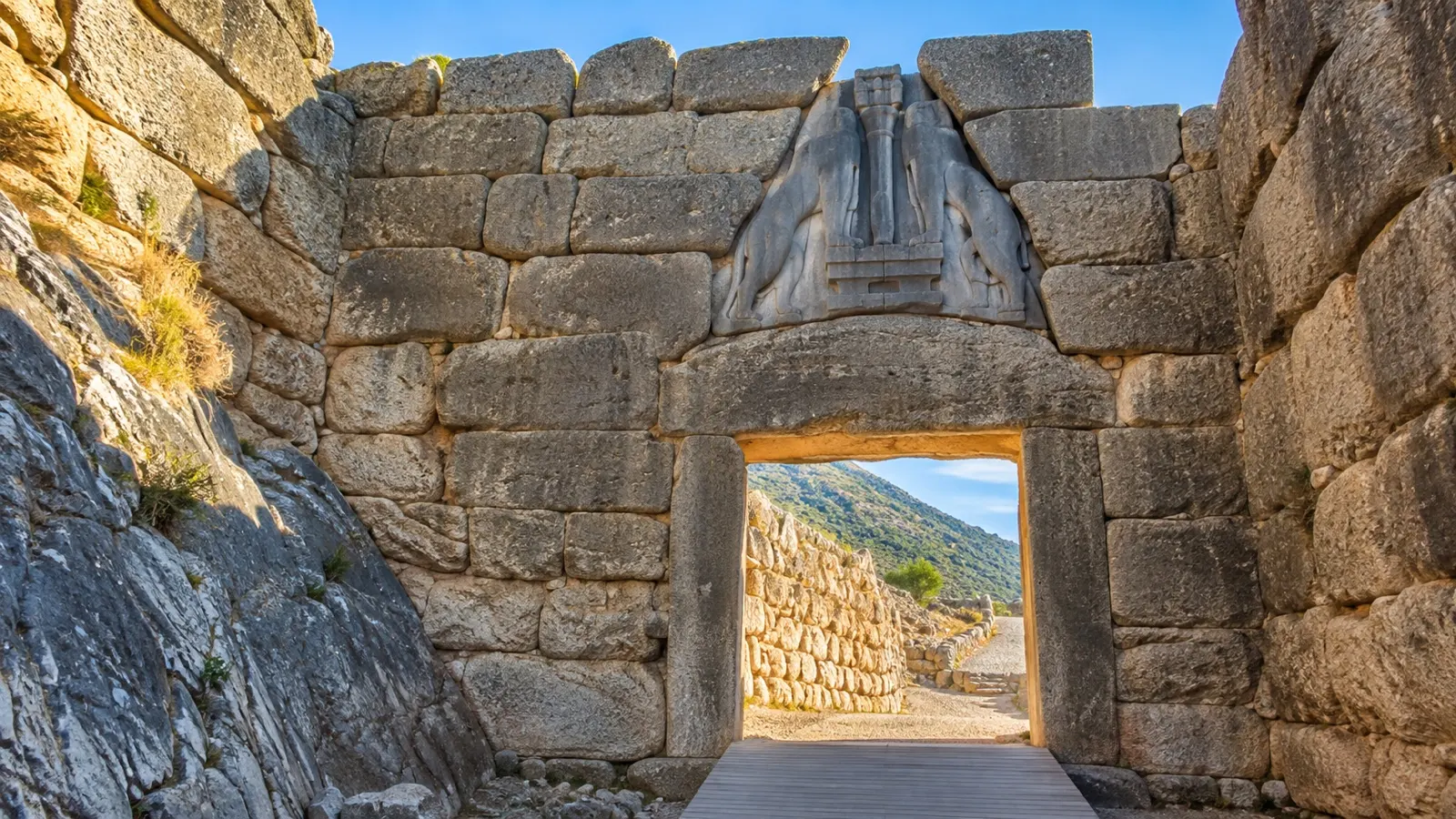
At Mycenae, the Lion Gate, massive defensive walls, palace area, grave circles, museum, and nearby tholos tombs create a site that needs more than a quick photo stop. Its exposed hill and uneven ancient ground also make heat and footwear important.
The drive from Nafplio is manageable on many calls, but public transport is not as flexible as a reserved taxi or excursion. Confirm the site hours, meeting point, total time on location, and the return plan before leaving the tender quay.
UNESCO notes that the property is actively protected, monitored, and conserved. Stay on designated paths, do not climb walls, and treat closures as part of preserving the site rather than an invitation to find another way in.
Tiryns as a quieter alternative
Tiryns lies closer to Nafplio and shares the UNESCO inscription with Mycenae. Its enormous Cyclopean walls and surviving galleries make the engineering of a Mycenaean citadel easier to appreciate without the same mythology-driven crowd pattern.
A shorter visit may combine Tiryns with Nafplio more comfortably than a rushed Mycenae itinerary. Check the official opening schedule because smaller archaeological sites can have more limited hours or temporary closures.
Epidaurus is a different story
Epidaurus is not simply a famous theater. The UNESCO property is the Sanctuary of Asklepios, an extensive healing center whose temples, hospital buildings, athletic spaces, water systems, museum, and theater reveal the relationship between ritual, health, and early medicine.
The theater is celebrated for its proportions and acoustics, but the wider sanctuary deserves time. Treating it as a five-minute sound test misses the reason the site has world-heritage status.
Epidaurus requires a longer road commitment from Nafplio than a local-city day. Use a ship excursion or a reliable driver with a fixed return time, and verify whether a performance or conservation work changes normal access.
The archaeological landscape is broad, sunny, and uneven. Bring water, sun protection, and appropriate shoes, and ask about the accessible route between parking, museum, theater, and sanctuary areas.
Can you combine Mycenae and Epidaurus?
Some full-day excursions combine them, but the plan consumes much of a cruise call. It works only when the ship stays long enough, the tender operation begins promptly, and transport is designed around the all-aboard time.
I would not improvise the combination with public buses. Different routes, waiting time, site hours, and a final tender create too many points where a small delay becomes a serious problem.
Choose Mycenae for Bronze Age power and Homeric connections, or Epidaurus for the sanctuary, theater, and history of healing. Seeing one properly is better than racing through both.
Beaches and the coast
Nafplio’s surrounding coast offers swimming and beach options, but the most convenient choice depends on current path access, transport, wind, and facilities. Arvanitia is close to town, while longer beach outings require a taxi or verified local bus.
Greek beaches may use pebbles, rock entries, ladders, or deep water close to shore. Wear suitable footwear, follow flags and local warnings, and never leave valuables unattended during a tender-port day.
A beach plan needs time to dry off, change, and join the return tender line. Salt water and wet sandals make a rushed boarding process unnecessarily difficult.
Accessibility in Nafplio
The flat waterfront and central squares can support a gentle day, but historic paving, curb cuts, narrow sidewalks, café furniture, and crowds create variable conditions. Choose a route that allows frequent pauses rather than trying to cover every lane.
Ask the cruise line about tender transfer rules before booking anything ashore. Safe boarding may depend on sea state, the ability to manage steps, chair type, and the crew’s assistance limits.
Palamidi, Akronafplia, Mycenae, Tiryns, and Epidaurus all involve historic or archaeological terrain. Request exact information on gradients, steps, restrooms, shade, seating, and the distance from the vehicle to the main sight.
A mobility device that works well on the promenade may not suit a rough archaeological path. Reserved accessible transport and a focused old-town plan can still produce a full, memorable day.
Heat, wind, and marine conditions
Summer heat in Argolis can be intense, especially on exposed fortress and archaeological stone. Start outdoor climbs early, carry more water than you expect to need, and use a hat and sunscreen.
Wind matters because it affects both comfort and tender operations. A calm old-town street can hide rougher conditions in the bay, so monitor ship announcements even after going ashore.
Thunderstorms or high fire risk can change site access and road plans. Follow Greece’s official weather and civil-protection guidance, plus any instructions from archaeological staff or the cruise line.
In difficult weather, keep the route compact with the Archaeological Museum, covered café breaks, churches that are open to visitors, and short waterfront views. Do not force Palamidi or a remote site after authorities advise against it.
Food, money, and language
Nafplio is an easy place to slow down over Greek coffee, local pastries, salads, seafood, grilled dishes, and regional specialties. Pick one relaxed meal that fits the tender schedule instead of collecting several crowded recommendations.
Greece uses the euro, and cards are common in established businesses. Carry a modest backup payment method for small purchases, taxis, or a network interruption.
Greek is the official language, while English is widely used in tourism. Save your ship’s tender landing, the name of the archaeological site, and the return instruction offline in Greek and English.
Download maps and tickets before leaving the ship because coverage or battery life can fail at the worst moment. A small power bank is particularly useful when a regional driver, map, and tender update all depend on the same phone.
Entry rules belong to the full itinerary
Greece is in the Schengen Area, but the documents needed on a cruise depend on nationality and every country in the sailing. Follow the cruise line plus official Greek and European Union sources for passports, visas, and any live border system.
Do not assume a planned European authorization date means the program is operating, and do not pay an unofficial application website. Carry the original identification named in the daily program because a phone copy may not satisfy port or immigration officials.
Return timing without guesswork
The all-aboard time is the fixed deadline, and the last tender usually leaves shore earlier. I plan to be at the tender queue well before the published final boat, with a larger cushion after Mycenae or Epidaurus.
For taxis, save the driver’s number and agree on both the pickup place and time. Ask to return to the precise cruise tender pier rather than simply to Nafplio port.
For a local day, do not spend the buffer climbing one more lane above the old town. For a regional day, turn back when road delay begins to erode the margin even if one final tomb or viewpoint remains.
Three Nafplio plans that fit
The relaxed old-town day
Explore Syntagma Square, the Archaeological Museum if open, waterfront lanes, churches, and cafés. Add Akronafplia only if the path and heat suit you, then join an early return tender.
The Palamidi day
Take a taxi to the road entrance, tour the fortress at a comfortable pace, and return to the old town for lunch and a waterfront walk. Skip the full stair climb unless fitness, weather, and timing are all favorable.
The major archaeology day
Choose Mycenae or Epidaurus through a ship excursion or accountable driver and make it the main event. Add only a short Nafplio walk after returning if the tender margin remains generous.
Common Nafplio cruise questions
Will my ship dock?
Most cruise calls use anchorage and tenders, but the ship’s final operational notice controls. Never plan around a generic port listing.
Can I walk into the old town?
Yes, the usual tender landing is close to the waterfront and historic center. Save the return quay because local harbor activity can make the landing less obvious later.
Should I climb the Palamidi stairs?
Only if you are fit, properly equipped, and comfortable with a long exposed ascent and descent. A taxi to the upper entrance is the safer and more time-efficient choice for many passengers.
Can I visit Bourtzi independently?
Only when local boats and site access are operating. Confirm that the trip includes a landing, note the return time, and protect the ship tender margin.
Is Mycenae possible during a cruise call?
Yes on many calls with reserved transport and a conservative schedule. A ship excursion simplifies the risk created by tendering and road travel.
Which is better, Mycenae or Epidaurus?
Mycenae focuses on Bronze Age citadel power and Homeric tradition, while Epidaurus combines theater, healing, and sanctuary architecture. Choose the story that matters more to you and give it enough time.
My bottom line for Nafplio
Nafplio is already a complete destination before you leave the tender pier. The waterfront, Syntagma Square, old lanes, museums, fortifications, and café culture make a graceful day with very little transport risk.
Choose Palamidi, Mycenae, or Epidaurus when one deeper experience is the clear priority. Verify the tender operation, site hours, transport, accessibility, weather, pickup point, and final boat before leaving the harbor.
Continue planning with our Greece cruise ports guide and our Piraeus cruise port guide. Our excursion versus DIY guide helps compare tender-port transport risk.
How this guide was researched: This guide was independently checked on September 11, 2026, against Visit Greece, the Hellenic Ministry of Culture, the UNESCO pages for Mycenae and Tiryns and Epidaurus, and current official cruise-line instructions. Reconfirm the tender, documents, transport, accessibility, site access, weather, and final return before sailing because live conditions can change.