Kampong Cham River Cruise Port: Mekong Landing and Temple Guide
Kampong Cham is an active Mekong city where a cruise call may combine a riverbank landing, temple visit, island excursion, or transfer to Siem Reap. The exact experience depends on water level, vessel position, and the operator’s schedule.
This is not a port with one permanent passenger terminal and an identical gangway every week. The best plan starts with the cruise director’s same-day landing instructions, then adds only the sights that fit the confirmed time.
Quick Facts
- Landing: River ships normally use a suitable location along the Kampong Cham riverfront or another nearby bank selected for current conditions.
- Town access: Central streets may be close to the landing, but the ship-to-shore route can include a steep gangway, steps, or an uneven bank.
- Main sights: Wat Nokor, Koh Pen, Phnom Pros and Phnom Srei, the riverfront, market, and Kizuna Bridge feature in local visits.
- Season: Mekong water levels influence landings, island transport, and the seasonal bamboo bridge to Koh Pen.
- Transfer role: Some cruise programs use Kampong Cham as an embarkation or disembarkation point for motorcoach transfers to Siem Reap.
- Currency: Cambodian riel is official, while United States dollars are also commonly accepted in visitor transactions.
- Time zone: Cambodia uses Indochina Time, UTC+7, throughout the year.
What a Kampong Cham cruise call can mean
Kampong Cham appears in Mekong itineraries in several ways. It can be a city call, the base for a guided temple or island excursion, or the point where guests join or leave the vessel for a road transfer.
Nearby itinerary labels can create confusion. Angkor Ban and Wat Hanchey are separate places that may be visited before or after Kampong Cham, not neighborhoods to combine on an independent walk.
Marketing pages also sometimes name the broader destination rather than the precise landing. Final documents and onboard briefings matter more than an old map pin because the riverbank position can change.
Where river ships land
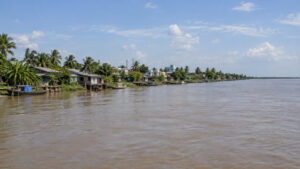
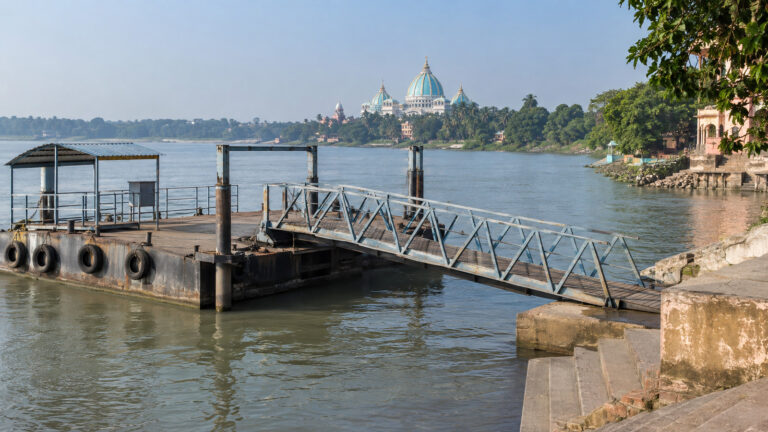
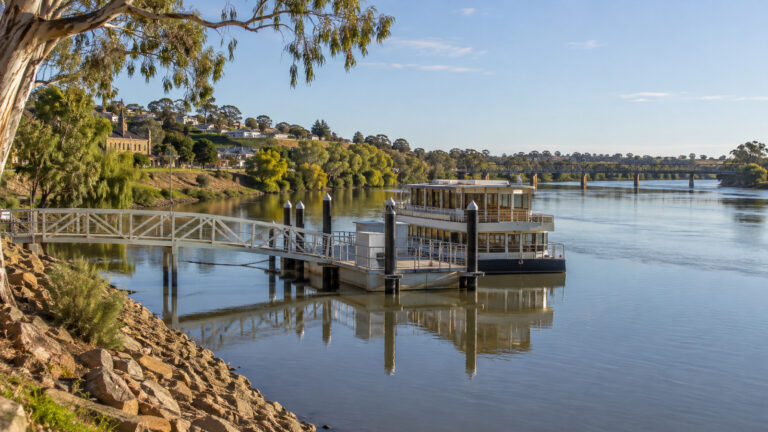
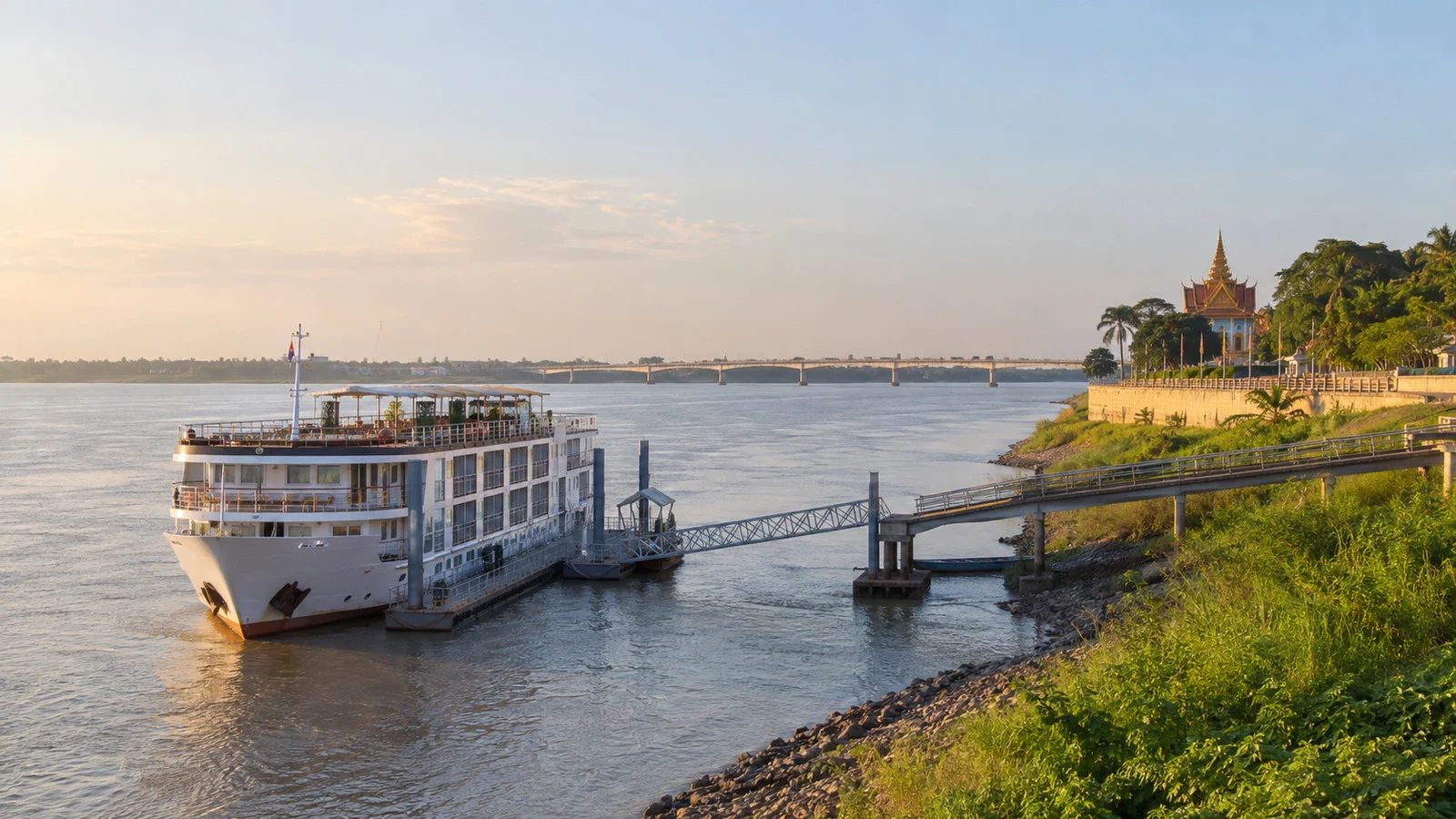
Travelers should think of the Kampong Cham waterfront as a working landing area rather than a fixed cruise terminal. The captain and local authorities choose a suitable position based on river depth, current, bank stability, vessel draft, and other traffic.
The route ashore may use a direct gangway, temporary steps, a sloped bank, another vessel, or a smaller local boat. A central position can place town within easy reach, but a more distant landing may require organized transportation.
Ask whether the ship will remain in the same place while passengers are away. Photograph the landing and save the vessel contact number, but follow crew directions if the return route changes.
Independent drivers need the vessel name, current meeting point, arrival window, and local cruise contact. Telling a driver to go to Kampong Cham port is not precise enough for a riverbank that can move.
Exploring the riverfront and town
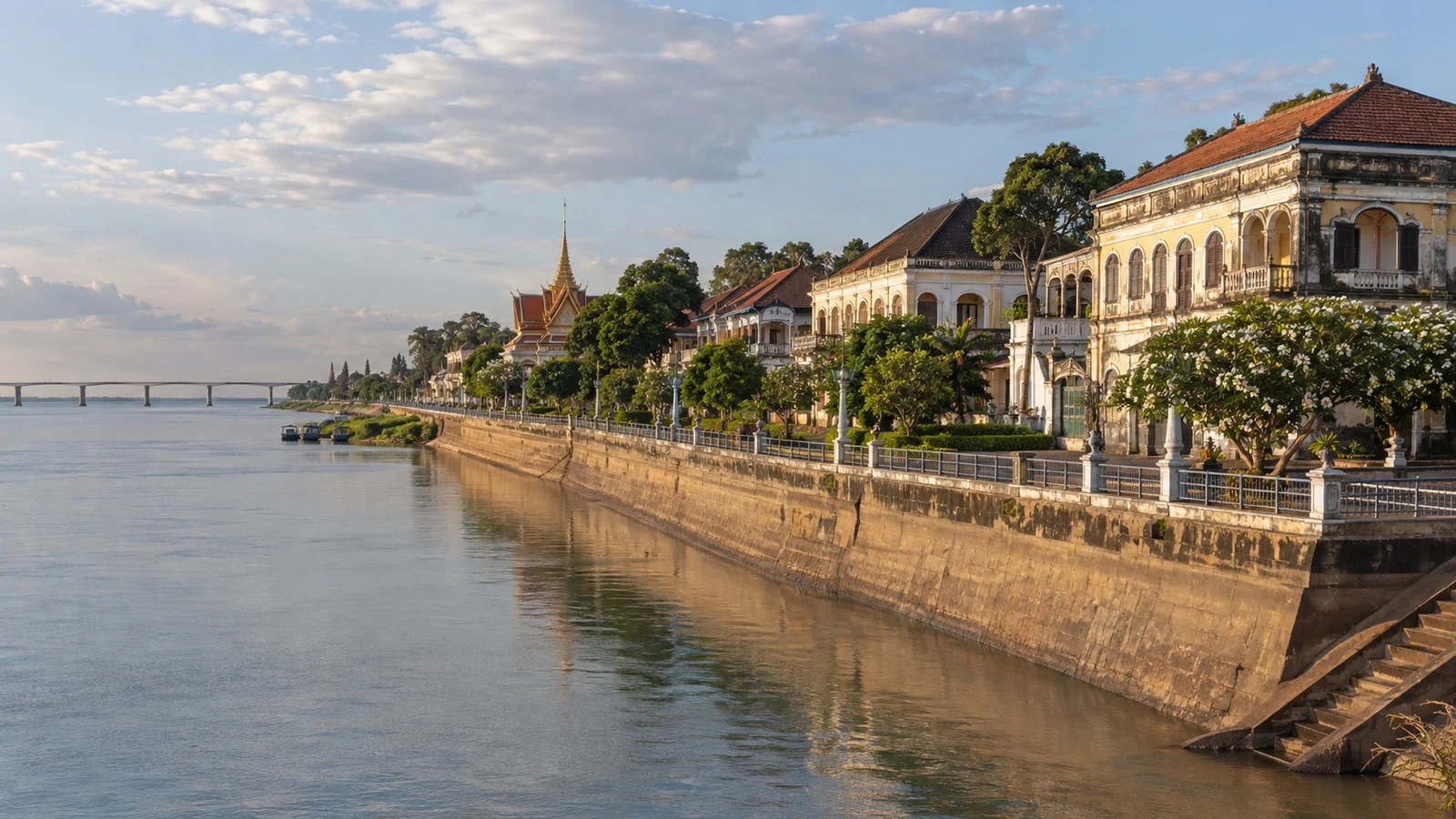
Kampong Cham is a provincial capital with markets, shops, cafes, traffic, and daily life beyond the cruise schedule. A town walk can be rewarding when the landing is central and the free-time window is clear.
The upper riverfront is generally easier than the transition from ship to shore. Heat, uneven sidewalks, motorcycles, curb changes, and limited shade can slow a route that looks short on a phone.
The local market offers a direct look at ordinary commerce, but it is not a staged attraction. Keep valuables secure, ask before taking close photographs, and move out of the way of shoppers and vendors.
Kizuna Bridge is the city’s dominant modern landmark and an important Mekong crossing. It is best viewed as part of the river landscape unless the operator provides a safe, timed route for a closer visit.
Wat Nokor
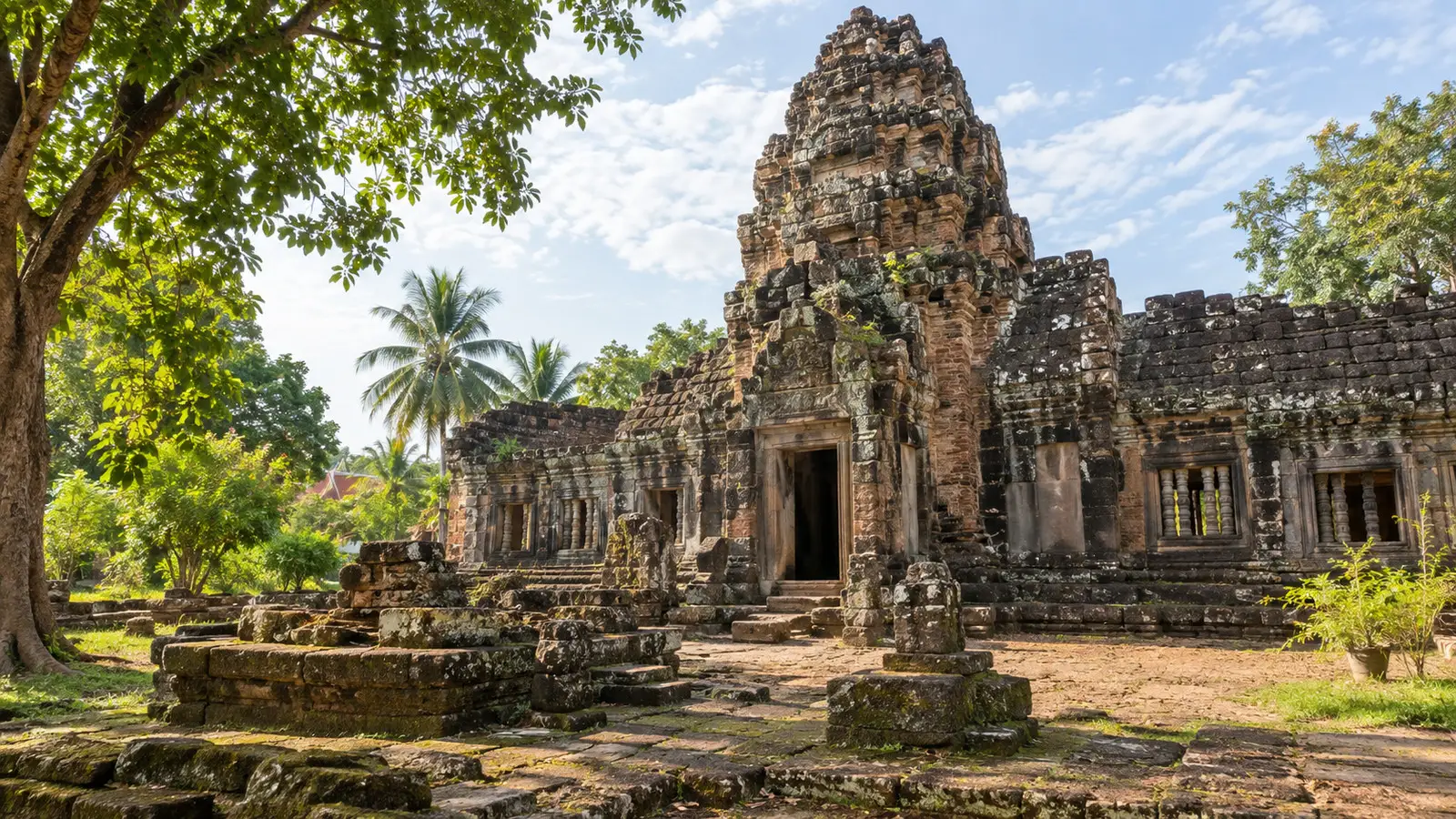
Wat Nokor, also called Nokor Bachey, is the most important historic site close to the city. Kampong Cham’s provincial government places it about two kilometers from the provincial capital and dates it to the late twelfth or early thirteenth century under Jayavarman VII.
The official description identifies Bayon-style architecture and a dedication to Mahayana Buddhism. A modern pagoda now shares the complex with the older stone remains, so visitors encounter both archaeology and active religious life.
A guided vehicle transfer is usually more practical than walking from the landing. The exact drive depends on where the ship stops and on local traffic, so keep the crew’s departure time rather than relying on a generic estimate.
Wear clothing that covers shoulders and knees, follow instructions about footwear, and keep voices low around worship. Uneven paving, thresholds, and steps require care even when the main approach looks level.
Phnom Pros and Phnom Srei
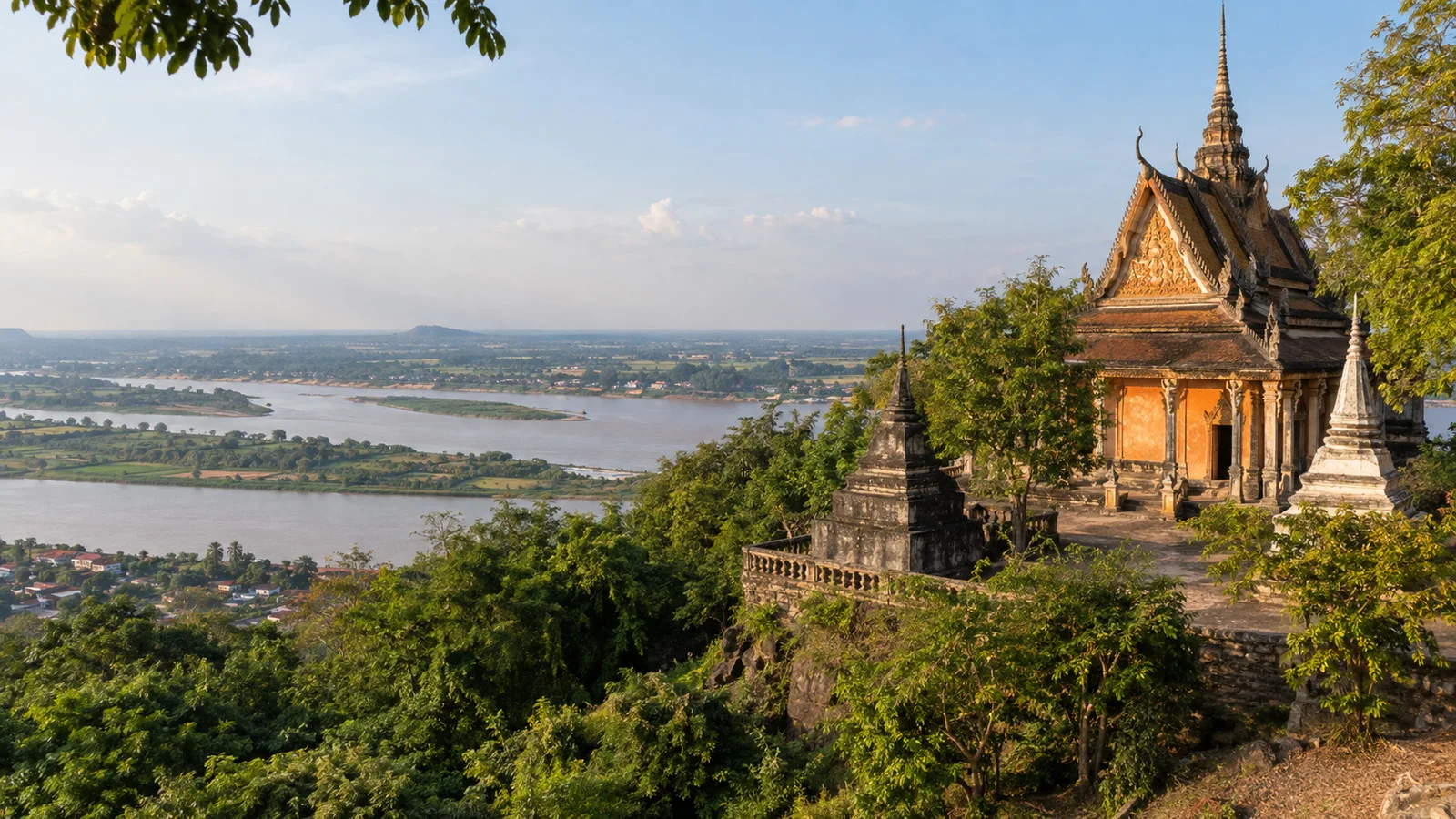
Some excursions visit the paired hills of Phnom Pros and Phnom Srei west of the city. The experience can include temple buildings, landscape views, stairs, and a motorcoach transfer.
Phnom Srei has a long staircase, making it a demanding choice for travelers with limited mobility, balance concerns, or heat sensitivity. Ask whether the excursion includes the full climb or a lower-level alternative.
Monkeys may be present around some Cambodian temple sites. Secure food and loose items, do not feed wildlife, and follow the guide’s instructions about distance.
Koh Pen and the bamboo bridge
Koh Pen is a large inhabited island in the Mekong south of Kampong Cham. The provincial government’s tourism page describes a community shaped by farming, fishing, and traditional crafts.
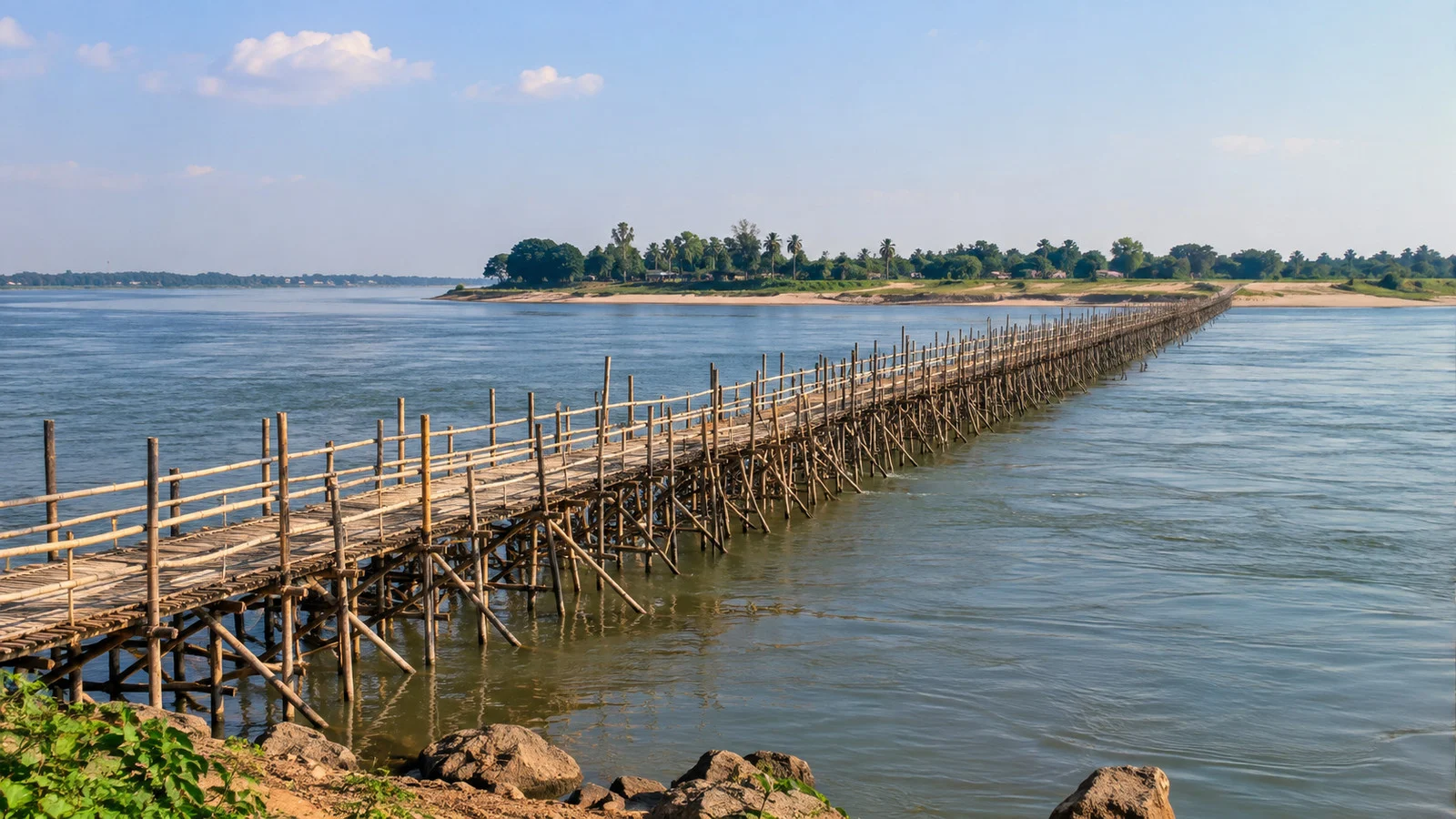
Access changes with the river. The official provincial description says residents use a ferry during high water and a long bamboo bridge during the dry season.
That bridge is seasonal, not permanent infrastructure. A cruise excursion may use a local boat, ferry, tuk-tuk, bicycle, or minivan depending on conditions, even when the itinerary keeps the same name.
Treat the island as a living community rather than a backdrop. Ask before photographing residents or homes, buy crafts directly when they appeal, and stay with the route approved by the guide.
Seasonal water changes the experience
The Mekong River Commission maintains a hydrological monitoring station at Kampong Cham. Its live data shows why a river landing should never be described as a fixed structure with one permanent slope.
Higher water can strengthen current, cover sandbars, and change the relationship between the ship and the top of the bank. Lower water can expose beaches while creating a longer or steeper walk to the promenade.
Rain and lightning can interrupt a small-boat excursion even when the main vessel can continue. Wear shoes with grip, protect electronics, and expect the operator to substitute transport when conditions require it.
No authoritative source publishes a dependable missed-call percentage for Kampong Cham. It is more accurate to prepare for a changed landing or excursion than to rely on an invented cancellation rate.
Embarking or disembarking for Siem Reap
Large Mekong cruise vessels do not sail to Siem Reap, so programs that connect the Angkor region with the river use road transfers. Kampong Cham can serve as the point where guests board or leave the ship.
Use the cruise company’s named hotel, meeting time, luggage instructions, and motorcoach whenever possible. A marketing phrase such as embark in Siem Reap may mean meeting the group there and traveling by road to the vessel.
Keep medication, passport, valuables, water, and anything needed before dinner in a carry-on bag. Larger luggage may be loaded separately and unavailable during the transfer.
Arrive in Cambodia with enough time to absorb flight or baggage delays. Verify visa and entry information through Cambodia’s official eVisa service and the cruise operator rather than through an advertisement or unofficial application site.
Accessibility
Accessibility must be evaluated as a chain from cabin to attraction. That chain may include an elevator, stairs, gangway, bank, local boat, motorcoach, and uneven temple grounds.
Ask whether the landing is direct, how steep the gangway is expected to be, and whether another ship must be crossed. Also confirm whether crew can assist with the exact mobility device you use.
Wat Nokor has old paving and thresholds, Phnom Srei has a substantial staircase, and Koh Pen access can involve a ferry or temporary surface. One accessible segment does not make the whole excursion step-free.
Request the number of vehicle steps, walking distance from parking, availability of seating, and restroom access. If steps are not possible, ask for a genuinely step-free alternative in writing before final payment.
Weather and clothing
Cambodia is hot and humid for much of the cruise season. Light breathable clothing, sun protection, insect repellent, water, and a compact rain layer are practical for most outings.
Temple dress should cover shoulders and knees without relying on a last-minute loan garment. Shoes that can be removed easily may help at religious sites, but they should still grip a wet bank and uneven paving.
A shaded motorcoach can feel much cooler than the riverfront. Keep a light layer in the day bag if air conditioning is uncomfortable.
Money and food
The Cambodian riel is the official currency, and United States dollars are also widely used in many visitor transactions. Carry smaller clean notes and expect change in riel.
Card payment is less dependable in small markets and villages than at hotels or onboard. Ask the guide about a reputable ATM before separating from the group.
Choose food that is cooked and served hot, and drink sealed or properly treated water. Heat and dehydration can shorten a port day more effectively than any schedule change.
Safety on a working riverfront
Motorcycles, uneven edges, and busy crossings deserve attention in town. Look in both directions, keep phones away from the street side, and avoid standing close to an unstable riverbank.
Wear the provided life jacket in local boats and follow seating instructions. Do not swim from an island beach or bank unless the operator confirms that the location and current are safe.
Save the cruise director’s local number and carry the ship’s contact card. The onboard team is usually the fastest route to help with a missed meeting point or changed landing.
A short-call plan
With limited time, choose one theme. A guided Wat Nokor visit followed by a brief riverfront walk is a sensible history-focused plan when the operator offers it.
Travelers who prefer local life can choose the organized Koh Pen excursion and accept that transport will follow the season. The island remains worthwhile whether the crossing uses bamboo, ferry, or boat.
Independent town time should stay close to the confirmed landing. Set a return alarm and allow extra time for the final descent to the ship.
A longer-call plan
A longer call may combine one major excursion with a market or riverfront walk. Avoid stacking Wat Nokor, the paired hills, and Koh Pen unless the cruise line has designed the sequence.
Each place requires different transportation and walking. A shorter, well-paced visit leaves more room for heat, traffic, river conditions, and an unhurried return.
Common planning mistakes
The first mistake is assuming Kampong Cham has one fixed cruise terminal. The landing can move, and an independent driver needs current instructions.
The second mistake is treating the bamboo bridge as a year-round guarantee. Koh Pen access changes with the river, and a seasonal ferry is part of normal local life.
The third mistake is combining separate itinerary stops into a self-guided route. Angkor Ban and Wat Hanchey may be part of the broader sequence but are not central Kampong Cham attractions.
Another mistake is judging accessibility only from the town map. The gangway, bank, local transport, and temple surface can be more important than the road distance.
Quick answers
Is there a permanent cruise terminal?
Do not expect a conventional terminal building. Ships use a suitable riverfront or nearby landing selected for current operating conditions.
Can passengers walk into town?
Often they can from a central landing, but distance and the ship-to-shore route vary. Ask the crew before setting out independently.
Is the bamboo bridge always open?
No. Official provincial information describes a dry-season bamboo bridge and high-water ferry access to Koh Pen.
Is Wat Nokor close to Kampong Cham?
Yes. The provincial government places the temple complex about two kilometers from the provincial capital, though a vehicle transfer is usually the practical cruise option.
Can the call be used for a Siem Reap transfer?
Yes. Some cruise programs connect Kampong Cham with Siem Reap by organized motorcoach at the beginning or end of the river segment.
Final word
Kampong Cham is most rewarding when its moving parts are treated as part of the destination. The river level, landing, island crossing, temple route, and transfer schedule all shape what is possible.
Confirm the day’s mechanics, choose one clear priority, and keep the return conservative. That approach leaves room to notice a real Mekong city rather than racing through a list of labels.
How this guide was researched: This guide was checked on September 12, 2026 against Kampong Cham provincial government information, the Mekong River Commission’s Kampong Cham gauge, Cambodia’s official eVisa service, and current operator planning materials. Landings, water levels, island access, temple programs, transportation, accessibility, and entry rules can change, so verify the live details for your sailing.