Murshidabad and Baranagar River Cruise Port: Palaces and Terracotta Temples
Murshidabad and Baranagar are separate Bhagirathi landings that operators may combine by moving the ship or using local boats and vehicles. Confirm the sequence, museum hours, protected temples, India entry permission, weather, accessibility, and return before assuming both places form one walkable port.
Murshidabad and Baranagar river cruise port quick facts
- Into Town: Murshidabad tours often use electric rickshaws or vehicles; Baranagar is usually a guided village walk from a separate landing. Tendering varies by vessel.
- Currency and Language: Indian rupee (INR). Bengali is dominant; Hindi and English are useful with guides and some visitor-facing businesses.
- Time Zone: India Standard Time, UTC+5:30 year-round, with no daylight saving time.
- How Often the Call Is Missed: Not published. Monsoon flow, shoaling, fog, landing safety and schedule recovery can alter one or both visits.
No cruise line, port or government source publishes an audited missed-call rate for this combined day. If the ship reaches Murshidabad but drops Baranagar, or vice versa, treat that as a partial change to the planned two-stop day.
My quick take
Do both places if they appear in the included program. Murshidabad supplies the political scale and complicated history, while Baranagar brings the architectural detail down to eye level.
At Hazarduari, spend less energy counting doors and more time understanding how the Nawabs, the East India Company and colonial administration overlapped. At Baranagar, let the guide decode a few terracotta panels instead of attempting to photograph every square inch before the boat whistle.
Independent touring is possible only when the cruise director approves it and confirms the landing plan. This is not a one-pier destination where a late taxi can simply chase the ship across a parking lot.
Is this one port or two?
Two. Murshidabad’s palace district and Baranagar’s temple village occupy different positions on the Bhagirathi, and current itineraries commonly sail between them.
Some programs visit Murshidabad first, return aboard for lunch and then continue to Baranagar. Others call at Baranagar before Murshidabad, moor overnight nearby or combine the places with Khushbagh and Azimganj.
A booking page that lists “Murshidabad/Baranagar” is describing a destination day, not a consolidated terminal. The site’s Ganges river cruise ports guide helps place both calls within the larger Kolkata, Farakka and Varanasi route.
Are Murshidabad and Baranagar active cruise calls?
Yes. Current river programs include Murshidabad’s palace-city sights and Baranagar’s temples on lower Ganges or Hooghly voyages.
Antara’s 2026 cruise brochure places Murshidabad on its Kolkata-to-Varanasi route and specifies an electric-rickshaw ride to Katra Mosque followed by Hazarduari Palace. Pandaw’s current Hooghly and Ganges itinerary describes separate Murshidabad and Baranagar days, including an overnight riverbank mooring across from Murshidabad and a village walk at Baranagar.
That confirms active calls, not a guaranteed berth. Public sources do not assign every cruise vessel to one Murshidabad pontoon or one Baranagar ghat.
The Bhagirathi-Hooghly setting
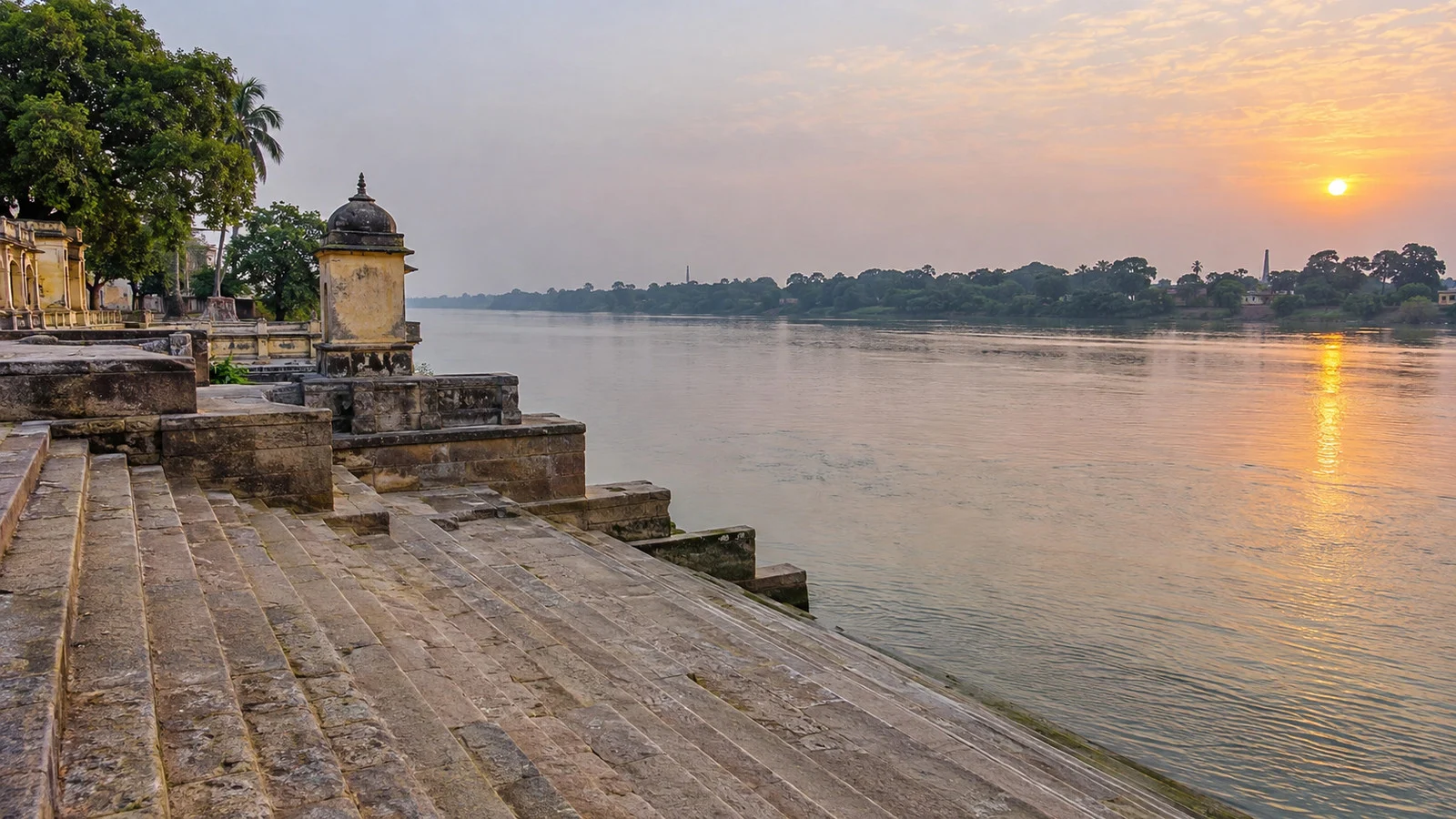
Murshidabad and Baranagar sit on the Ganga-Bhagirathi-Hooghly waterway, part of India’s National Waterway 1. Cruise marketing often calls the whole journey the Ganges, while local and operational references may say Bhagirathi or Bhagirathi-Hooghly.
The naming difference is harmless once you know it exists. The physical river is less forgiving because channels, shoals, current, seasonal flow and landing height can change.
Ships may adjust departure time or approach according to navigation advice. A quiet river view from the lounge does not reveal the depth under the keel or the quality of the next bank landing.
Murshidabad landing realities
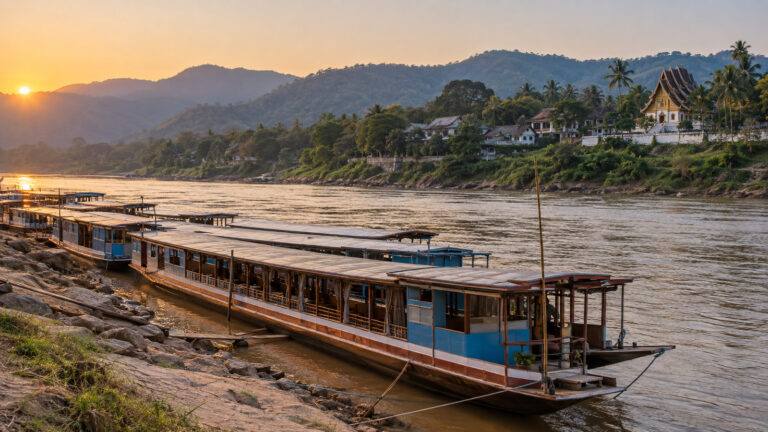
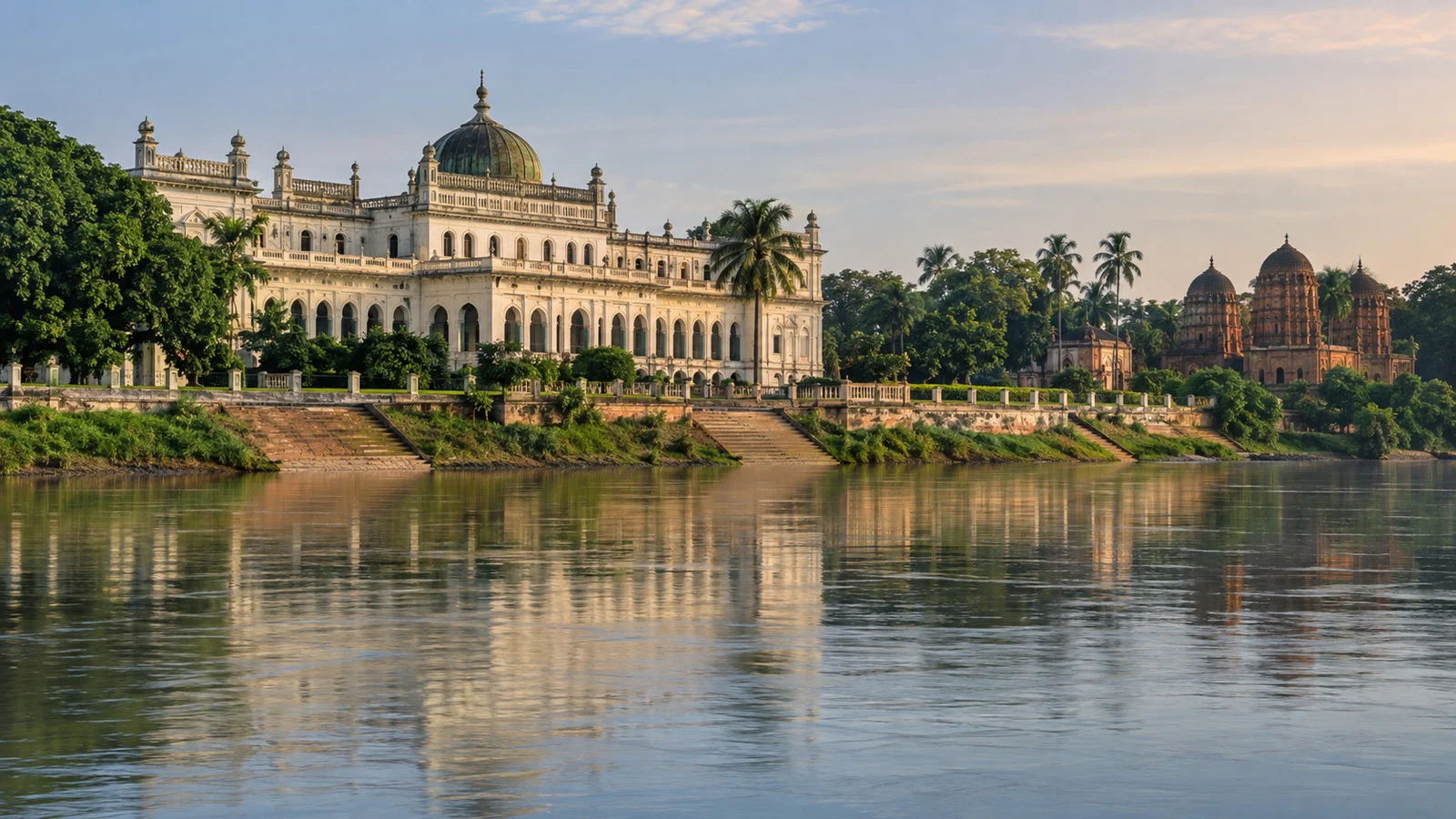
Hazarduari Palace dominates a long waterfront, making the city appear wonderfully simple from the river. The vessel’s safe passenger landing may still be at a different point chosen for water depth, bank condition, permissions and ground transport.
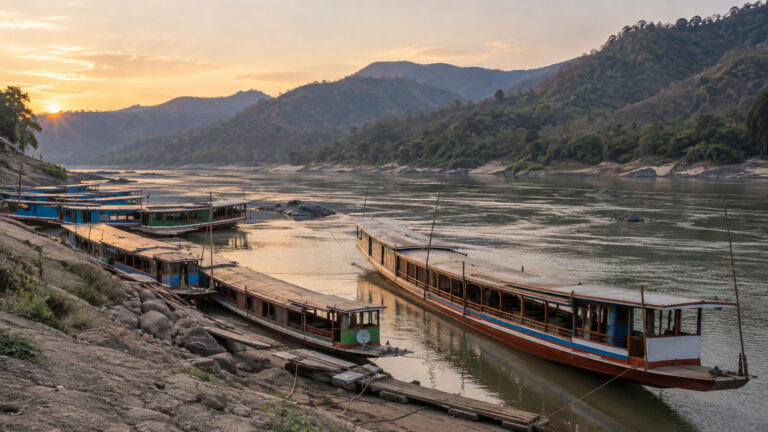
Some smaller vessels can use a direct gangway or simple local jetty, while others may anchor and transfer passengers by tender. Neither arrangement should be promised for all departures.
The first steps ashore can include a sloping gangway, floating pontoon, masonry steps, compacted earth or an uneven riverbank. Ask whether the landing is step-free before interpreting “palace near the waterfront” as “palace beside an accessible pier.”
Murshidabad programs often use electric rickshaws, horse-drawn carriages or road vehicles between the palace district, Katra Mosque and other sites. The precise mode is part of the excursion design rather than a permanent port shuttle.
Baranagar landing realities
Baranagar is a village call, not a terminal operation wearing rustic makeup. A suitable landing can lead to a guided walk through lanes, fields or riverside ground toward the temple group.
Depending on vessel size and water conditions, passengers may step directly ashore or use a tender or utility boat. A different landing can lengthen the walk and introduce muddy, sandy or uneven surfaces.
Do not confuse this Baranagar near Azimganj in Murshidabad district with the better-known Baranagar in metropolitan Kolkata. The cruise stop is the temple village associated with Rani Bhabani and the Char Bangla group.
Stay with the guide even when the ship remains visible. Village paths can fork, and a vessel may reposition after dropping passengers ashore.
Hazarduari Palace Museum
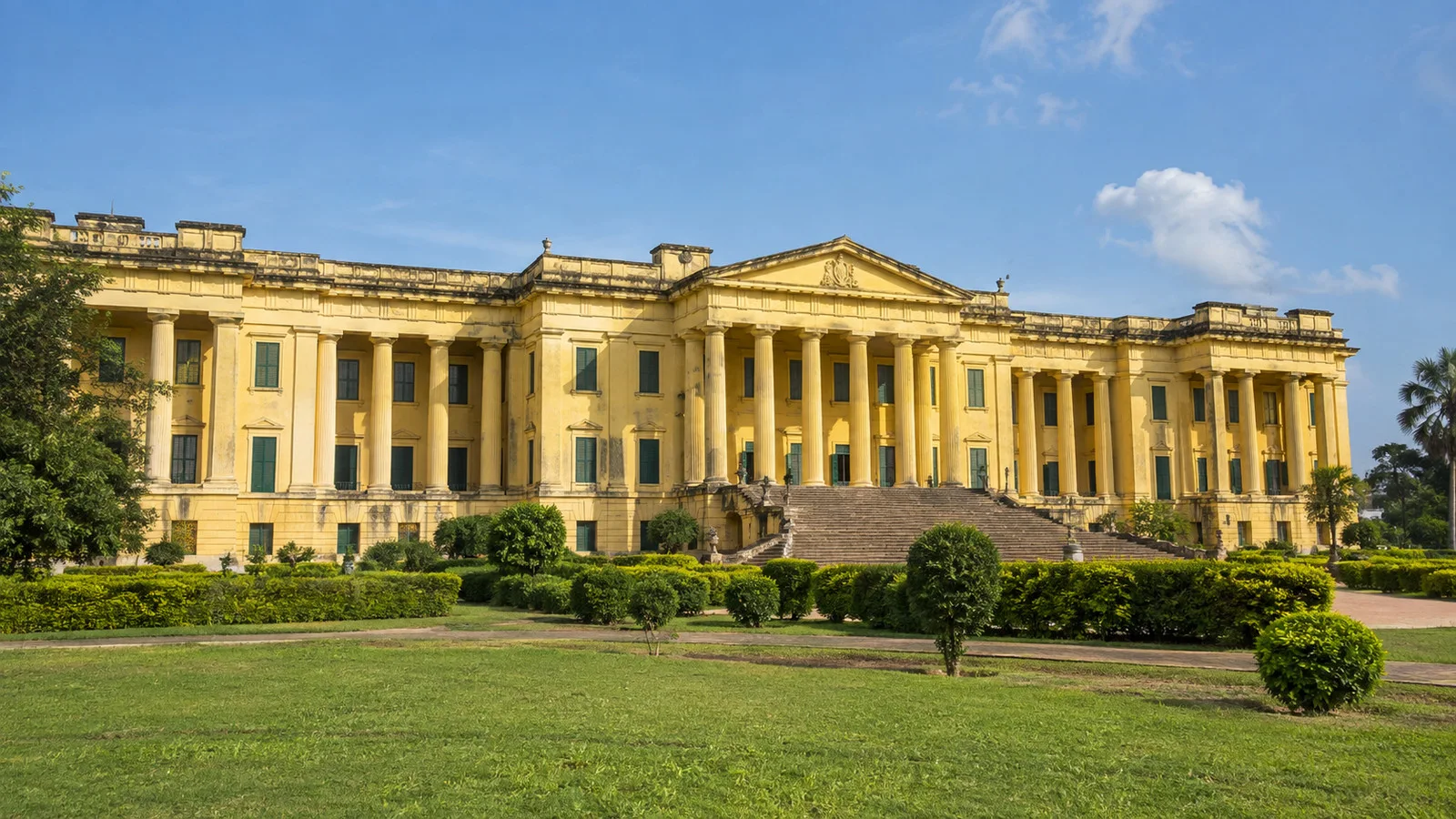
Hazarduari means “palace of a thousand doors.” West Bengal Tourism says 900 of those doors are real, with the remainder designed as false doors, a detail that has been doing excellent work for tour guides ever since.
The palace was completed in 1837 for Nawab Nazim Humayun Jah and designed by Duncan MacLeod. Its neoclassical scale reflects a court operating in a political landscape increasingly shaped by British power.
The building now houses a museum with arms, paintings, portraits, ivory objects and other collections. The official West Bengal Tourism Hazarduari guide describes 114 rooms and eight galleries.
Do not rely on an old blog for current hours, ticket price or camera rules. The operator may include admission and may schedule around museum closure days, so check the daily program before buying anything separately.
Nizamat Imambara and the waterfront ensemble
The Nizamat Imambara faces the palace across the open grounds and forms part of the Kila Nizamat setting. It is a Shia congregation hall rather than an extension gallery of Hazarduari.
Exterior viewing is often straightforward within the palace-zone visit, while interior access can depend on religious use, local management and the excursion. Dress modestly and follow the guide instead of treating every open doorway as museum circulation.
The waterfront ensemble also includes gateways, mosques, a clock tower and other protected structures. A short call benefits from understanding the group rather than sprinting between names with a camera held at chest height.
Katra Mosque and why transport matters
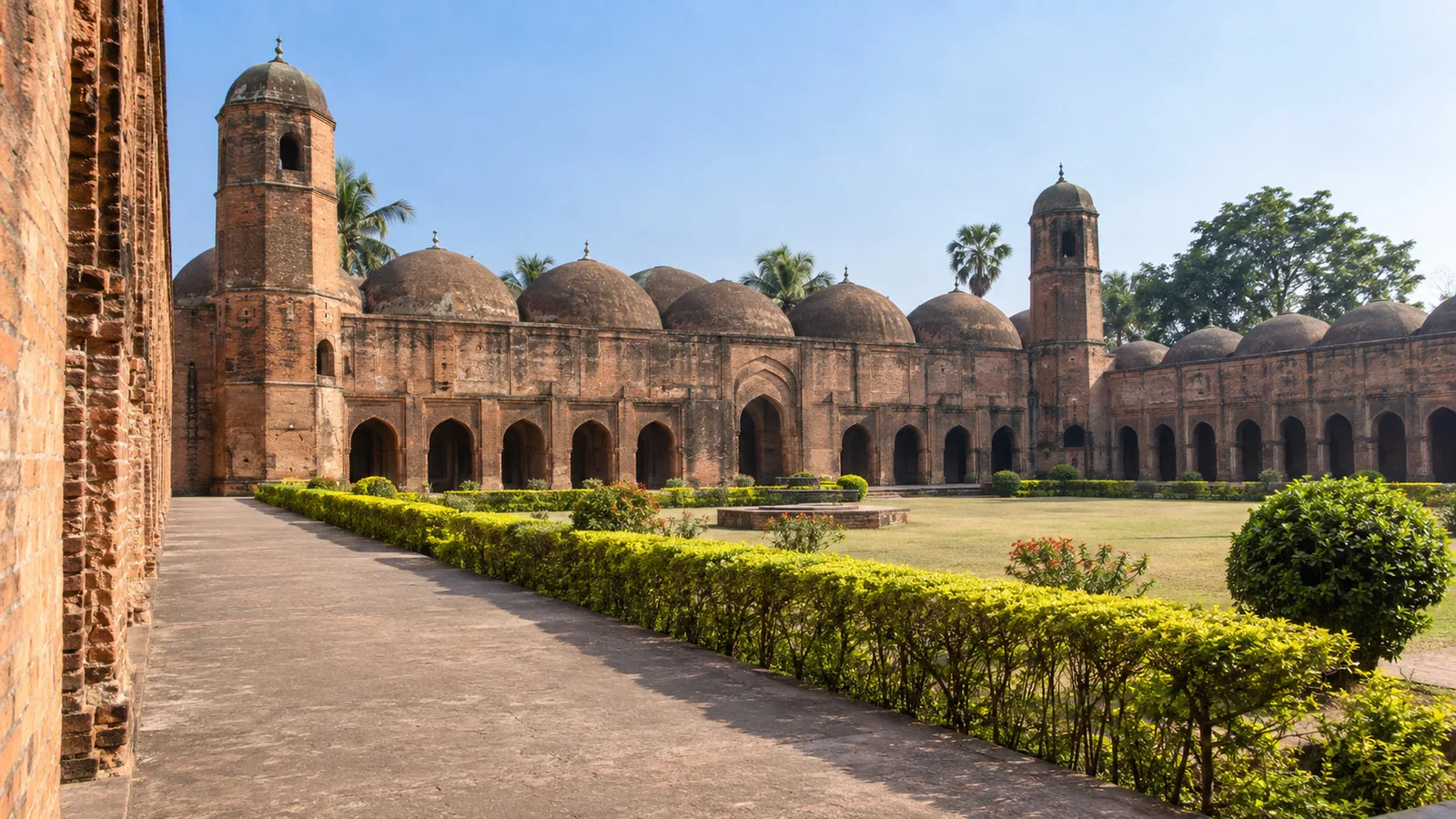
Katra Mosque stands away from the palace waterfront, which is why current programs use electric rickshaws, carriages or vehicles. It is not a sensible add-on to a tightly timed palace visit unless the operator has coordinated the transfer.
The mosque was built in 1723-1724 and contains the tomb of Murshid Quli Khan, the ruler whose name the city bears. Its original complex combined religious, funerary and caravanserai functions.
The Murshidabad district’s official heritage listing identifies Katra as a former caravanserai, mosque and tomb. Earthquake damage altered the great towers, but the surviving mass and courtyard remain powerful.
Dress respectfully, ask before photographing worshippers and follow local instructions on shoes and restricted spaces. Historic importance does not cancel present-day religious courtesy.
Kathgola and other operator variations
Some excursions add Kathgola Palace and gardens, Nashipur Rajbari or a hosted refreshment stop. These are operator-selected additions rather than automatic inclusions in every Murshidabad call.
Kathgola usually requires road transport and extra time beyond Hazarduari. If your program lists it, expect a fuller half-day rather than a casual walk from the ship.
Choose the included routing when the call is short. Murshidabad contains enough heritage to tempt an ambitious map, but the sailing schedule does not become more flexible because you discovered three additional palaces at breakfast.
Baranagar’s Char Bangla temples
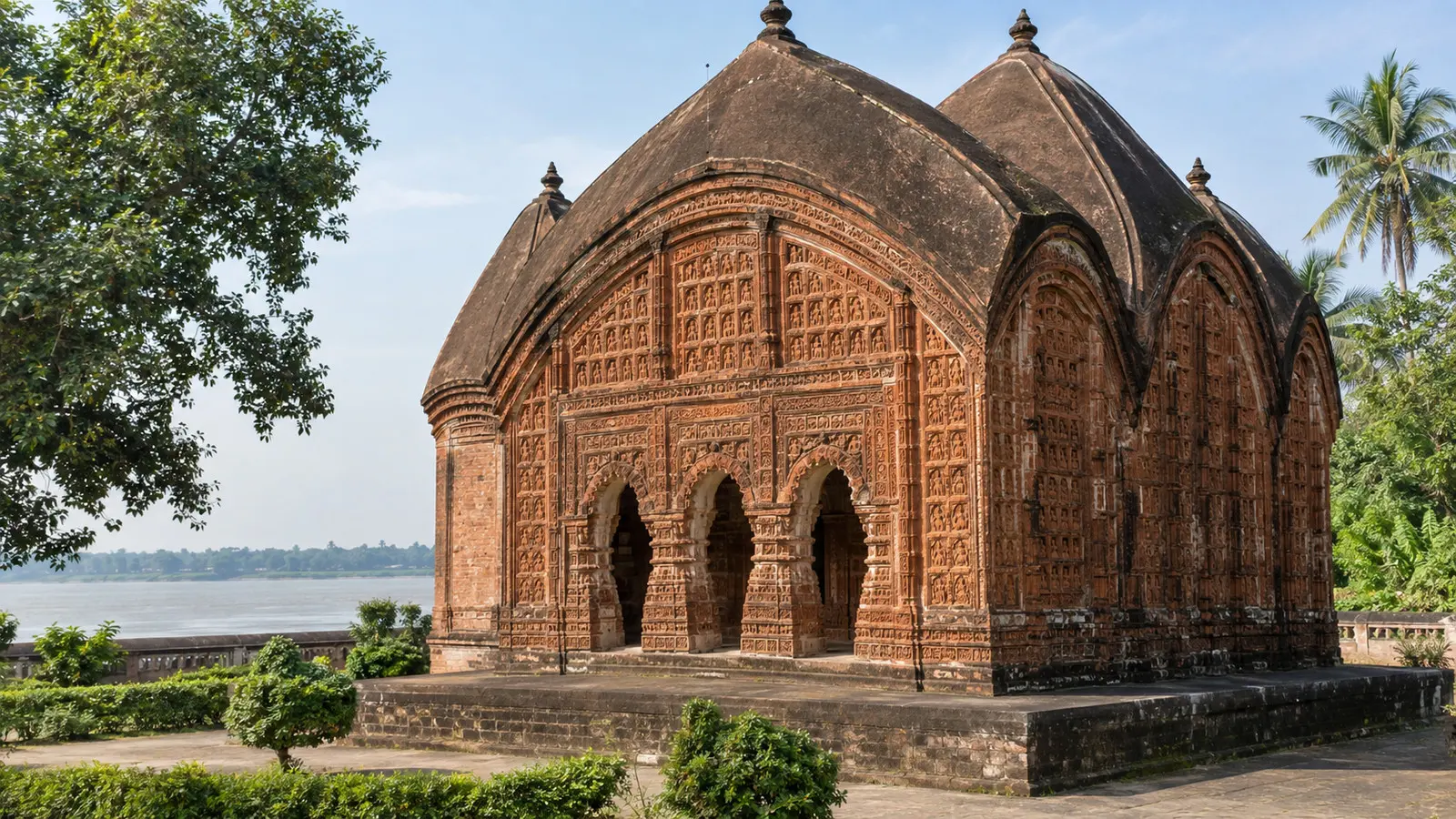
Char Bangla is a group of four brick Shiva temples arranged around a courtyard. The name refers to their four-bungalow composition, while their curved roof forms echo Bengal’s vernacular building traditions.
The Murshidabad district’s official Char Bangla heritage page identifies the temples as 18th-century works built under the patronage of Rani Bhabani of Natore, now in Bangladesh. The group is also listed by the Archaeological Survey of India as a centrally protected monument.
Terracotta panels show deities, epic stories, animals, ornament and scenes drawn from social life. A guide can help separate a Krishna narrative from a hunting scene before every tiny figure becomes “probably from the Ramayana.”
Look without touching, and keep bags away from the walls. Fired clay is durable enough to survive centuries but vulnerable to abrasion, moisture and enthusiastic fingers.
Bhavanisvar Temple
Bhavanisvar is distinct from the four Char Bangla temples and adds a dramatically different shape to the village visit. It is an octagonal Shiva temple with arched openings, a covered veranda and a roof culminating in an inverted-lotus form.
An Archaeological Survey of India preservation report describes terracotta figurines, arabesque patterns and geometric designs on the 18th-century structure. The report also documents conservation work addressing biological growth and deposits, a reminder that access and appearance can change during treatment.
Respect barriers even if they interrupt a photograph. Conservation scaffolding is not a secret second entrance.
Vehicle transfers in Murshidabad
Electric rickshaws, locally called totos, are common in current cruise programs. They negotiate narrower roads well but may have a step, bench seating, limited grab points and a lively relationship with potholes.
Horse-drawn carriages appear on some itineraries, while vans or coaches may serve groups or longer routes. Never assume the vehicle pictured in a brochure will be the one assigned on your date.
Keep hands and loose clothing inside, secure bags and wait for the guide’s boarding instruction. Ask the operator how gratuities are handled rather than negotiating with the driver at the moment the group is leaving.
Accessibility in Murshidabad
Murshidabad’s palace grounds can look level from the river, but the full excursion may combine a variable gangway, tender transfer, rickshaw step, museum security, stairs and substantial standing. No public source supports one end-to-end accessible route from every cruise landing.
Ask whether Hazarduari has a step-free visitor route operating that day, which galleries it reaches and whether elevators are available to cruise groups. Also ask about accessible restrooms, seating and the distance from vehicle drop-off to the museum entrance.
Katra’s historic surfaces and elevated areas may require uneven walking or steps. Travelers who cannot manage them should ask whether exterior viewing or a vehicle-based alternative is possible.
A wheelchair that works at the palace may not fit or be secured in a toto. Send the site’s river cruise accessibility checklist to the operator and request measurements for the actual transport.
Accessibility in Baranagar
Baranagar is often the harder of the two calls because its charm comes with village-scale infrastructure. The landing and temple approach may include earth, grass, sand, mud, narrow paths, thresholds and little shade.
A tender can require stepping between moving boats before any walking begins. A direct gangway can still be steep or end on an uneven bank.
No authoritative step-free route specification was found for the complete Char Bangla and Bhavanisvar visit. Ask whether a vehicle can approach the temples, whether a folding wheelchair can travel and whether there is a shorter viewing option.
Travelers with balance concerns should bring a compact walking aid only if the transfer crew confirms it can be handled safely. Two free hands and attentive crew assistance are more valuable on a plank than a bag full of theoretical solutions.
Seasonal water, fog and itinerary changes
The Bhagirathi changes with monsoon flow and drier-season sediment. High current can make a bank or tender operation unsafe, while lower water can shift the usable approach away from the most convenient landing.
The Inland Waterways Authority of India maintains navigation support and fairway work along National Waterway 1. Its NW-1 overview points mariners to current river notices and least-available-depth reporting because conditions are actively managed rather than permanently fixed.
Winter fog can delay sailing, while monsoon rain can turn Baranagar paths muddy and raise transfer risk. Extreme heat, a museum closure, religious activity or ground-transport delays can also reshape the day.
Operators may reverse the two calls, substitute a landing, shorten Baranagar, change the Murshidabad vehicle loop or protect the onward schedule toward Farakka. Ask whether an altered day still includes both places before deciding that a different sequence means a cancellation.
What to wear and carry
Wear closed shoes with traction, light clothing covering shoulders and knees, and socks suitable for any required shoe removal. A hat, water and sunscreen matter on palace lawns and village paths.
During wetter months, bring a small rain layer and protect electronics from spray. Leave both hands available for the gangway or tender rather than carrying a market-day collection of loose bottles.
Keep small Indian rupee notes for approved purchases or tips, but follow the cruise line’s guidance. Cards and ATMs should not be assumed at a temporary landing or village stop.
A realistic combined day
Murshidabad morning: Land with the group, visit Hazarduari and the waterfront ensemble, then use the assigned vehicle for Katra Mosque and any included palace or garden. Return aboard on the operator’s timing.
Baranagar afternoon: Sail to a separate landing and follow the guide through the village to Char Bangla and Bhavanisvar. Photograph respectfully, leave conservation surfaces untouched and preserve energy for the return bank.
The sequence may be reversed or divided across two days. Treat the daily program as the controlling plan because river movement and museum access matter more than the order printed in a long-range brochure.
Quick answers
Do Murshidabad and Baranagar use the same cruise landing?
No; they are separate destinations, and vessels commonly sail between different landings for the palace-city and temple-village visits.
Where do ships dock in Murshidabad?
No verified universal berth serves every vessel; a direct gangway, local landing or tender may be used according to operator and river conditions.
Can you walk from the ship to Hazarduari Palace?
Possibly from some landings, but the operator may use a different access point and transport for the wider city excursion.
How do passengers reach Katra Mosque?
Current cruise programs commonly use electric rickshaws, carriages or road vehicles because Katra is away from the palace waterfront.
What is special about Baranagar?
Its 18th-century Char Bangla and Bhavanisvar temples combine distinctive Bengal forms with exceptionally detailed terracotta ornament.
Is the combined call wheelchair accessible?
Not reliably end to end; the landing or tender, vehicles, museum route and Baranagar village paths all require sailing-specific confirmation.
Can one half of the call be canceled?
Yes; different landing conditions, museum access or schedule pressure can preserve Murshidabad while dropping Baranagar, or the reverse.
How I would plan two separate landings
Use the operator’s sequence for Murshidabad and Baranagar because the ship may reposition while guests travel by local boat or vehicle. A saved landing from another itinerary cannot safely determine the day’s meeting point.
Check West Bengal or Archaeological Survey information for Hazarduari and protected monuments, then prioritize the palace ensemble or Baranagar temples when hours are short. Temple panels are protected fabric, so do not touch them, climb structures, or use restricted photography.
Verify India entry requirements through the official portal and follow the ship’s stated return time. Vehicles, boat transfers, riverbank slopes, palace elevators, temple steps, heat and toilets all need separate accessibility checks.
How this guide was researched: No firsthand Murshidabad or Baranagar visit is claimed. Details were checked against Antara and Pandaw itineraries, West Bengal Tourism, the Murshidabad district administration, the Archaeological Survey of India and the Inland Waterways Authority of India.
Logistics and time-sensitive details were reviewed September 12, 2026. See our Editorial Policy.