Düsseldorf River Cruise Port: Berths, Altstadt, Rheinturm, and Transit
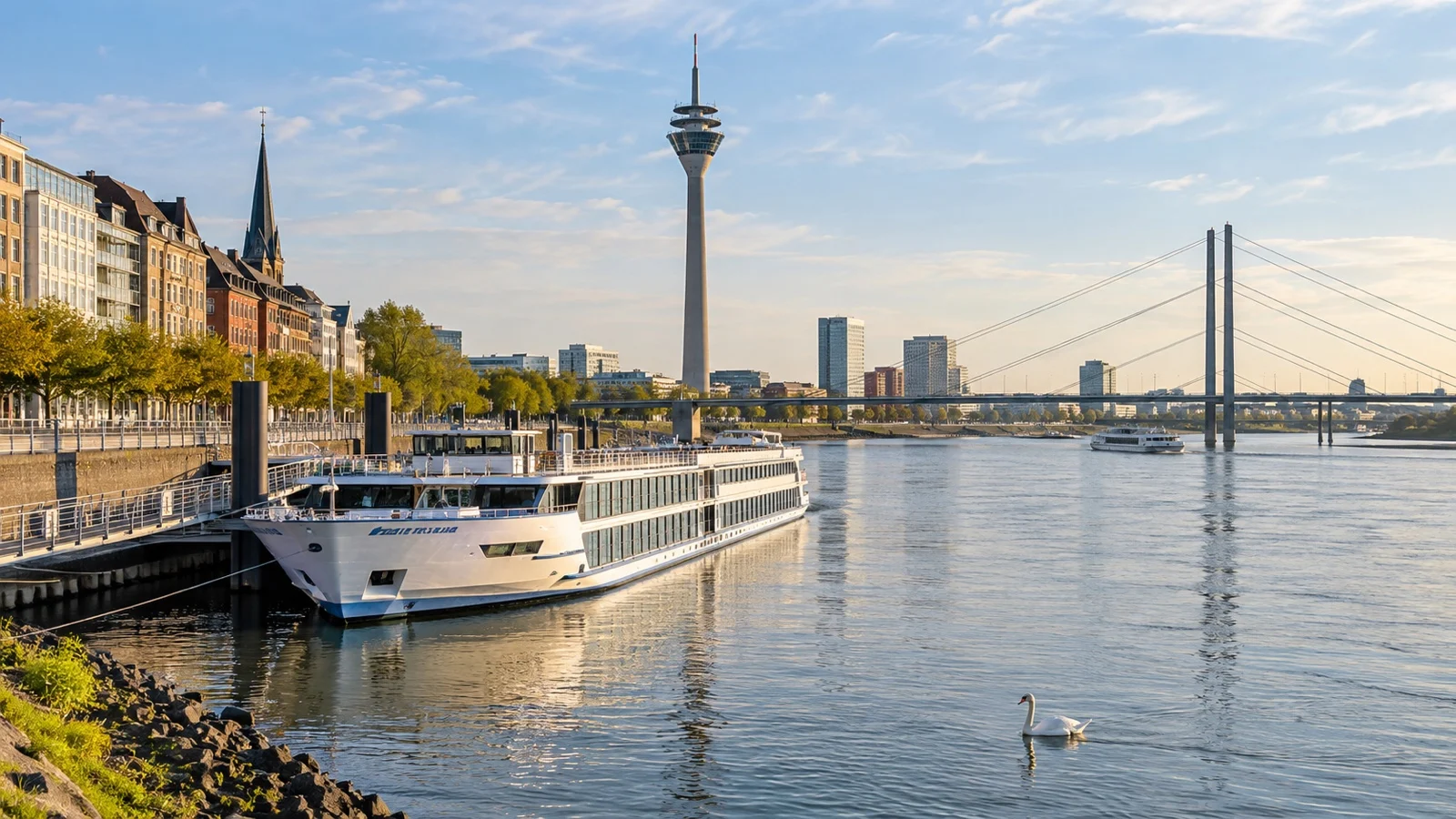
Düsseldorf is one of those Rhine calls that can feel polished, historic, creative, and delightfully casual in the same afternoon. The riverfront leads naturally toward the Altstadt, while the Rheinturm and sculptural buildings of the MedienHafen pull you in the opposite direction.
The key is to begin with your actual berth rather than a generic port pin. River ships can use different landing areas, and a route that looks effortless from one quay may waste valuable time from another.
My quick take
For a first visit, I would walk the Rhine promenade into the Altstadt, pause at Burgplatz, and choose either Königsallee for a classic city stroll or the Rheinturm for a broad view. Add the MedienHafen only if your berth, mobility, and time make the southern riverfront practical.
Düsseldorf is easy to enjoy without a formal excursion, but only after you confirm the gangway location and return route. Save the berth pin on your phone, take a photo of the landing sign, and never assume that another cruise ship is docked where yours will remain.
Quick Facts
- River: Düsseldorf sits on the Rhine, with river ships using different city landing stages according to the operator and local conditions.
- First check: Confirm the exact berth name and map pin before choosing a walking or transit route.
- Best first visit: Pair the Rhine promenade with Burgplatz, the Altstadt, and one additional focus such as Königsallee or the Rheinturm.
- Transit: Rheinbahn operates the city’s U-Bahn, tram, and bus network, but routes and disruptions should be checked on the day.
- Currency: Germany uses the euro, and carrying a physical card plus a small amount of cash is practical.
- Accessibility: The promenade is generally easier than old lanes and quay ramps, while gangway conditions remain vessel-specific.
- Return rule: Use the ship’s stated all-aboard time and leave a generous buffer for transit or a long walk back.
Where river ships dock in Düsseldorf
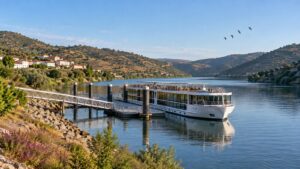
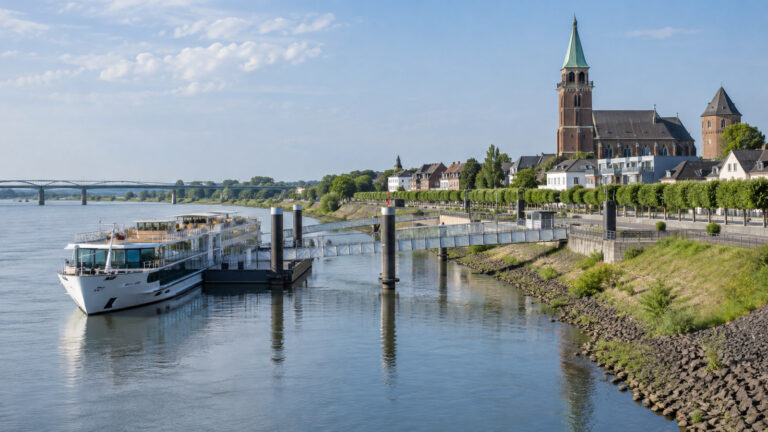
Düsseldorf does not function as one single cruise terminal with a universal address. Operators use landing stages along the Rhine, and assignments can change because of traffic, water levels, events, construction, or operational needs.
Your cruise program may name a street, a waterfront section, a bridge, or a nearby landmark. Match that wording with a map pin from the crew before leaving, because the upper promenade and lower quay can have different access points.
Some locations favor the Altstadt and Burgplatz, while others make the Rheinturm or MedienHafen the more natural first stop. A berth farther from the central sights may require a shuttle, transit, or taxi even though the ship is technically in Düsseldorf.
Ask whether the vessel is expected to remain at the same landing stage all day. Ships can occasionally reposition, and the cruise director’s instructions always take priority over a route saved before arrival.
Leaving the ship safely
Gangway slope and step configuration depend on the berth and river level. A flat-looking quay does not guarantee a level exit, and rafting through another vessel can add narrow passages or extra steps.
Travelers with mobility concerns should ask about every part of the exit, including the ship elevator, sun deck restrictions, stairs between vessels, gangway width, handrails, and the route from the lower quay to street level. Get the answer for your call rather than relying on the ship’s general accessibility description.
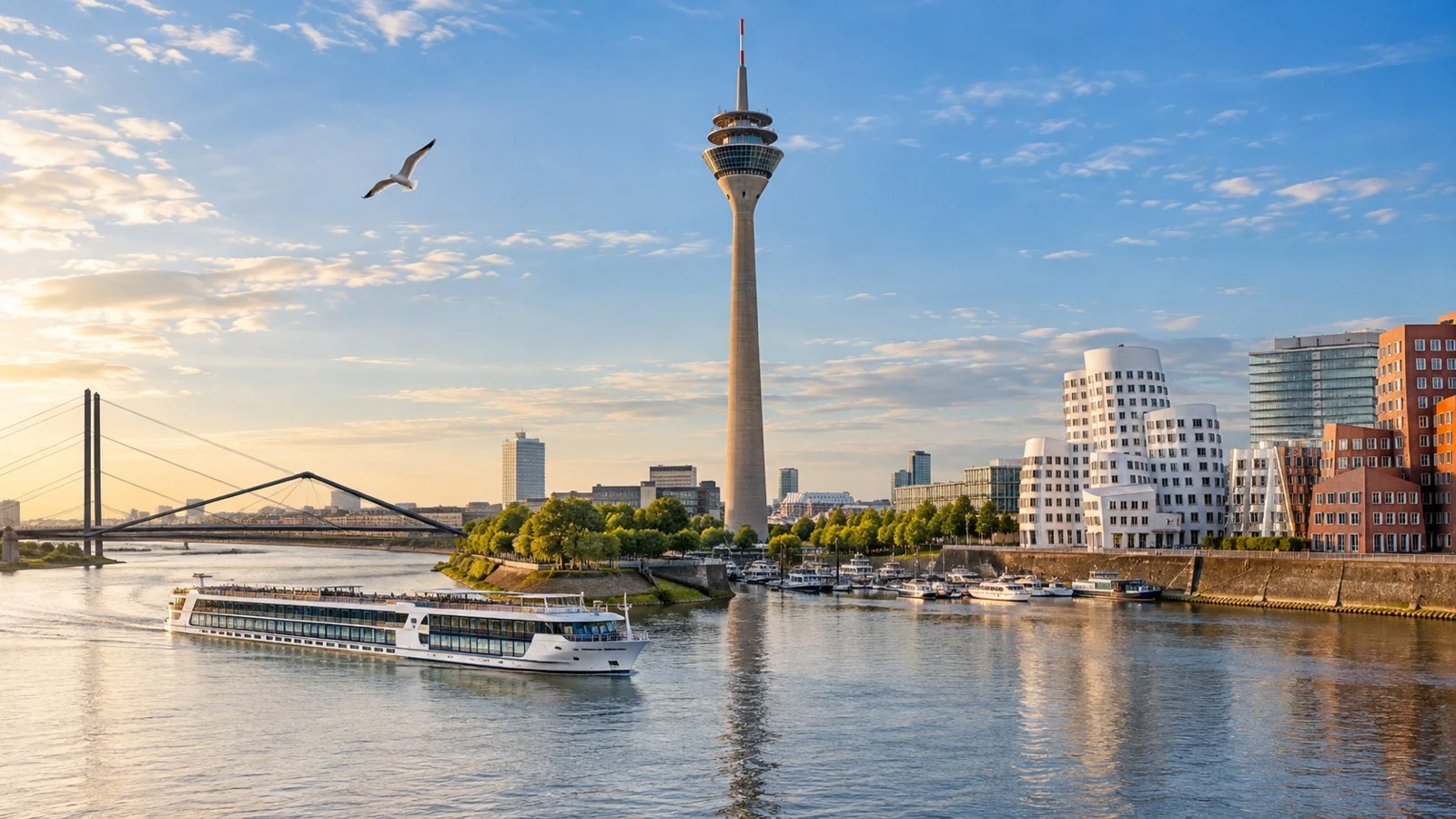
Once ashore, look back and note the exact access point. Düsseldorf’s long river edge can make one flight of steps, ramp, or underpass look much like another when you return.
A strong first-time walking route
Start along the Rhine promenade in the direction of the Altstadt. This keeps the river as a simple reference and avoids disappearing into city streets before you understand the relationship between the quay, Burgplatz, and your ship.
At Burgplatz, the Schlossturm is the surviving tower of the former palace and now houses a museum devoted to the Rhine and shipping. Nearby, the old lanes open toward the Marktplatz, city hall, Saint Lambertus, and the Altstadt’s dense network of restaurants and taverns.
Continue east if you want Königsallee, the landscaped canal boulevard known locally as the Kö. Turn south along the river if the Rheinturm and MedienHafen matter more, but watch the clock because that choice lengthens the return for many berth locations.
Do not try to include every headline sight on a short call. Düsseldorf works better as two connected neighborhoods with time to look around than as a high-speed loop across the entire center.
Rhine promenade and Burgplatz
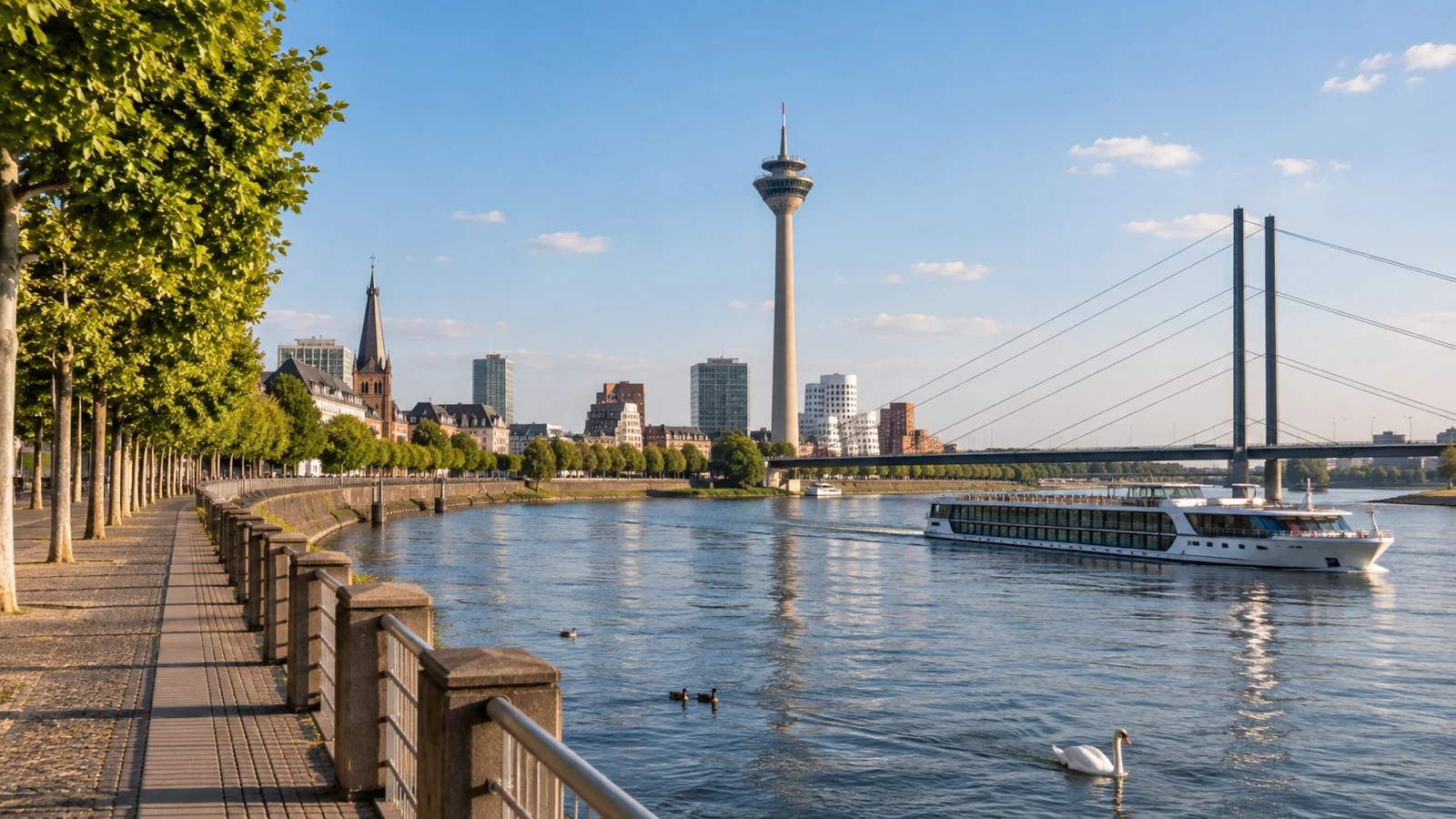
The promenade is the city’s easiest orientation line and one of its most enjoyable spaces. It links river views with the Altstadt, seating, bridges, civic buildings, and the southern skyline.
Burgplatz is a natural pause rather than merely a point on the map. The broad river view, Schlossturm, and nearby old streets make it a useful place to decide whether your next priority is history, food, shopping, art, or architecture.
The lower waterfront and upper promenade are connected by ramps and steps in several places, but the most convenient transition depends on your route. Wheelchair and scooter users should identify a ramp before committing to the lower level.
Cyclists, runners, events, and busy outdoor seating can make the promenade more crowded than expected. Keep to the pedestrian side where marked and be careful when crossing cycle lanes.
Inside the Altstadt
Düsseldorf’s Altstadt is compact, lively, and easy to combine with the riverfront. It offers historic churches, small squares, museums, shops, breweries, and an atmosphere that changes noticeably between morning and evening.
Saint Lambertus is recognizable by its twisting spire, while the Marktplatz places the city hall and equestrian monument in one concise scene. Interiors and museums have their own opening hours, so verify the current schedule before building a short call around one doorway.
The SchifffahrtMuseum in the Schlossturm is especially relevant on a river cruise because it explores the Rhine and navigation. Check the City of Düsseldorf service page for the SchifffahrtMuseum for current access rather than assuming it opens every day.
Old lanes can include cobbles, thresholds, narrow sidewalks, and delivery activity. Travelers seeking the smoothest outing may prefer the promenade and larger squares, with only a brief turn into the historic core.
Altbier without turning the day into a pub crawl
Altbier is Düsseldorf’s signature beer style, and traditional breweries in the Altstadt serve it in small glasses. Servers may replace an empty glass automatically in the customary service style, so ask your cruise staff or host how to signal when you are finished.
A short tasting with food can be part of the culture without taking over the port call. Order water as well, keep track of time, and remember that alcohol affects balance on cobbles and gangways.
Düsseldorf mustard and hearty regional dishes are other local themes. Menus and payment practices vary, so check prices before ordering and keep a small cash backup even if you normally use a card.
Königsallee and the city-center option
Königsallee is a broad boulevard organized around a landscaped canal, with luxury retail and attractive bridges. You do not need to shop for it to be worthwhile, since the water, trees, and urban design create a polished contrast with the Altstadt.
The route from the river passes city streets and shopping areas where crossings and construction can slow you down. Use a live map and choose a clear turnaround point rather than drifting toward the main station by accident.
This is the better extension for travelers who enjoy storefronts, city life, and an easier surface than some old lanes. It is less rewarding if your priority is river engineering, panoramic views, or contemporary waterfront architecture.
Rheinturm and the view from above
The Rheinturm anchors the southern skyline and gives a wide view over the Rhine, city center, and MedienHafen when visibility is good. Admission, opening hours, security procedures, elevator access, and restaurant operations can change, so check the tower’s current visitor information before setting out.
Allow more time than the elevator ride itself. A ticket line, busy entry, photography stop, restroom break, or slow walk from the berth can turn a quick idea into a substantial part of the call.
The tower is a strong choice in clear weather and a weaker choice when cloud or haze obscures the panorama. On a short visit, be willing to switch to the promenade or Altstadt if conditions do not justify the detour.
Travelers with limited mobility should ask about the complete route from street level to the public viewing area, not only whether an elevator exists. Emergency evacuation rules and restaurant seating access may impose separate conditions.
MedienHafen and modern architecture
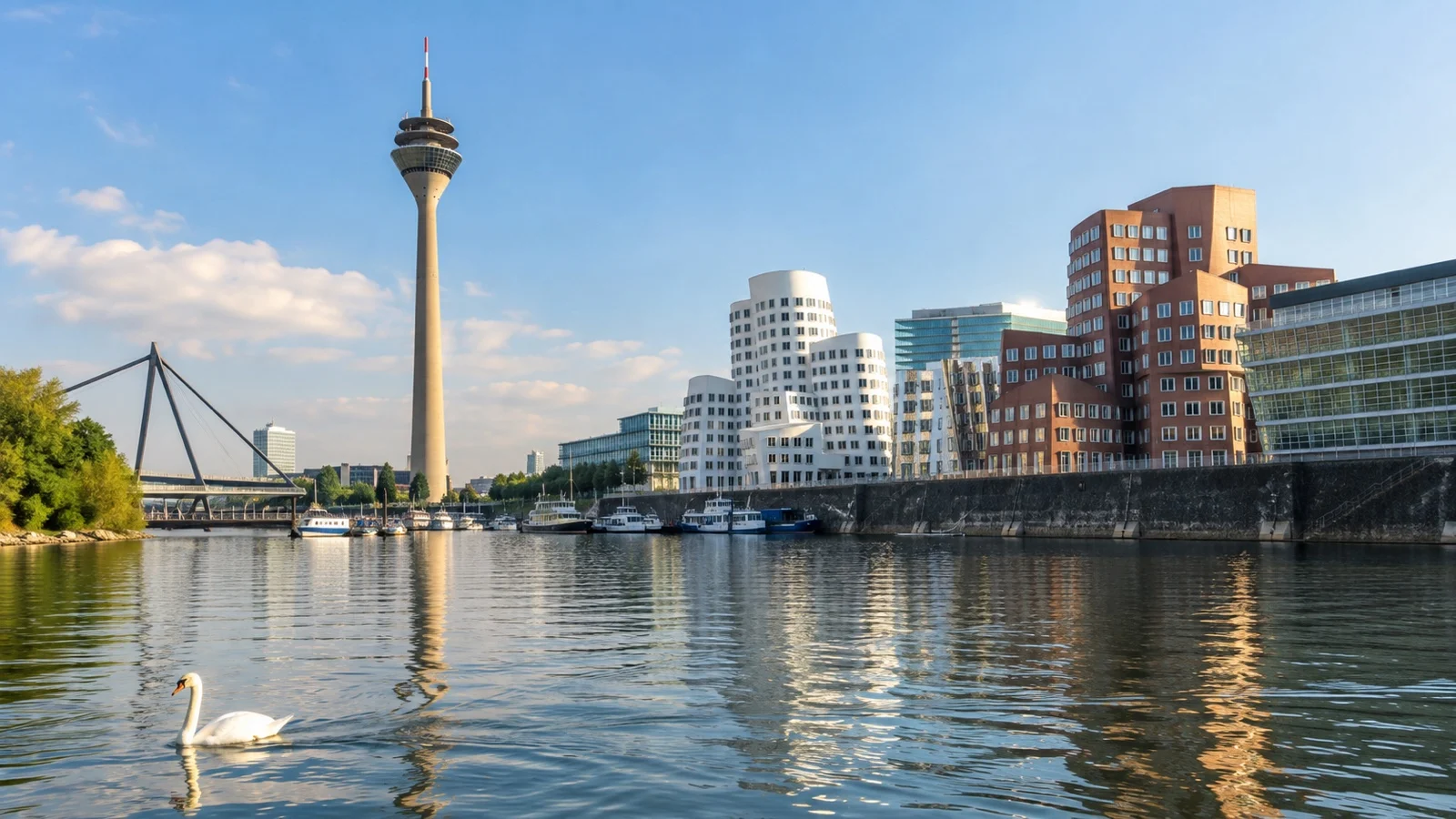
The MedienHafen shows how Düsseldorf transformed a working harbor district into a center for offices, dining, media, and design. Its best-known landmark is the ensemble of curved and leaning buildings by Frank Gehry, which the city identifies as an emblem of the harbor’s redevelopment.
Architecture fans will enjoy walking around the buildings rather than viewing them from only one angle. Reflections and changing sight lines are part of the effect, especially around the stainless-steel facade.
The district is farther south than the central Altstadt sights, so combine it with the Rheinturm rather than treating it as an extra after a long shopping route. City information about the area is available through the official Düsseldorf MedienHafen page.
Working harbor edges, driveways, cycle routes, and construction may interrupt the most direct-looking line. Stay on public paths and do not enter private courtyards simply to reproduce a photograph.
Art museums for a focused visit
Düsseldorf has serious art credentials, and K20 at Grabbeplatz is particularly convenient for the northern side of the Altstadt. Its modern collection and temporary exhibitions can easily fill more time than a cruise call allows.
Choose one museum only if the current exhibition genuinely interests you. Confirm opening hours, timed tickets, cloakroom rules, accessibility, and the portion of the collection on view through the museum’s official site.
A museum plan is especially useful in rain, cold, or intense heat. It also demands discipline, because it is easy to lose track of time once you are inside a large exhibition.
Using Rheinbahn transit
Rheinbahn operates local U-Bahn, tram, and bus services, with regional connections integrated into the wider transport system. A route that worked on a previous visit can change because of construction, events, or service disruptions.
Use the official Rheinbahn website or app to check the same-day journey, correct platform, direction, ticket, and disruption notices. Screenshot the return trip while you have a data connection.
Validate or activate the correct ticket according to the product you buy. If the fare system feels unclear and your time is short, ask at an official sales point or choose a straightforward walk rather than boarding with an uncertain ticket.
Station names matter because several stops can serve the central area. Save both the stop nearest your destination and the one that returns you most directly to the berth or shuttle point.
Taxis and ride services
A taxi can be useful for a berth outside the center, a mobility-sensitive visit, or a one-way trip to the MedienHafen. Show the exact berth address or saved pin instead of saying only river cruise ship.
Ask whether card payment is accepted before the ride and allow for traffic near events. For the return, a pickup on the upper street level is usually easier to describe than a lower quay without road access.
Do not book a tight pickup that assumes the ship cannot move. Confirm the vessel’s expected location and keep the cruise line’s local contact details available.
Accessibility in the city
The upper Rhine promenade is generally the simplest sightseeing surface, but access from the ship may still involve a steep gangway, steps, or rafting. The Altstadt adds cobbles and thresholds, while the Rheinturm, museums, and transit each have venue-specific details.
Ask precise questions about gradients, curb cuts, elevators, accessible restrooms, boarding gaps, and construction. A general statement that Düsseldorf is walkable does not answer whether one traveler’s route will work.
If stamina is limited, choose one anchor such as Burgplatz and use a taxi for a second focus. This preserves energy for the gangway and avoids turning the return into the hardest part of the day.
Travelers using mobility scooters should confirm the vessel’s lift dimensions and battery policy before sailing. An accessible city route is not useful if the device cannot reach the gangway from the cabin deck.
Weather and river conditions
Düsseldorf weather can change quickly, and the exposed riverfront often feels windier than streets inside the Altstadt. Dress in light layers and carry a compact rain shell even when the morning forecast looks settled.
High or low Rhine water can affect ship operations, gangway angle, sailing time, and berth assignments. It does not automatically cancel your day, but it makes crew updates more important than a plan created weeks earlier.
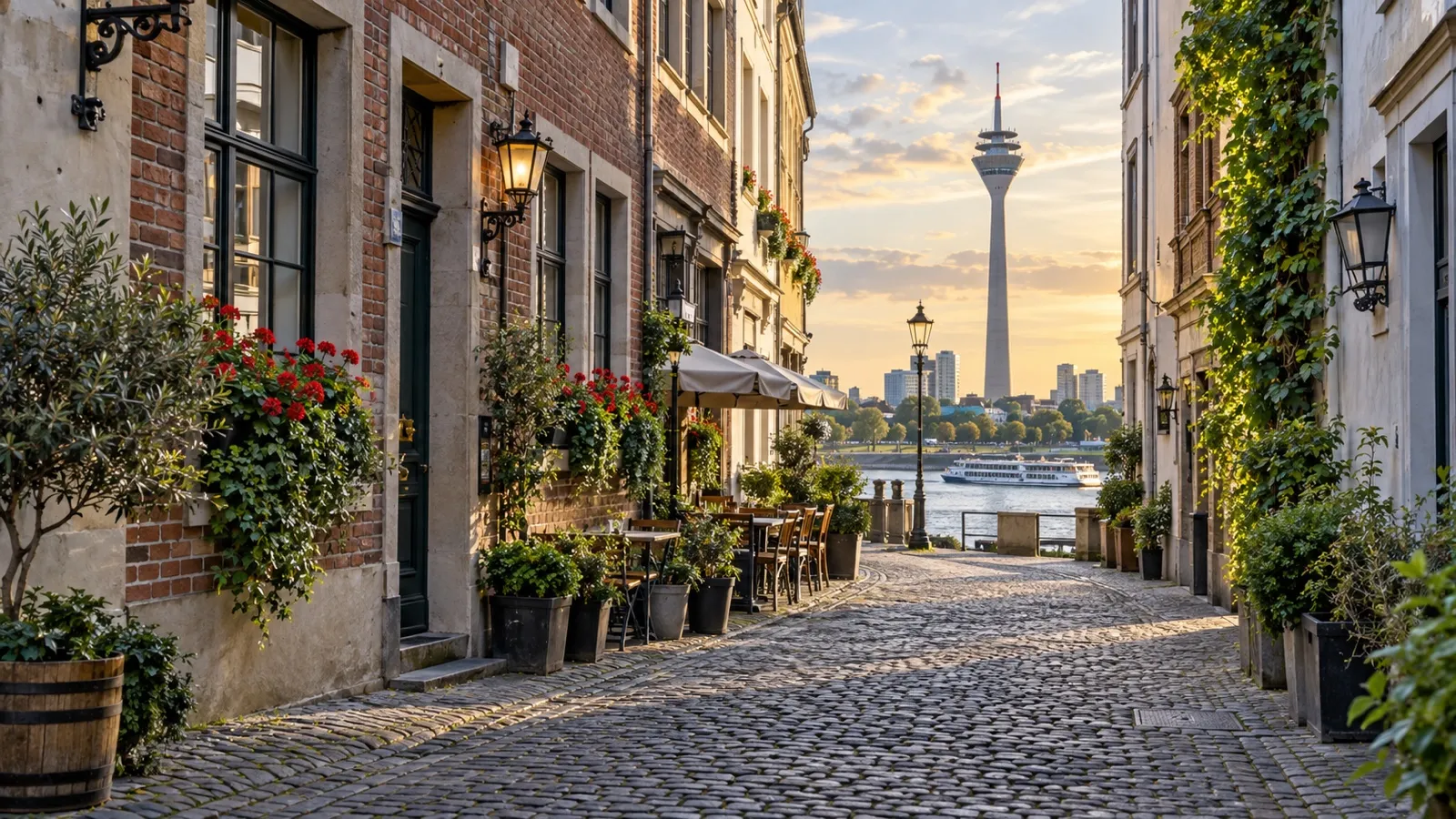
If the vessel must adjust its schedule, keep your independent plan flexible. A shorter waterfront loop is much better than missing a new all-aboard time while trying to save an ambitious itinerary.
A practical half-day plan
Confirm the berth, walk the promenade to Burgplatz, and spend time in the Altstadt around the Schlossturm, Marktplatz, and Saint Lambertus. Then choose either a relaxed regional lunch or a walk toward Königsallee before returning along a route you already understand.
Architecture lovers can reverse the emphasis by heading toward the Rheinturm and MedienHafen first. Return toward the Altstadt only if the remaining time and berth position leave a comfortable margin.
On a rainy call, use a taxi or transit to one museum, then take a short covered or umbrella walk through the Altstadt. Do not stack two museums unless the ship is staying late and you have verified both hours.
If you have a full day
A longer call allows a museum, a proper meal, and a more complete walk between the MedienHafen and Altstadt. It may also make Little Tokyo around Immermannstraße worthwhile for travelers interested in Düsseldorf’s Japanese community and food culture.
Little Tokyo is inland and closer to the main station than the river, so it needs a transit or taxi plan from most berths. Choose it as a destination, not as an accidental addition after Königsallee.
Even with a full day, retain a return buffer. Events, tram changes, traffic, and long restaurant waits can consume time without warning.
Common mistakes
The most common mistake is navigating to a generic Düsseldorf port marker instead of the ship’s actual landing stage. The second is assuming the vessel will remain in the same place without checking.
Travelers also underestimate the distance created by combining Königsallee, the Rheinturm, MedienHafen, and a museum. Each is reasonable alone, but all of them together can turn a relaxed city call into a race.
Another mistake is depending on exact opening hours from an old article. Use official attraction and transit sources shortly before the visit, because schedules and closures change.
Finally, do not let a drink, long lunch, or shopping stop erode your return margin. The Rhine sailing schedule matters, and the ship may not be able to wait.
Quick answers
Can I walk from the ship to the Altstadt?
Often yes, but not from every landing stage with the same ease. Confirm your exact berth and ask the crew whether a shuttle or transit connection is recommended.
What is the best first sight?
Burgplatz is the most useful starting point because it connects the river promenade, Schlossturm, Altstadt, and routes toward the city center. From there, add one larger priority.
Is the Rheinturm worth it on a short call?
Yes when visibility is good and admission is moving smoothly. Skip it when the detour, line, or weather would squeeze the rest of your visit.
Do I need a ship excursion?
Not necessarily for central sightseeing because Düsseldorf is manageable on foot and by public transit. An excursion can still help when the berth is remote, mobility support matters, or you want structured interpretation.
Can I pay by card everywhere?
Card acceptance is common but not universal, especially for small purchases or traditional venues. Carry a small amount of euros and ask before ordering if payment method matters.
How much return time should I allow?
Use a larger margin than the map’s travel estimate, especially when taking transit or visiting the MedienHafen. Follow any revised all-aboard instruction from the ship.
Final word
Düsseldorf makes a rewarding Rhine stop because its strongest sights are connected by the riverfront yet different enough to suit several travel styles. History, art, shopping, architecture, and local food are all available without forcing one rigid itinerary.
Start with the berth, choose two or three priorities, and keep the final part of the route simple. That small amount of discipline leaves more time to enjoy the promenade and less time worrying about the ship.
Research note
This guide was checked against current information from the City of Düsseldorf, Düsseldorf Tourism, Rheinbahn, and official attraction resources. Time-sensitive berth, transit, attraction, accessibility, and river details were reviewed on September 12, 2026, but live ship and local instructions remain final.