Bratislava River Cruise Port: The Best Walk-Off on the Danube
Bratislava is one of those river ports that rewards you almost immediately. In many cases, you step off the ship, look toward the castle, and reach the edge of the Old Town in about five to ten minutes.
That easy arrival is the city’s superpower, but it can also make people underestimate how much there is to choose from. A short call is enough for the historic center, while a longer stay opens the door to Bratislava Castle, the UFO observation deck, or a carefully planned side trip to Devin.
The quick take
For a first visit, keep the day simple: walk into the Old Town, circle its compact lanes, and add the castle if your legs and schedule allow. The main sights sit close together, so Bratislava works beautifully without a tour.
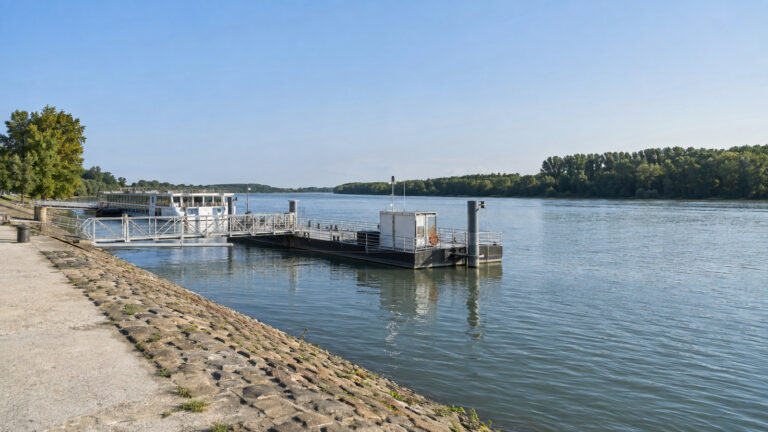
The variable is your exact berth. Most river traffic uses the passenger port area along the Danube near Fajnorovo nábrežie, but ships can moor at different pontoons or raft alongside another vessel, changing the walk and the gangway.
Bratislava river cruise port quick facts
- Typical location: Central Danube quays near Fajnorovo nábrežie and the Old Town
- Walk to the historic center: Usually about five to fifteen minutes, depending on berth
- Best first stop: Hviezdoslav Square or the lanes around Main Square
- Currency: Euro
- Language: Slovak, with English common in visitor areas
- Castle grounds: Generally open daily from 8:00 AM to 10:00 PM
- Castle museum: Typically open 10:00 AM to 6:00 PM, closed Tuesday, with last entry at 5:00 PM
- UFO observation deck: At the top of the SNP Bridge tower, about 95 meters above the river
- Best for limited mobility: Old Town riverside routes, with advance checks for gangways and cobbles
- Most important rule: Confirm the ship’s final all-aboard time before leaving the quay
Where river ships dock
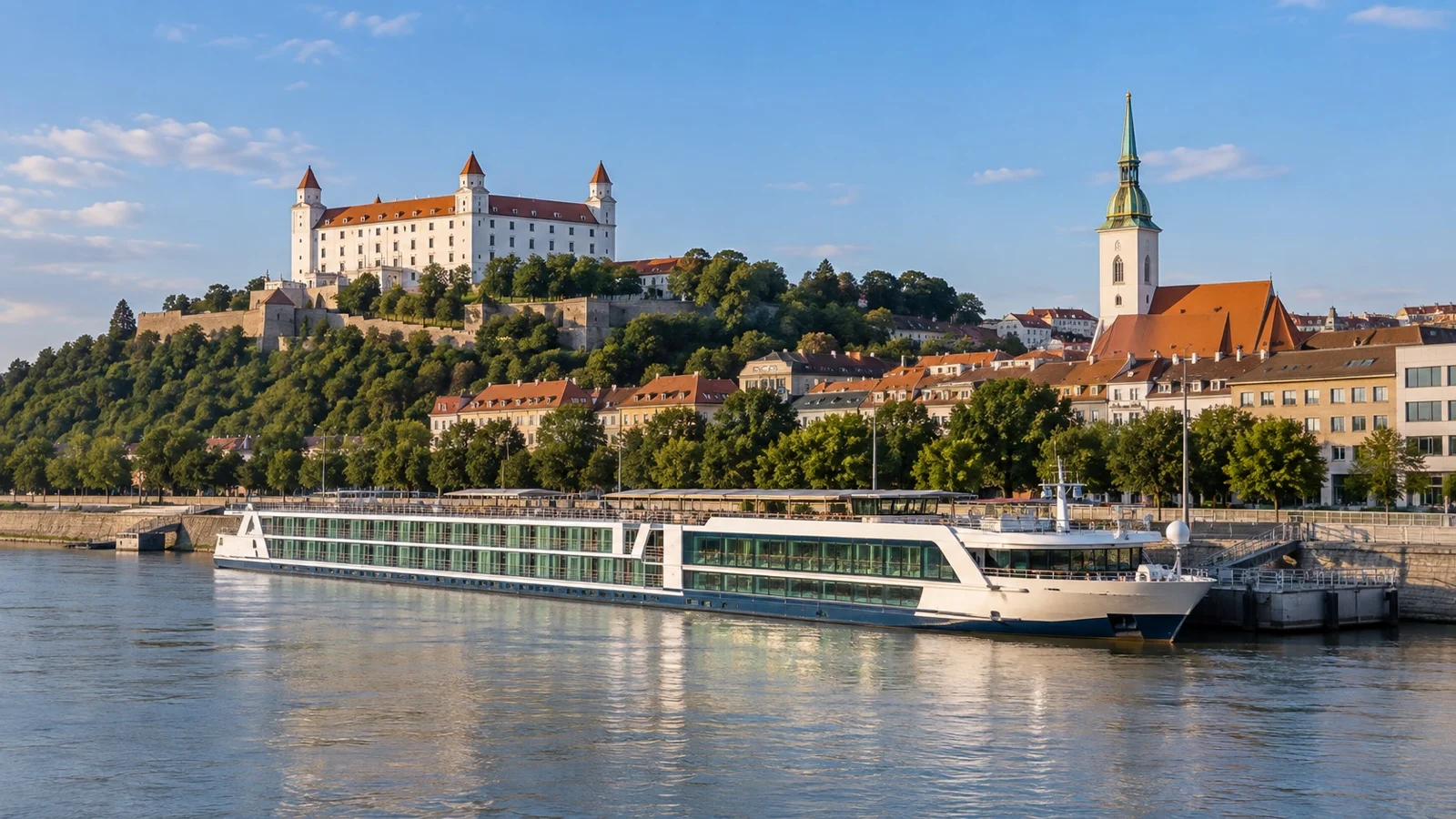
Bratislava’s passenger port is on the north bank of the Danube, directly below the central city. The official passenger port address is Fajnorovo nábrežie 2, although your vessel’s assigned pontoon may be a little east or west of that point.
Do not plan around a single pin saved weeks in advance. River levels, traffic, and port operations can alter the precise landing place, so use the docking information supplied by your cruise director on arrival.
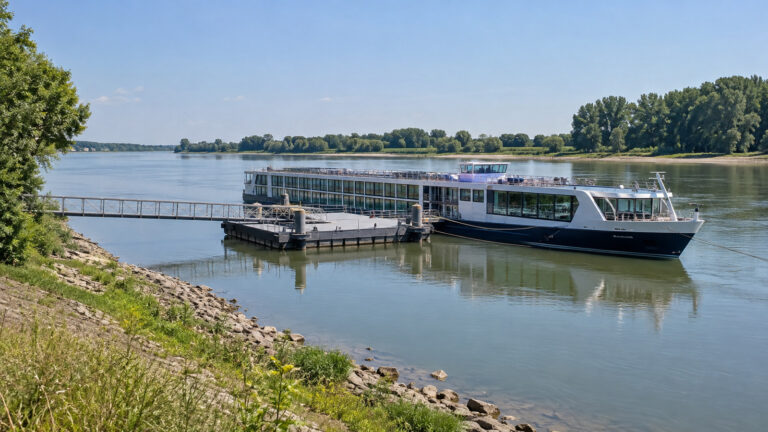
Rafting is common on busy river days. If your ship is tied outside another vessel, you may cross one or more lobbies and use extra steps before reaching the quay.
What the walk feels like
Once ashore, the river promenade gives you an easy visual reference. The Old Town rises behind the waterfront, while the SNP Bridge and its saucer-shaped UFO tower stand prominently to the west.
The route is short but not completely level everywhere. Curbs, tram tracks, uneven paving, and cobblestones appear as you move into the historic core, and the climb to Bratislava Castle is much steeper than the map suggests.
Walking into the Old Town
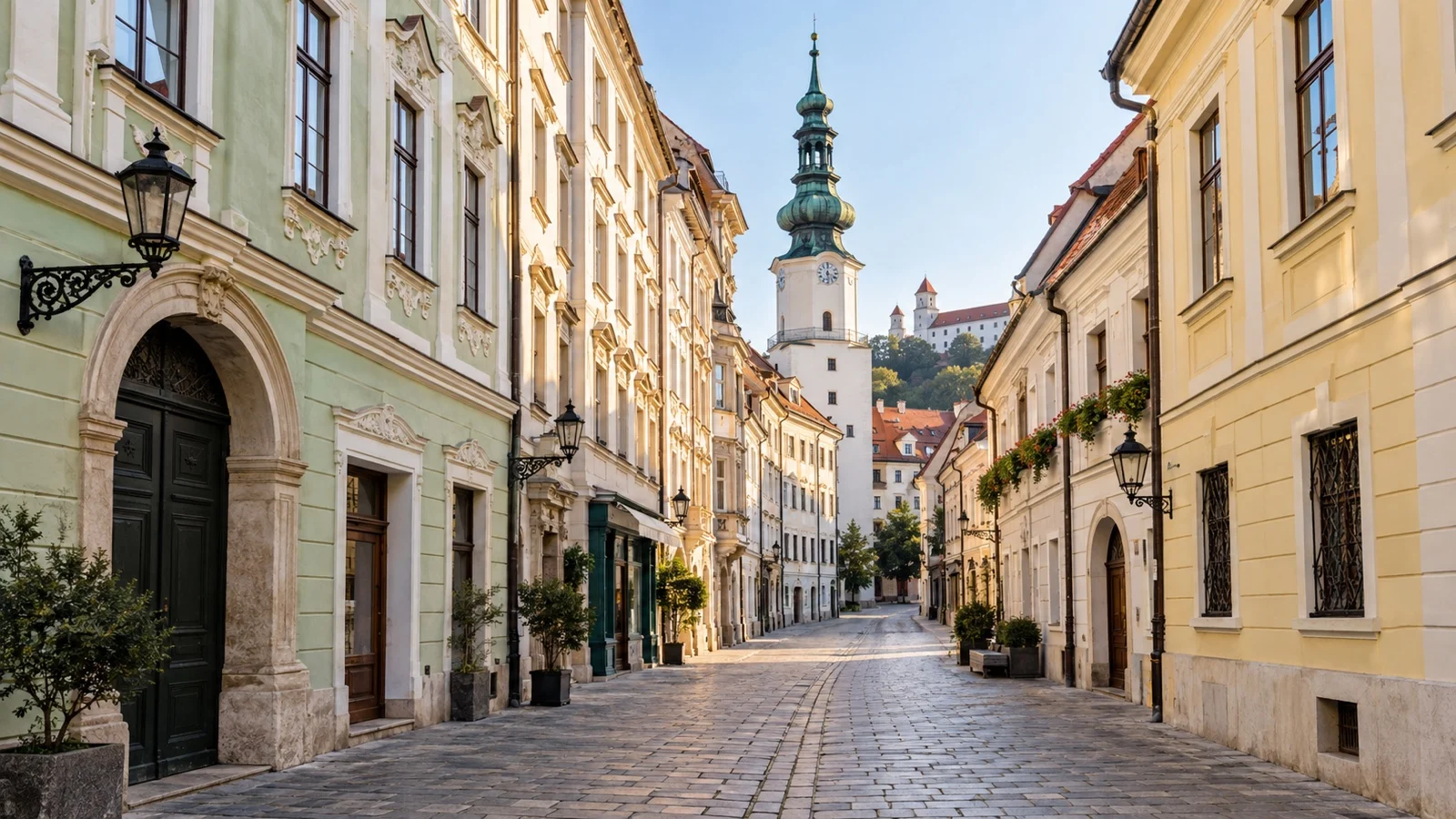
Start by crossing the waterfront roads toward Hviezdoslav Square, a broad pedestrian space lined with cafés and anchored by the Slovak National Theatre. From here, the city unfolds in a compact web of lanes that is easy to explore at a relaxed pace.
Main Square is the classic center of the old city. The Old Town Hall and its tower frame the square, and nearby streets lead toward the Primate’s Palace, small courtyards, restaurants, and some of Bratislava’s playful bronze statues.
Michael’s Gate marks the last surviving gate from the medieval fortifications. It is a natural point on a walking loop, but the narrow street beneath it can become crowded when several river ships and tour groups arrive together.
Saint Martin’s Cathedral stands closer to the castle side of the center. The Gothic church served as a coronation church for Hungarian monarchs, making it one of the city’s most historically important interiors.
The Blue Church
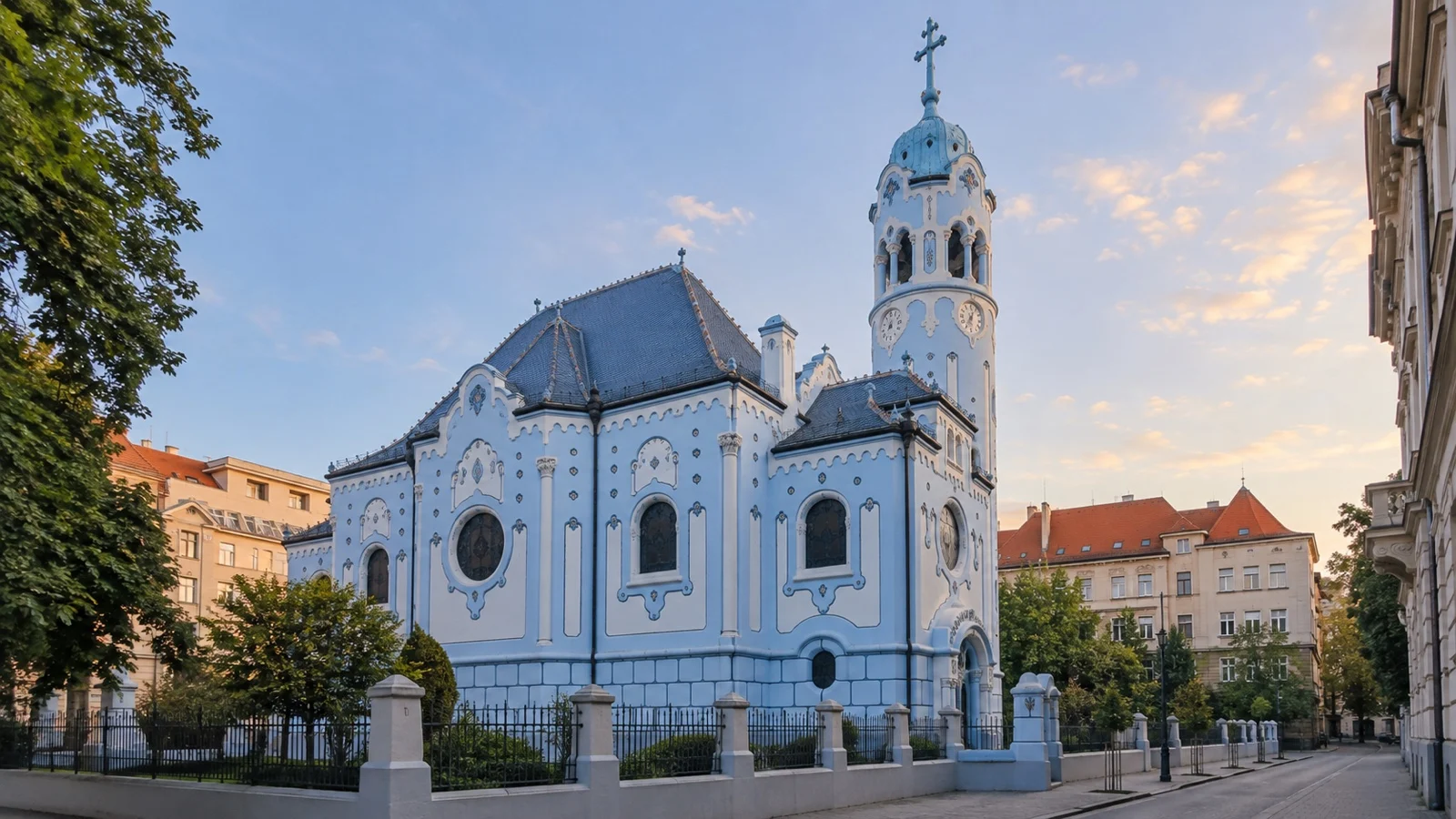
The Church of Saint Elizabeth, usually called the Blue Church, sits east of the Old Town core. Its pastel Art Nouveau exterior is worth the detour, but interior access can be limited outside services.
Allow about fifteen minutes each way from Main Square and check the clock before setting out. If your port call is tight, the Old Town and castle offer a more efficient first visit.
Bratislava Castle
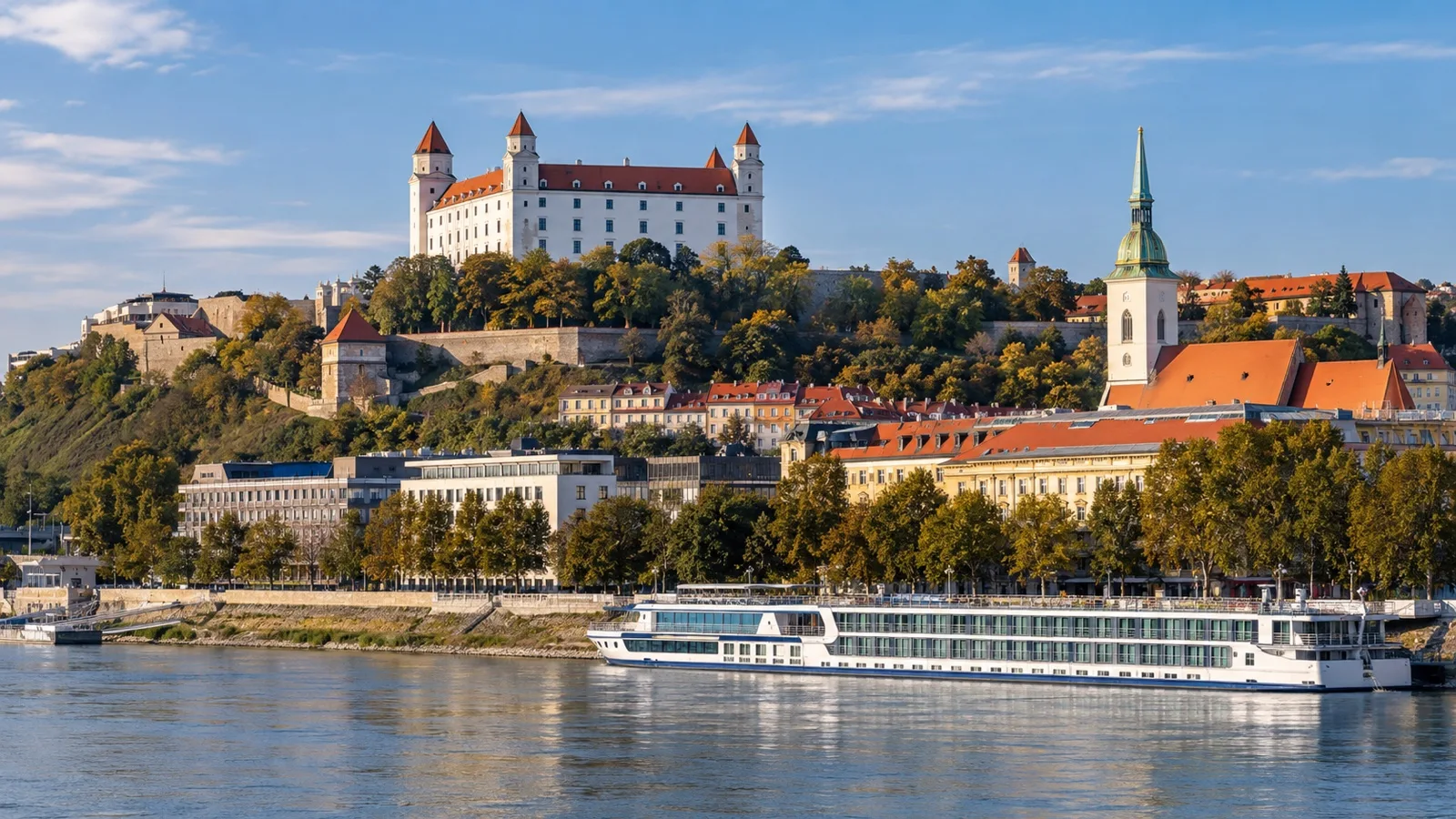
The white, four-towered castle dominates almost every arrival view from the river. It stands roughly 80 meters above the Danube, so reaching it on foot involves a real uphill stretch even though the distance looks modest.
The grounds are the easiest reward. Terraces and gardens provide broad views over the river, the city, and neighboring Austria on a clear day, and you can enjoy them without buying a museum ticket.
The castle houses branches of the Slovak National Museum. Official visitor information generally lists museum hours from 10:00 AM to 6:00 PM, with last entry at 5:00 PM and Tuesday closure, while the grounds are typically open from 8:00 AM to 10:00 PM.
A standard museum ticket is currently listed at 14 euros, but prices and temporary exhibitions can change. Check the official museum page close to your sailing if the interior is a priority.
The building visible today reflects major reconstruction after a devastating fire in 1811. That layered history makes the castle more than a viewpoint, although travelers with only a few hours may reasonably choose the grounds and spend the saved time in the Old Town.
The easiest castle strategy
Walk uphill before lunch while temperatures are cooler, then descend through the lanes into the center. This direction also keeps the final part of your day closer to the ship.
Travelers who want the view without the climb can use a taxi or local transportation toward the castle area, then walk downhill. Confirm where vehicles can legally stop because access immediately beside the entrances may be restricted.
How much time do you need?
With two hours ashore, focus on a compact Old Town loop. Walk through Hviezdoslav Square, Main Square, Michael’s Gate, and the lanes near Saint Martin’s Cathedral, leaving a comfortable return buffer.
With three to four hours, add the castle grounds or the UFO observation deck. Both provide excellent orientation, but doing both can turn a pleasant visit into a race.
With five or more hours, you can visit the castle museum, linger over lunch, or consider Devin if transportation lines up. Always build the plan backward from all-aboard time, not from the ship’s published departure time.
Devin Castle as a side trip
Devin Castle sits where the Danube and Morava rivers meet, outside central Bratislava. The dramatic ruins and borderland setting make it one of the region’s strongest half-day excursions.
It is not a casual add-on for a short port call. You need time for the trip each way, admission, walking on uneven ground, and a safe return margin.
Public buses can reach the Devin area, and the official passenger operator also runs seasonal boat services between Bratislava and Devin. Boat schedules are limited and require careful matching to your ship’s call, so advance booking and same-day confirmation are wise.
Choose Devin instead of an extended city visit, not on top of one. If the ship offers a guided excursion, its transportation protection may be worth the premium when the port window is narrow.
The UFO observation deck
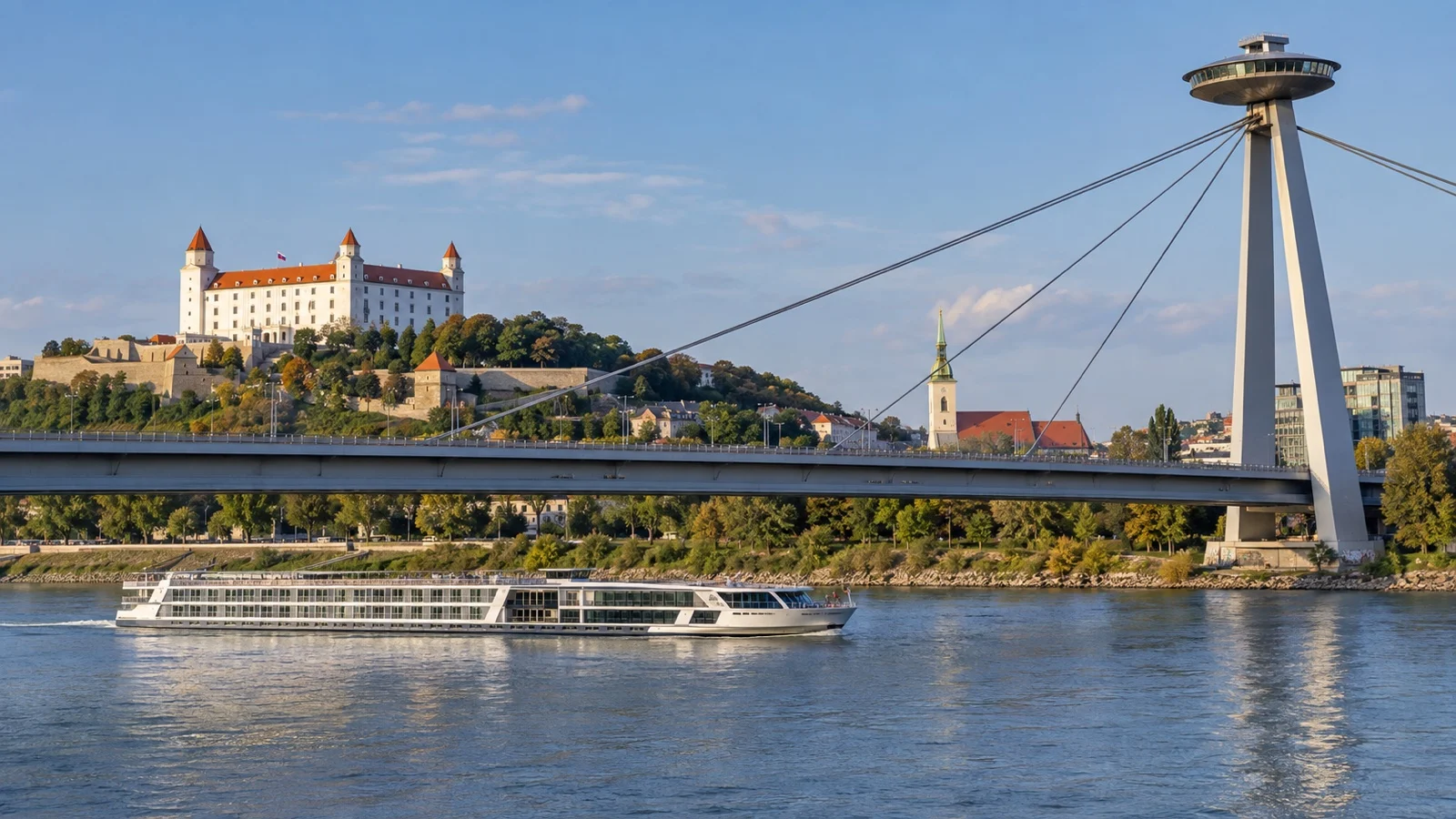
The UFO tower sits above the SNP Bridge on the south side of the river. Its observation deck is about 95 meters high and, in favorable conditions, official visitor information says the view can extend as far as 100 kilometers.
The attraction is generally open daily from 10:00 AM to 11:00 PM, while the restaurant usually begins service at noon. Hours, private events, and weather restrictions can change, so check directly before committing.
Reaching the entrance requires crossing the river or using local transportation, then navigating the bridge approach. For a short call, calculate the full out-and-back time rather than judging by the tower’s apparent closeness.
The payoff is a clean panorama of the castle, Old Town, river, and surrounding landscape. Photographers often prefer the deck when visibility is good, while history-focused visitors may get more from the castle.
Getting around
Bratislava’s center is best explored on foot, and most first-time visitors will not need public transportation. Trams and buses become useful for the main railway station, farther neighborhoods, or reducing part of the castle climb.
Slovakia uses the euro. Cards are widely accepted in central businesses, but a little cash can help with small purchases, public restrooms, or machines that do not cooperate with a foreign card.
If you use public transportation, buy and validate the correct ticket under the current system. Rules and mobile options can change, so use the city transport operator’s official information rather than an old travel forum.
Taxis and app-based rides can save time, especially uphill. Leave extra margin for road closures, event traffic, and pickup restrictions in pedestrian areas.
Accessibility and comfort
The flat riverfront and parts of Hviezdoslav Square are the most manageable areas for travelers with limited mobility. Conditions become more demanding in the Old Town, where cobbles, shallow steps, curbs, and sloping lanes are common.
The castle approach is the largest physical challenge. A vehicle transfer can reduce the climb, but the grounds and museum may still involve uneven surfaces, thresholds, or interior route changes.
Ship access can be just as important as the city route. Ask the cruise team about rafting, gangway steepness, elevator availability, and whether crew assistance will be available at your expected return time.
Wear shoes with dependable grip because polished paving can become slick in rain. In summer, carry water and use shade whenever possible, especially on the exposed castle hill and river promenade.
Weather and river conditions
Bratislava can be hot and bright in midsummer, cool and damp in spring or fall, and sharply cold in winter. A light layer and compact rain protection are useful even when the morning looks settled.
Danube water levels affect river cruising throughout the region. High or low water can change berth assignments, arrival times, or transportation plans, which is why the ship’s daily briefing should override any itinerary created in advance.
Wind is often more noticeable along the waterfront and at elevated viewpoints. If the UFO deck or castle terrace is central to your plans, check visibility and conditions before buying a ticket.
A realistic four-hour plan
Spend the first hour walking from the quay through Hviezdoslav Square to Main Square and Michael’s Gate. Keep the route flexible enough to pause for photos without losing track of time.
Use the second hour for Saint Martin’s Cathedral and the climb toward Bratislava Castle. If the climb is uncomfortable or the weather turns, remain in the center and substitute a café or museum.
Give the third hour to the castle grounds and viewpoints, then descend toward the Old Town. A quick Slovak snack or coffee fits naturally on the way back.
Reserve the final hour for the return, a riverside stroll, and a generous boarding buffer. This schedule leaves room for a wrong turn, a crowded street, or a slower gangway without creating stress.
What to eat and drink
Central Bratislava offers traditional Slovak dishes alongside modern cafés and international menus. Bryndzové halušky, potato dumplings with sheep cheese and bacon, is the best-known local specialty and a filling choice.
Other approachable options include cabbage soup, schnitzel, pastries, and open-faced snacks. Ask about portion size if you want to keep moving, since a traditional lunch can easily consume an hour.
Local wine deserves attention because vineyards begin close to the city and extend through the nearby Little Carpathian region. Beer is also widely available, but keep alcohol modest when you still have cobbles, a gangway, and a firm return time ahead.
Common mistakes
The first mistake is assuming every Bratislava berth is identical. Confirm the ship’s exact location and remember the visual landmarks near your pontoon.
The second is trying to combine the Old Town, castle, UFO, and Devin in one short call. Pick one major viewpoint or excursion beyond the center and leave enough space to enjoy it.
The third is treating all-aboard as a target rather than a deadline. Aim to reach the quay well before it, particularly if another ship stands between you and your gangway.
Finally, do not rely on old opening hours or ticket prices. Seasonal schedules, Tuesday closures, events, and maintenance can all affect what is available.
Quick answers
Can I walk from the ship to Bratislava Old Town?
Usually, yes. Most central river berths are within about five to fifteen minutes on foot, but the exact distance depends on the assigned pontoon.
Is Bratislava Castle free?
The outdoor grounds can generally be visited without a museum ticket. Interior exhibitions require paid admission during museum hours.
Should I book a tour?
You do not need one for a basic Old Town visit because the center is compact and easy to navigate. A guided tour adds value if you want deeper history or a tightly organized trip to Devin.
Is the UFO observation deck worth it?
It is worthwhile on a clear day if panoramic views are a priority. Travelers with limited time may prefer the castle grounds because they combine scenery with the city’s main historic landmark.
Can I visit Vienna from Bratislava during a port call?
It is technically possible on a long itinerary, but it is rarely the best use of a first Bratislava stop. Transportation time and delay risk can consume the relaxed advantage of this walkable port.
The last word
Bratislava is at its best when you resist the urge to overplan it. Walk into the old city, choose one elevated viewpoint, and let the short distances work in your favor.
Keep your ship’s location and all-aboard time fixed in your mind, especially if the berth changes or vessels are rafted. With that simple discipline, this can be one of the Danube’s easiest and most satisfying independent port days.
Planning details were checked against official information from the Bratislava Tourist Board, the Slovak National Museum at Bratislava Castle, the Bratislava Passenger Port operator, the city transport operator, and the UFO observation deck.
Information was reviewed on September 12, 2026; confirm current berth assignments, opening hours, fares, and sailing times before your visit, and see our editorial policy for how we research port guides.